UCAT Preparation Australia: The Complete 2026 Guide
How to prepare for the UCAT ANZ: the current four-subtest format, official 2025 and 2026 score statistics, section strategies and a study schedule.
The University Clinical Aptitude Test for Australia and New Zealand (UCAT ANZ, the admissions test used by medical, dental and clinical science courses in both countries) was sat by 17,341 candidates in 2026. Their mean Total Cognitive Score was 1,964 and the median 1,950, according to the official UCAT ANZ summary statistics for 2026. Those figures change how Australian applicants should think about UCAT preparation. You aren’t preparing for a school assessment where completing the syllabus is enough. You’re preparing to rank against a large, capable national cohort, and small improvements can move you meaningfully through a tightly grouped score distribution.
Strong UCAT preparation has three parts: understand the local competition, train the specific skills the current test rewards, and measure progress against reliable benchmarks. Generic advice such as “do more questions” isn’t a strategy. You need a diagnostic baseline, targeted practice, disciplined review and realistic test-day planning.
Table of Contents
- Understanding the UCAT ANZ Competitive Landscape
- Decoding Test Structure and Scoring Benchmarks
- Section-by-Section Strategies for Australian Candidates
- Building a Time-Sensitive Study Schedule
- Mapping Practice to Australian Medical School Expectations
- Registration, Timing, and Test Day Logistics
- Next Steps on the Australian Medical Pathway
Understanding the UCAT ANZ Competitive Landscape
Why the Australian cohort demands a plan
UCAT ANZ is used by universities in Australia and New Zealand for entry to medicine, dentistry and clinical science courses. The consortium’s About UCAT ANZ page puts the figure at around 15,000 candidates a year; the 2025 and 2026 sittings both came in above that, at 16,950 and 17,341. That participation level makes preparation a normal part of the admissions process, not an optional advantage reserved for unusually competitive applicants.
The 2026 cycle shows why timing matters. Candidates sitting the test for 2027 entry had to book by 15 May 2026 (late bookings ran to 29 May and final late bookings to 5 June, each with an extra fee), and testing ran from 1 July to 5 August 2026, according to the UCAT ANZ test cycle page. The 2027 sitting will have its own dates, so check that page rather than assuming the same calendar. The gap between booking and testing is short, so candidates who wait for motivation or attempt to cram late are giving away valuable preparation time.
Practical rule: Treat your UCAT date as a fixed admissions deadline, not as the end point of a flexible study project.
The scale of the cohort matters because your result is interpreted in a competitive context. A practice score that feels impressive in isolation may sit close to the national middle, while a relatively modest improvement can move you towards the upper part of the distribution. That makes score tracking more useful than vague confidence. Record your total score, section scores, question type, time used and error reason after every substantial practice session.
Competition is section-specific
A single total score can conceal the problem holding you back. One candidate may read accurately but too slowly in Verbal Reasoning. Another may understand Decision Making concepts but lose marks through rushed assumptions. A third may know the required mathematics but spend too long setting up calculations in Quantitative Reasoning.
Australian candidates should therefore stop treating UCAT preparation as a single subject. It is a group of separate performance tasks, each requiring a different response under pressure. Your training should identify whether the issue is knowledge, method, speed, attention or decision-making, because each problem needs a different solution.
The official data also gives candidates a more useful perspective than online score anecdotes. Practice results should be interpreted against published distributions, while still being treated as an indicator rather than a guarantee. UCAT ANZ itself says the test is used alongside other selection criteria such as academic qualifications and interviews (UCAT ANZ Essentials 2026), so manage it as one critical component of a broader application.
Decoding Test Structure and Scoring Benchmarks
The current UCAT ANZ is a computer-based, multiple-choice test sat at Pearson test centres, made up of four separately timed subtests. The official test format page sets them out as follows:
| Subtest | Questions | Time (plus instruction time) |
|---|---|---|
| Verbal Reasoning | 44 | 22 minutes (+1 min 30 s) |
| Decision Making | 35 | 37 minutes (+1 min 30 s) |
| Quantitative Reasoning | 36 | 26 minutes (+2 min) |
| Situational Judgement | 69 | 26 minutes (+1 min 30 s) |
The whole test runs just under two hours. Knowing what a question looks like is only the starting point. The competitive advantage comes from producing accurate decisions quickly while maintaining concentration across the full test.
Each of the three cognitive subtests is scored on a 300 to 900 scale, and the Total Cognitive Score is their sum, on a 900 to 2700 scale. Situational Judgement is reported separately, as its own scaled score between 300 and 900, according to the UCAT ANZ scoring page. The most useful benchmarks are not isolated “good score” claims from social media. They are the median, quartiles and deciles UCAT ANZ publishes each year.
The table below sets out the Total Cognitive Score benchmarks from the official 2025 summary statistics (candidates who tested 1 July to 17 August 2025, for 2026 entry) and the official 2026 summary statistics (for 2027 entry).
| Total Cognitive Score | 2025 test | 2026 test |
|---|---|---|
| Candidates | 16,950 | 17,341 |
| Mean | 1,941 | 1,964 |
| Median | 1,930 | 1,950 |
| 1st quartile (25th percentile) | 1,750 | 1,760 |
| 3rd quartile (75th percentile) | 2,130 | 2,170 |
| 2nd decile (20th percentile) | 1,710 | 1,720 |
| 8th decile (80th percentile) | 2,190 | 2,220 |
| 9th decile (90th percentile) | 2,310 | 2,340 |
How to use the benchmarks
Start with your median performance across several properly timed practice sessions, not your best attempt. If your median sits below the national median, your first objective is to build consistency and eliminate avoidable errors. If you’re already around the middle, broad practice may produce limited returns. Diagnose the section and question types preventing movement towards the upper quartile.
The 2026 median of 1,950 and 3rd quartile of 2,170 show why a candidate shouldn’t rely on a single threshold. The distance between the middle of the cohort and its upper quarter represents a practical training target, but it isn’t a universal admission cut-off. Universities set their own selection processes, and the value of a UCAT result depends on the rest of your application.
Set targets without chasing rumours
Use three targets in your study plan:
- Baseline target, your stable score before serious preparation.
- Progress target, the result you should reach after addressing your weakest skills.
- Application target, the level you want to approach based on the published requirements and selection method of your preferred courses.
Don’t build your plan around an anonymous claim that a particular university “needs” a particular score. Check each institution’s current admissions information for your entry year and consider how UCAT is used alongside academic performance and interviews. Your score target should guide your preparation, not replace proper course research.
Section-by-Section Strategies for Australian Candidates
The current test rewards different behaviours in each area. Verbal Reasoning is a reading and triage problem. Decision Making tests structured judgement across logical and numerical information. Quantitative Reasoning demands fast, controlled calculation. Situational Judgement asks you to judge responses by professional appropriateness rather than personal preference.
Older resources need careful scrutiny. Abstract Reasoning is no longer part of the test: neither the 2025 nor the 2026 official statistics report it, and the current test format lists only the four subtests above. Legacy timing models and practice sets built around a five-subtest test can misdirect your preparation.
Verbal Reasoning
Don’t read every passage from beginning to end by default. Read the question first, identify its task, then scan for the relevant evidence. This approach reduces the risk of spending too long understanding material that isn’t needed for the question.
Practise distinguishing explicit evidence from reasonable-sounding inference. UCAT questions reward what the passage supports, not what you already know about the topic. In review, label each error as misreading, unsupported inference, missed keyword or poor time allocation. The label matters because repeating questions without identifying the error mechanism won’t reliably improve performance.
Decision Making
Decision Making rewards a repeatable logical process. For syllogisms, translate the statements into simple relationships. For probability or numerical questions, write down the possible outcomes before calculating. For graphs and tables, confirm the units, labels and requested comparison before touching the calculator.
Don’t allow a difficult puzzle to consume the time needed for several more accessible questions. Build a triage rule during practice. If you can’t identify a clear route after a short inspection, flag the question and move on. Return only when you have protected the rest of the section.
Quantitative Reasoning
Quantitative Reasoning is rarely improved by relearning every school mathematics topic. Most candidates need better estimation, unit control, percentage reasoning, ratio handling and calculator fluency. Practise recognising when an exact answer is necessary and when an estimate can eliminate options quickly.
Train with the same on-screen environment you’ll use in the exam. Mental arithmetic shortcuts help only when they reduce mistakes. A fast incorrect calculation is still an incorrect calculation, so review working carefully and track whether lost marks come from mathematics, transcription or time pressure.
Situational Judgement
Situational Judgement requires professional reasoning. Evaluate each response through priorities such as patient safety, honesty, confidentiality, communication, escalation and respect. The most dramatic response isn’t automatically the best one, and a passive response isn’t appropriate just because it avoids conflict.
Use high-quality explanations rather than memorising answer patterns. You need to understand why an action is more or less appropriate in context. A structured Situational Judgement Test (SJT) preparation guide can help you practise the reasoning process, but check the current UCAT ANZ format and how each university uses the Situational Judgement score for your entry year.
Building a Time-Sensitive Study Schedule
A UCAT schedule should be built backwards from your test date. In the 2026 cycle, the standard booking deadline was 15 May and testing ran from 1 July to 5 August (UCAT ANZ test cycle). Those dates create a practical constraint. You need to make administrative decisions early enough to preserve a meaningful period for skill development and timed conditioning.
Don’t copy a timetable designed for a full-time gap-year student if you’re completing Year 12, university subjects or paid work. Protect regular study blocks, then assign each block a clear purpose. A short session reviewing mistakes can be more valuable than an unfocused session completing random questions.
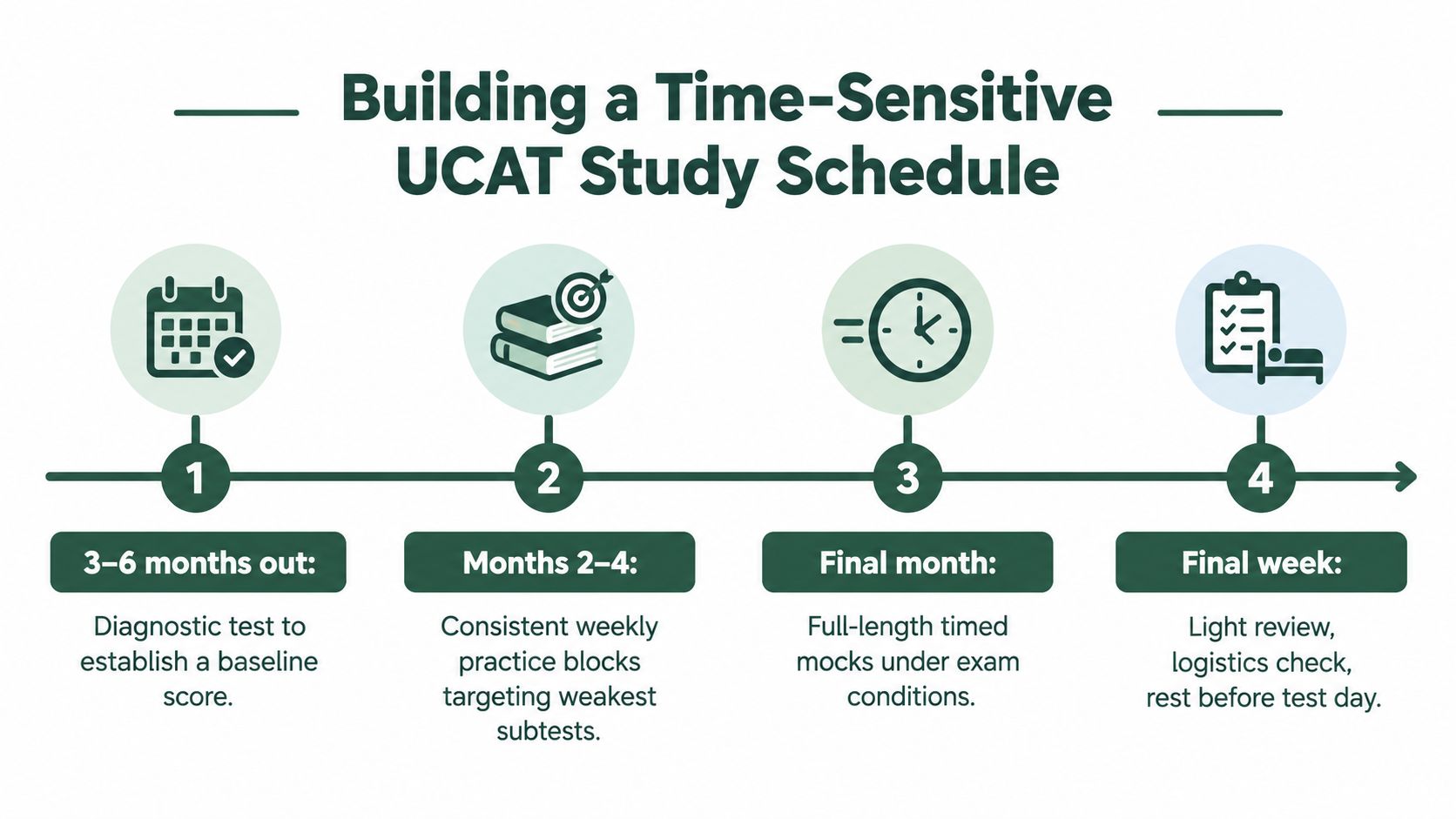
Phase one establishes the baseline
Begin with a diagnostic under realistic conditions. Don’t spend weeks learning strategies before discovering your actual weaknesses. Your baseline should show where time disappears, which question types produce careless errors and whether your score falls apart when fatigue appears.
Create a simple review record with these fields:
- Question type, identify the task rather than recording only the subtest.
- Outcome, mark correct, incorrect, guessed or unfinished.
- Cause, record knowledge gap, misread, calculation error, inefficient method or time pressure.
- Correction, write the method you’ll use next time.
- Follow-up, revisit the same skill after a gap rather than immediately repeating the question.
Phase two builds specific skills
Use the middle of your preparation for targeted work. Allocate more time to weak sections, but retain enough contact with stronger areas to prevent regression. Alternate untimed method practice with timed sets, because speed without accuracy creates unstable performance.
If your runway is short, don’t attempt to complete every available resource. Prioritise question types that repeatedly cost you marks, then move towards mixed timed sets. Guidance on structuring broader medical exam preparation can also help students balance UCAT work with existing academic commitments, although your UCAT schedule must remain specific to the test.
Phase three conditions the full performance
Full-length mocks belong later, once you have a method worth testing. Use them to assess stamina, transitions between sections, pacing and emotional control, not to collect a score. Review each mock in detail. A result without an error analysis is only a number.
In the final week, reduce the volume of difficult new material. Review your pacing rules, keyboard and calculator habits, identification requirements and travel arrangements. Keep sleep, meals and movement predictable. You want to arrive alert, not exhausted from trying to compensate for months of inconsistent preparation.
Mapping Practice to Australian Medical School Expectations
A UCAT score doesn’t exist in isolation. Australian medical schools may consider combinations of academic results, UCAT performance, interviews and other eligibility requirements, with the balance varying by course and institution. That means your preparation should begin with the admissions criteria of the courses you’re considering, not with a generic target borrowed from an overseas forum.
Match resources to the current ANZ test
Local relevance matters in three ways. First, you need the current section structure rather than old material containing removed content. Second, you need score interpretation grounded in the Australian and New Zealand cohort. Third, you need to understand that selection assesses more than rapid reasoning: interviews and other criteria look for communication, judgement, reflection and suitability.
That doesn’t mean every practice question needs an Australian setting. It does mean your overall plan must reflect the pathway you’re entering. A global question bank can provide useful repetition, but it shouldn’t be your only reference point when official ANZ guidance and individual university criteria are available.

Build an admissions decision rule
For each preferred course, record, for your entry year:
- Eligibility requirements, including the academic results and prerequisite subjects that apply to your application.
- UCAT role, identify whether the score is used for shortlisting, ranking, interview selection or another stated purpose.
- Interview format, check whether the course uses a Multiple Mini Interview (MMI, a circuit of short timed stations, each with a different interviewer), a panel interview or another assessment.
- Contingencies, understand what happens if your UCAT result is weaker than planned.
This research prevents a common mistake: spending all your energy maximising UCAT while neglecting the academic or interview component that a particular university also values. It also helps you choose a sensible application portfolio rather than tying your future to one assumed cut-off.
Use practice to develop professional habits
The best preparation develops habits that remain useful after test day. Read carefully before responding. Separate evidence from assumption. Explain decisions clearly. Review mistakes without defensiveness. Manage pressure without allowing one poor question to dictate the next decision.
Those habits won’t guarantee an offer. They do, however, give you a stronger foundation for the interview and medical study environments that follow.
Registration, Timing, and Test Day Logistics
Administrative errors can undermine preparation that took months to build. Use the official UCAT ANZ website and your Pearson account for booking, read the current candidate instructions carefully and save confirmation details where you can find them quickly.
Book deliberately
Book before the standard deadline. In 2026 the fee was $335 for a test taken in Australia or New Zealand, $240 under the Australian concession scheme and $405 overseas, with an extra $85 for late bookings and $185 for final late bookings (UCAT ANZ test cycle, 2026 dates and fees). Choose a test date that gives you enough preparation time without placing the exam immediately beside major school or university assessments. An early date may suit a candidate who wants the result settled sooner. A later date may provide more preparation runway, but only if you use that time in an organised way.
Don’t book first and investigate logistics later. The test is sat in Pearson test centres, and you must register under your legal name exactly as it appears on the approved photo identification you will present on the day (UCAT ANZ booking your test). Check the centre location, travel route, arrival process and permitted-item rules in the current year’s instructions rather than relying on advice from a previous cycle.
Prepare the physical routine
Make your final practice sessions resemble the environment as closely as possible. Use a computer, practise with an on-screen calculator and avoid building a routine around materials you won’t have in the actual assessment.
On test day:
- Confirm your identification, and make sure the details match your registration.
- Allow travel margin, because arriving rushed increases cognitive load before the first question.
- Follow staff instructions, including rules about personal items and the testing room.
- Use the instruction screens well, each subtest opens with a short timed instruction section, so reset your posture and attention there instead of replaying the previous subtest.
- Report technical problems immediately, rather than trying to solve an equipment issue while the clock continues.
Test-day performance depends partly on preparation and partly on recovery. Eat in a way you know suits you, hydrate normally and avoid experimenting with stimulants or an unfamiliar routine. The objective is controlled focus from the opening screen to the final response.
Next Steps on the Australian Medical Pathway
The UCAT is a major milestone, but it isn’t the medical degree and it isn’t the interview. Results are issued on the day of your test (UCAT ANZ Essentials 2026), and in the 2026 cycle they were delivered to universities in early September. Save your score report and review it calmly. Identify what the result says about your performance, then shift attention to the next selection requirement instead of repeatedly calculating hypothetical outcomes.
A candidate with a strong cognitive score may still need to demonstrate communication and judgement at interview. A candidate with a less competitive result may need to reassess course choices, academic pathways or a later application cycle. Neither response should be impulsive. Use the published criteria for each course and make decisions based on your complete application profile.
Move quickly to interview preparation
If your preferred courses use an MMI or panel format, start learning the format before invitations arrive. Interview preparation should include ethical reasoning, teamwork, communication, motivation for medicine, reflection on experience and responses to unfamiliar scenarios. It shouldn’t produce memorised speeches that collapse when the question changes.
The MMI interview preparation guide can help you think about station-based practice and answer structure. Practise aloud, seek specific feedback and record whether your response is clear, balanced and responsive to the question.
Medical training continues through university assessments, clinical placements, specialty applications and college examinations. The useful lesson from UCAT preparation carries forward: identify the assessment format, understand the scoring expectations, practise deliberately and review performance with honesty. Your next task isn’t to remain anxious about the UCAT. It’s to prepare for the part of the pathway in front of you.
CliniRoo is building preparation material for the Australian medical pathway. Nothing is on sale yet. If you want to be told when there is something to use, CliniRoo takes an email address and does nothing else with it.