MMI Interview Prep: The Australian Medical Guide
Master your MMI interview prep with this Australian-focused guide. Learn station formats, scoring rubrics, timing techniques, and local scenario strategies.
You’ve read the university’s interview guide, watched a few MMI videos and built answers for ethics, teamwork and motivation. Then you discover that your target pathway uses different station timings, a group task, an online format or a specialty-specific rubric. The preparation that felt thorough suddenly looks generic.
That’s the central problem with MMI interview prep in Australia. The multiple mini interview (MMI — a circuit of short stations, each scored separately by a different assessor) isn’t one national exam with one stable design. Universities, colleges, states and hospital networks adapt the format, the weighting and the competencies they want to observe. Strong preparation starts by identifying the exact variant you’re sitting, then building answers that make the local scoring domains easy to award.
Table of Contents
- Understanding the Australian MMI Format and Scoring Rubrics
- Building Station-Specific Answers for Local Scenarios
- Designing a High-Yield MMI Practice Schedule
- Mastering Timing and Communication in Mock Drills
- Navigating Format Variations Across Australian Pathways
- Finalising Your Preparation and Interview Day Strategy
Understanding the Australian MMI Format and Scoring Rubrics
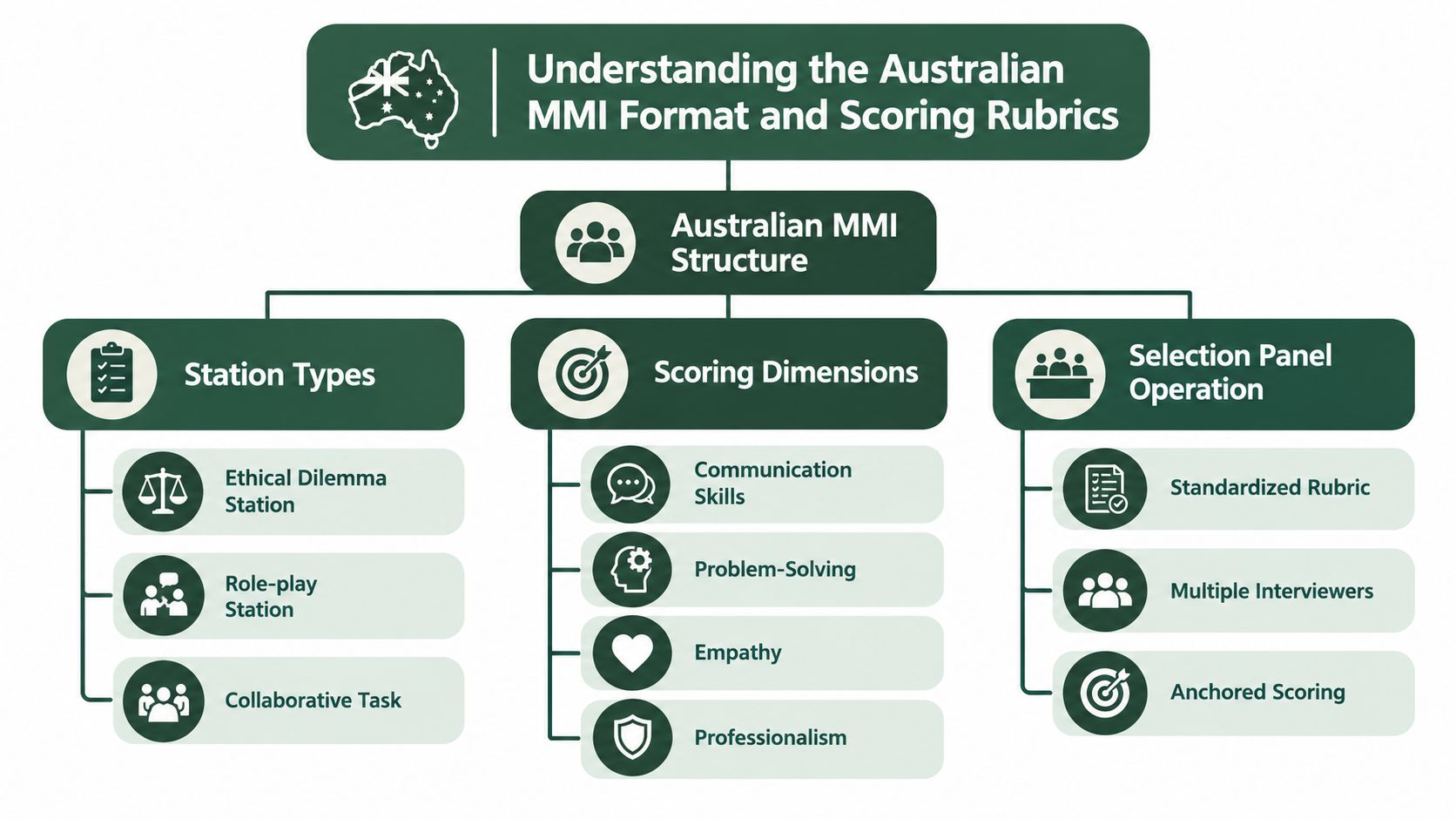
A station may give you a minute to read, then ask you to manage an ethical dilemma, conduct a role-play, join a teamwork task or explain your motivation. The next station may test a different attribute with a different timing and scoring emphasis. Australian MMIs are circuits of independent assessments, not one national interview format.
Panels usually score each station against defined criteria rather than deciding whether they generally liked a candidate. A fluent answer can still score poorly if it leaves the assessed competency unclear. Strong responses identify the conflict, explain the reasoning, acknowledge the people affected and show a safe action the assessor can record.
What the format is designed to measure
MMIs give panels a structured way to observe qualities that academic records do not fully show. Communication, empathy, professionalism, ethical reasoning and collaboration appear through separate interactions, with each station offering a new chance to demonstrate capability.
Australian medical schools have long combined academic results, admissions tests, written applications and interviews. A 2008 Medical Journal of Australia study of 706 students at the University of Queensland found that grade point average was most strongly correlated with academic performance, followed by the interview score, and that the link between interview score and performance grew stronger from first year to fourth year. All the selection criteria together explained only a modest share of performance, so an interview is not a crystal ball. It does carry real weight, which is why it deserves deliberate preparation rather than ceremonial conversation.
Postgraduate selection can weight the interview much more heavily. In cardiothoracic surgery, for example, the 2026 selection regulations for the 2027 intake set the overall score as 20% curriculum vitae, 20% unit-based competency assessment and 60% semi-structured interview. Weightings differ by specialty and change between intake years, so check your own specialty’s current regulations rather than assuming this split. Preparing only motivation stories leaves several possible scoring domains unaddressed.
Practical rule: Prepare for the rubric you’ll be marked against, not the interview you wish the panel were conducting.
Reverse-engineer the rubric
Begin with the target university’s or college’s selection guide, candidate information pack and station instructions. Compare the wording carefully. One pathway may emphasise communication and cultural safety, while another gives more weight to clinical judgement, leadership or specialty commitment. That variation is the hidden format drift that generic MMI scripts miss.
Turn every published competency into a working grid:
- Communication: Can you explain a complex issue clearly and adapt to the person in front of you?
- Ethical reasoning: Can you identify competing duties without relying on a slogan?
- Professionalism: Do you recognise limits, confidentiality, escalation and accountability?
- Clinical judgement: Can you prioritise safety while acknowledging uncertainty?
- Commitment: Can you connect your experience to the actual specialty, program or community?
For each domain, prepare relevant examples and practise making the evidence visible. You do not need to announce, “This demonstrates professionalism.” Show it through a specific action, such as seeking senior advice, documenting concerns, protecting privacy or checking that the patient understands the plan. Rebuild the grid whenever the local guide changes.
Building Station-Specific Answers for Local Scenarios
A prompt about voluntary assisted dying may appear at several Australian universities or specialty colleges, yet the scoring can shift from ethical reasoning to communication, legal awareness or professional judgement. Generic frameworks help you begin, but memorised scripts quickly sound detached from the patient, service and decision in front of you.
Build a locality-aware answer bank instead. Connect health-system knowledge with the setting named in the prompt. A rural bonded pathway, an urban teaching hospital and a specialty program serving a particular patient population may reward different applications of the same principle. Review the target program’s selection documents and map each answer block to the domain labels it publishes. Check whether one answer shows evidence for two domains, rather than forcing every response into the same template.
Build a reflection notebook
Create a page for each major topic and answer four questions:
- What is the issue? Define it in plain language, without trying to sound like a policy document.
- Who is affected? Name patients, families, clinicians, communities and services that may experience the consequences differently.
- What would change the response locally? Consider geography, access, referral pathways, cultural safety, state legislation and the resources of the service.
- What would I do first? Give a safe, realistic action, then explain when you would seek advice or escalate.
For Closing the Gap, move beyond a general statement about equity. Explain how you would listen to the patient, avoid assumptions, support culturally safe care and work with appropriate Aboriginal and Torres Strait Islander health services. For Medicare, connect access and affordability to the patient’s circumstances rather than reciting the system’s structure.
Voluntary assisted dying needs the same discipline. Distinguish personal beliefs from professional duties, respond respectfully, recognise that legal and institutional processes govern the pathway, and avoid presenting a personal opinion as a clinical recommendation. Apply the Medical Board of Australia’s code of conduct through observable behaviours, such as maintaining boundaries, communicating openly and recognising when your competence is limited.
Turn knowledge into adaptable answer blocks
A useful answer bank contains short sections you can recombine, not perfect speeches:
- Opening: Identify the central concern and acknowledge missing information.
- Stakeholders: Explain whose interests, safety or autonomy require consideration.
- Action: State what you would do now, including communication and escalation.
- Reflection: Show how you would balance competing considerations.
- Close: Return to patient safety, respectful care and the relevant competency.
In specialty interviews, match each block to the labels used by your target college, then test whether the answer provides evidence across more than one domain. A response may demonstrate decision-making through a safe escalation, professionalism through accountability and communication through an adapted explanation. That is more useful than naming a list of competencies without showing them.
A strong answer can mention a national policy, but it earns marks by applying that knowledge to a person and a service. Research the program’s mission, placement footprint and patient population. Then write reflections from your own experiences that show what you learned, what you would do differently and how the lesson transfers to that pathway. Recheck the local guide whenever the published format or scoring language changes.
Designing a High-Yield MMI Practice Schedule
Cramming produces familiarity, not reliable performance. You recognise the topic, but recognition disappears when a station changes the facts, introduces a distressed actor or gives you less time than expected.
Use a phased schedule that moves from understanding to application, then from application to pressure. The exact calendar can be adjusted around your interview date, but the progression shouldn’t be skipped.
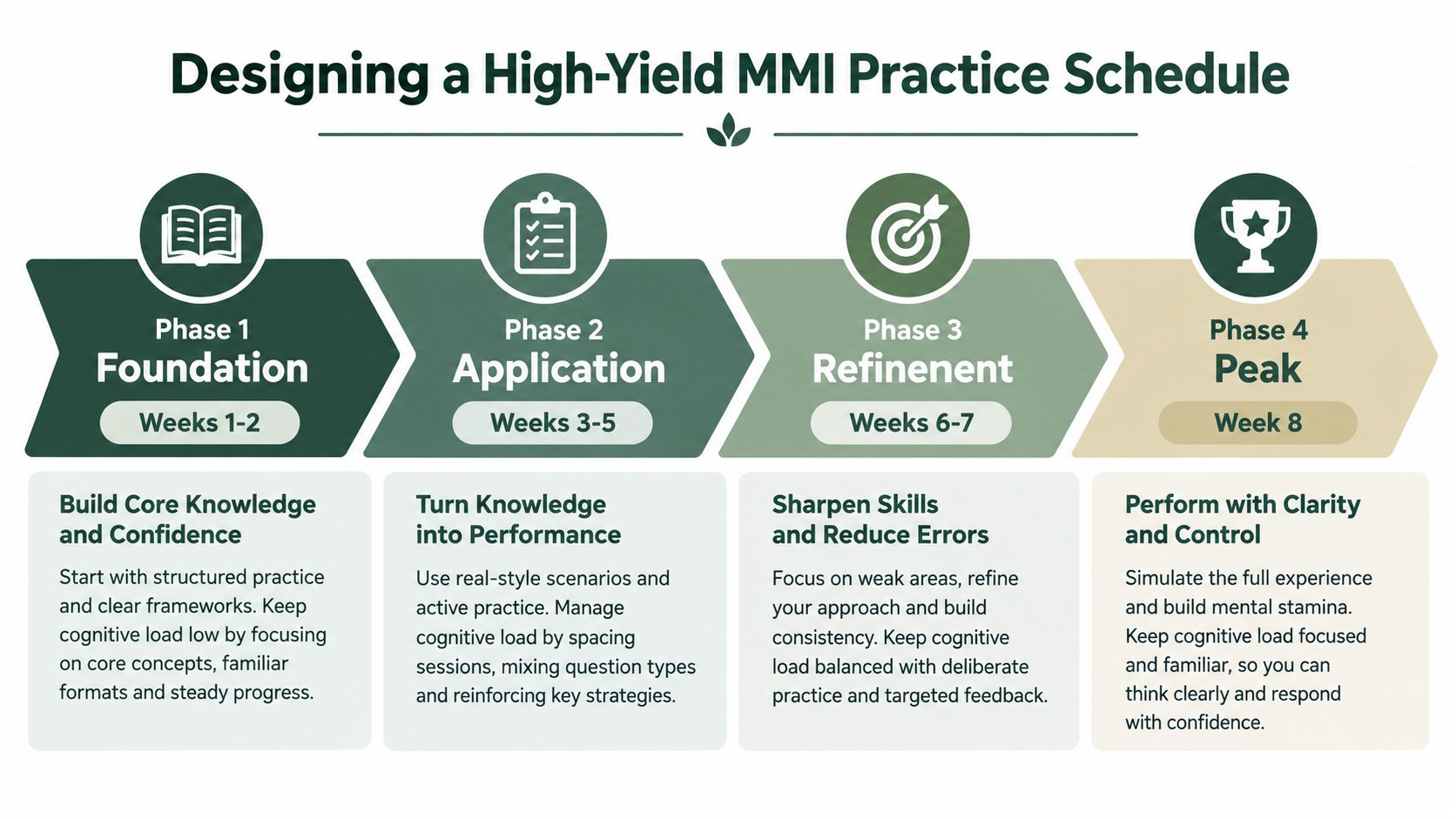
Phase one builds raw material
Begin with the official format and scoring domains. Read the university, college or network documents, collect locality-specific information and list experiences that demonstrate communication, teamwork, resilience, ethical awareness and responsibility.
At this stage, practise untimed. Write short reflections rather than model answers. For each experience, record the situation, your action, the result, what you learned and how the lesson applies to medicine or the specialty. Include moments where you made a mistake or changed your view. They often provide more credible material than stories in which everything went perfectly.
Phase two introduces station structure
Move to prompts without a clock, but impose a clear answer shape. Ask a partner to interrupt if you drift into background detail or make an unsupported claim. Practise opening with the issue, identifying stakeholders, proposing a safe action and explaining escalation.
Build a bank large enough for repetition and variation. Don’t rehearse one answer per topic. Prepare several ways to approach confidentiality, conflict, health inequity, teamwork and motivation so that a new scenario doesn’t force you outside your memorised wording.
Phase three adds scoring and recording
Record selected responses on your phone or laptop. Review for:
- Verbal habits: repeated “um”, “obviously”, “I think” or rushed filler.
- Structure: whether the listener can identify your decision and reasoning.
- Non-verbal behaviour: fixed eye contact, closed posture, fidgeting or failure to engage with a role-play actor.
- Clinical safety: whether you recognise uncertainty and seek appropriate support.
- Reflection: whether you explain what changed in your thinking.
Study groups work when someone acts as the assessor, someone performs the station and someone records observations against the actual rubric. “You sounded good” isn’t useful feedback. “You acknowledged the family’s distress but didn’t explain how you’d protect confidentiality” is actionable.
Phase four simulates the circuit
Finish with mixed mock stations, unpredictable prompts and minimal discussion between stations. Ask your group to vary actors, tone and subject matter. Review performance after the circuit, not after every response, because resetting between stations is part of the assessment.
Use Australian medical exam guidance to keep your broader preparation aligned with the pathway rather than treating the MMI as an isolated performance.
Mastering Timing and Communication in Mock Drills
A station can feel generous until the prompt contains several tasks. The MMI used to select general practice registrars in 2010 and 2011, described in a 2016 BMC Medical Education study, rotated applicants through six 10-minute stations: two minutes to read the question, then eight minutes to answer. That is an older process, and it is not how every MMI runs today, but it makes the practical point clear: timing is a technical constraint. The timings in the next three sections assume that two-plus-eight structure; rescale them to whatever your own pathway publishes.
You enter the station and read a scenario involving a colleague, a patient or a team decision. Don’t write a full essay in your head. Use the reading period to identify the task, the primary risk, the people affected and the competencies likely to be scored.
Minutes one and two
Read the final question first if the prompt is long. Underline mentally what you must do, such as explain, respond, prioritise, counsel or reflect. Then create a simple route through the answer:
- State the central issue.
- Clarify what you know and what you don’t.
- Identify stakeholders and competing duties.
- Give an immediate safe response.
- Explain communication and escalation.
- Reflect on the broader implication.
This isn’t a rigid acronym. It’s a memory aid that prevents a common failure, answering the interesting part of the scenario while ignoring the question.
Minutes three to seven
Open decisively but don’t rush. “The immediate concern is patient safety, but I’d also want to understand the patient’s preferences and the context before making a final decision” gives the examiner a clear starting point and leaves room for nuance.
Signpost when you change direction. Say, “I’d approach this in three parts,” or, “First I’d address the immediate risk, then speak with the people involved, and finally escalate if the concern remained.” Signposting helps the panel follow your reasoning and helps you recover if nerves disrupt your train of thought.
In role-play, speak to the actor rather than performing a speech for the assessor. Use open questions, acknowledge emotion and check understanding. Don’t overpromise confidentiality or claim authority you don’t have. If you need clinical information, say what you’d clarify and why.
Minutes seven to eight
Reserve time to close. Summarise the action, identify who you’d involve and state the principle guiding your decision. If you lose your place, pause briefly, breathe and return to the central risk. A calm reset is safer than filling the remaining time with repetition.
If a response feels too short, add reasoning and stakeholder impact. If it feels too long, remove background and keep the decision, action and escalation.
Practise with the exact timer your pathway specifies. Train yourself to begin speaking promptly after reading time, to make one clear decision and to finish before the buzzer rather than being cut off mid-sentence.
Navigating Format Variations Across Australian Pathways
There is no single Australian MMI format. Station count, station length, reading time, whether there is a group task and whether it runs online all vary between universities and between specialty pathways, and some institutions publish very little about their format at all.
These differences change what earns marks. Short stations reward rapid prioritisation and a clear opening. Longer stations allow more exploration of a conflict, but give you more time to lose structure. A group task assesses listening, shared airtime and progress toward a decision, rather than the polish of an individual response.
Compare the variant before you practise
Before building your format card, check the current university, college or network instructions. Station numbers, reading time, delivery mode and task design can change, so older coaching notes may describe a process that no longer applies.
Online MMIs alter the communication environment. Check camera position, audio, lighting, internet connection and permitted materials. Practise looking at the camera when addressing the examiner and at the screen when reading instructions. In person, posture, movement between stations and interaction with actors are more visible. Neither mode is automatically easier.
Account for layered selection
Some university pathways combine the interview with the University Clinical Aptitude Test for Australia and New Zealand (UCAT ANZ — the admissions test for most undergraduate-entry medicine) or the Graduate Medical School Admissions Test (GAMSAT — its graduate-entry equivalent), while others include rural, bonded or school-specific requirements. Preparation priorities should reflect that balance. A strong interview will not compensate for every other selection component, and a national admissions pattern may not match a particular program.
Specialty selection can differ by college, state and employing network; how specialty selection works in Australia maps which model applies to which specialty. Identify whether the interview is structured, semi-structured, panel-based or station-based. Check the named domains, the evidence expected and whether assessors test knowledge of local services or patient populations.
Create a one-page “format card” containing:
- delivery mode and platform or venue
- station sequence and timing
- reading-time rules
- individual, role-play and group components
- published competencies
- pathway-specific mission and patient population
- documents or identification required
Build mock sessions from that card. Generic MMI resources can supply prompts, but they should not set your final practice conditions. Reverse-engineering the local rubric and format is how you prepare to perform in that particular circuit, rather than reciting a script designed for a different pathway.
Finalising Your Preparation and Interview Day Strategy
The final week isn’t the time to rebuild your entire answer bank. Consolidate what you’ve prepared, check the logistics and protect your ability to think clearly. Review your format card, rubric grid and locality-aware reflection notes, then practise enough to maintain fluency without turning every waking hour into an interview rehearsal.
A focused final checklist
Use the last days to test readiness rather than collect endless content:
- Review the rubric: Match each major competency with evidence from your experience.
- Practise aloud: Complete mixed stations with the correct reading and response conditions.
- Refresh local knowledge: Revisit Closing the Gap, Medicare, relevant state or institutional processes and the target service context.
- Check the route or technology: Confirm the venue, travel plan, platform, camera, microphone and backup arrangements.
- Prepare clothing and documents: Choose professional attire and organise anything the instructions require.
- Reduce the load: Keep the final review light enough that you arrive alert rather than saturated.
Read good questions to ask in an interview only if the pathway allows candidate questions and the material is relevant to that setting. Don’t prepare a theatrical closing statement. A concise, genuine question about supervision, service priorities or the learning environment is more useful than one designed to display memorised knowledge.
Reset between stations
A difficult station doesn’t carry a score into the next room. As you leave, release the scenario, take a breath and adopt a neutral posture before reading the next prompt. Don’t spend the next station trying to repair the previous answer.
Keep your demeanour consistent with the role. Be courteous to administrators, actors and fellow candidates, but don’t perform friendliness or discuss station content where it could compromise other candidates. Your aim is steady professional behaviour under changing conditions.
Confidence comes from having a tested process for uncertainty, not from predicting every question.
Arrive with enough time to complete check-in without rushing, and follow the instructions given by the institution. Eat and hydrate in a way that suits you, avoid last-minute experimentation and keep your final mental task simple: read carefully, identify the competency, communicate safely and respond to the person in front of you.
CliniRoo is building Australian interview preparation organised by university, specialty and station format, with scoring domains and annotated answer guidance. Nothing is on sale yet. If you want to be told when there is something to use, CliniRoo takes an email address and does nothing else with it.