Situational Judgement Test Preparation: A Practical Guide
Situational judgement test preparation for Australian medical selection: work out which format you face, then practise the response style it actually scores.
You’ve booked the assessment, opened a practice bank and started working through questions. Then you notice that every guide seems to assume a different test. One asks you to rank responses, another expects a written answer, and a third focuses on a timed computer exam. The confusion is justified. In Australia, situational judgement test (SJT — a test that presents workplace dilemmas and scores the judgement in your response) preparation starts with identifying the assessment you’ll sit, not with completing as many generic questions as possible.
Table of Contents
- Why Generic SJT Advice Misses the Mark
- Understanding the Australian SJT Construct
- Building Your Answer Strategy
- Worked Example Scenario Comparison
- Designing Your Practice Schedule
- Common Pitfalls to Avoid
- Your Situational Judgement Test Preparation Checklist
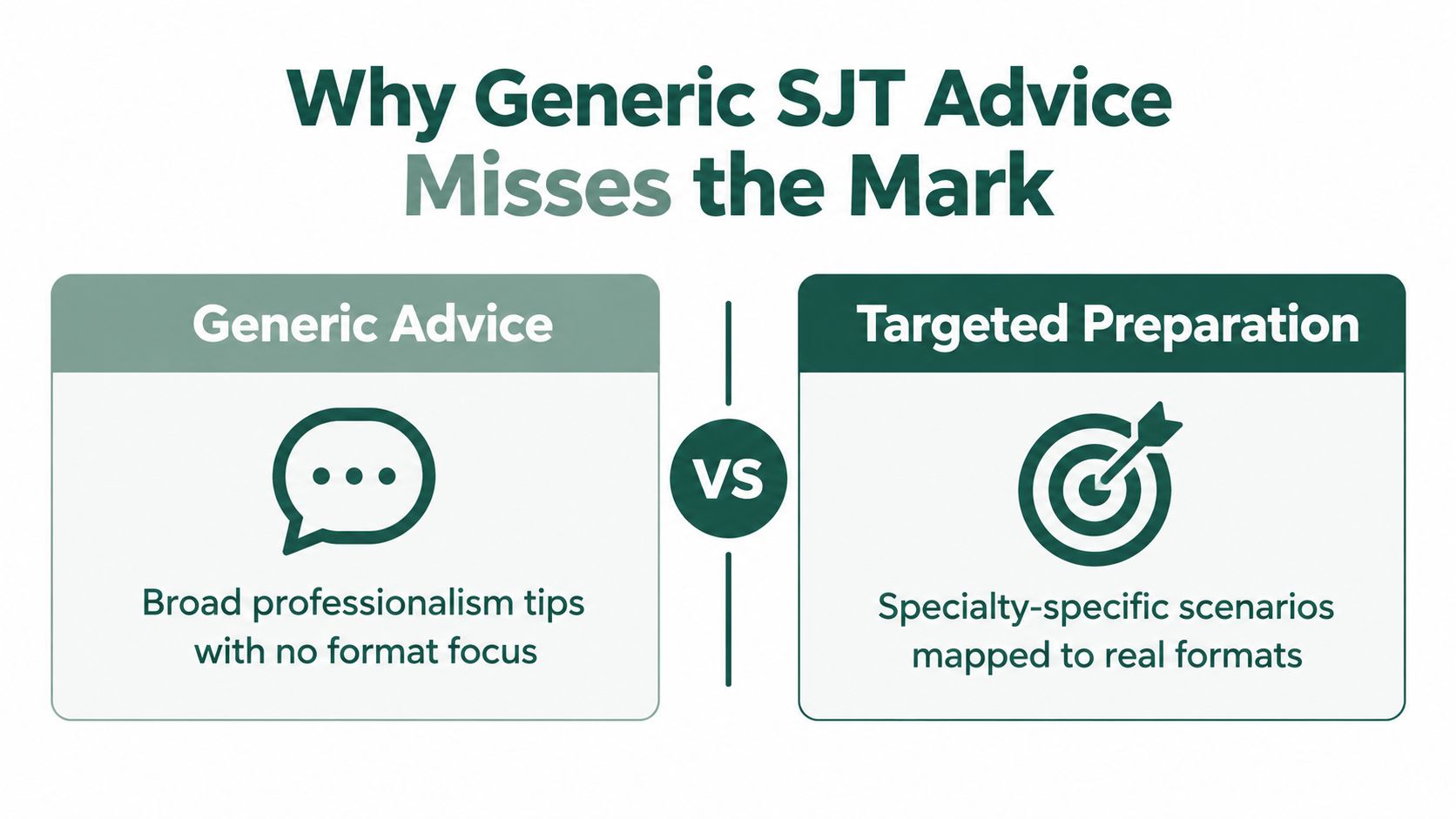
Why Generic SJT Advice Misses the Mark
Candidates searching for situational judgement test preparation often find the same broad recommendations: demonstrate empathy, communicate clearly, escalate appropriately and act professionally. Those principles matter, but they don’t tell you how to respond in your specific assessment interface, how much you need to write or how the scoring system distinguishes a strong answer from a merely acceptable one.
Australian pathways use the SJT label for materially different tasks. Three documented examples show how different:
- General practice selection now. For the 2027 intake, entry to the Australian General Practice Training (AGPT) program through the Royal Australian College of General Practitioners (RACGP) uses the Casper test: 11 scenarios with two open-ended questions each, four answered on video and seven typed, taking roughly 65 to 85 minutes, with no interview. Source: the RACGP National Entry Assessment page.
- General practice selection in 2010 and 2011. The SJT then was a low-fidelity, invigilated, computer-delivered exam of 50 questions in two hours, using ranking-style response formats, according to a 2016 BMC Medical Education study.
- A medical school trial. The University of Sydney’s SJT trial for 2020 entry to its Doctor of Medicine (MD) and Doctor of Dental Medicine (DMD) showed candidates 25 scenarios with four options each, 100 items in all, and asked them to rate how appropriate each option was. It was a research trial, not a selection hurdle.
Writing two open answers on camera, ranking options and rating options are different preparation problems, even when the dilemmas look alike.
The response mechanic changes the skill
In an open-response task, you must generate and organise a response. A ranked multiple-choice task asks you to compare options against one another. A timed computer-delivered exam adds reading discipline, pacing and the ability to make a defensible judgement without writing a long explanation.
Those are related skills, but they aren’t interchangeable. A candidate who rehearses polished paragraphs may still struggle to rank four plausible actions. Someone who becomes quick at selecting options may give an unfocused answer when a university asks them to explain their reasoning in writing or on video.
The same professional dilemma can therefore produce different scoring opportunities. The underlying principle might be patient safety, honest communication or appropriate escalation. The assessors still need to see that principle expressed through the required response format.
Practical rule: Confirm the pathway, question type, delivery mode, timing and scoring instructions before choosing a question bank.
Australian SJT use also varies by institution and selection pathway. Some universities use an SJT, some don’t, and some provide limited public detail. The RACGP lists nine competencies the Casper test evaluates: collaboration, communication, empathy, fairness, ethics, self-awareness, resilience, problem-solving and motivation. Other tests name different domains, so work from the list your own program publishes.
Understanding the Australian SJT Construct
Most SJTs used in medical selection are low fidelity, whether the answer is ranked, rated or written. The scenarios are built around professional dilemmas rather than detailed clinical knowledge, and the RACGP states that its current test does not assess clinical knowledge at all.
“Low fidelity” doesn’t mean unimportant or simplistic. It means the assessment presents written situations rather than recreating a full clinical encounter with a patient, examination findings and a complete medical record. The test asks you to interpret the information provided, identify competing obligations and select the response that best reflects sound professional judgement.
What the questions are really testing
A scenario may involve a colleague whose conduct raises a concern, a communication breakdown, a competing clinical priority or an error that needs to be addressed. The strongest response usually protects patients, maintains honesty, respects role boundaries and communicates with the appropriate people. It also avoids pretending that every problem can be solved alone.
The assessed domains interact. Professionalism shapes your obligations. Communication determines how you raise the issue. Decision-making determines what you do first. Clinical reasoning helps you recognise risk and prioritise the next safe action. Treating these as separate boxes can produce rigid answers. A response may sound polite but fail to address immediate risk, or appear decisive while ignoring consent, supervision or confidentiality.
Read the stem as an assessor would
Before choosing an answer, identify four things:
- The immediate risk, such as harm to a patient, a breach of confidentiality or an unsafe process.
- Your authority, including what you can manage independently and what requires senior input.
- The people who need to know, distinguishing necessary escalation from indiscriminate reporting.
- The first defensible action, rather than an idealised account of everything that might happen later.
Timing matters because every SJT format rewards disciplined interpretation, not elaborate essays. Even an open-response test gives you minutes, not an hour, per scenario. You need to read closely, reject attractive but unsafe options and move forward once you have identified the best-supported action.
Candidates often prepare by memorising professional slogans. That approach is weak because the test presents conflicts between good values. “Be supportive” may be appropriate, but not if support means concealing a serious error. “Escalate” may be correct, but not if it replaces an immediate action within your competence. The construct tests how you balance principles in context.
For broader context on how medical selection scenarios are framed, you can also review this guide to situational judgement tests in medicine. Use it as background, then return to the criteria and instructions for your own pathway.
Building Your Answer Strategy
Once you know the format, preparation becomes a rehearsal problem. The most useful sequence is criteria first, spoken reasoning second, scored review third. This is more demanding than passive question-drilling, but it gives you feedback about judgement rather than familiarity with recurring wording.
Start with the published criteria
Collect the official information for the specialty, university, college or employing organisation. Look for named domains, candidate instructions, sample questions, response limits and any explanation of how results contribute to selection. Don’t assume that a general medical professionalism framework is identical to the one used by your program.
Create a short rubric in your own words. For example, you might record:
- Patient protection, does the response address immediate safety?
- Integrity, does it acknowledge rather than conceal an error?
- Communication, does it involve the right person clearly and respectfully?
- Proportionality, does it avoid both passive inaction and unnecessary escalation?
- Reflection, does it create an opportunity to learn without delaying urgent action?
These headings aren’t a substitute for published criteria. They’re a working tool that helps you explain why one option outranks another.
Practise aloud before you practise fast
For an open-response or video task, answer aloud using the actual expected structure. State the concern, identify the priority, describe your first action, explain who you would involve and mention follow-up where relevant. Record yourself if the format permits it. Listen for vague claims, excessive background and answers that jump to escalation without showing what you would do immediately.
For a ranked task, speak through the comparison instead. Ask why option A is safer or more professional than option B, and what makes the lowest-ranked option unacceptable. This forces you to distinguish the best answer from an option that is not disastrous.

Use scored mocks for diagnosis
After each mock scenario, don’t just record whether you were correct. Record the principle you underweighted. You may have prioritised collegiality over patient safety, confidentiality over necessary escalation or speed over accuracy.
A useful review table looks like this:
| Review question | What to record |
|---|---|
| What was the central risk? | The harm or professional obligation that drove the answer |
| What did I prioritise? | The principle that influenced your first choice |
| What did I miss? | The domain that the scoring rationale weighted more heavily |
| What would change my ranking? | The detail that separates two plausible options |
| What is my revised rule? | A short principle you can apply to a new scenario |
Don’t memorise “ideal answers”. Memorised wording collapses when the facts change. Build a consistent decision process that remains flexible enough to respond to the details in the stem.
Worked Example Scenario Comparison
Consider a junior doctor who notices that a colleague has documented a medication administration incorrectly. The patient appears stable, but the record could mislead the next treating team. The professional principle is consistent across formats, yet the response task changes substantially.
In an open-response university-style task, you might be asked to explain what you would do. A strong answer would identify the possibility of patient risk, check the relevant information without altering the record improperly, raise the issue promptly with the colleague or appropriate senior clinician and ensure the documentation is corrected through the proper process. It would avoid accusation, concealment and unsupported assumptions.
In a ranked-format question, the options might include correcting the record secretly, waiting to see whether harm occurs, confronting the colleague publicly or raising the discrepancy privately and escalating through the appropriate clinical pathway. You aren’t rewarded for producing a polished explanation. You must place the actions in order and recognise that the most effective response combines immediate risk management, accurate documentation and proportionate communication.
| Feature | Open-Response Format | Ranked Multiple-Choice Format |
|---|---|---|
| Candidate task | Generate and structure an answer | Compare and order provided actions |
| Main difficulty | Clarity, completeness and prioritisation | Distinguishing close alternatives |
| Strong response | Explains the first action and follow-up | Places safe, proportionate action highest |
| Common error | Writing general principles without a plan | Choosing the least uncomfortable option |
| Best rehearsal | Timed spoken or typed responses | Ranking drills with rationale review |
The open-response candidate loses quality by saying only, “I would escalate because documentation errors are serious.” That identifies a principle but doesn’t show sequence, communication or proportionality. The ranked candidate makes a similar mistake by selecting immediate public confrontation because it appears decisive, even though it may damage communication and doesn’t itself manage the record or patient risk.
For additional practice with clinical decision-making prompts, use clinical scenario questions for medical preparation selectively. Adapt the exercise to your own format. Write when your assessment requires writing, speak when it requires speaking and rank options when ranking is the actual task.
Designing Your Practice Schedule
A sound schedule moves from understanding to application, then from application to simulation. The order matters. Timed practice before you understand the rubric can make you faster at repeating the wrong habits.
Phase one builds the foundation
Begin by locating the official format and criteria. Read the instructions slowly and write down the response mechanics in operational language. If the assessment uses ranking, practise ranking. If it asks for an open response, practise producing a structured explanation. If it uses video, include the act of speaking to a camera rather than relying only on silent notes.
Start with untimed scenarios. For each one, identify the central risk, the relevant professional domains and the first defensible action. Your early objective isn’t speed. It’s learning to recognise what the question is testing.
Phase two adds breadth
Rotate across scenario types rather than completing a long run of nearly identical questions. Include communication problems, errors, conflicts of interest, supervision, confidentiality, workload pressure and concerns about colleagues. After each set, classify your errors by principle.
A practical weekly rhythm can be adapted around clinical work:
- Early study sessions, review one published domain and analyse a small group of untimed scenarios.
- Middle sessions, practise the exact response format aloud or in writing, then compare your reasoning with the available rationale.
- Later sessions, complete a timed block and review it while your decisions are still fresh.
- One review session, revisit only the domains you repeatedly underweight.
The value lies in the review, not in claiming a large number of completed questions. If a rotation leaves you exhausted, shorten the practice block and preserve the error analysis. A smaller, carefully reviewed set is more useful than hurried work that teaches you to skim.
Phase three develops depth
For every wrong or uncertain answer, write a one-line diagnosis. “I overvalued avoiding conflict.” “I escalated before taking the safe action within my role.” “I focused on the colleague’s intention instead of the patient’s risk.” These statements turn mistakes into reusable rules.
Review the same principles after a gap rather than immediately repeating the identical question. You want to recognise the underlying dilemma in unfamiliar wording.
Phase four introduces simulation
Use full timed mocks only after you can explain your decisions without relying on the answer key. Reproduce the delivery conditions as closely as possible, including the computer interface, response method, timing and interruptions you can realistically control.
For wider planning around Australian medical assessments, this medical exam preparation guide provides a useful complementary framework. Keep your SJT work focused on judgement and format rather than turning it into a general clinical knowledge revision session.
Common Pitfalls to Avoid
More practice questions don’t automatically produce better judgement. If the questions use the wrong format or reward a different response mechanic, volume can reinforce habits that won’t transfer to your assessment.
Treating every Australian SJT as identical
This is the first and most expensive mistake. A candidate preparing for an open-response task needs a different rehearsal routine from a candidate preparing for a ranked-format test. Even when both assessments present professional dilemmas, the candidate must generate an answer in one and discriminate between options in the other.
Check whether your pathway uses the SJT as a gatekeeper, a tie-breaker or one component of a broader selection process. Australian institutions don’t use the assessment uniformly, so the amount and type of preparation should reflect its role in your pathway rather than an assumed national standard.
The RACGP’s format has itself changed: the ranked 50-question test studied for 2010 and 2011 is not the open-response Casper test used for the 2027 intake. Verify your current program instructions every year. Selection arrangements can differ by institution, state, college and intake.
Confusing clinical knowledge with professional reasoning
A medically advanced answer can still be poor if it overlooks communication, consent, documentation, supervision or scope of practice. SJT preparation isn’t an invitation to display every guideline you know. It’s an exercise in selecting the safest and most professionally defensible next action from the information provided.
A clinically plausible answer can still fail if it doesn’t manage the professional problem in front of you.
Using generic banks without auditing their fit
Generic question banks can help you become familiar with dilemmas, but they may use overseas terminology, different assumptions about hierarchy or a scoring model that doesn’t match your pathway. Treat them as supplementary material, not as evidence that you’re ready.
Before using any bank, ask whether it reflects your response format, Australian terminology, published domains and expected level of explanation.
The practical alternative to collecting random questions is to build a decision framework. It should tell you what to notice first, when to act independently, when to involve a senior and how to communicate without concealing or inflaming the problem.
Your Situational Judgement Test Preparation Checklist
Use this checklist before you begin serious practice and revisit it after each mock. It should function as a working document, not a motivational poster.
Identify the exact assessment
- Name the pathway: Write down the university, specialty, college or selection program.
- Confirm the format: Record whether responses are written, spoken, video, ranked, rated or multiple-response.
- Check delivery conditions: Note whether the assessment is invigilated, computer-delivered, timed or completed under another specified condition.
- Clarify the scoring role: Determine whether the SJT is a gatekeeper, tie-breaker or one part of a broader selection process.
- Save the official instructions: Keep the current candidate information beside your practice notes.
Build the rubric
- Extract published domains: Use the program’s own language wherever it provides criteria.
- Translate domains into decisions: Define what patient safety, integrity, communication, proportionality and escalation look like in action.
- Separate first action from follow-up: Make sure your answers show what happens immediately and what happens after the urgent risk is controlled.
- Mark authority boundaries: Identify decisions you can make independently and those that require supervision.
Rehearse the response mechanic
- Practise aloud: Use a timer and record responses when your assessment expects spoken or video answers.
- Rank deliberately: For multiple-choice tasks, explain why the top option beats the second-best option.
- Write to the limit: If the task is open response, remove background detail that doesn’t affect the judgement.
- Use unfamiliar scenarios: Change the setting and wording so you practise principles rather than memorised scripts.
Review and simulate
- Log underweighted principles: After every uncertain response, record the domain you missed.
- Space your revision: Return to weak domains after a gap instead of repeating identical items immediately.
- Add timed blocks gradually: Introduce pressure after your reasoning is reliable.
- Run realistic mocks: Match the actual structure, timing and delivery mode before the assessment.
- Review the mock in detail: Correct the decision process, not just the final selection.
Avoid predictable errors
- Don’t confuse kindness with professionalism: Empathy must sit alongside boundaries, accuracy and safety.
- Don’t escalate reflexively: Involve seniors when risk, authority or complexity requires it, not only because the situation feels uncomfortable.
- Don’t hide mistakes: Accurate reporting and correction are part of professional judgement.
- Don’t substitute clinical knowledge: Answer the dilemma presented, not the clinical essay you wish had been asked.
- Don’t let question volume replace analysis: A reviewed scenario is more valuable than an unexamined run of generic items.
The final check is simple. Can you explain why your answer is safest, most proportionate and most consistent with the published criteria? If you can do that in the format your pathway requires, you’re preparing for the actual assessment rather than for an imaginary generic SJT.
If the SJT is one stage of specialty selection, how specialty selection works in Australia shows where it sits among the other stages for each specialty. CliniRoo is building format-focused preparation for Australian selection, with scenarios and annotated answer guidance. Nothing is on sale yet. If you want to be told when there is something to use, CliniRoo takes an email address and does nothing else with it.