Medical Exam Preparation That Actually Works in Australia
Match your preparation to the exam format: study plans, question banks and timed simulation for Australian MD, AMC and college assessments.
You’re in the hospital library with two tabs open: the official curriculum on one screen and a question bank on the other. Your exam is close, your notes are extensive, and yet you can’t answer the practical question, “What should I do today?” That uncertainty usually isn’t caused by laziness. It comes from treating every Australian assessment as if it tests the same skill.
A Doctor of Medicine (MD) Objective Structured Clinical Examination (OSCE — a circuit of short, timed clinical stations scored against a fixed checklist), an Australian Medical Council (AMC — the body that accredits Australian medical education and assesses overseas-trained doctors) multiple-choice question (MCQ) examination, a Royal Australasian College of Physicians (RACP) written paper, a Royal Australasian College of Surgeons (RACS) selection interview and a college clinical examination reward different behaviours. Medical exam preparation works when the format determines the training method, not when a larger textbook pile determines the study plan.
Several bodies are named by their initials below. There is a plain-English list of all of them at the end of this page.
There is one Australian dataset worth knowing before you plan anything, because of what it does not explain. The Australian Medical Schools Assessment Collaboration (AMSAC — a group of medical schools that pool anonymised assessment items and performance statistics to benchmark students against an external standard) covered 12 of 19 medical schools and 68% of Australian medical students by 2013. Its analysis of 6,401 preclinical students from 13 medical schools across 2011 to 2013 found that graduate-entry students scored higher than school-leaver entrants and students at large schools higher than those at small schools — but that the whole set of school and cohort variables it measured explained only 12% of the total variation in student performance. The published AMSAC analysis does not say what the other 88% is. It does mean the things you cannot change — which school took you, which entry route you came through — account for very little, which puts the weight back on what you actually do between now and the exam.
Table of Contents
- The Night Before Every Australian Medical Exam
- Building a Realistic Study Plan From the Blueprint
- Using Question Banks the Way High Scorers Do
- Practising Under Real Exam Conditions
- Matching Your Prep Method to the Format You Face
- Pitfalls That Quietly Sink Australian Candidates
- A One-Page Checklist Before You Sit Any Medical Exam
- Acronyms
The Night Before Every Australian Medical Exam
Picture two candidates at the same kitchen table. One is a final-year MD student shuffling OSCE cards; the other is preparing for an AMC examination and reading adult health notes. Both have been studying for hours. Neither is rehearsing the thing they’ll have to do.
The MD student knows the facts but hasn’t practised entering a station, setting an agenda, checking the patient’s concerns or delivering a concise handover. The AMC candidate recognises the topics but hasn’t worked through questions at exam pace. They’re both adding content when they should be reducing uncertainty about sequence, timing and response structure.
The night before an exam isn’t the time to rescue an entire syllabus. For an OSCE, rehearse the opening, information-gathering sequence, examination explanation and closing summary. For an AMC MCQ paper, review the instructions, question style, pacing plan and a small selection of familiar errors. For a college written paper, skim your error log and practise recognising the task hidden in the stem. New material feels productive because it creates activity, but it rarely improves control of the format at that point.
Practical rule: The final evening should make the exam feel familiar, not make the syllabus feel larger.
A reliable preparation system rests on four habits:
- Blueprint-driven planning: Start with the published curriculum, station list or capability framework.
- Deliberate repetition: Revisit questions and stations until the reasoning process becomes accessible under pressure.
- Timed simulation: Practise making decisions with the same constraints the assessment will impose.
- Format-matched work: Use role-play for clinical performance, written questions for written assessment and structured answers for interviews.
The AMC’s own preparation guidance is built the same way round. For the clinical examination it directs candidates to the examination specifications, the candidate briefing video, a suggested reading list and a Tips from Examiners document; for the multiple-choice question examination it directs them to the MCQ Examination Specifications booklet and the free MCQ Preparation App. Note what leads that list: format documents, not content. Preparation is more than knowing medicine. It’s knowing how the assessment asks you to display it.
Building a Realistic Study Plan From the Blueprint
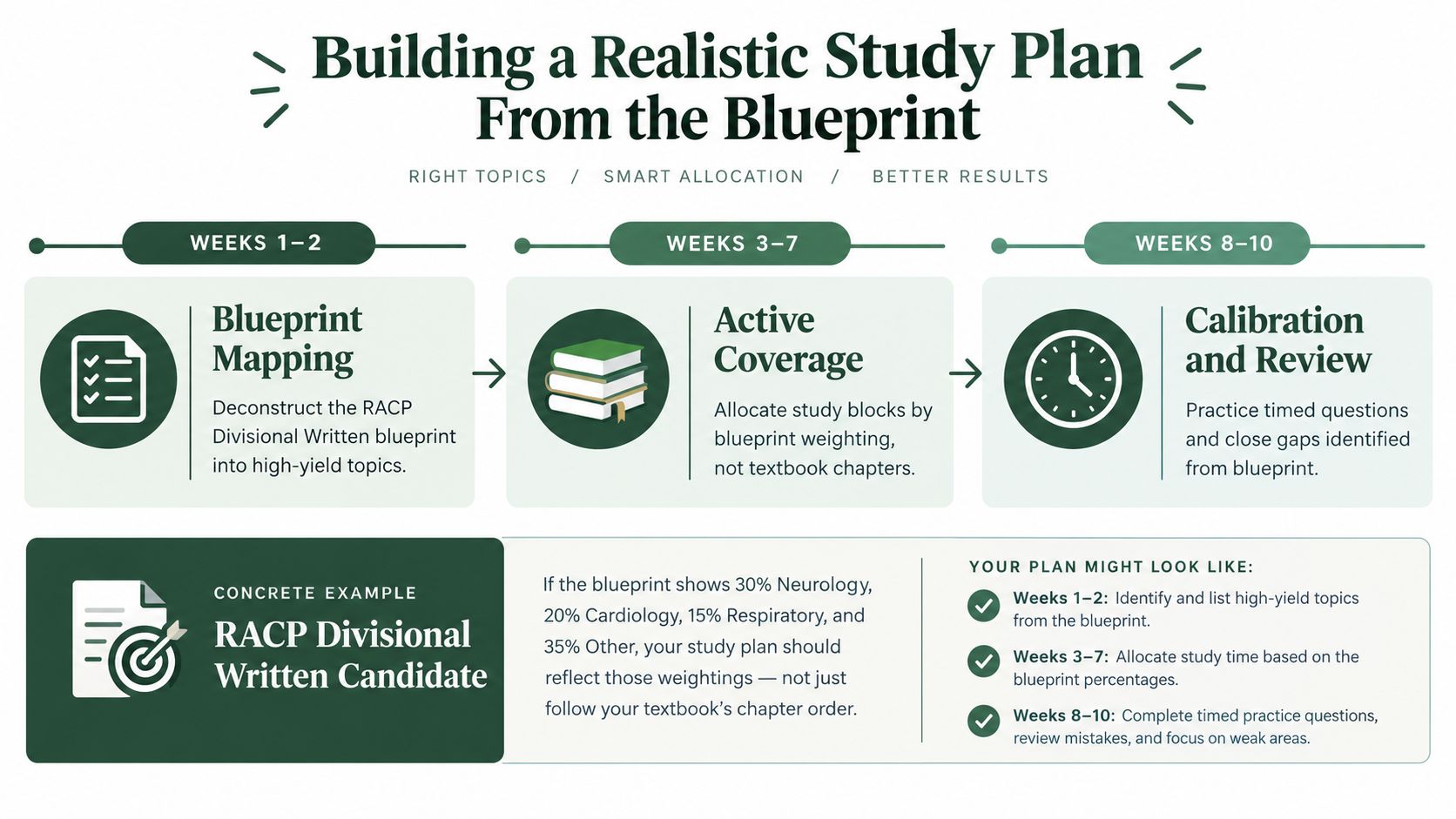
Start with the exam date and work backwards. A workable plan may span six to ten weeks, but the exact duration matters less than what occupies each block. The blueprint, not the textbook table of contents, should decide where your time goes.
For an RACP Divisional Written Examination candidate, place the Basic Training curriculum domains across a weekly grid. Give heavily examined or personally weak domains more deliberate practice, then reserve the final part of the plan for full-condition simulation and targeted repair. A candidate who gives every topic equal attention may feel organised while undertraining the areas that carry more assessment weight.
A final-year MD OSCE requires a different grid. Use the university’s published station list, then rotate systems and task types in matched blocks. Cardiology might sit beside cardiovascular examination and chest pain counselling, respiratory beside respiratory examination and inhaler education, and mental health beside risk assessment and a structured formulation. The point is not to finish one body system and forget it. The point is to return to it through the exact behaviours the station requires.
A weekly planning sequence
- Map the blueprint. List domains, station types, capability areas and any published weighting or guidance. Mark what you’ve already assessed under timed conditions, not what you’ve merely read.
- Allocate active recall first. Put questions, flashcards, oral answers or station practice into the calendar before passive reading. Reading can fill gaps, but it shouldn’t consume the hours reserved for retrieval.
- Protect simulation time. Keep a regular weekend or rostered slot for a complete practice session. Don’t leave simulation until the final days, when fatigue and logistics make honest feedback harder.
- Build a repair loop. After each practice block, identify the specific failure. A knowledge gap needs targeted study. A sequencing problem needs rehearsal. A timing problem needs another timed block.
- Revise every Sunday night. The plan is a working document. Move topics when clinical workload changes, but don’t delete the practice that exposes whether the plan is working.
A useful schedule gets more realistic as the exam approaches. Early weeks establish coverage and technique. Middle weeks increase retrieval and mixed practice. The final phase should be dominated by calibration, error correction and confidence in the format.
Using Question Banks the Way High Scorers Do
A question bank is not a digital textbook. Used once, it tells you what you missed on one encounter. Used repeatedly, it reveals whether you can recognise the problem, select the relevant information and commit to an answer when the wording changes.
Come back to the AMSAC finding here, carefully. That study measured school and cohort characteristics, not study methods, so it says nothing at all about question banks either way. What it does say is that the fixed characteristics explained only 12% of performance variation — which leaves the field open rather than settling it. The honest conclusion is narrow: your entry route and your school are not the explanation, so the quality of your practice loop is worth treating as the variable you control, not because a study proved it works but because the alternative explanations have been measured and came up small.
A single-pass approach often looks like this: answer a question, read the explanation, highlight a fact and move on. A repetition-based approach returns to the same material after the explanation has faded. For example, take a 200-question topic set, complete it, classify every miss, revisit the underlying concepts, then repeat the set until the reasoning is stable. The aim isn’t to memorise the letter of the answer. It’s to understand why the correct option wins and why the distractors fail.
Log the reason, not just the result
Use a compact error record with categories such as:
- Didn’t know: The required fact, guideline or mechanism was absent from memory.
- Misread: You missed a qualifier, timeframe, negative phrase or key examination finding.
- Reasoned poorly: You knew the facts but applied them to the wrong clinical problem.
- Format error: You misunderstood what the question or station asked you to produce.
Australian-specific resources should lead your preparation. Use AMC practice questions for AMC-style exposure, RACP or other college banks mapped to the relevant curriculum, and university custom banks for local MD assessments. The AMC has partnered with eMedici to produce a free online resource for MCQ preparation, and separately publishes a free MCQ Preparation App. The Royal Australian College of General Practitioners (RACGP — the college running general practice fellowship training and exams) points its candidates somewhere different again: Exam Support Online through gplearning, reports from past exams covering pass marks, performance and psychometrics, preparation courses through the state faculties, and clinical guidelines. RACGP’s exam-support page is a reminder that the support ecosystem differs by pathway — check your own college’s rather than assuming it mirrors another’s.
Platforms built around the United States Medical Licensing Examination (USMLE — the American licensing exam sequence) can help with content exposure, but they shouldn’t become your only format training for an AMC or Australian college assessment. For an Australian-focused question-bank workflow, see this guide to AMC question banks. Repetition gives you raw control. Timed simulation teaches you to use that control when the clock is running.
Practising Under Real Exam Conditions
Many candidates practise questions in comfortable fragments, then expect performance to transfer automatically to the paper. It often doesn’t. The final three weeks before a written exam should include full-length simulations that reproduce the practical demands of the assessment as closely as the official instructions allow.
Start with the paper itself. Use the correct item sequence and interface where available, and sit the session in one block. Keep breaks brief and planned. You’re testing more than knowledge. You’re testing concentration, pacing, decision-making and your ability to recover after a difficult item.
Build the simulation deliberately
- Replicate the opening conditions. If the examination provides a reading window or specific instructions before questions begin, practise using that time to understand the structure rather than trying to solve everything immediately.
- Use a fixed pacing rule. Decide how you’ll respond to a question that resists an answer. Mark it, make the best supported choice and move on if the platform permits. Don’t let one stem consume the time needed for several later items.
- Record the failure pattern. Create three columns: topic, question-stem pattern and cognitive trap. The trap might be a misread, recalled-out-of-context information or a genuine knowledge gap.
- Review within a day. Immediate review keeps the reasoning visible. Re-do the missed items cold after an interval, without looking at the previous explanation first.
AMC examination data shows why candidates should respect the difficulty of high-stakes assessment. In its 2023–24 reporting year the AMC recorded 6,331 MCQ examinations with 3,234 passes, a 51% pass rate, and 2,107 clinical examinations with 509 passes, a 24% pass rate (AMC Annual Report 2023–24). Read those as pass rates per examination sat, not per candidate — people resit, so the share of candidates who eventually pass is a different and higher number that these figures do not give you.
The 2024–25 reporting year recorded 7,821 MCQ examinations, with 2,482 sat in Australia and 5,339 internationally, alongside 2,401 clinical examinations and 400 workplace-based assessments (AMC Annual Report 2024–25). That report does not publish pass rates, which is why the 2023–24 figures above are the most recent available rather than the most recent year. Those numbers describe examination volume, not a guarantee that any particular study method will produce a pass. They do make one point clear: broad reading without examination rehearsal leaves an important part of performance untested.
For clinical candidates, spoken practice matters just as much as written simulation. This OSCE preparation resource is useful as a prompt to practise the actual behaviours an examiner observes, including structure, prioritisation and communication.
Matching Your Prep Method to the Format You Face
The fastest way to waste study time is to prepare for the exam you wish you were sitting. A candidate facing an OSCE shouldn’t spend every session reading written explanations. A candidate facing a college written paper shouldn’t replace question practice with endless informal clinical discussion.
| Exam format | Primary prep method | Secondary method | De-emphasise |
|---|---|---|---|
| OSCE or clinical examination | Paired station rehearsal with a colleague, senior clinician or structured simulator | Video review, focused examination drills and concise handover practice | Passive reading without spoken or observed performance |
| College written examination | High-volume questions mapped to the published curriculum and error-log review | Targeted reading of guidelines and difficult domains | Unstructured textbook coverage |
| Specialty selection interview | Structured answer rehearsal using the relevant capability framework and local policy | Mock panels, feedback and current clinical examples | Generic clinical trivia and memorised speeches |
An OSCE rewards visible performance. Practise how you open the interaction, establish the agenda, transition between history and examination, explain your findings and offer a senior-facing summary. A good answer delivered without structure can score less effectively than a concise answer that makes priorities easy to follow.
College written examinations demand a different rhythm. RACP Divisional Written Examination preparation should combine the curriculum blueprint with repeated questions and timed blocks — and check which curriculum applies to you, because the RACP is midway through a curricula renewal and the domains a recent-entry basic trainee is assessed against are not necessarily the ones an earlier cohort used. The same principle applies to the Australian College of Rural and Remote Medicine (ACRRM — the college running the rural generalist fellowship pathway) multiple-choice examination, or the RACGP’s Applied Knowledge Test (AKT — its written knowledge exam for general practice fellowship), although candidates must use the current requirements and resources for their own pathway. This overview of Australian medical examinations can help you identify which assessment family you’re preparing for before choosing resources.
Interviews reward disciplined thinking
Selection into RACS, RACP and Australasian College for Emergency Medicine (ACEM — the college running emergency medicine training) programmes is a different assessment from any of their examinations, and it is the one most often prepared for as though it were a knowledge test. It is not. What each of these processes actually scores, how heavily an interview counts against your referee reports and curriculum vitae, and whether there is an interview at all, is set by the college or the employing jurisdiction and rewritten most years — so the only source worth planning from is your own college’s selection regulations for your intake year, not last year’s, and not another specialty’s. How selection into Australian specialty training actually works is the map of who sets what. Once you have your intake year’s document, rehearse a structure against the criteria it names, but don’t memorise a speech so rigidly that it sounds detached from the question.
A secondary method should support the primary one, not compete with it. Reading guidelines can improve an OSCE explanation, but it can’t replace role-play. Flashcards can reinforce written knowledge, but they can’t teach an interview panel how you prioritise a difficult scenario. Choose the method that most closely resembles the action being assessed, then use other resources to repair specific weaknesses.
Pitfalls That Quietly Sink Australian Candidates
More hours don’t automatically produce better preparation. If the practice method doesn’t resemble the assessment, extra time can reinforce the wrong habits. Australian candidates face additional risks because guidance, terminology, referral pathways and legal frameworks can vary across colleges, states and hospital networks.
The first trap is relying on United States question banks as the complete study system. UWorld and AMBOSS can offer useful clinical exposure, but they foreground American guidelines, medication terminology, screening approaches and thresholds. Those aren’t always interchangeable with the expectations of Australian colleges, the AMC clinical standard, RACGP guidance or local antimicrobial stewardship practice. USMLE-oriented material tests a different syllabus for a different regulator. Use it selectively, then return to Australian source material for the decisions your assessment tests.
A second trap is ignoring jurisdictional variation. Consent, child-protection obligations and mental health legislation differ between New South Wales, Victoria and Queensland — these are state Acts, not one national rule, so there is no generic correct answer to memorise for a scenario involving mandatory reporting or involuntary treatment. Check the policy and legislation relevant to the position, hospital network or selection process you are actually facing.
The rubric is part of the syllabus
Candidates also lose marks by skipping the competency framework their college assesses against. The RACP’s Advanced Training curricula and the nine RACS competencies — medical expertise, judgement and clinical decision making, technical expertise, professionalism and ethics, health advocacy, communication, collaboration and teamwork, management and leadership, and scholarship and teaching — don’t just describe professional ideals. They are the vocabulary assessors mark in, which means an answer that demonstrates one of them explicitly is easier to score than an equally good answer that doesn’t.
Other common failures are more behavioural:
- Treating an OSCE as a knowledge test: Knowing the examination steps isn’t enough if you can’t explain them, maintain patient rapport and summarise findings.
- Writing content without answering the task: A clinically accurate response can still miss the marking intention if it doesn’t prioritise, justify or communicate the decision requested.
- Postponing mock sessions: Waiting until a clinical rotation ends can leave no time to act on feedback. Schedule observed practice early enough to change your approach.
- Ignoring support structures: RACGP resources, AMC practice material and college guidance can reveal format expectations that commercial summaries omit.
Digital tools create another subtle risk. Anki, Obsidian, Readwise Reader and AI applications can organise retrieval and condense notes, but a polished system isn’t evidence of exam readiness. Use technology to create prompts, track errors and generate practice. Keep human observation and timed performance central for any assessment that judges communication or clinical action.
A One-Page Checklist Before You Sit Any Medical Exam
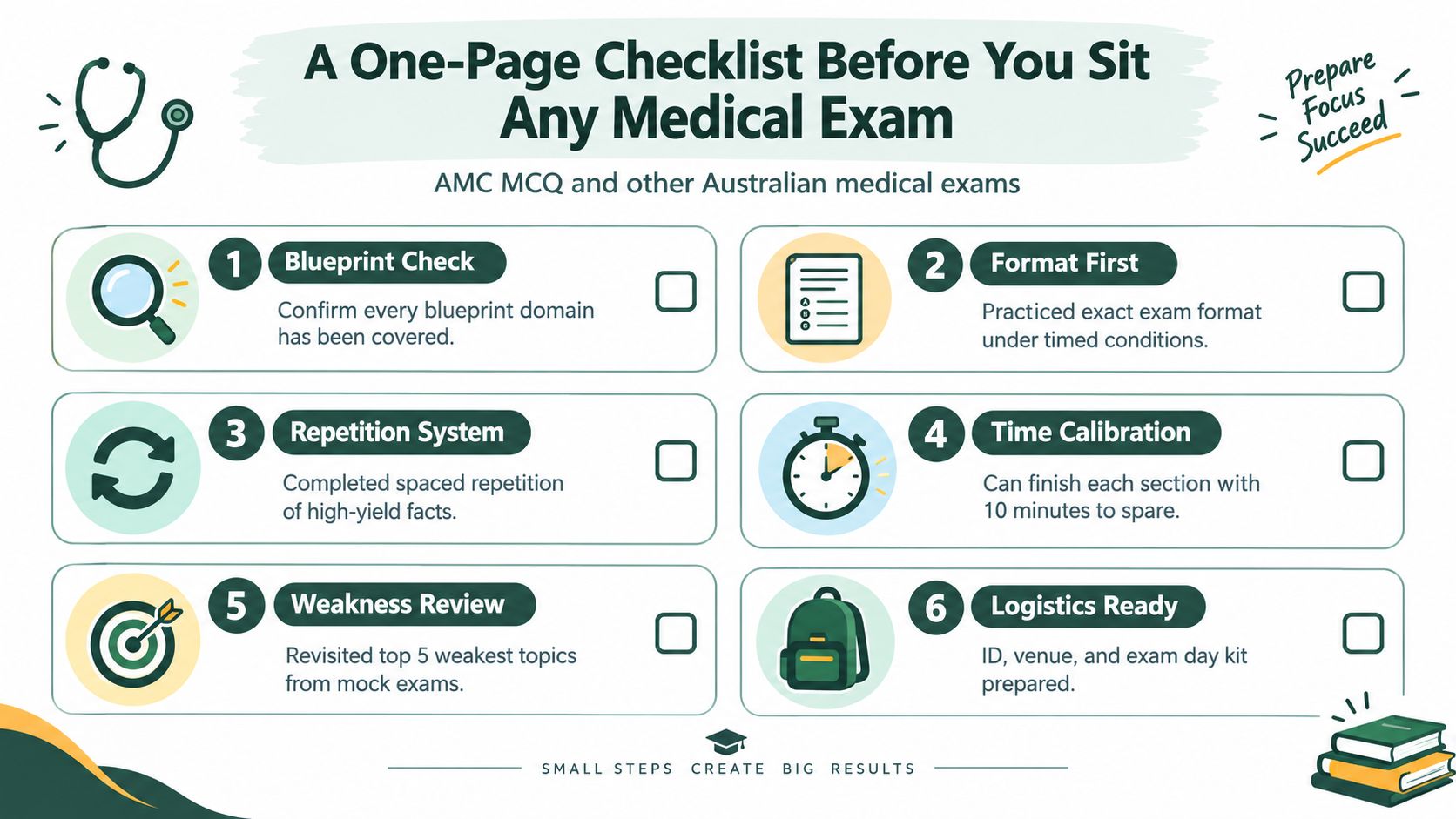
In the final week, stop expanding the resource list. Run a short audit that tests whether your preparation matches the assessment. This works for an AMC MCQ examination, an RACP Divisional Written Examination, the RACS Generic Surgical Sciences Examination (GSSE — the anatomy, physiology and pathology exam required for Surgical Education and Training eligibility) or a final-year OSCE, provided you replace the generic wording with the requirements of your exam.
The preparation audit
- Confirm the blueprint: Check every curriculum domain, station type or capability area against the official materials. Alignment prevents you from mistaking familiar content for complete coverage.
- Practise the exact format: Complete timed questions, structured written answers, interview responses or observed stations in the form you’ll face on the day.
- Repeat high-yield material: Revisit missed concepts through spaced recall. Don’t reread the explanation that felt persuasive the first time.
- Calibrate timing: Know your pace for an individual item, station or written response. For an OSCE, rehearse the complete station, including handover, rather than timing only the examination component.
- Review the error log: Return to the recurring traps from your simulations. Sort them into knowledge gaps, misreading, reasoning and format failures.
- Prepare logistics: Confirm identity documents, venue or online-proctoring requirements, technology, permitted equipment and the route to the examination.
Your checklist should also contain a readiness decision. If your timed blocks remain unstable, don’t hide that result by doing more untimed questions. If your OSCE performance runs beyond the station limit, remove unnecessary explanation and rehearse transitions. If interview answers become generic, return to the capability framework and practise responding to unfamiliar prompts.
The AMC’s own guidance puts the examination specifications, the reading list and the practice questions ahead of everything else, and that ordering is worth copying: confirm requirements, rehearse format, then repair the errors that remain. The examination data cited earlier show why candidates should respect both written and clinical assessment difficulty, rather than assuming that competence in one format transfers automatically to another.
The final 24 hours should be deliberately uneventful. Check documents and technology, prepare clothing and travel details, protect sleep, and read your personal error log cold. Don’t start a new textbook chapter or chase an obscure diagnosis because anxiety is asking for one more task. Your job is to arrive able to retrieve, prioritise and communicate what you’ve already trained.
Acronyms
| Short form | Stands for | What it means in practice |
|---|---|---|
| ACEM | Australasian College for Emergency Medicine | The college running emergency medicine training and exams |
| ACRRM | Australian College of Rural and Remote Medicine | The college running the rural generalist fellowship pathway |
| AKT | Applied Knowledge Test | RACGP’s written knowledge exam for general practice fellowship |
| AMC | Australian Medical Council | Accredits Australian medical education and assesses overseas-trained doctors for registration |
| AMSAC | Australian Medical Schools Assessment Collaboration | A group of medical schools pooling anonymised assessment items to benchmark student performance externally |
| DWE | Divisional Written Examination | RACP’s two-paper written exam, taken at the end of Basic Training |
| GSSE | Generic Surgical Sciences Examination | RACS’s anatomy, physiology and pathology exam, required for SET eligibility |
| MCQ | Multiple Choice Question | A question format with one correct answer selected from several options |
| MD | Doctor of Medicine | The Australian primary medical degree, taken as a graduate-entry programme at most schools |
| OSCE | Objective Structured Clinical Examination | A circuit of short, timed clinical stations, each scored against a fixed checklist |
| RACGP | Royal Australian College of General Practitioners | The college running general practice fellowship training and exams |
| RACP | Royal Australasian College of Physicians | The college running physician training and exams across Australia and New Zealand |
| RACS | Royal Australasian College of Surgeons | Oversees all nine surgical specialties, with selection devolved to specialty societies |
| SET | Surgical Education and Training | The RACS training programme surgical applicants apply into |
| USMLE | United States Medical Licensing Examination | The American licensing exam sequence — a different syllabus for a different regulator |
| WBA | Workplace-Based Assessment | An AMC-accredited assessment route completed over time in an approved workplace, as an alternative to the Clinical Examination |
CliniRoo is building preparation material for the Australian pathway: medical school assessments, specialty selection interviews, and college written and clinical examinations. Nothing is on sale yet. If you want to be told when there is something to use, CliniRoo takes an email address and does nothing else with it.