Situational Judgement Test Medicine: A Practical Guide
Situational Judgement Test Medicine. Learn what a situational judgement test in medicine actually measures, how scoring works, and how Australian medical
You’re sitting in a quiet testing room, trying to settle your breathing before the next screen appears. The scenario involves a colleague, a worried patient and a decision that has no perfect answer. You know enough medicine to recognise the risk, but the question isn’t asking for a diagnosis. It’s asking what a responsible future doctor should do first, what can wait and which response crosses a professional line.
That uncertainty is exactly why the situational judgement test in medicine feels different from an academic exam. It assesses how you apply professional values to realistic problems, not how many facts you can recall. In Australia, the reasoning required also changes as you move from undergraduate admission to postgraduate and specialty selection.
Table of Contents
- What a Situational Judgement Test Really Measures in Medicine
- How SJT Scenarios and Response Options Are Built
- Undergraduate vs Postgraduate SJT Formats in Australia
- How SJT Scoring Actually Works
- Australian Example Scenarios and Model Responses
- The Reasoning Skills Top Scorers Use
- Evidence-Based Preparation Strategies That Work
- Putting It All Together Before Test Day
What a Situational Judgement Test Really Measures in Medicine
A junior doctor notices that a patient has received unclear information about a medication. The patient is anxious, the colleague involved is busy, and the doctor must decide what to do first. An SJT uses this kind of situation to examine the quality of that decision, including how the candidate balances safety, communication, professional responsibilities and the limits of their role.
A situational judgement test in medicine presents a workplace or clinical scenario and asks you to assess possible responses. You may rate each action, rank options from strongest to weakest, or select the most suitable response. The question is usually about professional judgement in context, rather than the technical solution to the medical problem.
The assessment is not a personality quiz or a choice between the kindest-sounding answers. It provides a standardised signal about professional judgement, considered alongside academic results, interviews and other selection tools. The reasoning emphasis can shift between undergraduate admission and postgraduate specialty selection. UCAT ANZ-style admissions questions ask applicants to apply broad professional values before entering medical training. Specialty selection questions place greater weight on the responsibilities, authority and pressures attached to a clinical role.
SJTs can assess:
- Integrity, including honesty about errors, limitations and responsibilities.
- Empathy, shown by attending to a patient’s concerns and perspective.
- Teamwork, particularly when communication fails between professional groups.
- Resilience, demonstrated by responding constructively under pressure and seeking support.
- Prioritisation, when several patients or duties require attention.
- Ethical reasoning, including respect for autonomy, confidentiality and patient safety.
These attributes reflect professional expectations in Australian healthcare. Depending on the pathway, candidates may need to reason consistently with the Medical Board of Australia’s Good Medical Practice code, the JDocs Framework published by the Royal Australasian College of Surgeons for prevocational doctors, or the competency expectations set by the relevant specialist college.
One scenario can involve several duties
In the medication example, empathy supports a calm explanation to the patient. Integrity requires clarifying what was communicated and avoiding concealment of a possible problem. Teamwork supports a respectful discussion with the colleague. Patient safety may require escalation if the misunderstanding could affect treatment.
A strong response holds these duties together. Kindness without checking the risk may leave the patient unsafe. Aggressive escalation may address the process while damaging trust and future communication.
Practical rule: Choose the action that protects the patient, respects your role and keeps an appropriate route for follow-up open.
Australian medical admissions have documented SJT use in undergraduate selection. For the University of Sydney’s trial for 2020 entry, applicants completed the SJT after the MMI. The trial contained 25 scenarios with four options each, producing 100 scored judgements, and the university described the assessment as measuring empathy, ethics, integrity, communication and personal autonomy in a medical-education context (University of Sydney SJT trial materials).
How SJT Scenarios and Response Options Are Built
Most SJT items become easier once you stop reading them as one large paragraph. Treat each question as a small decision system with four parts: the situation, your role, the available actions and the instruction for responding.
Take an example. You’re a junior doctor on a teaching-hospital rotation in Sydney and overhear a nurse giving a family an incorrect explanation about a medication dose. The item may not tell you whether the error has already harmed the patient. That missing detail is deliberate. You must use the information provided, recognise the immediate risk and avoid inventing facts.
Start with the item anatomy
- The stem establishes what happened, who is involved and what information you know.
- The role and setting define your authority. A medical student, intern, registrar and consultant can’t automatically take the same action.
- The response options offer actions that may range from sensible to unsafe. Several can sound reasonable at first.
- The instruction tells you how to judge them. You may need to rate each option independently, rank the options, or select the strongest and weakest actions.
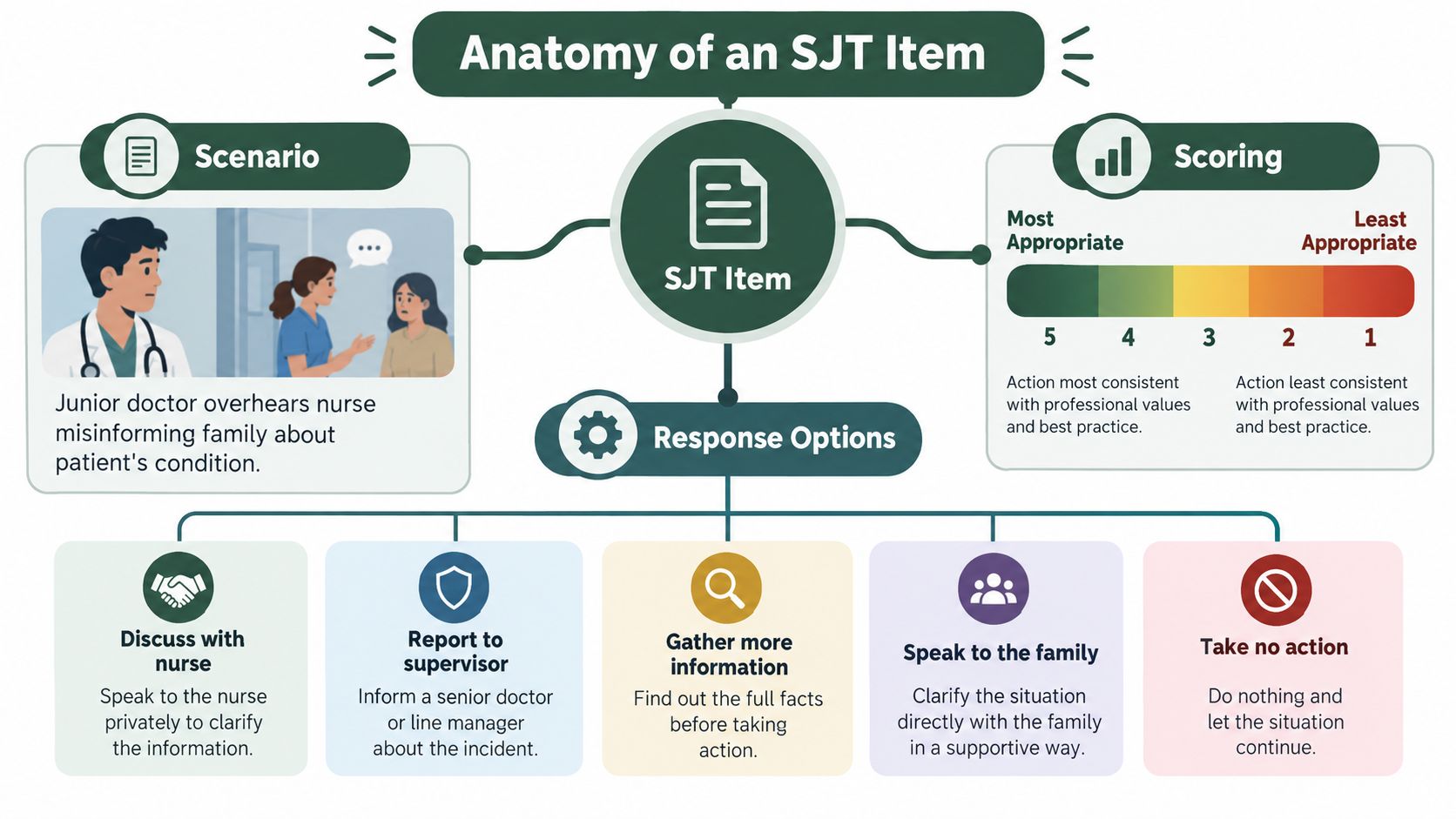
A rating question might ask whether “speak privately with the nurse to clarify what was communicated” is very appropriate, appropriate but not ideal, inappropriate but not awful, or very inappropriate. You judge that action on its own. A ranking question makes the actions compete, requiring you to order them from most to least appropriate.
Read ambiguity as a cue to prioritise
Distractors are often not absurd. “Immediately report the nurse to the hospital executive” may sound decisive, but it could bypass proportionate first steps if there’s no evidence of deliberate misconduct or continuing danger. “Say nothing unless the family complains” avoids conflict, but it leaves a possible medication misunderstanding unaddressed.
Use a simple parsing sequence:
- What is the most urgent risk?
- What does the character in this role have authority and responsibility to do?
- Which option addresses the problem without creating a new one?
- If the action fails, is there a clear and appropriate escalation route?
Scenario length varies because the test may be assessing rapid identification of a key issue or careful management of competing considerations. Don’t assume that the longest option is the most complete, or that the shortest option is the most direct. The wording, role and instruction carry more weight than the number of words.
Undergraduate vs Postgraduate SJT Formats in Australia
Australian candidates often use the phrase “medical SJT” as though it describes one national examination. It doesn’t. UCAT ANZ Situational Judgement belongs to the undergraduate admissions environment, while postgraduate and specialty selection SJTs operate within workplace and training contexts.
The UCAT ANZ Situational Judgement subtest contains 69 questions with 26 minutes of test time, and results are “expressed as a separate scaled score between 300 and 900” — reported separately from the total scaled score the three cognitive subtests combine into (UCAT ANZ test format and scoring). Postgraduate and specialty selection formats are built differently, with their own question structures and response rules, and are not interchangeable with the undergraduate version.
| Feature | UCAT ANZ SJT | Postgraduate or specialty SJT |
|---|---|---|
| Candidate stage | Prospective medical or dental student | Medical graduate, junior doctor or doctor seeking a training pathway |
| Main context | General professional and interpersonal scenarios before clinical training | Workplace judgement, training suitability and specialty-related responsibilities |
| Delivery | Computer-based admissions assessment | Format varies by programme, college, hospital network or selection process |
| Response style | May involve independent appropriateness judgements or other structured responses | May involve ranking, multiple response or pathway-specific formats |
| Reporting | Reported separately on a 300 to 900 scale | May be used as a ranking score, gateway measure or part of a broader panel process |
| Reasoning emphasis | Professional instincts, role awareness and ethical priorities | Proportionate escalation, system awareness, workplace accountability and defensible judgement |
Australian general practice training shows how different the postgraduate context can be. The selection system for entry into GP training was implemented nationally in 2011 following a pilot in 2010, and combined an SJT with a multiple mini interview. In the published validation study, that SJT comprised 50 questions with two hours to complete the test, used ranking and multiple response formats, and was reported to have high internal reliability at Cronbach’s alpha = .91 (The predictive validity of a situational judgement test and multiple-mini interview for entry into postgraduate training in Australia, BMC Medical Education, 2016). Note the age of that evidence: GP training has since changed administration, so use it to understand how postgraduate SJTs are built rather than as a description of a current process.
The practical shift is simple. An undergraduate candidate often asks, “Which response reflects sound professional values?” A postgraduate candidate must also ask, “What is proportionate for my role, what does the system require and how would I justify this decision to a supervisor?”
For broader context on the Australian pathway, review this guide to Australian medical exams. If you are heading towards specialty training rather than medical school, whether your pathway uses a situational judgement test, an interview, or neither depends on the college and sometimes on your state — our guide to specialty selection interviews in Australia sets out who decides what.
How SJT Scoring Actually Works
A candidate may choose a response that sounds thoughtful yet score poorly. SJT scoring rewards the option pattern that matches the assessment’s marking key, not the eloquence of an explanation. Subject-matter experts generally develop that key through structured judgement, so your task is to recognise the professional standard being tested.
The scoring method changes how you should read the options. Three models appear frequently in Australian medical selection.
| Scoring method | Used by | Response style | Scoring logic | Candidate implication |
|---|---|---|---|---|
| Full-rank ordering | Some postgraduate selection formats | Put every option in order | Award reflects how closely your complete order matches the key | Small ordering decisions can affect the result |
| Partial-rank ordering | SJT formats using ranking or multiple response | Select or order the strongest options | Credit may reflect agreement on the most important positions | Distinguish urgent, useful and harmful actions |
| Likert-style ratings | UCAT-style appropriateness or importance items | Rate options independently | Each response is compared with the keyed level of appropriateness | Do not downgrade a good action simply because another is stronger |
The Australian postgraduate validation study used ranking and multiple-response formats. By contrast, the University of Sydney trial presented scenarios with four options and assessed professional traits rather than clinical knowledge. The formats point to a practical rule: read the instruction before applying a familiar strategy.
Partial credit changes the guessing decision
Some SJT systems recognise how close your answer is to the marking key instead of treating every response as right or wrong. A near miss may therefore be more useful than a random extreme answer. That does not make every option a middle rating.
Use “very inappropriate” for an action that creates a serious professional or safety problem. Give the strongest positive rating to an action that addresses the central issue proportionately, respects your role and supports appropriate escalation. In a ranking task, separate the action that should happen first from one that may help later.
Your result may be reported as a scaled score, percentile-style summary or band. These labels turn performance into information for selection, but the reasoning task remains the same. Identify the main risk, consider your responsibilities and choose the response that best protects patients and professional standards. In undergraduate admissions, that logic often centres on appropriateness. In postgraduate selection, it also requires attention to supervision, accountability and the wider system.
Australian Example Scenarios and Model Responses
Worked examples help because SJT logic is easiest to understand when you can compare plausible actions. The following scenarios are illustrative practice cases, not official questions or official marking keys. They use common professional principles, including patient safety, respectful communication, confidentiality and appropriate escalation.
For more practice with structured clinical reasoning, see these clinical scenario questions.
Scenario one, a dismissed patient concern
You’re a junior doctor on a busy ward. A patient tells you that their chest discomfort has worsened, but a senior doctor says, “They’re always anxious,” and asks you to continue with routine jobs. You haven’t yet reviewed the patient’s observations or examined them.
Possible responses:
- Review the patient promptly, check the available clinical information and escalate if concerned.
- Tell the patient the senior doctor has assessed the situation and there’s no need to worry.
- Challenge the senior doctor loudly in front of the team and insist that they stop the ward round.
- Ask another junior doctor to assess the patient while you continue your allocated work.
- Wait until the senior doctor has finished and mention the concern later.
The strongest response is option one. It acknowledges the patient’s concern, gathers relevant information and uses escalation if the findings justify it. The junior doctor doesn’t need to diagnose the cause before recognising that a change in symptoms deserves attention.
Option three contains a safety impulse but is poorly proportioned. Public confrontation can damage team communication and may not be necessary before the junior doctor has gathered basic information. Option two is weak because it dismisses the patient without an independent review. Option four may be reasonable in a different staffing situation, but delegating without confirming the other doctor’s competence, availability and findings is less reliable. Option five risks delaying assessment.
The marking logic generally penalises inaction, false reassurance and disproportionate confrontation. Strong SJT answers often combine immediate attention with calm escalation.
Scenario two, an inappropriate comment on placement
You’re a medical student in a general practice placement. You overhear a colleague making a derogatory comment about a patient in a staff area. You’re unsure whether the patient could hear the comment, and you don’t know whether the colleague intended it as a joke.
Possible responses:
- Laugh along so the interaction doesn’t become uncomfortable.
- Speak privately with the colleague, explain that the comment was inappropriate and remind them of respectful patient care.
- Immediately post about the incident on social media without naming the patient.
- Raise the concern with your placement supervisor if the colleague dismisses it or if patient dignity or safety may be affected.
- Repeat the comment to another student as an example of poor professionalism.
The best initial action is usually option two, followed by appropriate escalation when needed. A private conversation allows the colleague to reflect without turning the first response into a public confrontation. If the comment was audible to the patient, discriminatory, repeated or linked to unsafe conduct, the threshold for informing the supervisor becomes more urgent.
Option four is important, but its position depends on the facts and the instruction. A ranking item may place it immediately after option two. Options one, three and five fail in different ways. Joining in normalises disrespect, public posting breaches professional judgement, and repeating the comment spreads rather than resolves the problem.
Strong answers don’t ignore misconduct, but they also don’t escalate every concern in the most dramatic way available.
The Reasoning Skills Top Scorers Use
Empathy matters, but SJTs don’t reward kindness. A candidate can choose a compassionate-sounding response and still miss the safety issue, exceed their authority or fail to act. High scorers usually perform several mental operations before they select an answer.
Identify the salient principle
First, decide what the scenario is really testing. Is the central problem confidentiality, immediate safety, honesty, respect, consent, supervision or team communication? Several values may appear, but one usually carries the greatest weight.
A patient who is distressed may need empathy, but if their distress follows a medication error, the priority includes transparent clarification and safety. Naming the central principle prevents a pleasant but incomplete response from dominating your judgement.
Weigh consequences and perspectives
Next, compare short-term and long-term effects. A private conversation may feel slower than an immediate public accusation, yet it can correct behaviour while preserving a workable team relationship. Consider the patient, family, colleague, supervisor and wider service, but don’t let concern about someone’s embarrassment outweigh patient welfare.
Then ask whether the option respects the limits of the character’s role. An undergraduate candidate may need to identify the need to seek help. A doctor applying for specialty training may be expected to recognise escalation pathways, documentation responsibilities and system effects.
Choose the defensible action
The final test is reviewability. If a supervisor later examined your decision, could you explain what you knew, what risk you identified and why your response was proportionate? A defensible action doesn’t need to be perfect. It needs to be safe, honest, role-appropriate and capable of being followed up.
Use this self-test before committing to an answer:
- What is the key risk?
- Who is affected immediately?
- What can this role do now?
- Which option protects safety without unnecessary conflict?
- What escalation is appropriate if the first step doesn’t work?
- Could I defend the decision using the facts in the stem alone?
Evidence-Based Preparation Strategies That Work
Effective preparation treats judgement as a skill you can practise, not a fixed personality trait. Use authentic SJT-style items, read the explanations carefully and write down why your answer differed from the key. Generic aptitude questions may build speed, but they won’t necessarily teach you how Australian medical selection formats distinguish between a proportionate response and an overreaction.
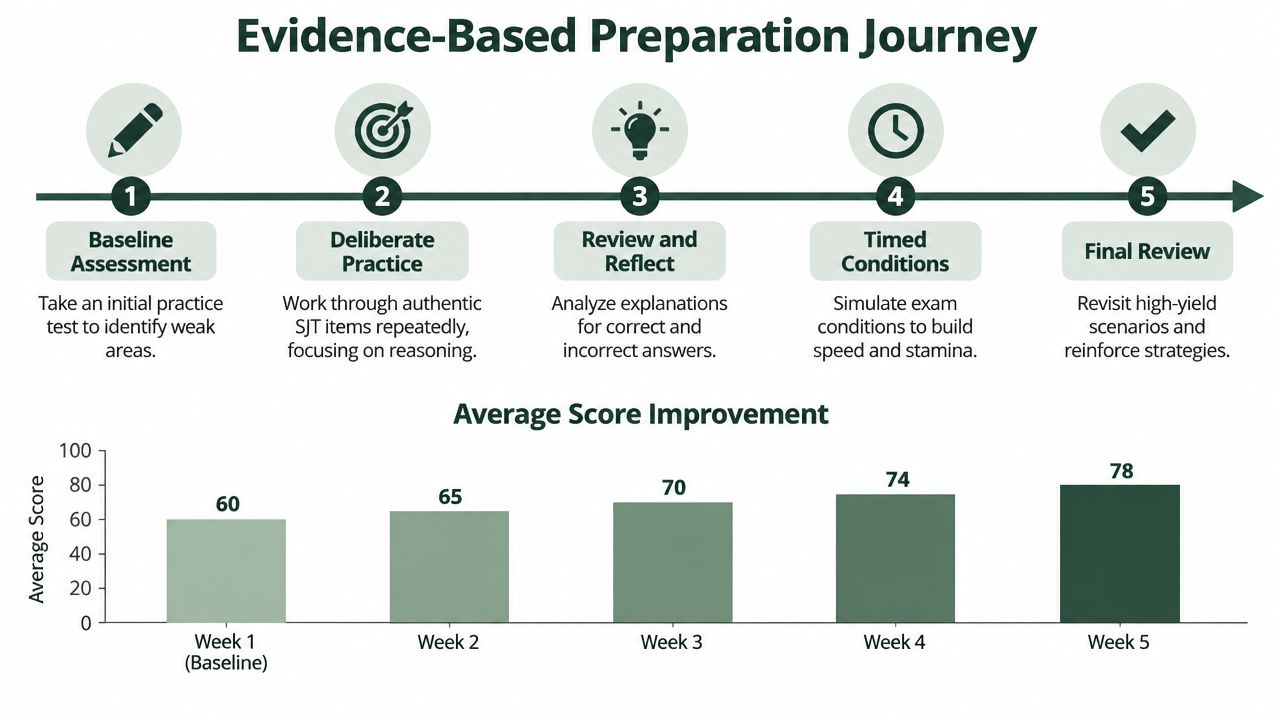
A structured preparation cycle can run across several weeks:
- Begin with format decoding. Learn whether the test asks for independent ratings, a full ranking, a partial ranking or multiple responses. Review professional guidance relevant to your pathway, including Australian expectations around safety, confidentiality, teamwork and honesty.
- Move into mixed practice. Rotate between UCAT-style admissions scenarios and postgraduate workplace scenarios if you’re preparing for more than one pathway. Don’t assume that success in one format automatically transfers to the other.
- Justify every decision. After each item, write one sentence identifying the salient principle, one sentence describing the risk, and one sentence explaining why your selected action is proportionate.
- Add timed blocks. Practise reading the full stem, identifying the role and responding under realistic time pressure. Keep the review separate from the timed attempt so speed doesn’t replace reflection.
- Use a mistake log. Label each error as a misread stem, poor prioritisation, role confusion, over-escalation, under-escalation or misunderstanding of the response scale.
- Finish with simulation and recovery. Complete realistic mocks, review recurring errors and protect sleep and concentration before test day.
The mistake log is more useful than a raw question count because it tells you what to fix. If you repeatedly choose immediate confrontation, practise proportional escalation. If you select reassurance before assessment, practise separating emotional support from clinical safety.
Use medical exam preparation resources to organise revision around the assessment format rather than relying on broad medical trivia.
Putting It All Together Before Test Day
Your final mental model should contain two related but distinct tracks. Undergraduate UCAT Situational Judgement asks you to recognise appropriate and inappropriate behaviour in general professional scenarios, often before you’ve developed extensive clinical experience. Postgraduate and specialty SJTs place more weight on workplace accountability, ranking, escalation and the reasoning expected from someone already inside the healthcare system.
Use this test-day checklist:
- Read the stem fully and identify the character’s role before judging an option.
- Put immediate patient safety first, then consider communication and team functioning.
- Treat each option according to the instruction. Rate independently when asked, and rank only when options are meant to compete.
- Avoid the two extremes, passive inaction and dramatic escalation without enough information.
- Use partial credit intelligently where the format allows it, but don’t select a middle answer merely to avoid commitment.
- Rehearse the movement from empathic impulse to a specific, defensible action.
Commit to three actions before the assessment: complete a format-specific mock, review your mistake log, and practise explaining your decisions aloud. That final explanation exposes whether you’ve identified the issue or picked the response that sounds most caring.
Treat SJT preparation as deliberate professional reasoning. You’re not trying to guess what a fictional perfect doctor would do. You’re learning to identify risk, respect your role, communicate proportionately and choose an action that remains defensible when the situation is reviewed.
CliniRoo is building preparation material for the Australian pathway — medical school assessments, specialty selection interviews and college examinations — with format-first guidance and structured question banks for local processes. Nothing is on sale yet. If you want to be told when there is something to use, CliniRoo takes an email address and does nothing else with it.