Interview Scoring Criteria: How Australian Medical Interviews Are Marked
How Australian medical and specialty training interviews are scored, what rubrics and domains reward, and how to make your evidence easy to mark.
Australian medical interview scoring criteria are structured, criterion-based domains such as communication, professionalism and clinical judgement, and the interview often carries a large share of the final ranking. In general surgery’s 2027 intake, for example, it is worth 50% (2026 General Surgery Selection Regulations, clause 13.1.1). A high-scoring answer therefore isn’t just polished or empathetic. It gives assessors observable evidence against the domain they’re rating.
That point is more counterintuitive than it first appears. Interview preparation often focuses on producing impressive answers, yet Australian selection systems are designed to score evidence of defined competencies, not a candidate’s overall likeability or fluency. If you can identify the construct being tested, you can shape a concise response that makes your evidence easy to find.
Table of Contents
- Why Structured Interview Scoring Criteria Matter in Australian Medical Selection
- Core Scoring Domains Across Australian Medical Interview Formats
- How Scoring Criteria Differ Between Surgical, Physician and University Pathways
- Interpreting Marking Rubrics and Band Descriptors for Medical Interviews
- Strong Versus Average Answers: Worked Examples
- Why Practising More Answers Is Not the Same as Understanding Scoring Criteria
- Jurisdictional Variation in Australian Medical Interview Scoring and Equity Considerations
- Quick-Reference Guide to Australian Medical Interview Scoring Domains
- Building Preparation Around Interview Scoring Criteria Rather Than Generic Advice
Why Structured Interview Scoring Criteria Matter in Australian Medical Selection
Structured interview scoring matters because panels need to compare candidates against the same expectations. A structured station uses a defined prompt, a named criterion and rating guidance. An unstructured conversation, by contrast, can allow confidence, familiarity or personal similarity to influence the discussion before the panel has examined the evidence.
Australian research shows what an interview score can and can’t tell a selector. A study of 382 graduate-entry medical students at Flinders University, enrolled between 2006 and 2009, found that grade point average, the national admissions test and the interview together explained between 7.1% and 29.1% of the variance in later performance, depending on the outcome measured. Grade point average was the most consistent predictor; the interview predicted performance in the clinical years (Years 3 and 4) rather than the pre-clinical ones (Sladek et al., BMC Medical Education, 2016).
That finding has two implications. First, the interview measured something the other tools didn’t, and a rubric can make that evidence more useful by linking an answer to a defined domain such as communication, professionalism, judgement or teamwork. Second, an interview score shouldn’t be treated as a complete measurement of candidate quality. Even combined selection criteria left most variation in later performance unexplained.
What structure changes for candidates
A structured process gives you a more useful preparation target than “make a good impression”. You can ask:
- What domain is being assessed? Is the station testing ethical reasoning, communication, teamwork or clinical prioritisation?
- What evidence will demonstrate it? Can you describe what you did, why you did it and what happened?
- What does the rating anchor require? Does a strong performance require reflection, escalation, cultural humility or a clear safety-net?
- What belongs in the first answer? Panels may follow up, but relevant evidence shouldn’t depend entirely on prompting.
Interview scoring criteria work best as part of a transparent, multi-measure model alongside academic results, cognitive testing and referee evidence. Your task isn’t to guess the panel’s personality. It’s to make the relevant evidence visible, specific and connected to the criterion.
Core Scoring Domains Across Australian Medical Interview Formats
Australian medical interviews vary by pathway, but recurring domains are recognisable. The Royal Australasian College of Physicians (RACP, the college that trains physicians and paediatricians) publishes interviewing guidance for local selection panels. It says structured interviews should include an agreed mechanism for rating responses, with guidance to interviewers on rating each question against an agreed grading rubric, and suggests interviewers note answers to behavioural questions as situation (or context), action and result. That is guidance written for panels, so it tells you what the person scoring you has been asked to look for.
Communication and interpersonal skills
Assessors look for whether you listen, explain clearly and adapt your language to the person in front of you. A strong response might show how you clarified a concern, checked understanding and maintained respect during disagreement. Merely saying that communication is important doesn’t provide assessable evidence.
Communication can overlap with empathy, but they aren’t automatically the same construct. Communication concerns how you exchange information and build understanding. Empathy may concern whether you recognise and respond to another person’s emotional experience. If both appear in a station, address both deliberately rather than assuming one automatically earns marks for the other.
Professionalism and ethical behaviour
Professionalism is usually demonstrated through accountability, boundaries, honesty and appropriate escalation. Candidates should be prepared to describe what they would do when they make an error, notice unsafe practice or face a conflict of interest.
Avoid presenting professionalism as flawless performance. Reflection, openness about limits and a willingness to seek supervision often provide stronger evidence than a story in which everything went perfectly.
Clinical judgement and level-appropriate decision-making
This domain isn’t asking whether you can sound like a consultant. It asks whether your decision matches your level of responsibility and the information available. Useful evidence includes identifying immediate risk, gathering essential information, prioritising actions, communicating uncertainty and escalating appropriately.
A safe answer makes its decision process visible. It doesn’t hide behind “I would manage the patient” without explaining what would happen first and why.
Teamwork, cultural competence and continuing development
Teamwork is shown through collaboration, role clarity and constructive management of disagreement. Cultural competence includes respect for cultural identity, awareness of power differences and a willingness to avoid assumptions. Commitment to specialist training and continuing professional development becomes credible when connected to a specific learning need, feedback or teaching activity.
A practical station map should include the target domain, behavioural indicators, the anchored scale, permitted prompts and a separate global rating. This is the logic behind domain-based interview preparation, where an answer functions as an evidence map rather than a memorised script.
How Scoring Criteria Differ Between Surgical, Physician and University Pathways
The same answer can be useful in one pathway and incomplete in another because panels apply different weightings, formats and thresholds. Candidates need to read the rules for their actual college, university, hospital network or intake rather than assume that every Australian medical interview uses the same scorecard.
Surgical selection
Surgical training in Australia runs through the Royal Australasian College of Surgeons (RACS) Surgical Education and Training (SET) program, and each specialty publishes its own selection regulations every year. General surgery is a clear example of explicit weighting. For the 2027 intake, the final ranking is 10% rurality, 20% structured curriculum vitae, 20% professionalism referee reports and 50% interview (2026 General Surgery Selection Regulations, clause 13.1.1).
The interview is five panels of two assessors, up to 10 minutes each, and every panel asks two structured questions with follow-up allowed. Each panel member scores you individually out of five per question against criterion statements, and also gives a global score out of five covering communication, ethics, organisation, reflection of RACS competencies, situational awareness and safety (clauses 12.3–12.5). To meet the minimum standard you must rank within the top 75% of applicants (clause 13.1.2). Other surgical specialties set different weightings, so check the current regulations for yours.
For surgical candidates, preparation should therefore be station-specific. Practise identifying the criterion, delivering evidence efficiently and remaining consistent when several assessors examine the same response.
Physician training
Physician Basic Training selection is not run by the RACP centrally. RACP’s own Basic Training Discovery Phase Report (July 2025) found it is run by health services in each state and territory, typically combining curriculum vitae review, written statements, referee reports and structured interviews, often multiple mini-interviews (MMIs, a circuit of short, separately scored stations). Interviews typically carried around 60% of the selection score and commonly assessed communication, professionalism, clinical reasoning and commitment to physician training. That report is a snapshot, and each health service sets its own criteria, so read the selection criteria for the posts you are applying to.
The practical difference is that physician candidates should avoid broad specialty enthusiasm without evidence. Explain what has shaped your interest, what you understand about the work and how you respond to feedback or ongoing learning requirements.
University pathways
University interviews show greater variation in station design and rating scales. Schools can differ in which non-academic attributes they assess and how tightly they anchor ratings. Some panel interviews are highly structured, while others may be less structured and therefore more vulnerable to similarity and interviewer bias, as discussed in the Australian medical-school selection analysis.
The preparation consequence is simple. Confirm the format, list each station’s likely construct and prepare evidence that can flex across prompts without becoming a rehearsed speech.
Interpreting Marking Rubrics and Band Descriptors for Medical Interviews
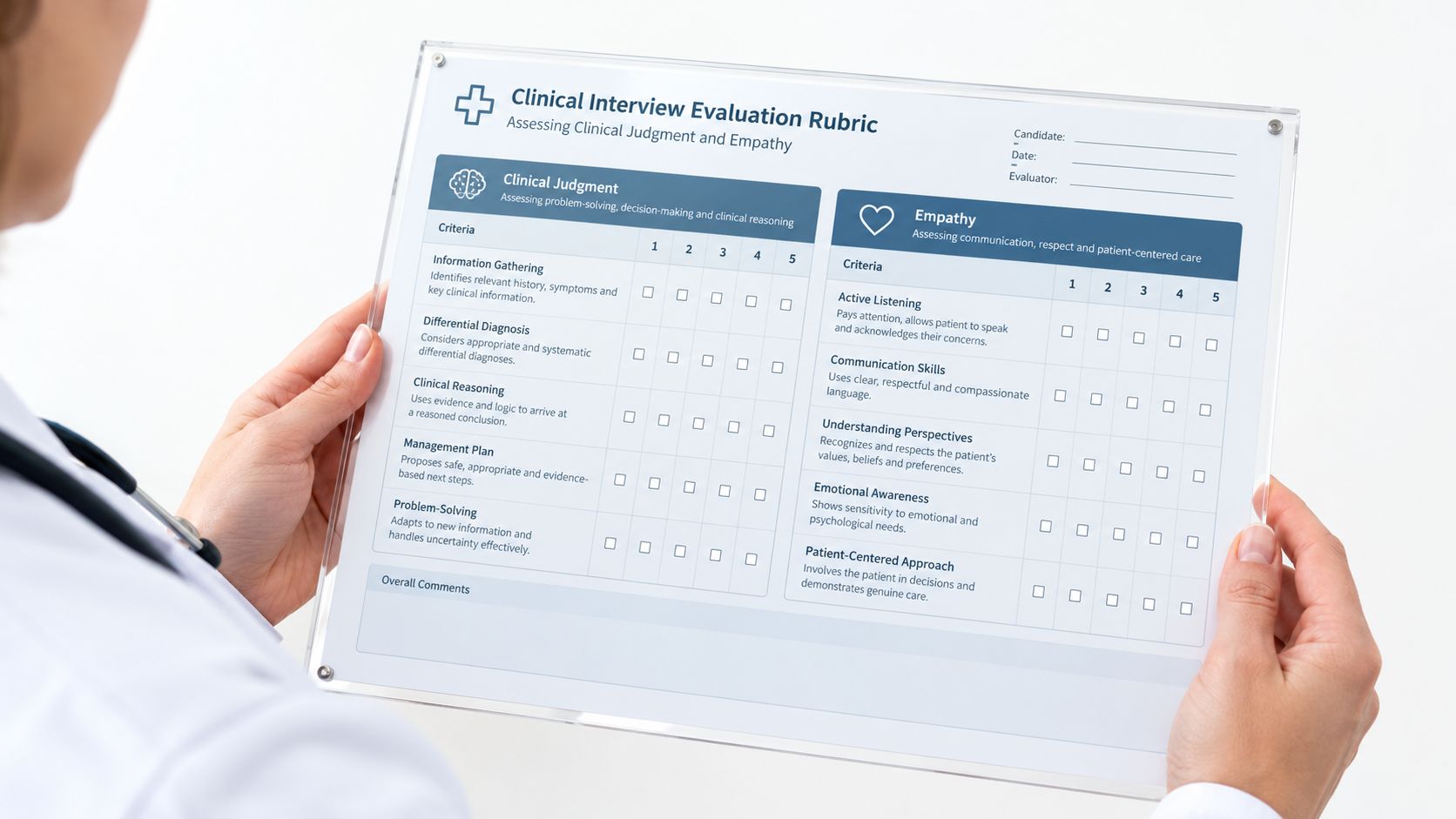
A rubric isn’t a mood scale. It translates a broad competency into observable behaviours that allow assessors to distinguish a limited, adequate or strong response.
Start by separating the criterion from the story. A question might ask about conflict, but the scoring domain could be teamwork, professionalism, communication or self-awareness. Your example matters only when it demonstrates the behaviour the panel is rating.
A practical reading method
Use the rubric in four passes:
- Name the construct. Write the domain in plain language, such as “recognises limits and escalates safely”.
- Underline the behaviours. Look for verbs, including identifies, explains, reflects, collaborates, prioritises and adapts.
- Separate levels. A lower band may describe a generic or incomplete response. A middle band may show relevant action but limited reasoning or reflection. A higher band usually connects actions to impact, risk, learning or the needs of others.
- Plan the evidence. Choose a situation that lets you demonstrate the required behaviours without spending most of the answer on background.
In some processes each assessor scores you separately. General surgery’s 2027-intake panels do exactly that (clause 12.5.2). That means your response must stand on its own for each assessor. Don’t rely on one panel member to infer what you meant from a general impression.
Practical rule: If a criterion says “reflects”, include what you learned and what you changed. If it says “escalates”, name who you would involve, when and why.
What “good” does not mean
A good answer isn’t necessarily long, emotional or highly technical. It is relevant, evidenced and proportionate to the station. A candidate can lose marks by providing a fascinating story that never states their action, or by describing an ethical principle without showing how they would apply it.
Using MMI interview preparation effectively means reviewing your answer against the criterion after practice. Ask whether the assessor could point to a sentence demonstrating each required behaviour.
Strong Versus Average Answers: Worked Examples
A high-scoring answer makes the assessed construct visible. Consider a station asking: “Tell us about a time you recognised a mistake or potential safety issue.”
An average answer might be:
“During placement, I noticed there was some confusion about a medication. I spoke to the team, and we sorted it out. It taught me to communicate better and be more careful.”
The topic is relevant, but the evidence remains unclear. What did the candidate notice? What action did they take? Who needed to know? What risk did they manage? What changed in their practice?
A stronger response keeps the same broad situation while showing each decision:
“During a ward placement, I noticed that the medication list and the patient’s reported medicines did not appear to match. I paused the medication discussion, checked the chart and asked the supervising doctor and pharmacist to review the discrepancy before administration. I explained to the patient that we were checking the list to prevent an error. Afterwards, I reflected on how easily assumptions can enter a handover. I now verify discrepancies explicitly and escalate them rather than treating a familiar medication list as confirmation.”
This version provides evidence of situational awareness, safe escalation, communication, accountability and reflection. It also shows appropriate limits. The candidate does not imply independent authority beyond their level, and instead uses supervision to reduce risk. The same evidence-mapping logic applies to specialty-specific stations, as shown in this internal medicine training interview walkthrough.
A teamwork station should test a different construct rather than repeat the same average-versus-strong comparison. A strong answer might describe a handover disagreement where the candidate restated the shared clinical goal, invited the registrar’s view, agreed on a documented plan and checked back that the plan had been followed. That example gives the panel observable evidence of collaboration, respectful challenge, follow-through and patient-focused reasoning.
The example does not need to sound heroic. A modest incident can score well when it shows insight, respectful behaviour and a clear outcome. Panels score evidence of the domain, not the drama of the story.
A polished narrative without observable action remains a weak scoring response.
Why Practising More Answers Is Not the Same as Understanding Scoring Criteria
Practising more answers does not guarantee a higher score. It can produce fluent delivery while leaving the candidate unsure which construct the panel is assessing. A station may appear to ask about empathy, yet the marks may depend on communication, cultural awareness, boundaries or reflection.
Candidates who rehearse fixed scripts often describe the situation at length, then compress the action and reflection. That pattern leaves assessors with too little observable evidence to rate the criterion. Scoring literacy changes the task: identify the construct, choose evidence that demonstrates it and organise the answer so the panel can record what you did, why you did it and what resulted.

Replace answer volume with construct practice
Use one scenario to practise several scoring lenses. A conflict example can show communication through listening and clarification, teamwork through shared problem-solving, or professionalism through boundaries, supervision and escalation. The event stays the same. The evidence you foreground changes.
Before answering, identify:
- The target construct: What capability is being scored?
- The evidence requirement: Which behaviours would support a strong rating?
- The time constraint: Which details help the assessor judge you?
- The follow-up boundary: What must you explain without waiting for a prompt?
This method reduces dependence on memorised wording. If the question changes, a script can become irrelevant. A domain map lets you select suitable evidence in real time and keep the answer proportionate.
Practise stating the action and reasoning clearly, then add the outcome and reflection. Panels need enough specific evidence to apply the criterion. A positive tone alone does not supply it.
Jurisdictional Variation in Australian Medical Interview Scoring and Equity Considerations
A structured rubric can improve consistency without guaranteeing fairness. The criterion itself may still reward access to metropolitan networks, prestigious activities or experiences that some candidates have had fewer opportunities to obtain.
Rural selection is one place this is changing. In June 2025 the Council of Presidents of Medical Colleges (CPMC) and the National Rural Health Commissioner released a guide to rural selection for specialist training, under which every college uses consistent definitions and transparent processes to recognise rural background and experience, such as significant childhood years in a rural area or extended rural placements (CPMC, June 2025). How much that counts, and how it is scored, is still set by each college for each intake.
Evidence without metropolitan assumptions
Candidates from rural, regional, or Aboriginal and Torres Strait Islander contexts shouldn’t feel compelled to imitate an urban pathway. Instead, make the context relevant to the competency explicit. If an opportunity was unavailable, explain the experience you did have and the capability it developed. If a community connection shapes your motivation, describe the responsibilities, learning and relationships involved rather than presenting identity as a credential.
A strong panel should distinguish capability evidence from opportunity-dependent prestige signals. Candidates can help by naming the context, but they shouldn’t need to apologise for not having access to a particular network or activity.
What variation means in practice
Rules differ by college, state and health service in eligibility, weighting, station format and the type of evidence expected. Physician Basic Training alone ranges from formal affirmative action pathways in some states to targeted rural programs in others (RACP, July 2025).
For preparation, the practical lesson is to read the local policy, identify its stated domains and prepare contextually grounded examples.
Quick-Reference Guide to Australian Medical Interview Scoring Domains
Use this table as a starting point, then verify the current instructions for your pathway.
| Pathway | Common scoring emphasis | Evidence to prepare |
|---|---|---|
| Surgical selection (general surgery, 2027 intake) | Criterion statements per structured question, plus a global score for communication, ethics, organisation, situational awareness and safety | Concise behavioural examples, safe escalation and an answer that stands on its own for each assessor |
| Physician Basic Training | Communication, professionalism, clinical reasoning and commitment to physician training, set locally by each health service | Situation, action, result examples mapped to the health service’s published selection criteria |
| University medical selection | Non-academic attributes selected by the institution, often across varied station formats | Flexible examples showing communication, ethical reasoning, reflection and cultural awareness |
| Rural pathways | Rural background and experience, recognised under definitions the colleges agreed in 2025 | Rural experience explained in context, without relying on metropolitan prestige signals |
A station may assess more than one domain, but don’t assume every domain receives equal weight. Look for named criteria, rating descriptors, eligibility rules and instructions about what candidates should provide without prompting.
Building Preparation Around Interview Scoring Criteria Rather Than Generic Advice
Effective preparation starts with the scorecard, not the model answer. How specialty selection interviews in Australia differ by college and jurisdiction is the place to start mapping yours. For every station, identify the domain, translate the rating language into observable behaviours and choose evidence that demonstrates those behaviours at your level of responsibility.
Practise saying the evidence plainly. State the situation briefly, explain your action and reasoning, give the result, then add reflection where the criterion requires it. Review whether your response covers the construct rather than whether it sounds impressive.
Structured criteria support panel consistency, but they also give candidates a fairer preparation target. Once you can read the scoring language, unfamiliar prompts become manageable because you’re solving the same task: identify the domain and deliver assessable evidence.
CliniRoo is building station-by-station interview preparation for the Australian pathway. Nothing is on sale yet. If you want to be told when there is something to use, CliniRoo takes an email address and does nothing else with it.