Domain Score in Medical Interviews: An AU Guide
Learn how the domain score works in Australian medical interviews and discover practical strategies to improve your performance in 2026.
A domain score in a medical assessment is a numbered rating on an anchored scale that an assessor gives you for a named competency such as Communication, Clinical Reasoning or Professionalism. Where a rubric weights its domains, those weighted ratings combine to produce your overall station or selection result.
You’ve finished a specialty selection interview, a college assessment or a university objective structured clinical examination (OSCE — a circuit of timed stations, each marked by an examiner against set criteria), and the waiting is harder than the station itself. When the result appears, you may see one number for each competency area, or only a combined outcome. The natural question is, “What did that number measure?”
In this setting, domain score has nothing to do with the website “domain authority” metric used in search engine optimisation. It describes how assessors rate your observable performance against a defined competency. A candidate who sounds confident but misses the management plan may score well for rapport and poorly for Clinical Reasoning. Another who gives technically accurate information but ignores the patient’s distress may lose marks in Communication and Professionalism.
The useful question isn’t whether your score feels high or low in isolation. It’s which behaviours moved the mark, which domain carried the greatest weight, and what the panel needed to hear or see before awarding the next anchor.
Table of Contents
- What a Domain Score Actually Means in Australian Medical Assessments
- Inside the Scoring Rubric, Domains, Anchors, and Weights
- Strong Versus Average Answers on the Same Station
- How Panels Calculate and Weight Domain Scores
- How Domain Scoring Differs Across Interviews, Clinical Exams, and Written Papers
- Building a Preparation Routine That Lifts Domain Scores
- Common Mistakes That Quietly Cap Your Domain Score
What a Domain Score Actually Means in Australian Medical Assessments
Where an assessment reports results by domain, each number is the panel’s judgement of performance in one defined area, not a general impression of whether the candidate was likeable or polished.
A domain score is assigned against a named competency using an anchored scale. The length of the scale depends on the institution and assessment. Each point should correspond to a description of behaviour, such as incomplete, developing, competent or highly effective performance. The wording varies, but the principle remains stable: the assessor rates what you demonstrated, not what you intended to demonstrate.
Australian medical assessments use this logic in different forms, and the details belong to whoever runs the assessment. For specialty selection, the domains, scale and weightings are set by each college, and sometimes by each specialty or state training network, and they can change from one intake year to the next. The only reliable source is the selection regulations or applicant guide for your specialty and your intake year. For how selection is organised across the colleges, see how specialty selection works in Australia.
The number is not a vibe
A panel may still experience a complete impression, but a defensible rubric breaks that impression into observable evidence. Did you identify the patient’s concern? Did you explain the error plainly? Did you take responsibility? Did you propose a safe next step? Those details allow assessors to justify why one answer sits at a middle anchor while another reaches the top band.
The score is then summed or weighted with other domain scores. A strong Communication mark may not compensate fully for absent Clinical Reasoning if the latter carries greater weight. Conversely, a candidate doesn’t need perfect performance in every area if the rubric rewards a clear strength and the weaker domain remains safe and competent.
Practical rule: Ask, “Which competency was the panel scoring at this moment?” before asking whether your answer sounded impressive.
The rest of the process becomes easier once you separate the domain, the anchor and the weighting. You can then practise the behaviours that earn marks rather than rehearsing broad answers and hoping the panel notices the right qualities.
Inside the Scoring Rubric, Domains, Anchors, and Weights
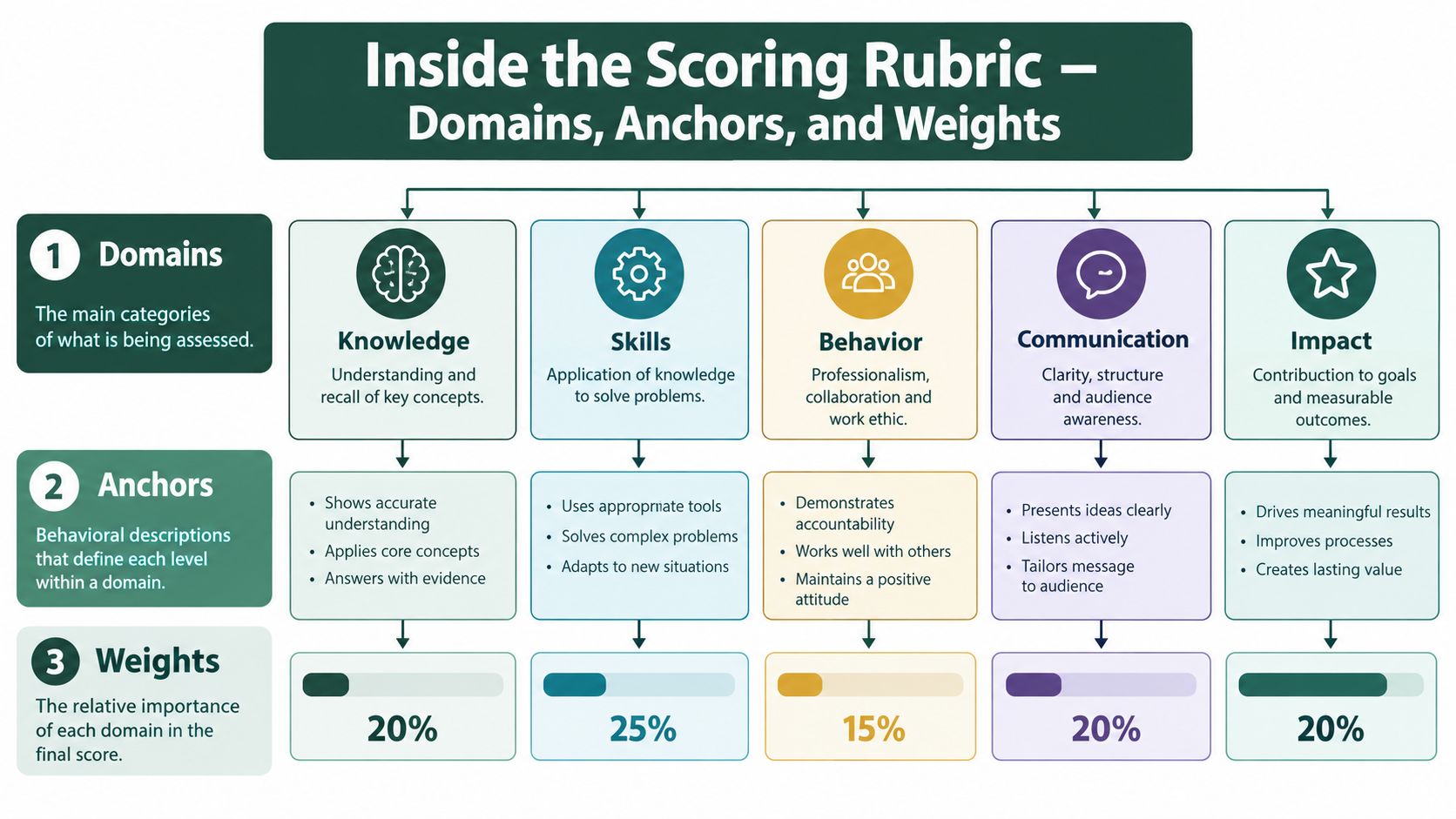
A scoring rubric has three working parts. Domains name the capabilities. Anchors describe what performance at each numeric level looks like. Weights determine how much each domain contributes to the final station result.
Take a generic 10-minute Communication station. The panel might assess Communication, Clinical Reasoning, Professionalism and Collaboration. Communication could carry the largest share because the station asks you to explain a difficult event, while Collaboration might carry a smaller share because it appears only when you describe escalation.
The exact structure differs between programs, so treat this as a teaching model rather than a universal Australian template. The important point is that the weighting is decided before candidates enter the room. It isn’t created in response to your particular personality or answer.
Domains identify what the assessor is reading
A domain is more precise than “overall performance”. For example:
- Communication: clear language, listening, empathy and checking understanding.
- Clinical Reasoning: identification of risk, prioritisation, differential thinking and a safe plan.
- Professionalism: accountability, honesty, respect, boundaries and escalation.
- Collaboration: appropriate use of the multidisciplinary team and shared responsibility.
- Technical Skill: accurate, organised execution of a practical task.
A response can therefore be strong in one domain and limited in another. That’s why candidates who leave a station thinking “I was good” often receive a less useful diagnosis than candidates who can identify exactly where their evidence sat.
Anchors translate behaviour into a number
An anchor gives meaning to the number. A middle Communication anchor might describe an answer that is understandable but somewhat generic, with limited exploration of emotion or understanding. A high anchor might require a logical sequence, patient-centred language, explicit ownership and active checking of concerns.
Vague wording produces inconsistent marking. Behavioural wording gives assessors something they can point to in their notes. It also gives you a practice target. “Be empathetic” is difficult to rehearse. “Acknowledge the patient’s fear before explaining the clinical facts, then check what they have understood” is observable.
Weights matter because a small improvement in a heavily weighted domain can affect the station more than a larger improvement in a minor domain. Don’t spend every practice session polishing a strength just because it feels comfortable. Find the domain where a clear behavioural change is both achievable and valued by the rubric.
Strong Versus Average Answers on the Same Station
Consider a disclosure station in which a junior doctor must explain a medication error to a simulated patient. The candidate needs to communicate clearly, reason through immediate safety actions and demonstrate professional accountability.
An average answer might sound like this:
“I’m sorry this happened. You were given the wrong medication, and we’ll monitor you closely. I’ll let the consultant know and make sure the team reviews what occurred. Please let me know if you have any questions.”
This answer isn’t reckless. It apologises, identifies a problem and mentions escalation. However, it stays general. It doesn’t acknowledge the patient’s likely fear, explain what happened in plain terms, specify how immediate harm will be assessed or invite the patient into a meaningful conversation.
A stronger answer could be:
“I can see this may be frightening, and I’m sorry. You were given medication that wasn’t intended for you. I’m responsible for explaining what happened. I’ll first assess whether you’ve had any symptoms, involve my senior immediately and arrange the monitoring or treatment you need. I’ll also document the event and ensure it’s reviewed openly. Before I continue, what worries you most, and could you tell me what you’ve understood so far?”
The second answer earns evidence across several domains. It acknowledges emotion before delivering detail, names the error without euphemism, takes responsibility without making excuses and provides a specific safety sequence. It also checks understanding rather than assuming that the explanation was sufficient.
| Element | Average Answer | Strong Answer |
|---|---|---|
| Opening | Offers a partial apology | Recognises distress and apologises directly |
| Explanation | States that the wrong medication was given | Names the event plainly and avoids vague language |
| Ownership | Refers to “the team” and review | Takes personal responsibility while involving senior support |
| Safety plan | Promises monitoring in general terms | Describes immediate assessment, escalation and follow-up |
| Patient involvement | Asks whether there are questions | Explores the patient’s main concern and checks understanding |
| Likely rubric reading | Competent but generic evidence | Behaviourally specific evidence at a higher anchor |
The difference between a 3 and a 5 is rarely a secret fact. It’s usually sequencing, specificity and the ability to make your reasoning visible. Candidates preparing for internal medicine pathways can compare this style of response with the broader expectations described in internal medicine training interview guidance.
How Panels Calculate and Weight Domain Scores
Once assessors have marked each domain, the panel can calculate a weighted station score. Consider an interview station with three assessors and four domains. The following figures are a worked fictional example, included to demonstrate the arithmetic rather than to represent a particular college rubric.
First, average the three assessor marks within each domain. Then multiply that average by the domain’s decimal weight. Finally, add the weighted results.
| Domain | Assessor A | Assessor B | Assessor C | Domain Avg | Weight | Weighted Score |
|---|---|---|---|---|---|---|
| Clinical Reasoning | 4.0 | 3.5 | 4.0 | 3.83 | 40% | 1.53 |
| Communication | 4.0 | 4.5 | 4.0 | 4.17 | 25% | 1.04 |
| Professionalism | 4.5 | 4.0 | 4.5 | 4.33 | 20% | 0.87 |
| Collaboration | 3.5 | 3.5 | 4.0 | 3.67 | 15% | 0.55 |
| Station total | 100% | 3.99 / 5 |
The station result is approximately 3.99 out of 5 in this model. Clinical Reasoning contributes the most because it carries the greatest weight. A half-point improvement in that domain changes the station result more than a half-point improvement in Collaboration.
Why three assessors may not give the same mark
Assessors notice different evidence. One may focus on whether the candidate identified the clinical risk, while another gives greater attention to the clarity of the explanation. That variation doesn’t automatically mean the rubric has failed.
Panels may manage variance by discussing outliers, reviewing unusually divergent marks, applying calibration rules or excluding an extreme score where the assessment design permits it. A borderline result may trigger a review of the evidence, a second marking process or a predefined decision rule. Candidates usually won’t know the exact procedure unless the relevant program publishes it.
Weighting is a design choice
Weights reflect the purpose of the station. A communication task may assign greater value to empathy and clarity. A clinical management task may prioritise prioritisation, safety and escalation. The panel chooses those priorities before the assessment, which is why answering every station with the same polished structure can be ineffective.
Your preparation should therefore mirror the arithmetic. Identify the high-weight domain, then make sure your response produces explicit evidence for it without neglecting safety-critical areas.
How Domain Scoring Differs Across Interviews, Clinical Exams, and Written Papers
The phrase domain score can describe different marking behaviours depending on the format. An interview asks a panel to interpret your response in real time. An OSCE often gives the assessor a station-specific checklist or banded rubric. A written paper maps questions to content areas and awards marks through a key.
| Feature | Interview Stations | Clinical Exams (OSCE) | Written Papers |
|---|---|---|---|
| Main evidence | Spoken response, behaviour and response to probes | Actions, examination technique, explanation and safety | Selected answers, written reasoning and knowledge |
| Assessor role | Holistic judgement within defined domains | Direct observation against station criteria | Marking against a key or standard |
| Common strength | Shows judgement, empathy and prioritisation | Makes clinical process visible | Covers broad blueprint content efficiently |
| Common trap | Halo effect from confidence or warmth | Missing one required action | Preparing deeply for content outside the tested blueprint |
| Best preparation | Timed answers and recorded feedback | Repeated station rehearsal with checklists | Blueprint mapping and error review |
Interview stations reward visible judgement
A panel can ask a follow-up question, test your flexibility and observe whether you listen. That creates room to demonstrate maturity, but it also creates the risk of a halo effect. A confident opening can make an answer feel stronger than its clinical content, while nervous delivery can hide sound reasoning.
Use signposting. State the immediate concern, explain your approach, identify who you’d involve and close by checking the person’s perspective. This gives the panel evidence to place under more than one domain.
OSCEs punish omissions
In a clinical station, you may receive credit for specific actions such as confirming identity, gaining consent, performing an examination step or explaining a management plan. The task may feel natural, but the marking structure can be less forgiving than an interview.
A polished manner won’t replace a missed safety action. Practise with the actual station sequence, and say key decisions aloud when the rubric rewards explanation as well as performance. Guidance on the Royal Australasian College of Physicians (RACP) clinical exam format can help candidates distinguish clinical station behaviours from interview behaviours.
Written papers depend on blueprint coverage
Written assessments move away from an assessor’s live impression. Questions are mapped to content domains and marked through selected-response keys or structured criteria for short answers. Your preparation should therefore identify recurring knowledge gaps, not only practise elegant explanations.
The trap is different in each format. Interviews can hide weak reasoning behind style, OSCEs can expose an omitted step, and written papers can reveal blind spots in the content blueprint. Match your practice method to the way evidence is collected.
Building a Preparation Routine That Lifts Domain Scores
A useful preparation routine starts with the rubric, not with a pile of model answers. The objective is to create repeated opportunities for a reviewer to mark the same behaviours and tell you whether they became clearer.
A six-week cycle
Week 1, audit your baseline. Choose a real or closely matched rubric, record a mock response and ask a colleague to score each domain separately. Keep the recording and write down the exact sentence or action that supported every mark.
Week 2, target the easiest meaningful lift. Start with the weakest domain that you can improve through behaviour. Communication is often suitable because changes such as acknowledging emotion, signposting and checking understanding can be observed quickly.
Week 3, rehearse contrasts. For each session, give an average answer first, then a stronger version to the same prompt. Name what changed. You might add ownership, a concrete safety plan or an explicit escalation step.
Week 4, introduce assessor variation. Run a full timed station with two assessors who score independently before discussing differences. If one marks Communication highly and the other marks it in the middle band, ask which observable behaviour caused the divergence.
Week 5, drill the format-specific gap. Use OSCE checklists for clinical stations, marking keys for written answers and panel-style probes for interviews. Don’t use interview practice to repair an examination omission.
Week 6, consolidate under pressure. Complete a panel-style debrief, review your recordings and select a small number of repeatable behaviours to carry into the assessment. Avoid rewriting every answer at the last minute.
Record movement, not just confidence
After each practice set, record the domain scores, the evidence supporting them and one behavioural change for the next attempt. Three useful repetitions of one station with targeted feedback are more informative than a large number of unscored attempts.
A specialist coach becomes useful when assessors consistently disagree about your performance, when you can’t identify the domain limiting your result or when your delivery deteriorates under timed questioning. Resources such as medical interview preparation materials can support structured rehearsal, but the scoring conversation still needs to refer to the rubric you’re facing.
Common Mistakes That Quietly Cap Your Domain Score
Candidates often assume that more knowledge will solve a disappointing score. Sometimes it will. More often, the panel already knows you understand the topic, but your response doesn’t display the behaviour required by the upper anchor.
Rehearse-speak in Communication. A memorised paragraph can sound smooth while failing to respond to the patient in front of you. If the simulated patient says they feel betrayed and you continue reciting your prepared explanation, the panel may read the problem under Communication, not Knowledge. Pause, acknowledge the emotion and answer the concern that was raised.
Omit the management plan in Clinical Reasoning. Naming the diagnosis or ethical issue is only part of the task. A candidate who says, “I’d escalate this,” without stating to whom, when and why may never reach the higher reasoning anchor. Finish with immediate safety, senior involvement, communication and review.
Let eye contact collapse under pressure. Looking down to search for a phrase can make a thoughtful answer appear uncertain or disengaged. You don’t need constant eye contact. Use a brief pause, look up, then deliver the next point in a complete sentence.
Hedge in Professionalism. “I might possibly consider telling my senior” sounds different from “I would inform my senior immediately because patient safety is at risk.” Appropriate uncertainty belongs in clinical reasoning, but it should not obscure responsibility, escalation or respect.
Run beyond the time limit. An answer that spends too long on background may never reach the action plan, reflection or check of understanding. Practise a structure that protects the final step. A panel can’t award evidence you haven’t had time to provide.
Review your transcript with five questions:
- Communication: Did I respond to the person’s emotion and check understanding?
- Clinical Reasoning: Did I prioritise risk and give a practical plan?
- Professionalism: Did I take responsibility and escalate appropriately?
- Collaboration: Did I identify the right people and use their roles well?
- Timing: Did I reach the behaviour described by the top anchor?
The most useful post-practice question is simple: which sentence would an assessor underline as evidence for the score I want? If you can’t find one, the domain score is likely to remain in the average band.
CliniRoo is building Australian medical preparation material organised around named station scoring domains, annotated model answers and specialty or exam-specific formats. Nothing is on sale yet. If you want to be told when there is something to use, CliniRoo takes an email address and does nothing else with it. In the meantime, have a colleague score your practice answers against the rubric you will actually face.