Internal Medicine Training Interview: How to Prepare
Prepare for your internal medicine training interview in Australia with format-first guidance, scoring domains, annotated model answers, and a practical study
You’ve got the interview invite. Now the spiral starts.
You’re opening old notes, asking registrars what they were asked, watching people trade rumours about which network prefers MMI versus panel, and trying to work out whether this is a clinical exam, a personality test, or a polished version of “tell us about yourself”. Most candidates prepare for the wrong thing. They treat the internal medicine training interview like a one-off performance instead of what it is: one scored step inside a broader RACP selection process.
That shift matters. Once you understand what the panel is really marking, your preparation gets cleaner. You stop memorising generic answers and start building responses that fit the actual criteria, the actual format, and the actual network you’ve been allocated.
Table of Contents
- What the Interview Is Selecting For
- Scoring Domains Panels Mark Against
- Common Interview Formats in Australia
- State and Hospital Network Differences
- An Annotated Model Answer You Can Steal
- Your Four-to-Six-Week Practice Plan
- Day-Of Habits and Common Failure Modes
What the Interview Is Selecting For
At 8:10 a.m., the candidate who looked strongest on paper gives a polished answer about sepsis. Two minutes later, the panel still does not know what they would do first, who they would call, or whether they understand the limits of an unaccredited role. Another candidate is less slick, but safer. They prioritise the unstable problem early, explain escalation clearly, and speak like someone a medical registrar could work with on a difficult evening shift. In a local selection process, that second answer often scores higher.
By interview stage, panels are usually sorting between candidates who are already appointable. The interview is one assessment inside a broader RACP local selection process, alongside the written application and referee input. The College’s guidance emphasises structured interviews, predetermined questions, and selection criteria tied to the role and training program, rather than free-form impression marking, as set out in the RACP interviewing guidance.
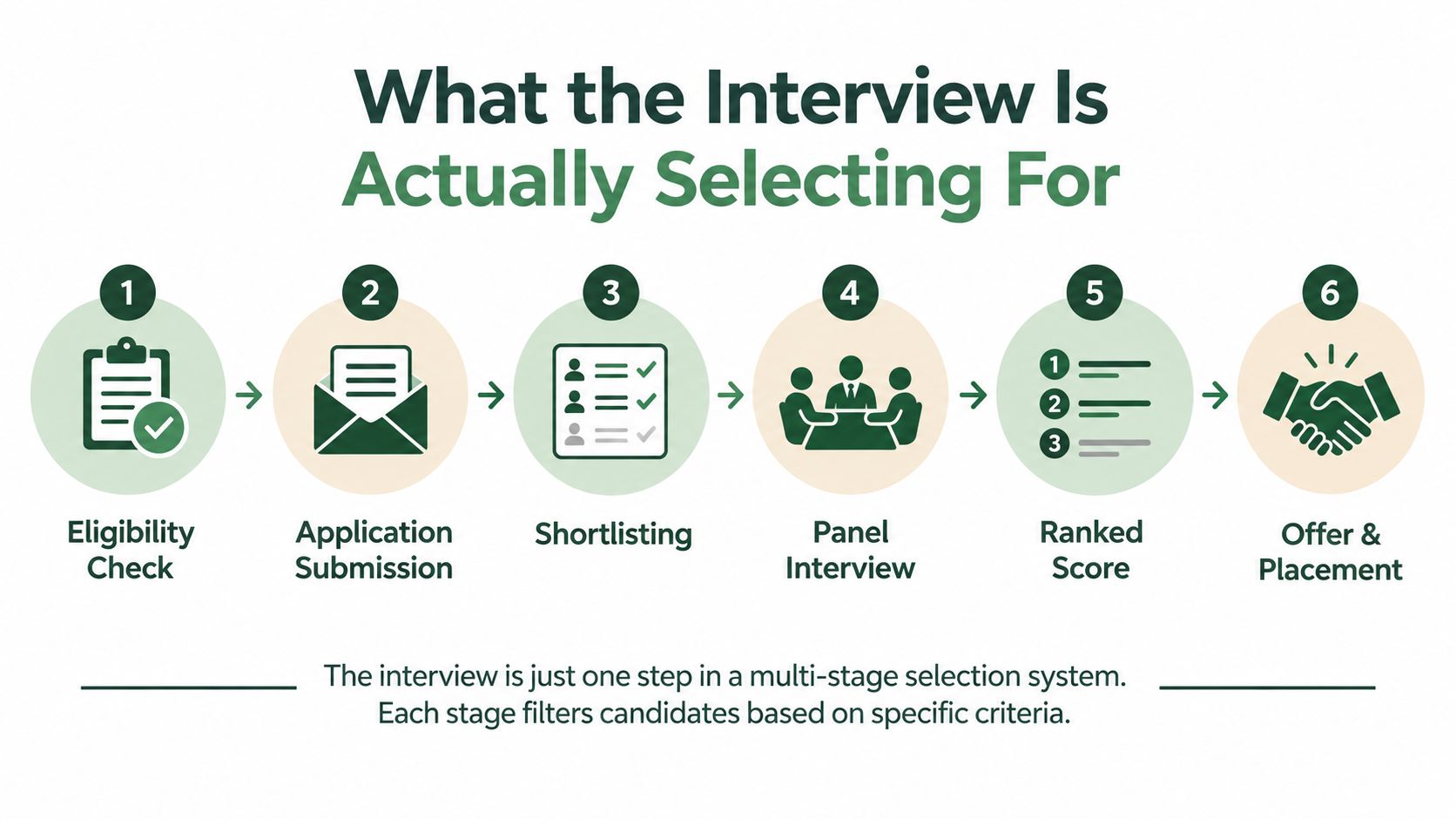
Where the interview sits in the real process
A practical reading of the process is simple. Eligibility gets you into the pool. Your application and referees shape whether you are shortlisted. The interview then helps rank shortlisted candidates against the behaviours and judgement the network wants in new Basic Trainees.
That matters because panels are not using the interview to decide whether you know medicine in the abstract. They are judging whether you can perform at the edge of your current role and step safely into physician training. In scoring terms, they are looking for evidence they can place somewhere: prioritisation, communication, professionalism, role insight, teamwork, and judgement under pressure. A candidate who says many correct things can still underperform if the answer is hard to score.
What panels reward in practice
Candidates who score in the middle often answer like they are trying to prove intelligence. They give broad lists, cover every differential, and drift away from the core task. Candidates who score well make the assessor’s job easy. They state the immediate issue, show a sequence, name the point of escalation, and keep the patient and team in view.
The pattern reported by candidates and by the published guidance is consistent. A mid-range answer usually sounds competent but slightly generic. A strong one is clearer about risk, clearer about role boundaries, and more explicit about why one action comes before another.
Panels tend to reward answers that show:
- Safe prioritisation. What needs attention first, what can wait, and what would trigger escalation.
- Registrar-level communication. Direct, calm, organised language without rambling or theatrics.
- Professional judgement. Insight into uncertainty, supervision, and the limits of your current experience.
- Role fit. A realistic understanding of Basic Training, including workload, team function, and learning expectations.
- Scoreable structure. Answers the panel can map to their marking domains without having to infer your reasoning.
One hard truth helps here. The interview does not reward the candidate who knows the most facts in the room. It rewards the candidate who makes the safest and most job-relevant judgement visible.
That is why preparation based only on clinical content misses marks. Networks vary in format, but the core question is similar across them: if this person starts as a physician trainee in our service, will they think clearly, communicate safely, and be workable in the team from day one?
Scoring Domains Panels Mark Against
Panels rarely reward “good vibes”. They reward answers that land cleanly inside specific domains. If you’ve ever walked out thinking you did well because you “connected” with the panel, but couldn’t say exactly how you performed in communication, professionalism, or reasoning, your prep is still too soft.
A useful way to think about the internal medicine training interview is that each answer is being split by the panel into separate buckets. One sentence can help you in more than one domain. One sloppy phrase can lose you marks in several at once.
The domains that usually matter most
The language varies by network, but the recurring domains are familiar:
- Clinical reasoning and prioritisation
- Communication and patient-centred care
- Professionalism and ethical judgement
- Teamwork, leadership, and role insight
- Commitment to physician training and specialty fit
The difference between a middling score and a strong one is usually not knowledge depth alone. It’s whether you make your reasoning visible.
| Domain | What It Assesses | What a 7 Looks Like | What a 9 Looks Like |
|---|---|---|---|
| Clinical reasoning and prioritisation | Whether you identify key problems, risks, next steps, and escalation points | Covers sensible differentials and management, but may sound broad or slightly unfocused | Prioritises immediately, states safety issues early, explains escalation thresholds and uncertainty clearly |
| Communication and patient-centred care | Clarity, empathy, structure, listening, plain-language explanations | Polite and understandable, but somewhat scripted or clinician-centred | Tailors language, acknowledges emotion, checks understanding, and closes the loop |
| Professionalism and ethical judgement | Honesty, boundaries, duty of candour, confidentiality, insight | Recognises the issue and gives a reasonable response | Handles the dilemma calmly, names obligations explicitly, and balances patient, team, and system factors |
| Teamwork, leadership, and role insight | How you function with seniors, juniors, nurses, and allied health | Says the right things about teamwork and escalation | Shows mature judgement about shared care, role limits, delegation, and situational leadership |
| Commitment to physician training and specialty fit | Why internal medicine, why this pathway, and whether your examples fit the role | Genuine interest, some relevant examples | Clear pattern of choices, thoughtful insight into the physician role, and evidence of reflection |
Why panels take these domains seriously
This isn’t just administrative theatre. A retrospective cohort study in one adult Basic Physician Training network in New South Wales looked at applicants selected for interview in the annual recruitment for the 2011 to 2015 clinical years — 436 applicants in total, between 84 and 91 in each year — and found that post-interview score predicted later success in the RACP clinical examination within the minimum time period (Does basic physician trainee selection predict successful progression in the RACP adult medicine training programme?, Internal Medicine Journal, 2024). Median post-interview scores were 7.75 among those who later passed versus 6.43 among those who did not (P < 0.0001), and applicants with mean scores below 8 were less likely to pass than those in the top band.
Two caveats before you read too much into that. It is a single network, and the recruitment rounds studied are now a decade old. What it supports is the general claim that a structured interview score carries real signal — not any specific threshold you should aim at.
Which is the argument for practising scoreable behaviours rather than “answers”.
If an assessor can’t easily write down what you just demonstrated, you probably didn’t score as highly as you think.
What separates a 7 from a 9
A 7 is usually competent. Safe enough. Pleasant. Reasonable. But a 7 often leaves the panel doing some interpretive work.
A 9 makes the panel’s job easy. The candidate labels the concern, prioritises action, uses patient-centred language, and summarises crisply. They sound like someone who can be trusted with supervision, not someone who’s trying to sound impressive.
If you need structured practice material for this style of preparation, it helps to use Australian station banks that are mapped to scoring criteria rather than generic conversational prompts, such as resources focused on medical interview preparation.
Common Interview Formats in Australia
Format changes how you should think. Candidates often prepare one style of answer and try to force it into every station. That’s where time gets burned and marks go missing.
In Australia, the internal medicine training interview commonly appears in three broad shapes: MMI circuits, semi-structured panel interviews, and hybrid formats that add a written scenario, prioritisation task, or short reading period before the live discussion.
MMI format
An MMI tends to reward quick orientation, disciplined structure, and a fast emotional reset between stations. These stations often test one main construct at a time: communication, ethical judgement, prioritisation, teamwork, or conflict handling.
You can’t spend the first half of the station “warming up”. If the prompt is about a colleague concern or a distressed family member, your first lines already need to show empathy, boundaries, and a plan.
Panel and hybrid formats
A longer panel interview places different pressure on you. The panel can probe one scenario in depth, interrupt your assumptions, and test how you recover when challenged. A hybrid format sits somewhere in between. It often rewards candidates who can rapidly scan a prompt, identify the core issue, and then talk through it in a layered, senior way.
| Format | Typical Length | What It Tests | Timing Cues |
|---|---|---|---|
| MMI | Short stations across a circuit | Fast judgement, communication, ethics, prioritisation | Bell, countdown prompt, station changeover, brief reading time |
| Semi-structured panel | One longer sitting | Depth of reasoning, follow-up handling, consistency across domains | Opening question, follow-up probing, time warning near close |
| Hybrid | Written or reading task plus discussion | Rapid comprehension, prioritisation, then verbal defence of reasoning | Short prep period, start signal, transition from reading to discussion |
What works in one format can fail in another
In an MMI, concise frameworks usually help. A STAR structure can work for behavioural prompts. A brief patient-safety opening followed by explanation and summary often works well for scenario stations. In a panel format, over-rehearsed mini-speeches sound brittle. You need a structure, but it has to remain conversational enough to tolerate interruption.
Candidates doing MMI preparation often benefit from practising with short, rotating scenarios rather than only long-form mocks. If that’s your likely format, targeted MMI practice questions are a better use of time than generic physician interview lists.
The panel doesn’t care whether your framework has a clever acronym. They care whether it helps you answer the question clearly, safely, and on time.
Before you rehearse, confirm the format from your own network material. Generic national prep wastes effort because answer shape is tightly linked to station design.
State and Hospital Network Differences
Candidates lose efficiency. They hear a friend in another state describe an MMI circuit, then spend two weeks drilling station transitions, only to discover their own network runs a longer panel with follow-up probing.
The RACP provides the broad structure for selection principles, but network-level delivery varies. That variation isn’t noise. It changes your preparation priorities.
How the differences usually show up
How much variation? Enough that it has been measured. A survey of Directors of Physician Education across adult and paediatric Basic Physician Training sites in Australia and New Zealand, run in early 2022, found no standardised method for selection into Basic Physician Training, with selection practices heterogeneous between sites and a heavy reliance on interviews and subjective assessment that the authors flagged as a bias risk (‘Selection into training will always be an inexact process’, Internal Medicine Journal).
That is the finding to plan around, and it is deliberately not a table of what each state does. Published, current, per-network format information is not something you can get from an article — formats shift between rounds, and hospitals within the same state do not always run the same process. Anyone who gives you a confident state-by-state breakdown is describing either one network or one year, and you have no way of telling which.
So treat the variation as the rule, and get your format from the only source that is authoritative for you: the candidate information your own network sends with the interview invitation.
What to do with that variation
Your prep should be built around your allocated network, not a mythical Australian average.
Focus on these questions:
- What format is this network using?
- Are they likely to probe one scenario or rotate through several?
- Do their candidate materials emphasise communication, ethics, teamwork, or clinical prioritisation?
- Does the pathway differ from nearby services with rural or generalist expectations?
If you’re trying to orient yourself to the broader Australian training pathway while checking local variation, it helps to review material that maps interview preparation against the wider Australian medical exam context, not just isolated interview tips. Whether the college or your state network is the body actually running your selection — which decides whose document you should be reading — is set out in our guide to specialty selection interviews in Australia.
The best prep is local. A decent answer in the wrong format often scores worse than a simpler answer delivered in the format the panel expects.
Check the current candidate information pack, email wording, and booking instructions from your own network. That matters more than advice from someone who interviewed somewhere else last year.
An Annotated Model Answer You Can Steal
A high-yield station in the internal medicine training interview is the delayed result disclosure scenario. It tests communication, professionalism, ethics, patient-centred care, and whether you understand your role boundaries.
The prompt might sound like this: You are a junior registrar. A family member is upset because an important investigation result was delayed and this has affected management. Speak with the patient’s family.

A strong answer
“I can see you’re worried and frustrated, and that’s understandable. [Domain: Communication] Before we go further, I want to make sure I’m speaking with the appropriate family member and that the patient is happy for me to discuss their care with you. [Domain: Professionalism]
What I understand is that there has been a delay in an investigation result being acted on, and you’re concerned about what that has meant for the patient. [Domain: Communication] I’m sorry this has added distress. [Domain: Professionalism]
I want to be honest about what I know at this stage. [Domain: Professionalism] I may not yet have every detail of how the delay occurred, but I can explain the current situation, what we’re doing now, and what the next steps will be. [Domain: Communication]
My immediate priority is the patient’s safety and current care. [Domain: Clinical Reasoning] I’d confirm the patient’s current clinical status, make sure the treating team is aware, and escalate promptly to the supervising physician if there has been any impact on treatment or if urgent review is needed. [Domain: Teamwork]
In terms of the delay itself, I wouldn’t speculate or assign blame before the facts are clear. [Domain: Professionalism] I’d let you know that we will review what happened carefully, involve the senior team, and follow the appropriate incident and governance processes if required. [Domain: Ethical Judgement]
I also want to give you a chance to tell me your concerns and ask questions. [Domain: Communication] What have you been told so far, and what is your biggest concern right now? [Domain: Patient-centred Care]
To summarise, I’m sorry for the distress this has caused, I’ll prioritise the patient’s immediate care, clarify the facts with the senior team, and make sure you receive an update as soon as we have accurate information. [Domain: Communication]”
Why that answer scores well
It does a few things that panels like:
- Starts with emotion and permission, not defence.
- Names uncertainty without sounding evasive.
- Prioritises patient safety before process review.
- Avoids blame and speculation.
- Shows escalation and governance awareness.
- Ends with a concise summary the assessor can score.
What the average answer sounds like
A 5-to-7 type answer often opens with too much explanation.
“Sorry about the delay. Sometimes these things happen in busy hospitals. I’d check the result, speak to the consultant, and reassure the family that we’re doing our best.”
That answer isn’t disastrous. But it leaks marks. “These things happen” sounds minimising. It doesn’t check confidentiality. It doesn’t make duty of candour visible. It doesn’t invite the family’s concerns. It mentions the consultant, but not as part of a clear safety-first escalation plan.
“Don’t rush to reassurance before you’ve shown that you understand the problem.”
The phrases that lift the answer
If you want to raise your score, borrow the moves, not just the wording:
-
“I want to be honest about what I know at this stage.”
This shows candour and boundary awareness. -
“My immediate priority is the patient’s safety and current care.”
This makes prioritisation explicit. -
“I wouldn’t speculate or assign blame before the facts are clear.”
This shows professionalism under pressure. -
“What is your biggest concern right now?”
This turns the station into a two-way interaction.
Frameworks like SPIKES can help with difficult conversations, but only if you use them lightly. Panels don’t award marks for naming a framework. They award marks for behaviours the framework is supposed to produce.
Your Four-to-Six-Week Practice Plan
Most candidates either start too late or practise too vaguely. They read questions, think “I’d say something like that”, and count it as preparation. It isn’t. Interview skill improves when you repeat the same domains in different stations until your structure becomes automatic.
A good plan doesn’t need marathon sessions. It needs consistency, feedback, and rehearsal in the format your network uses.
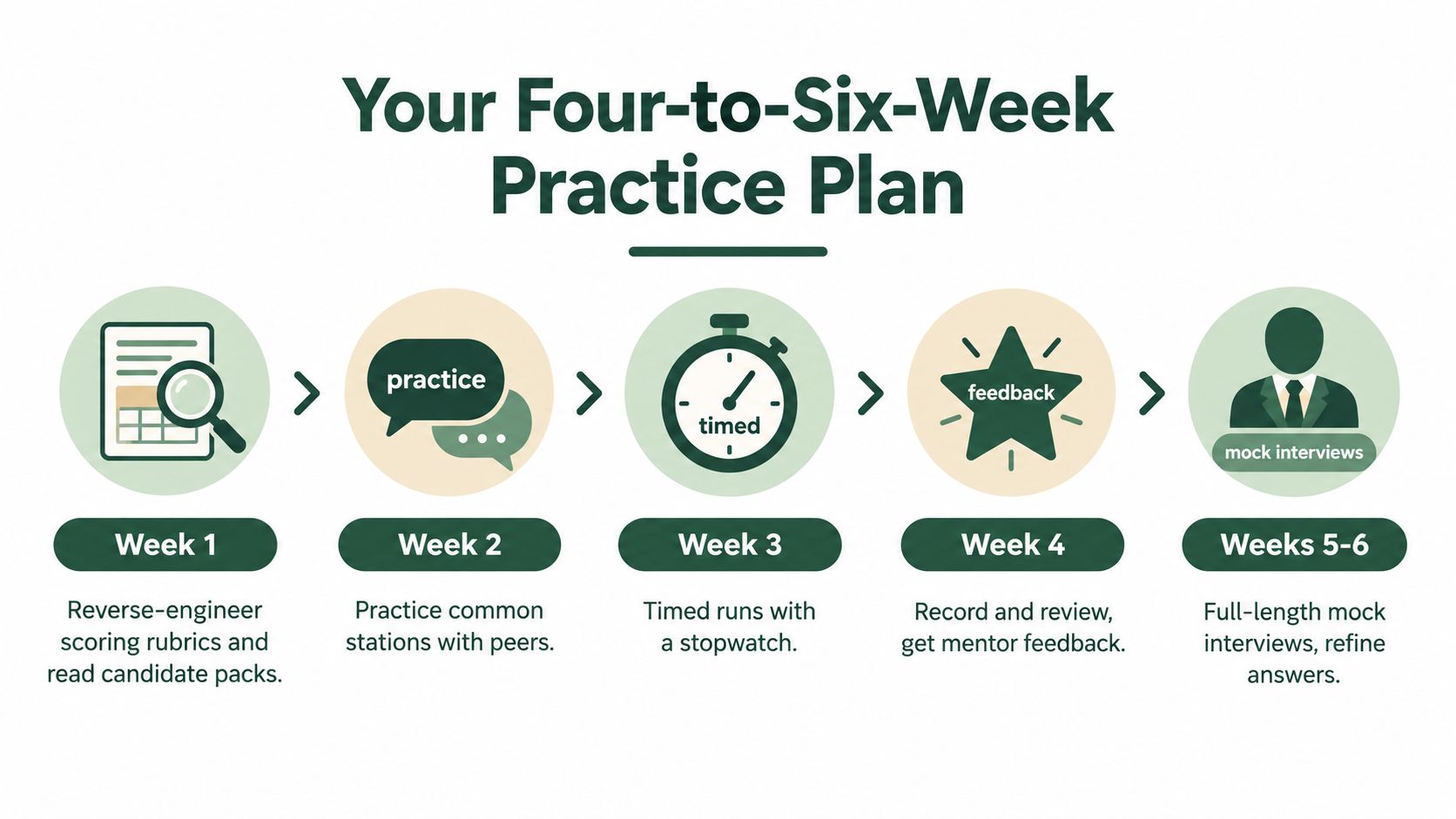
Weeks one to three
Keep your daily practice to 30 to 60 minutes. That’s long enough to stay deliberate and short enough to stay repeatable.
-
Week 1
Reverse-engineer the scoring domains from your network material. Build a one-page answer sheet for each major domain: communication, ethics, teamwork, prioritisation, specialty commitment. Write opening lines, escalation phrases, and closing summaries you can say aloud. -
Week 2
Start solo drills plus one peer session. Solo work is for speed and structure. Peer work is for realism. Speak every answer out loud. If you only think through answers in your head, you’ll discover timing problems on interview day instead of now. -
Week 3
Add timed runs. Use a stopwatch. Practise short behavioural stations, one difficult conversation station, and one prioritisation scenario each session. Rotate the order so you don’t become dependent on a warm-up pattern.
A simple checkpoint at the end of week three: you should be able to give a structured first minute on any common station without freezing or rambling.
Weeks four to six
Many candidates improve quickly, because feedback starts correcting blind spots.
A recorded mock with a real clinician is especially valuable in week four. A consultant, advanced trainee, or registrar who understands local selection can usually identify the exact issue: too much scene-setting, weak escalation language, defensive tone, poor summary, or overclaiming independence.
This is a useful point to watch a worked example or discussion before another practice block:
Then use the final stretch like this:
- Week 4
One formal mock. Record it. Review only three things: clarity, safety signalling, and answer structure. - Week 5
Rehearse in your likely network format. If it’s MMI, do circuits. If it’s panel, do sustained follow-up questioning. - Week 6
Dress rehearsal. Same start time as the interview if possible. Same clothes. Same timing. No pausing between stations.
Deliverables to finish before interview day
You should have these completed:
- A domain sheet with your scoring categories and what strong answers sound like.
- A bank of personal examples for conflict, error, teamwork, leadership, and resilience.
- A shortlist of safe opening lines for communication and ethical stations.
- At least one recorded mock reviewed critically.
- A network-specific format plan so your rehearsal matches the interview you’ll face.
If you want question banks that are organised by station type and scoring domain, use one source and stick with it. Jumping between random internet lists creates noise — you end up with volume instead of a structure you can rely on under pressure.
Day-Of Habits and Common Failure Modes
By the day of the interview, your score is shaped less by new knowledge and more by whether you can access what you’ve already built. Candidates who underperform often don’t fail because they’re weak. They fail because stress strips their structure.
That’s why your day-of habits matter.
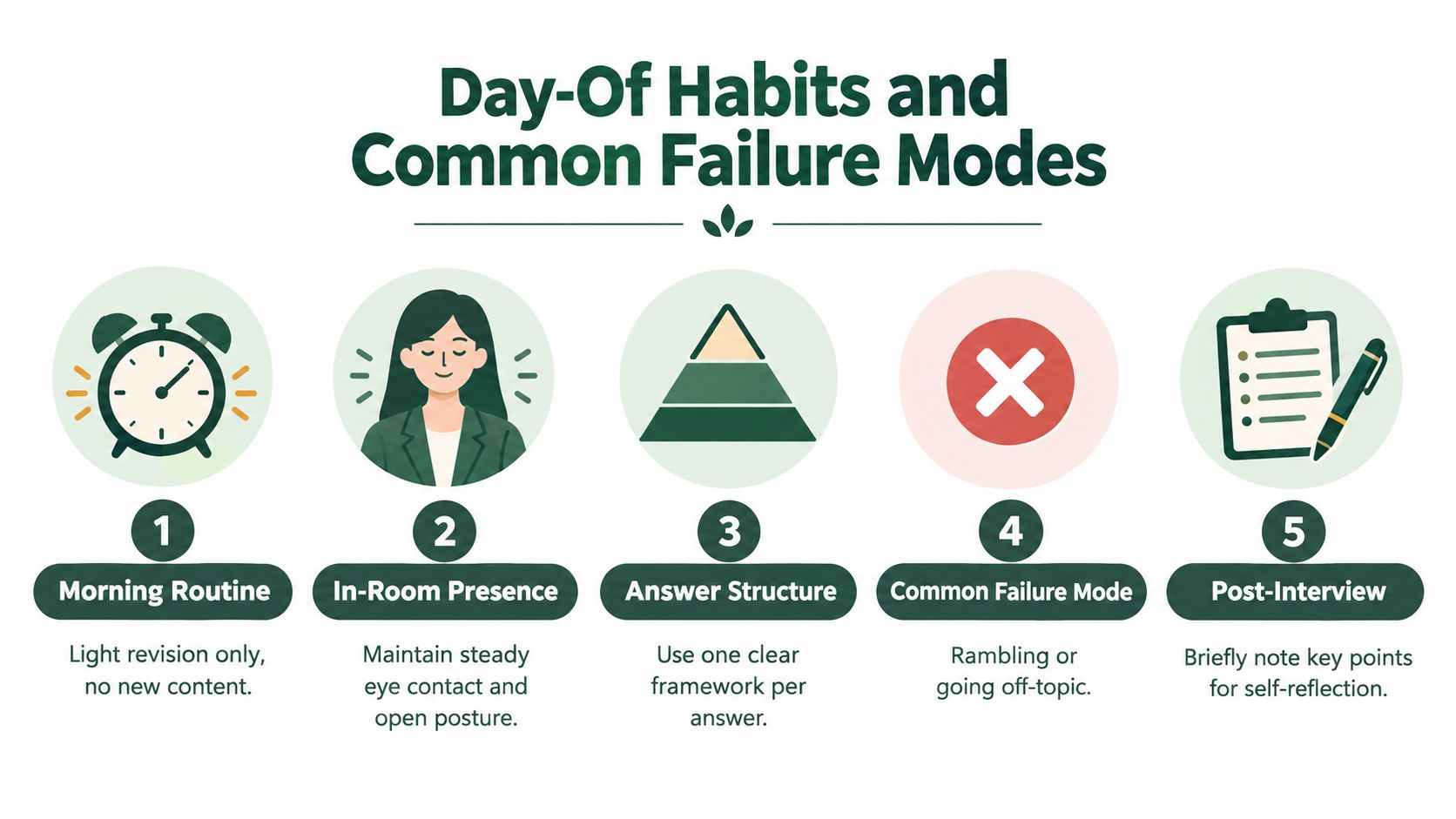
What to do before you walk in
Keep the morning narrow.
-
Light revision only
Read your own summary pages. Don’t open a new topic bank and panic yourself with stations you haven’t seen. -
Eat and hydrate normally
Nothing heroic. Nothing heavy. You want stable attention, not a glucose crash or a coffee tremor. -
Arrive early enough to settle
Too early can be a problem if you spend that extra time catastrophising in the corridor. Aim for calm, not martyrdom.
What costs marks in the room
These are the failure modes that come up most often:
-
Answering before the prompt is finished
It signals nerves and often means you miss the actual task. -
Overclaiming autonomy
Candidates say they would independently make decisions that should clearly involve senior input. Panels notice this immediately. -
Forgetting to say the safety bit out loud
You may be thinking it, but assessors can only mark what they hear. -
Rambling past the useful answer
The first minute was strong, then the candidate kept talking until the answer became diluted.
| Habit or Failure Mode | What the Panel Hears |
|---|---|
| Calm opening | Organised thinking and emotional control |
| Explicit escalation | Safe judgement |
| Clear summary | Easy-to-score answer |
| Defensive response to challenge | Fragility under pressure |
| Generic closing line | Candidate has mentally left the station |
How strong candidates reset
Good candidates don’t carry a bad station into the next one. They reset fast.
After each station, use a simple internal script: done, drop it, next task. Don’t try to post-mortem in real time. Between stations, one breath, shoulders down, eyes up. Then read the next prompt as if the interview has just started.
Small habit, big payoff: finish each answer with a short summary. It helps the panel score you, and it helps you stop on time.
That evening, do a brief debrief. Write down what came up, where you felt thin, and which phrases worked naturally. Keep it short. Reflection is useful. Replaying every facial expression from the panel isn’t.
CliniRoo is building medical interview preparation for the Australian pathway around the things panels actually score: station format, named domains, and model answers that show what a stronger response sounds like. Nothing is on sale yet. If you want to be told when there is something to use, CliniRoo takes an email address and does nothing else with it.