Medical Interview Preparation for Australian Panels
Prepare for Australian medical interviews by reading the assessment first, then building structured answers that hold up when the station changes.
You’ve read the candidate information, collected a list of common questions and practised describing why you want medicine. Then the format changes. One station asks you to respond to an upset actor, the next gives you a policy prompt, and a later panel asks for a specific example of conflict in a team. Under pressure, generic preparation quickly falls apart.
Effective medical interview preparation starts earlier than rehearsing answers. You need to identify the pathway, understand how performance is scored, locate the relevant Australian context and build responses that remain clear when the station changes. A strong answer isn’t just warm or articulate. It makes your reasoning, contribution, reflection and judgement easy for assessors to recognise.
Table of Contents
- Start With the Australian Interview Format
- Recognise Common Medical Interview Stations
- Build Concise and Structured Answers
- Avoid Weak and Generic Responses
- Learn From Australian Panel Scenarios
- Create a High-Value Practice Schedule
- Check Your Readiness Before Interview Day
Start With the Australian Interview Format
Treat the interview as a pathway-specific diagnosis, not a general test of confidence. Australian undergraduate entry commonly screens on academic rank and an aptitude test before anyone reaches an interview, which is exactly why the interview is built to separate candidates who are already closely ranked against each other. The aptitude test for undergraduate entry is now the University Clinical Aptitude Test for Australia and New Zealand (UCAT ANZ — the admissions test used by the consortium of Australian and New Zealand universities), which replaced the Undergraduate Medicine and Health Sciences Admission Test (UMAT) in 2019. Any preparation guide still quoting UMAT scores is describing a test that no longer exists.
Entry thresholds are set by each university rather than nationally, and they move. One published study of University of New South Wales entry, covering applicants from 2013 to 2018, records that school’s criteria and interview volume for those years. Read it as an illustration of how narrow the funnel is, not as a target: it predates the current aptitude test and it describes one university. Your own number is on your university’s current admissions page for your intake year, and nowhere else.
The same logic applies beyond medical school, but the structure underneath it changes. An intern allocation interview may reflect state health service attributes. Specialty selection is run by different bodies depending on the specialty: the Royal Australasian College of Surgeons (RACS — the college overseeing all nine surgical specialties) devolves selection to its specialty societies, the Royal Australasian College of Physicians (RACP — the physicians’ college) accredits hospitals to train while the hospitals themselves do the hiring, and the Royal Australian and New Zealand College of Psychiatrists (RANZCP — the psychiatry college) selects through state Branch Training Committees rather than centrally.
General practice is the clearest illustration of why that check matters before you rehearse anything. For the 2027 Australian General Practice Training (AGPT — the national training programme for general practice) intake, the Royal Australian College of General Practitioners (RACGP — the general practice college, which administers that programme) national entry assessment is a situational judgement test sat online, not a panel interview. A candidate who spent four weeks drilling panel answers for it would have prepared, carefully, for the wrong assessment. Don’t borrow a preparation plan from another pathway until you’ve confirmed which body assesses you and what that body actually runs.
Audit the assessment before writing answers
Start with the official candidate information booklet, selection policy or invitation email. Record:
- Station format: Identify whether you’ll face a multiple mini interview (MMI — a circuit of short, separately marked stations rather than one long conversation), a semi-structured panel, a single interview or a combination.
- Station timing: Note preparation time, response time, reading time and whether the assessor can ask follow-up questions.
- Panel composition: Check whether the panel includes clinicians, community members, senior trainees, consumers or trained actors.
- Scoring domains: Look for published attributes, such as communication, motivation, empathy, self-awareness, diversity and coping with uncertainty.
- Station instructions: Mark role-play requirements, information sheets, calculation resources and whether you’re expected to ask questions.
- Weighting: Record any available marking guidance. A station with several scored criteria needs a different rehearsal strategy from a conversational panel.
Published domains do exist, and one is worth reading purely to see the form they take. A study of University of New South Wales admissions covering the 2004 to 2007 entry cohorts records an interview scored across six predefined domains — communication skills, motivation, empathy towards others, self-awareness, responding to diversity and ability to cope with uncertainty — in the published Australian study of interview domains and selection criteria. That is one school’s rubric from two decades ago. It is not a national standard, and it is not a template to rehearse against. The domains that matter are the ones your own university, college, network or state process publishes for your intake year, and those are the headings your practice bank should carry.
This is also where most preparation goes wrong before it starts. The single biggest error is assuming the college runs the process. For several specialties it does not, and the difference decides which document you should be reading and who you are actually trying to convince. Which body decides, whether there is an interview at all, and whether your state changes the answer are set out against each college’s own current source on our guide to specialty selection interviews in Australia. Settle that before you decide what your interview even is.
Then use the audit to decide what an answer must contain. If the station assesses self-awareness, a polished story without reflection is incomplete. If it assesses coping with uncertainty, an overconfident diagnosis may score less well than a safe plan that explains what you’d clarify, escalate and review. For additional Australian assessment context, compare your interview preparation with the pathway-specific Australian medical exam guidance, then return to your official documents before finalising your drills.
Recognise Common Medical Interview Stations
Station families overlap, but they don’t reward identical behaviour. A motivation station asks whether your interest is informed and durable. A teamwork station asks what you did. An ethics station tests how you weigh competing duties, while a clinical vignette examines safe reasoning rather than a display of memorised facts.
Match the response to the station’s purpose
Motivation and commitment prompts might ask why you want general practice, psychiatry, surgery or rural medicine. Assessors listen for informed commitment, realistic understanding of the work and evidence that your interest has developed through experience. “I want to help people” is too broad because it could fit every applicant. A better answer connects a specific experience to the work, acknowledges a challenge and explains how you’ve tested your assumptions.
Teamwork and leadership stations often use a conflict, workload or handover scenario. The panel wants your contribution, not a description of how excellent the whole team was. Explain what you noticed, what you said, how you involved the right person and what changed. Leadership can mean clarifying risk or inviting a quieter colleague into the discussion, not taking control of every task.
Ethical scenarios may involve consent, error disclosure, confidentiality, competing resource needs or a disagreement with a senior colleague. Name the stakeholders, identify the duties in tension and choose a defensible next step. Don’t hide behind a list of principles. Assessors need to hear how you’d protect the patient, seek senior support, communicate openly and review the outcome.
Clinical reasoning stations can be written, panel-led or actor-driven. Begin with safety, clarify the information, form a working assessment and explain escalation. Avoid racing into a definitive diagnosis when the prompt gives limited information. Your reasoning should remain patient-centred and demonstrate awareness of scope.
Policy and systems prompts may reference Medicare, bulk-billing reforms, Closing the Gap, telehealth, voluntary assisted dying laws or the National Medical Workforce Strategy. You don’t need to recite policy language. You do need to explain how a system decision affects access, equity, safety and the responsibilities of clinicians in the relevant jurisdiction.
Use a station bank to test whether your examples cover these different demands rather than collecting endless questions. The MMI practice questions can help you identify gaps, but your final prompts should still reflect the university, college, hospital network or state process you’re entering.
A useful test is to ask what an assessor could write beside your answer. If the note would say “pleasant but generic”, the station needs a more specific example. If it would say “safe, structured and reflective”, you’re probably addressing the scoring purpose.
Build Concise and Structured Answers
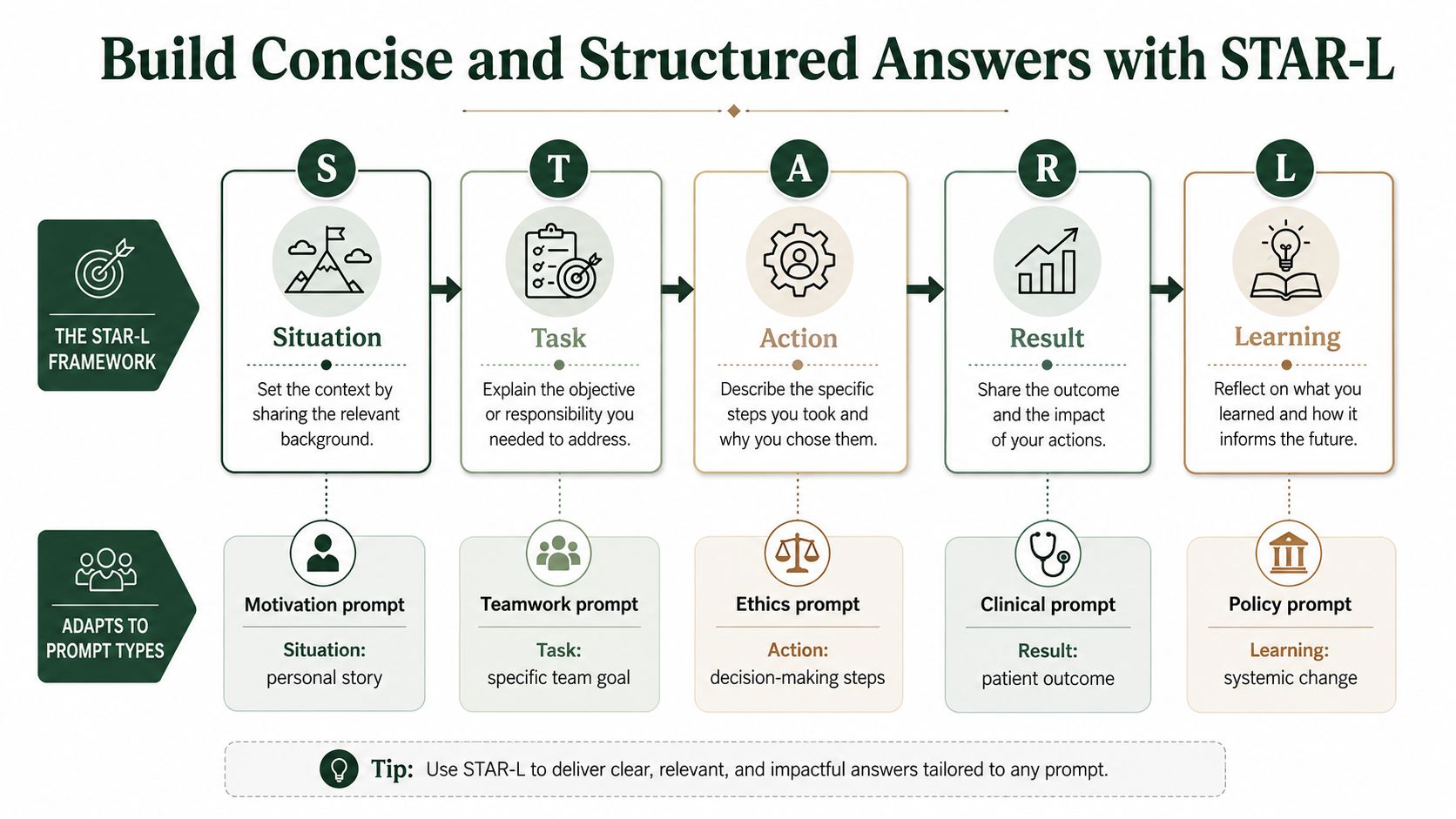
The STAR-L framework gives you a repeatable skeleton: Situation, Task, Action, Result and Learning. It works because it separates context from contribution and outcome. Panels don’t have to infer what you did from a long story, and you can adapt the same architecture without sounding as though you’ve memorised a script.
Use the two-minute delivery formula
For a typical response, practise this sequence:
- Position in 15 seconds. Answer the question directly and state your main judgement.
- Example in 60 seconds. Describe the relevant situation and task, then spend most of the time on your action. Use “I” when you’re describing your own responsibility.
- Reflection in 30 seconds. Explain what you learned and connect it to the published domain, such as empathy, self-awareness, teamwork or uncertainty.
- Close in 15 seconds. State how you’d apply that learning in the role or specialty.
A motivation answer might use a personal clinical, community or rural experience as the situation, define what you learned about the specialty and finish by explaining the work you’re prepared to undertake. A teamwork answer needs a concrete team goal, your communication choice and the effect on workflow, safety or relationships. An ethics answer can use STAR-L differently. The “action” becomes your judgement loop, including who you’d involve, what you’d communicate and how you’d review the decision.
Consider the difference between these two outlines for a rural commitment prompt.
Weak outline: “I’m passionate about rural medicine because rural communities need doctors. I enjoy variety and want to make a difference.”
Stronger outline: “During a rural placement, I saw how continuity, travel distance and limited local services shaped a patient’s options. My task was to understand the patient’s priorities rather than assume that referral was straightforward. I discussed the plan with the supervising clinician, checked what support was available locally and explained alternatives in plain language. I learned that rural practice requires clinical breadth alongside careful coordination and respect for community context. That’s the kind of responsibility I’m seeking, and I’d continue developing the skills needed to practise safely within the local team.”
The second answer doesn’t claim that one placement proves long-term suitability. It shows observation, action, reflection and a reasoned specialty link.
Keep compression from becoming omission
Candidates often shorten an answer by removing the parts that earn marks. They skip the task, describe the team instead of their role, or end immediately after the result. Others mention a lesson without explaining how the experience changed their behaviour.
Practical rule: A concise answer isn’t a small answer. It’s an answer where every sentence helps the panel score a relevant domain.
Record yourself answering the same prompt in a longer practice version and then in the timed version. Keep the example, personal action, reflection and forward link. Remove scene-setting, repeated adjectives and background that doesn’t affect your decision. Structured rehearsal matters because an MMI marks each station independently and combines those scores for ranking, so a single brilliant response won’t compensate for an inconsistent circuit.
Station counts and timings vary by institution and by intake year. Published preparation guides describe what circuits often look like, not what yours will be — the authoritative number is in the candidate information you were sent, and if your college or university publishes no station count, no guide can supply one for it.
Avoid Weak and Generic Responses
The most common problem isn’t lack of knowledge. It’s that the answer gives the panel no usable evidence. “I’m a good communicator” is a conclusion. It doesn’t show how you communicate when a patient is distressed, a colleague disagrees or information is incomplete.
Replace familiar scripts with observable behaviour
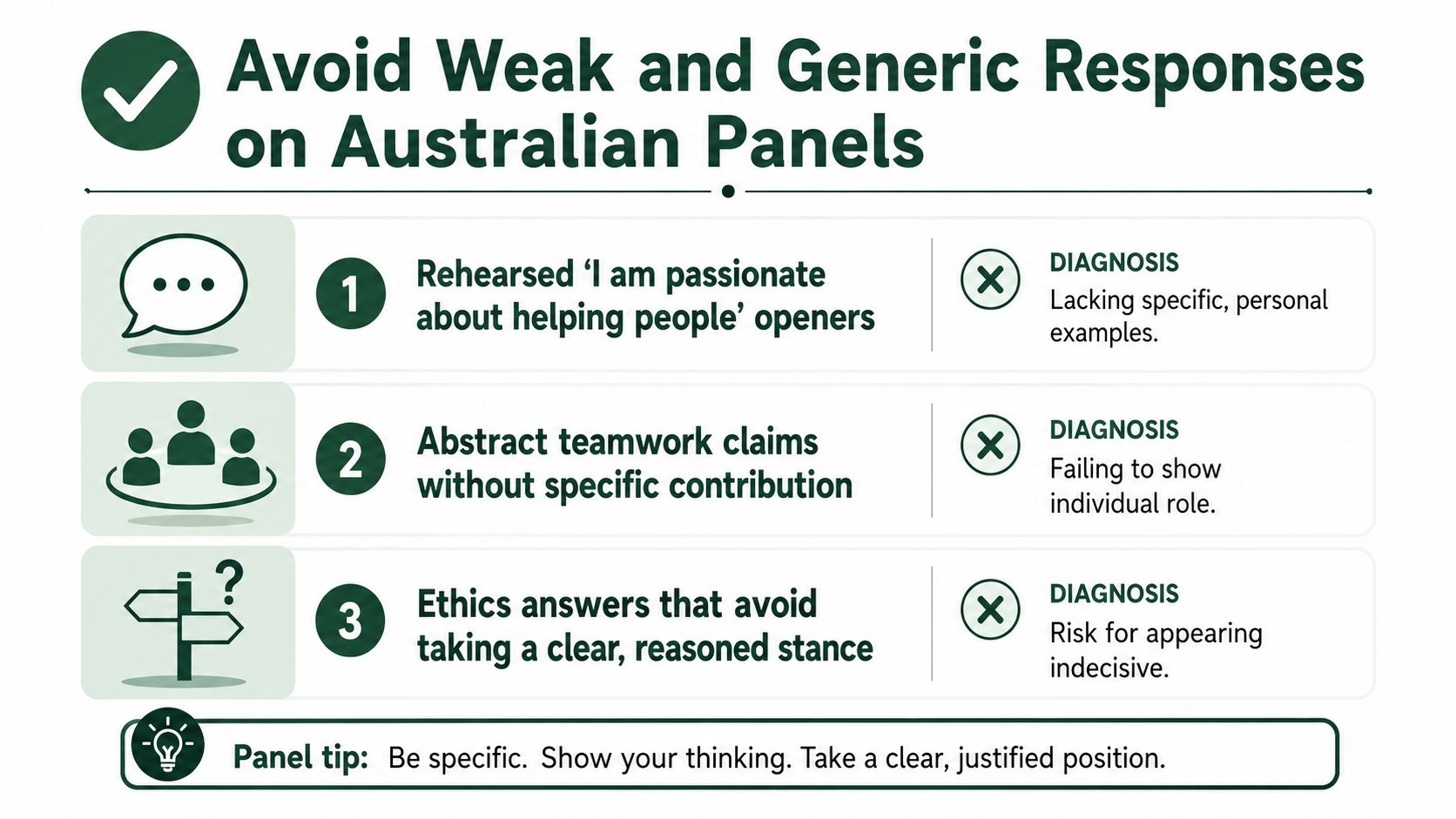
A rehearsed passion opener usually fails because it lacks personal evidence. Start with the experience that changed or tested your interest, then explain what you did and what you understand more clearly now. A broad claim about teamwork has the same weakness. Identify the team goal, the barrier, your specific contribution and the outcome.
Ethics answers create another trap. Candidates name autonomy, beneficence and justice, then avoid choosing a course of action. A stronger response accepts that duties may conflict. Identify the patient, family, team and system interests, explain the immediate safety priority, choose the least harmful defensible action and state how you’d seek review.
Clinical answers can also sound impressive while remaining unsafe. A textbook list of differential diagnoses doesn’t show whether you’d recognise deterioration, clarify consent, work within scope or escalate. Start with the patient’s immediate risk and explain what information would change your next step.
Use a four-step judgement loop
For difficult ethical or systems stations, write four prompts on your practice page:
- Identify stakeholders: Who may be affected, and whose voice is missing?
- Name conflicting duties: Which obligations pull in different directions?
- Choose a defensible action: What protects safety, fairness, dignity and lawful practice most effectively now?
- Explain review: Who would you involve, what would you document and how would you reassess?
This loop prevents two opposite errors. You won’t sound rigidly certain when the situation is genuinely complex, but you also won’t appear indecisive because you’ve explained your threshold for action.
A study of Australian general practice registrar selection, following 443 registrars chosen through the 2010–2011 process, found that a situational judgement test (SJT — an assessment of how you respond to workplace and professional dilemmas, rather than what you can recall) and a multiple mini interview each predicted end-of-training assessment scores, and that each added something the other did not, in this predictive validity study. That is a finding about one postgraduate selection system rather than a general law, but it does support preparing for structured assessment rather than for a single unstructured conversation. It doesn’t mean you should manufacture a polished persona. It means you should make your reasoning visible and repeatable.
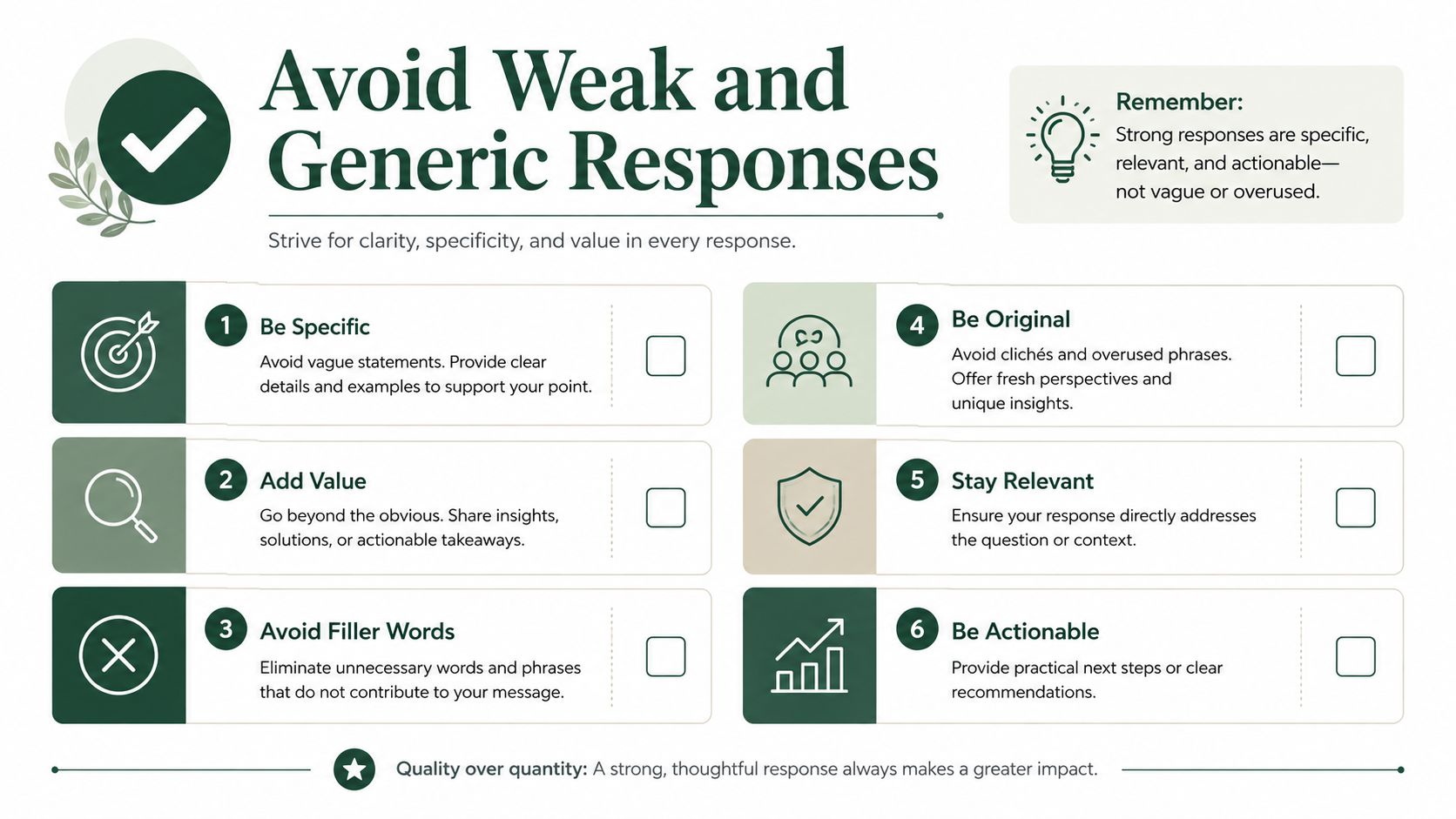
Before speaking, check whether the answer contains a specific situation, your own action, a balanced judgement, a clear outcome and a learning point. Then ask whether the specialty or pathway link is earned by the example, rather than added as a final sentence.
Learn From Australian Panel Scenarios
A candidate can sound articulate and still underperform if the answer misses the domain being scored. The following composite scenarios show how the same event can be framed weakly or usefully. They’re practice examples, not claims about any individual applicant or college panel.
A junior doctor asked in any general practice selection setting why they want the specialty might say, “I want general practice because I like building relationships and seeing a broad range of patients.” That answer expresses interest but doesn’t demonstrate understanding of continuity, prevention, uncertainty or community care. A stronger version could describe a consultation where the doctor clarified the patient’s priorities, coordinated follow-up with the wider team and reflected on how longitudinal care changes clinical decisions. The panel hears a specific contribution and a more informed view of general practice.
An unaccredited surgical registrar facing selection into Surgical Education and Training (SET — the RACS training programme you apply into) might describe staying late to help finish a list and conclude, “That shows I’m committed and work hard.” The stronger reframing identifies the competing pressures, explains how the registrar communicated with nursing and anaesthetic colleagues, protected patient flow and recognised when escalation was needed. The improvement comes from showing non-technical behaviour rather than treating endurance as evidence of suitability.
An advanced trainee sitting a fellowship station with the Australasian College for Emergency Medicine (ACEM — the college for emergency medicine training and examinations) may respond to a deteriorating patient with a rapid catalogue of investigations. A stronger answer starts with immediate assessment and resuscitation, calls for senior and multidisciplinary support, communicates with the patient or family where possible and reassesses after each intervention. The panel hears prioritisation, teamwork and safe clinical reasoning.
A psychiatry candidate answering a RANZCP motivation prompt might say, “I’m interested in mental health because I’m empathetic.” A stronger answer describes a difficult conversation, shows how the candidate managed assumptions, considered cultural safety and reflected on the limits of their own perspective. For Aboriginal and Torres Strait Islander patients, cultural safety shouldn’t appear as a decorative phrase. Explain how you’d listen, avoid assumptions, involve appropriate supports and work respectfully within the patient’s preferences and local service context.
| Scenario | Average answer cue | Strong answer cue | Scoring lift |
|---|---|---|---|
| General practice motivation | “I like relationships and variety.” | Specific continuity-of-care example, reflection and community link | Makes motivation and self-awareness observable |
| RACS selection | “I work hard and stay late.” | Patient safety, team communication, escalation and reflection | Shows non-technical judgement rather than stamina alone |
| ACEM clinical station | Long investigation list | Immediate risk, resuscitation, team roles and reassessment | Demonstrates prioritisation under uncertainty |
| RANZCP motivation | “I’m empathetic.” | Specific conversation, cultural humility and learning | Connects motivation with empathy and self-awareness |
Use the same diagnostic lens for clinical scenario questions. After each mock, record what the assessor heard, which domain remained thin and whether your structure helped the answer stay focused.
Create a High-Value Practice Schedule
A useful schedule builds accuracy before speed. Start by understanding the process, then add examples, timed delivery, external feedback and realistic variation. Repeating familiar questions without changing the station conditions creates fluency, but it won’t necessarily create adaptability.
A four-week progression
Week one, format and evidence. On Monday, read the official information and create a station map. On Tuesday, turn every published scoring domain into a heading. On Wednesday, list experiences that could support motivation, teamwork, conflict, ethics, uncertainty and cultural safety. On Thursday, ask a peer to test whether each story contains your action and learning. On Friday, identify local policy areas relevant to the pathway. Keep the weekend light, reviewing the map rather than drafting dozens of scripts.
Week two, answer construction. Analyse model answers on Monday and mark where they position, evidence, reflect and close. On Tuesday and Wednesday, deliver two timed STAR-L responses. Use five minutes to prepare a motivation answer, eight minutes for a clinical scenario and ten minutes for a policy or ethics prompt when those timings resemble your pathway. On Thursday, run a peer mock. On Friday, rewrite only the weak sections identified in feedback.
Week three, station switching. Build a mixed circuit so you can’t predict the next domain. Rotate motivation, teamwork, ethics, clinical reasoning and policy prompts. Rehearse your weaker domains twice as often as your confident areas, but don’t abandon the latter. A candidate who gives excellent ethics responses but becomes vague in teamwork still produces an uneven overall performance.
Week four, simulation and taper. Run realistic mocks early in the week, including reading time, transitions and interruptions if the format allows them. Reduce intensity later. Prioritise sleep, prepare clothing and technology, and use a one-page cue sheet for mental retrieval rather than trying to learn new scripts.
Log the evidence, not just the feeling
After every drill, record the prompt, intended structure, observed gap, feedback and next action. Ask the observer to score behaviours such as directness, ownership of action, safety, reflection and local relevance. “Sounded confident” is less useful than “named the escalation pathway but didn’t explain what you’d tell the patient.”
“Practise the weakness you can name, not the anxiety you can’t measure.”
A structured selection system rewards repeatable performance across stations. It is also worth knowing how little the interview predicts on its own. The University of New South Wales study cited earlier found that admission interview scores explained 3.9% of the variance in second-year clinical communication skills, 2.3% in the fourth-year integrated clinical assessment and 1.6% in the sixth-year integrated clinical examination, and concluded that interview scores explained very little variance in any outcome it measured. Prepare properly, because the interview is still a scored component you are ranked on. Just treat it as one part of a broader application rather than the thing your whole career turns on, and don’t chase theatrical perfection.
Check Your Readiness Before Interview Day
Run the final check 48 hours before the interview. You’re ready when you can explain the assessment as clearly as you can explain your own examples.
- Format knowledge: Confirm the MMI circuit or panel structure, station timing and whether follow-up questions are used.
- Panel expectations: Know who is likely to assess you and what perspective each panel member may bring.
- Domain recall: Recite the published attributes without turning them into empty buzzwords.
- Station coverage: Hold a specific example for motivation, teamwork, conflict, ethics, uncertainty, cultural safety and the pathway’s clinical or policy themes.
- Timed delivery: Complete a mixed mock without relying on a written script.
- Feedback action: Check that you’ve corrected the gaps identified by your last observer.
- Local context: Review relevant jurisdictional issues, referral pathways, Medicare settings and specialty expectations from reliable official material.
- Logistics: Confirm the location, arrival plan, identification requirements, attire and any virtual interview technology. Test your camera, microphone and connection if the interview is online.
Don’t spend the final day adding obscure facts. Review your one-page cue sheet, practise opening each answer directly and remind yourself to pause before responding. The preparation layers work together: format analysis tells you what to rehearse, scoring domains tell you what evidence to include, STAR-L keeps the response concise, and mock stations reveal whether you can repeat that performance under pressure.
Use pathway-aligned mock circuits and specialty college resources for the last gaps. Your aim isn’t to predict every question. It’s to enter each station able to listen carefully, identify the domain, make a safe judgement and communicate your contribution with enough structure for the panel to score.
CliniRoo is building preparation material for the Australian pathway: specialty selection interviews, medical school assessments and college examinations, organised around the station formats and published scoring domains each process actually uses. Nothing is on sale yet. If you want to be told when there is something to use, CliniRoo takes an email address and does nothing else with it.