What Is Dr in Australia: A Medical Professional's Guide
What Is Dr. Learn what Dr means in Australian medical contexts, from styling rules to common confusions. Essential reading for medical students and trainees
In Australia, Dr is primarily a professional honorific for medical practitioners, not only for people with doctoral degrees. It is formally recognised across medical workplaces, with styling guided by Australia’s Style Manual and hospital abbreviation policies.
You may be asking because you’re standing outside a specialty selection interview, preparing to email a consultant, or writing your first clinical note. You know the person in front of you is senior, but you’re unsure whether to say “Dr”, “Professor”, or use their first name. In a hospital, a small title choice can feel surprisingly high stakes.
The confusion exists because Dr can identify more than one kind of professional. In Australia, it may refer to a medical practitioner, dentist, veterinarian, or person with a doctorate. The surrounding context tells you which meaning applies, but clinical and academic environments often overlap. A medical supervisor may also hold a PhD, while a university researcher may use Dr without being a clinician.
Table of Contents
- Why This Question Matters for Australian Medical Trainees
- What Dr Actually Means in the Australian Context
- Correct Styling and Usage in Clinical Documentation
- Common Confusions Between Dr, MD and PhD
- Practical Examples for Interviews, Exams and Clinical Settings
- Key Takeaways for Your Training Journey
Why This Question Matters for Australian Medical Trainees
A medical student arrives for a specialty selection interview and notices that one panellist’s name is listed as “Dr”, another’s as “Professor”, and a third person’s role is unclear. The student rehearses an opening greeting, then worries that using the wrong title will sound careless. In the interview itself, the safest professional starting point is usually “Dr [surname]” for a clinician, unless the panel member introduces a different preference.
A junior doctor faces a related problem in the record. They want to document a discussion with a senior clinician and wonder whether “Dr” is acceptable shorthand, whether “Doctor” must be written in full, or whether the abbreviation could create ambiguity. That decision isn’t merely about spelling. Clinical records need consistent, controlled terminology so that another healthcare worker can understand who acted, advised, or reviewed a patient.

A title inside a long professional pathway
The Australian medical workforce is large and growing. The Medical Board of Australia’s annual report records 148,185 registered medical practitioners in 2024/25, an increase of 3.9% from 2023/24 (Medical Board of Australia annual report summary).
That scale doesn’t make the pathway informal. Doctors complete several years of university study, followed by a compulsory 12-month internship in an accredited post before general registration, and then — for those entering specialty training — several more years within a college program. Each stage brings formal interactions with supervisors, selection panels, the regulator, hospitals, and specialist colleges.
Professional rule: If you’re unsure how to address a senior clinician, begin formally, listen to how they introduce themselves, and follow their stated preference.
You’ll encounter these conventions in medical school, internship, hospital rotations, referrals, examinations, and specialty applications. The Australian medical training pathway is long enough that title use becomes part of everyday professional communication. Learning the convention early helps you focus on the clinical task rather than second-guessing basic etiquette.
What Dr Actually Means in the Australian Context
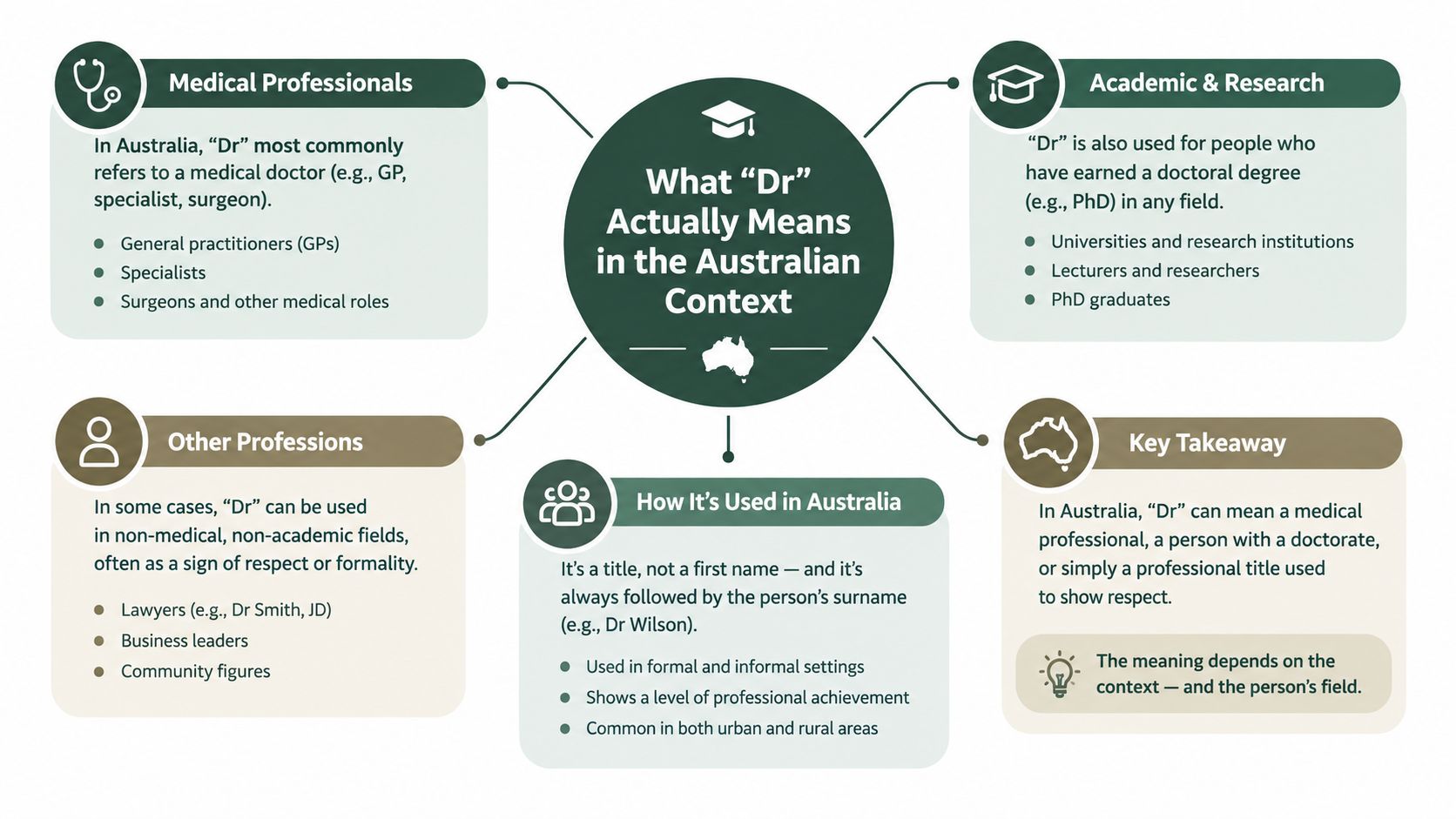
In Australia, Dr is a professional honorific, not a single qualification. It can be used by medical practitioners, dentists, veterinarians, and people who hold doctorates. Australia’s Style Manual guidance on academics and professionals directs writers to use “Doctor” or “Dr” for medical practitioners, dentists and veterinarians whether or not they hold a doctorate, and notes that those who do hold one may add the post-nominal “PhD”. The Style Manual writes Dr without a full stop.
That gives you a useful mental model:
- Dr as a clinical honorific: identifies a medical practitioner, dentist, or veterinarian in a professional setting.
- Dr as an academic honorific: identifies someone who has completed a doctorate, such as a PhD.
- Dr in another professional context: may be used by a qualified person outside healthcare who holds a relevant doctorate.
The word alone doesn’t tell you which pathway the person completed. Their role, workplace, registration, and introduction provide the context.
Medical registration is separate from the honorific
For a medical trainee, the important distinction is between holding a medical qualification, being registered to practise, and using the honorific Dr. These ideas are related, but they aren’t interchangeable.
A person may have completed a medical degree but still be moving through supervised training and registration requirements. Another person may have a PhD and legitimately use Dr while having no medical registration. In a hospital, “Dr” commonly functions as a professional form of address for a clinician, but it doesn’t by itself describe the person’s registration category, scope of practice, or specialty.
That’s why clinical introductions should be more specific where confusion could affect a patient. “Dr Singh, our medical registrar” gives the patient more useful information than “Dr Singh” alone. Similarly, a university event might identify “Dr Patel, researcher” to distinguish an academic doctor from a treating clinician.
There is one Australian convention that catches trainees out, and it runs in the opposite direction to everything above. The Style Manual notes that surgeons in human medicine are traditionally addressed as “Mr”, “Ms” or their preferred gender-appropriate honorific rather than “Dr”, though some surgeons prefer Dr. If you are walking into a surgical department or a surgical selection interview, that is worth knowing before you open your mouth. The safe move is the same as everywhere else: use the form the person uses for themselves, and follow the department’s lead.
General-usage references such as the Macquarie Dictionary grammar guide cover the everyday conventions, but they won’t tell you which honorific a particular clinician prefers.
What the title doesn’t establish
Dr doesn’t automatically mean specialist. It doesn’t tell you whether the clinician is an intern, resident medical officer, registrar, fellow, or consultant. It also doesn’t tell you whether the person holds a PhD.
When you need to understand someone’s clinical role, look for the accompanying position title, hospital identification, registration information, or direct introduction. Addressing a person as Dr is a matter of professional courtesy. Confirming who is responsible for a clinical decision is a matter of safe communication.
Correct Styling and Usage in Clinical Documentation
The safest approach to writing Dr in Australian clinical records is to follow the local health service’s approved abbreviation policy, because these are set service by service rather than nationally. The Sydney Children’s Hospitals Network’s Approved Abbreviation List for use in Medical Records is a worked example: it lists Dr for “Doctor” among its approved abbreviations, and states that medical records “must be legible and easily understood by all persons who access them” and that only approved abbreviations and symbols may be used. Your own service will have its own list, and that list is the one that governs your notes.
Use the form your workplace expects
Australia’s Style Manual allows Dr without a full stop, while many clinical systems, templates, and correspondence conventions may display titles differently. The practical priority is consistency with the document type and institution.
Use Dr in a staff name, referral, letter, or heading when that is the accepted local format. Write Doctor in full when the surrounding text is patient-facing, when a form requires it, or when expanding the title makes the sentence clearer. Don’t alternate casually between forms inside a formal document unless the template does so.
A referral might begin:
Dr Nguyen
Respiratory Physician
[Service or hospital]
A progress note may identify a clinician by name and role rather than relying on the title alone:
Discussed with Dr Nguyen, respiratory registrar. Plan confirmed.
The second example is stronger because it records both the person consulted and their clinical role. The title provides courtesy, while the role provides operational clarity.
Keep abbreviations single-purpose
Before using an abbreviation, ask three questions:
- Is it approved locally? A hospital’s policy takes priority over personal preference.
- Will every reader interpret it the same way? Avoid shorthand that could refer to different people, roles, or instructions.
- Does the record need the person’s role as well? Add the designation when it helps another clinician understand authority or responsibility.
Don’t create informal variants such as “doc” in a formal record. Don’t use a title to replace a complete clinical description when the patient’s care depends on knowing whether the person was a consultant, registrar, nurse practitioner, or another professional.
Documentation principle: A permitted abbreviation is not automatically the clearest choice. Use the approved form, then add the role when context matters.
For emails and letters, use the recipient’s preferred professional title and surname unless they’ve invited first-name communication. In patient discussions, introduce the clinician in a way the patient can understand, such as “Dr Lee, one of the doctors looking after you,” rather than assuming the title explains the person’s role.
Common Confusions Between Dr, MD and PhD
The terms Dr, MD, and PhD sit at different levels, which is why trainees can mix them up.
Dr is an honorific. MD is a medical degree. PhD is a research doctorate. A person may hold one, two, or all three, but the terms don’t perform the same job in a sentence.
| Term | What it represents | Typical Australian context |
|---|---|---|
| Dr | A professional form of address | Used for medical practitioners and for people with doctorates |
| MD | A medical qualification | Listed after a doctor’s name where the qualification is relevant |
| PhD | A research doctorate | Used after the name of an academic or clinician who completed doctoral research |
Dr is not the same as MD
A medical graduate may use Dr as a professional honorific in clinical settings, but the degree itself is described separately. Writing “Dr Taylor” addresses the person. Writing “Taylor, MD” identifies a qualification. The two forms answer different questions.
In Australia, medical graduates move through education, internship, registration, and later training stages. A person’s use of Dr shouldn’t be read as proof that they’ve completed specialist training. Conversely, a specialist may use Dr without listing every degree after their name.
PhD identifies research training
A PhD indicates advanced research training, not medical registration. A clinician may hold both an MD and a PhD, particularly in academic medicine, but the PhD doesn’t establish that the person treats patients. A researcher with a PhD may use Dr in an academic setting even when they aren’t a medical practitioner.
This distinction becomes important when you introduce someone to a patient. If the person is a clinician, identify their clinical role. If they’re a researcher attending a meeting, don’t imply that they provide medical care because they use Dr.
Students also encounter the issue in university assessments. A marker’s title doesn’t tell you whether they’re a clinician, academic, or both. Follow the institution’s instructions for names, credentials, and forms of address. Guidance on university grading criteria can help you separate assessment expectations from professional title conventions.
A simple decision test
Ask what you’re trying to communicate:
- Addressing a person: use the appropriate honorific and surname.
- Describing clinical responsibility: include the person’s role and service.
- Listing qualifications: use MD, PhD, or another credential only when relevant.
- Explaining a person’s expertise to a patient: use plain language, not an unexplained string of titles.
Australian usage remains context-dependent because Dr can legitimately identify both clinicians and doctorate holders. That isn’t a contradiction. It’s a reminder that an honorific is not a substitute for professional identification.
Practical Examples for Interviews, Exams and Clinical Settings
A trainee’s title decisions usually happen quickly. The following situations show how to stay respectful without making assumptions.
Specialty selection interview
You enter a room and the chair says, “Good morning, I’m Dr Ahmed.” A professional response is, “Good morning, Dr Ahmed. Thank you for having me.” If the chair says, “Please call me Sam,” you can adopt that preference.
If the panel introduces a member as Professor Williams, use “Professor Williams” unless they invite another form. Don’t guess that every academic panellist wants to be called Dr, even if the programme lists them as a clinician — and in a surgical selection interview, remember that the surgeons on the panel may use Mr or Ms. Whether your interview is run by the college or by a state network, and therefore who is likely to be in the room, is set out in our guide to specialty selection interviews in Australia.
Interview habit: Start formally, then mirror the form of address the panellist uses for themselves.
If you don’t know a panellist’s title, “Good morning, thank you for meeting with me” avoids an awkward guess. You can also ask politely, “How would you prefer to be addressed?” That question signals awareness rather than uncertainty.
For structured preparation, medical exam preparation can sit alongside mock interview practice. The title itself won’t determine your result, but calm, accurate professional communication contributes to how your preparation is perceived.
Referral letter
A referral should make the recipient identifiable and the clinical purpose clear:
Dear Dr Patel, Thank you for reviewing Ms Brown regarding persistent symptoms.
If the recipient has a stated professional title, use it. If the letter is addressed to a service rather than an individual, write to the service and identify the relevant clinician in the body. Don’t add PhD or MD because you’ve seen those letters in a directory. Include qualifications only when the format or purpose requires them.
Clinical note
A note should record actions and advice precisely:
Reviewed with Dr Chen, surgical registrar. Awaiting imaging before further discussion.
This is preferable to writing only “Discussed with Dr Chen” when the role affects how another clinician interprets the plan. Follow your health service’s approved abbreviations and documentation standards, and don’t invent local shorthand.
Introducing a colleague to a patient
A patient may not know what Dr means in a team with multiple professions. Try:
“This is Dr Morgan, one of the doctors on the medical team. They’ll speak with you about the results.”
If the person is an academic researcher rather than a treating clinician, say so plainly. “This is Dr Morgan, the researcher leading the study” prevents the patient from assuming that the visitor is part of their treating team.
Exam or viva setting
Address an examiner formally unless they’ve provided another instruction. “Good morning, Dr Roberts” is appropriate when the examiner is identified that way. Keep the rest of your answer focused on the clinical question. Repeatedly using a title, guessing a credential, or trying to impress the panel with academic labels can distract from clear reasoning.
Key Takeaways for Your Training Journey
The answer to what is dr in Australia depends on context, but the practical rule is straightforward. Dr is an honorific, commonly used for medical practitioners, dentists, and veterinarians, and also available to people with doctorates. MD and PhD are qualifications, not interchangeable forms of address.
Australia’s training system is large and active. The 2024 Medical Training Survey drew 24,812 responses from doctors in training, 53.4% of those invited. That is the scale of the professional environment in which these conventions operate — and the reason a consistent habit matters more than a clever one.
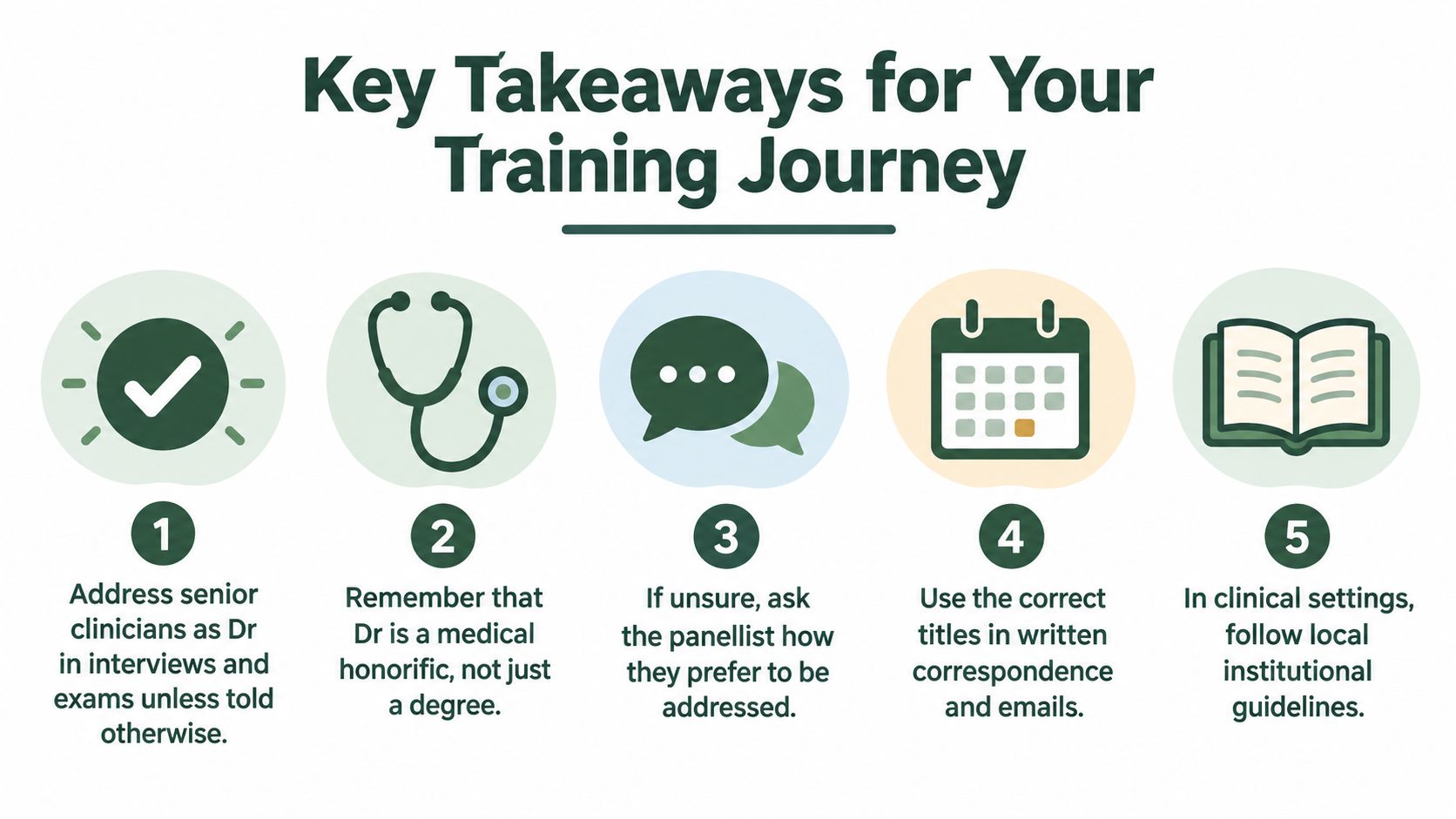
Use this checklist before an interview, exam, email, or clinical entry:
- Address senior clinicians formally: Start with Dr and the surname unless the person gives another preference.
- Separate titles from qualifications: Dr is an honorific, while MD and PhD describe qualifications.
- Name the role when safety depends on it: Add registrar, consultant, researcher, or another accurate designation.
- Follow local documentation policy: Use approved abbreviations and avoid giving one abbreviation multiple meanings.
- Clarify rather than guess: Ask how someone prefers to be addressed when the context is unclear.
Professional confidence comes from making small decisions consistently. Learn the local convention, check the hospital or university policy, and keep the patient’s understanding at the centre of every introduction.
CliniRoo is building preparation material for the Australian pathway — specialty selection interviews, medical school examinations, and college written and clinical exams — with format-focused practice and locally relevant scenarios. Nothing is on sale yet. If you want to be told when there is something to use, CliniRoo takes an email address and does nothing else with it.