Grading Criteria University Guide for Australian MD Programs
Australian MD grading criteria university guide with scales, rubrics and year-level expectations mapped to exam formats for every MD program.
You’ve just received a mark that doesn’t seem to match the effort you put in. Your result sits close to a grade boundary, but the unit guide talks about learning outcomes, clinical reasoning and professional performance rather than percentages alone. Then you compare your transcript with a student at another Australian university and discover that the same grade label may sit within a different band.
That confusion is common in Australian MD (Doctor of Medicine, the primary medical degree) programs. University grading criteria aren’t a single national rulebook. They combine percentage bands, grade point average (GPA) conversion, criterion-referenced descriptors, faculty rubrics, assessment formats and progression policies. A useful answer therefore has to explain both the published scale and the judgement behind the mark.
Table of Contents
- Introduction to Grading Criteria in Australian MD Programs
- How Australian University Grading Scales and GPA Mapping Work
- Understanding Criterion Referenced Descriptors and Rubric Logic
- University by University Grading Variations and Exception Grades
- Year Level Expectations From Foundations to Final Year
- How Grade Descriptors Map to MD Exam and Assessment Formats
- Annotated Rubric Examples That Show What Earns Each Grade
- Quick Reference Lookup and Cross Referenced Resources
Introduction to Grading Criteria in Australian MD Programs
A student preparing for a written examination needs a different lookup path from a student reviewing an OSCE (Objective Structured Clinical Examination, the rotating-station practical exam) result. The first student should locate the assessment blueprint, marking rules and answer expectations. The second should examine station criteria, communication behaviours, examination technique and safety-netting requirements. Neither can understand the result from a grade table alone.
This guide is designed as a practical reference for that situation. Start with the section on grading scales and GPA mapping if you need to decode a transcript. Move to criterion-referenced descriptors when a mark seems difficult to justify. Use the university comparison when you’re checking whether a published band applies to your institution, and use the year-level section when you’re deciding how standards should develop through the MD.
The assessment-format section connects broad criteria to written papers, OSCEs, workplace-based assessments, portfolios and research tasks. The annotated examples then show how a marker might distinguish a borderline Pass from a Credit, or a Distinction from a High Distinction, without pretending that every faculty uses identical wording.
Australian medical education adds another layer. Knowledge recall may dominate an early written task, while later assessment may require synthesis, prioritisation, communication and safe clinical action. A student can therefore ask a better question than “What percentage do I need?” Ask instead: What evidence must I provide, in this format, at this stage of the course, to demonstrate the stated outcome?
That question keeps the focus on criteria rather than guesswork.
How Australian University Grading Scales and GPA Mapping Work
Most Australian universities use five grade bands and set the passing threshold at 50%. Above that line, the boundaries are not standard — and the difference between two institutions can be a full ten percentage points on the same grade label.
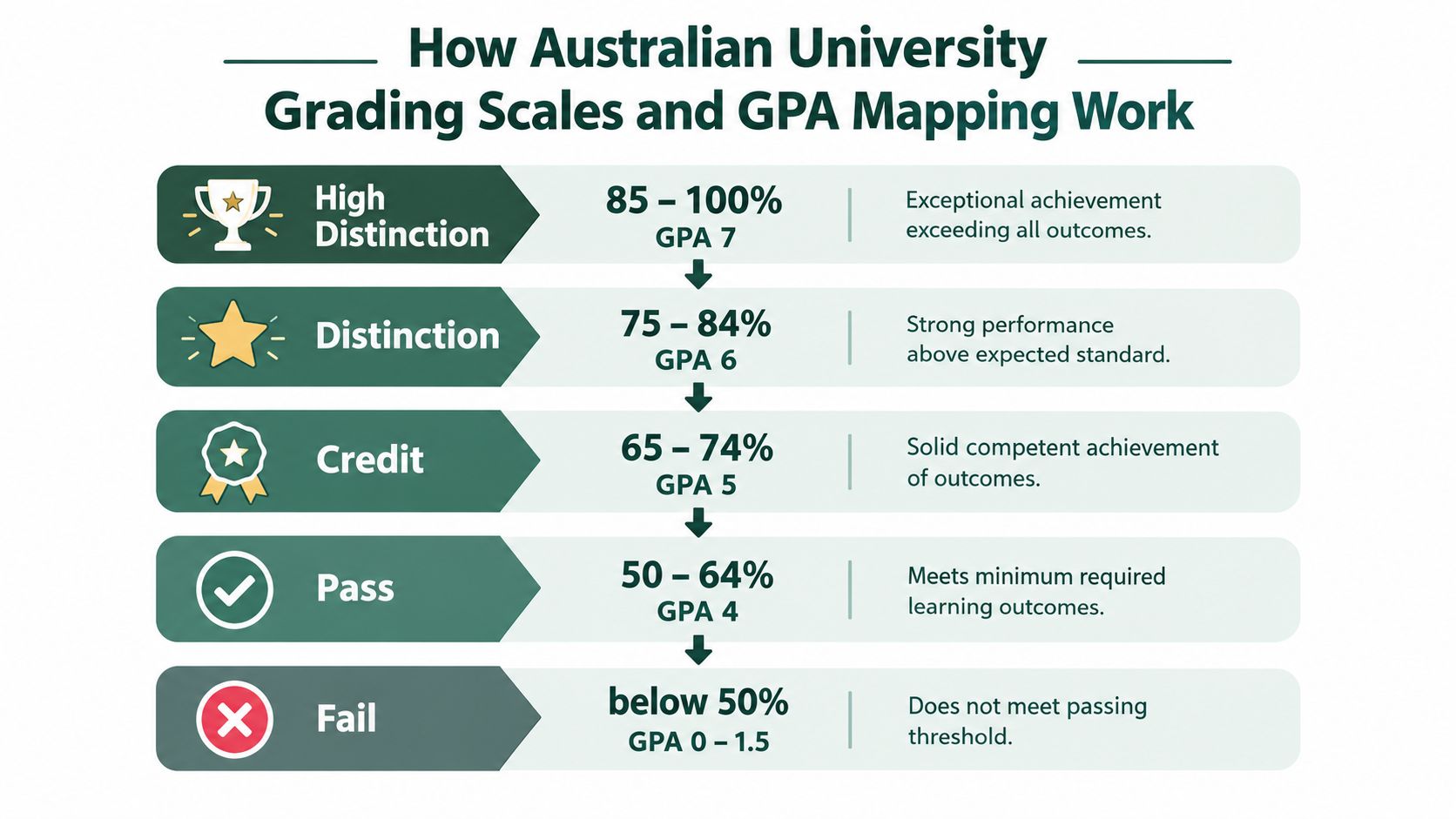
Compare the two scales below, both taken from the universities’ own published guidance:
| Grade | University of Sydney | Australian National University |
|---|---|---|
| High Distinction | 85–100% | 80–100% |
| Distinction | 75–84% | 70–79% |
| Credit | 65–74% | 60–69% |
| Pass | 50–64% | 50–59% |
| Fail | 0–49% | 0–49% |
Sources: the University of Sydney guide to grades and the ANU grading scale, both accessed September 2026.
The gap matters. A mark of 82% is a Distinction at Sydney and a High Distinction at the ANU. A student comparing transcripts across the two institutions, or a selection panel reading them, is not comparing like with like — which is the practical reason the grade label alone tells you very little.
Note also that the two universities do not aggregate results the same way. Sydney reports a Weighted Average Mark rather than a grade point average, so a GPA conversion taken from a general study website may not describe how your own institution ranks you at all. Check your university’s published method before converting anything.
Read the scale in three steps
First, identify the institution’s published bands. Don’t assume that a table found on a general study website applies to your medical school. Faculty handbooks and official grade guides take priority.
Second, check whether the result is a unit mark, an assessment mark or a hurdle outcome. A strong aggregate result may not remove a requirement to pass a particular clinical or safety-critical component. The rule is programme-specific.
Third, read the descriptor attached to the band. A percentage is an endpoint, not a complete explanation of what the student demonstrated. At the University of Sydney, a Pass is tied to demonstrating unit learning outcomes at an acceptable standard, as described by faculty or school descriptors and exemplars. The University of Sydney grade guide makes that criterion-referenced connection explicit.
For MD students, GPA mapping is useful for orientation, but it shouldn’t replace assessment literacy. A mark tells you where the result landed. The rubric, feedback and outcome evidence help explain why.
Understanding Criterion Referenced Descriptors and Rubric Logic
A criterion-referenced assessment judges work against a defined standard, not against the performance of classmates. That distinction changes how you should prepare. You’re not trying to appear better than the person beside you. You’re trying to demonstrate each required learning outcome with sufficient quality and consistency.
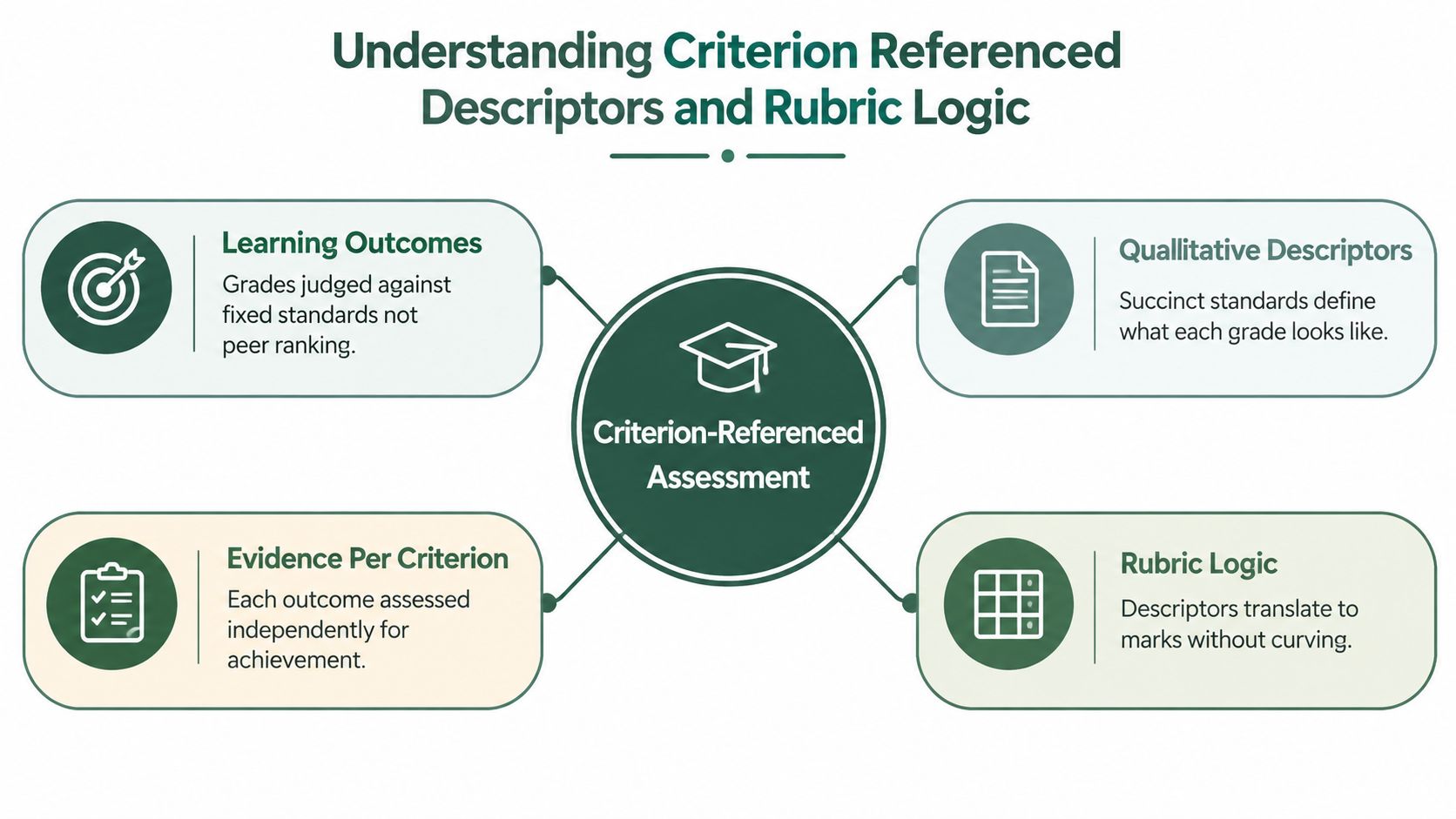
A rubric usually connects four elements:
- Learning outcomes: What the student must demonstrate, such as applying biomedical knowledge to a patient problem.
- Qualitative descriptors: Language that defines the standard, such as accurate, coherent, safe, justified or well integrated.
- Evidence per criterion: The observable content or behaviour that supports the judgement.
- Rubric logic: The way the marker translates performance across criteria into an overall result.
A published percentage range may therefore describe a grade without fully defining it. Australian policy material can distinguish a succinct qualitative descriptor, a generic description of standard and percentage ranges used as numerical references. In practice, that means the number should be read alongside the words.
What markers look for
Suppose an answer identifies the correct diagnosis but gives no reasoning, ignores a red flag and proposes an unsafe plan. The student may know relevant facts, but the evidence doesn’t demonstrate the complete outcome. Another answer may reach the same diagnosis while explaining prioritisation, acknowledging uncertainty and selecting an appropriate next step. The second answer offers stronger evidence across the criteria.
Read rubrics vertically before reading them horizontally. First ask what separates Pass, Credit, Distinction and High Distinction performance for one criterion. Then ask whether your response addresses all criteria, rather than polishing only the area you already handle well.
Practical rule: Convert every rubric verb into an observable action. “Analyse” means compare and justify. “Communicate” means structure information for the listener. “Demonstrate” means show the behaviour, not merely describe it.
Exemplars are especially valuable because they reveal how descriptors appear in actual work. Use them to identify the level of specificity, reasoning and organisation expected, but don’t copy their surface style. In a clinical skills context, criteria may involve the sequence of an examination, patient-centred language and escalation of concern. Guidance on structuring a clinical station can also be cross-referenced with Mini-CEX preparation for the RACP (Royal Australasian College of Physicians, which runs physician training), while keeping your own faculty rubric as the controlling document.
University by University Grading Variations and Exception Grades
Australian universities don’t all use the same percentage boundaries. The 85/75/65/50 structure and the 80/70/60/50 structure are both in use, and some institutions additionally recognise outcomes such as Marginal Fail or Conceded Pass. The label alone therefore doesn’t establish equivalent achievement.
| University or policy model | HD band | D band | C band | Pass threshold | Exception grades |
|---|---|---|---|---|---|
| University of Sydney | 85–100% | 75–84% | 65–74% | 50%, tied to demonstrated learning outcomes | Check faculty and course rules |
| Australian National University | 80–100% | 70–79% | 60–69% | 50% | Check current programme rules |
| Institution-specific policy model | Published locally | Published locally | Published locally | Published locally | May include Marginal Fail or Conceded Pass |
The table is a comparison aid, not a substitute for your handbook. The Sydney entry is worth reading closely because its Pass definition connects the result to demonstrated learning outcomes rather than treating the threshold as a purely mechanical percentage: a Pass is awarded when you demonstrate the unit’s learning outcomes at an acceptable standard, as defined by your faculty’s grade descriptors or exemplars.
Why exception grades matter
A Marginal Fail can have different implications from an ordinary Fail. A Conceded Pass may allow progression under defined conditions, while another institution may not use that category at all. These outcomes can affect remediation, prerequisites, clinical placement eligibility and progression decisions.
The same nominal grade can therefore carry different consequences across universities. A postgraduate admissions team may also need to interpret transcripts in context, especially where one institution awards a higher grade only at a narrower percentage band.
Check four documents before comparing results:
- The university-wide grading policy, which defines recognised categories.
- The faculty or medical programme handbook, which may add assessment rules.
- The unit guide and rubric, which describe the specific learning outcomes.
- The progression and review policy, which explains hurdles, remediation and appeals.
Public commentary on academic grading in Australia illustrates why simple HD, D, C, P and F tables don’t answer every practical question. Students need to know how the institution defines the grade, how markers apply criteria and what happens when a result falls near a boundary.
Year Level Expectations From Foundations to Final Year
A Credit doesn’t mean exactly the same thing at every stage of an MD. The grade label may remain stable, but the underlying task becomes more complex. Early students are usually building a reliable knowledge base, while later students must integrate information, manage uncertainty and act with increasing independence.
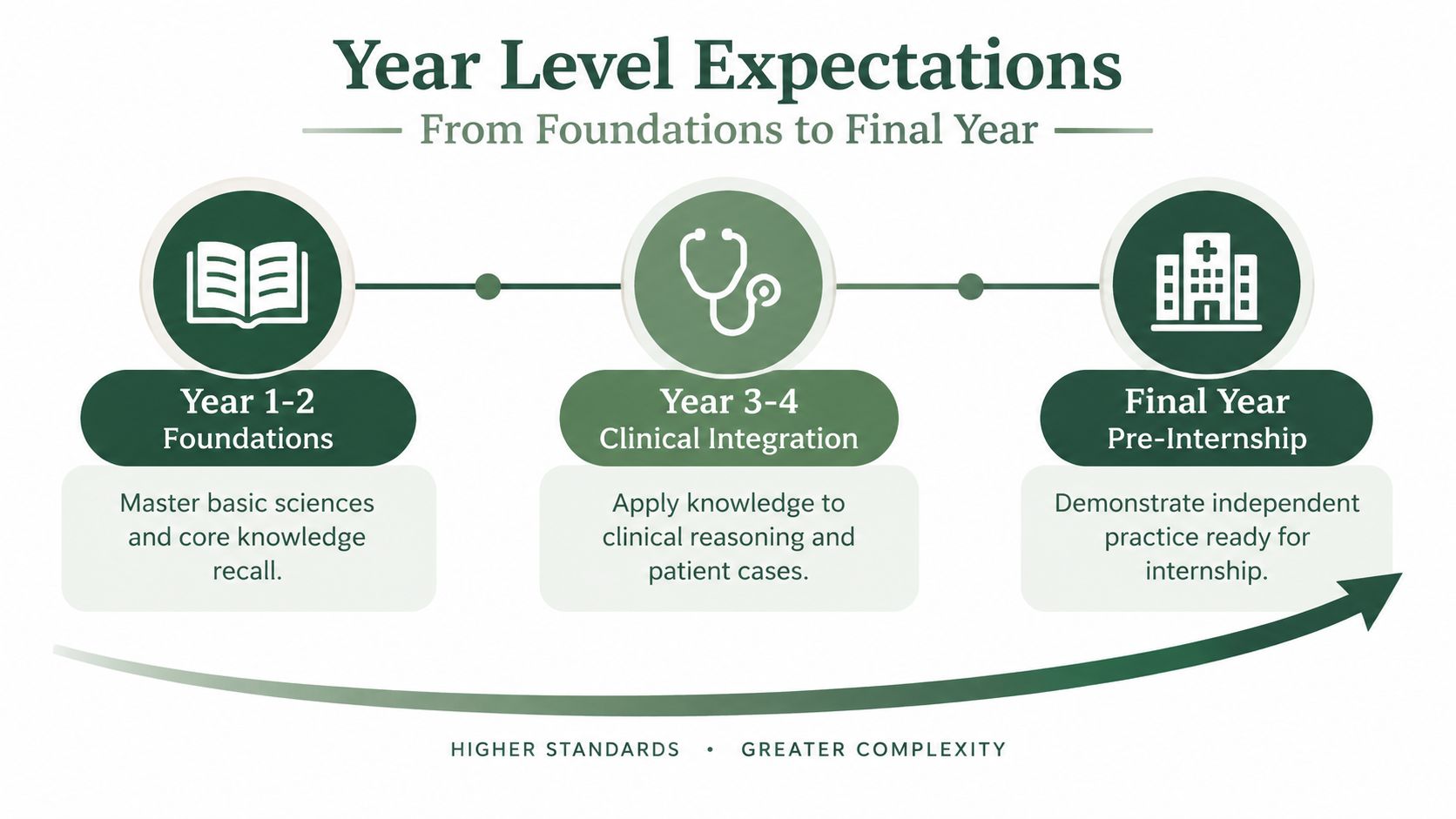
Year 1 and Year 2 foundations
Foundational assessment often rewards accurate recall, basic explanation and correct use of scientific concepts. A strong response defines the mechanism, links it to the relevant anatomy or physiology and avoids avoidable factual errors.
Students should build habits that later become clinical reasoning tools:
- Retrieve actively: Answer questions without relying on recognition alone.
- Explain relationships: Connect structure, function, pathology and treatment principles.
- Use precise language: Distinguish similar terms rather than listing loosely related facts.
- Check the outcome: Confirm that revision covers what the unit says students must demonstrate.
Year 3 and Year 4 clinical integration
Clinical integration shifts the question from “What is this fact?” to “What does this information mean for this patient?” Markers may expect a structured differential, prioritised investigations, interpretation of findings and a safe initial plan.
A Credit-level response may identify the important issues and apply relevant knowledge. A higher-level response usually makes the links explicit, explains prioritisation and recognises limitations. Clinical communication also becomes evidence of competence, not an optional presentation skill.
Final year and pre-internship performance
Final-year tasks can demand greater independence and professional judgement. Students may need to recognise deterioration, escalate appropriately, communicate with a patient or team and justify decisions under realistic constraints.
The standard isn’t “more facts”. It’s more reliable integration. Guidance on the Australian training pathway, including the relationship between medical school and later clinical development, is available in medical training in Australia.
Use your year level to calibrate preparation. Ask whether your practice answer merely recalls information, applies it to a case or demonstrates safe action with limited prompting. That progression is often more revealing than chasing a grade label in isolation.
How Grade Descriptors Map to MD Exam and Assessment Formats
The same descriptor appears differently across assessment formats. “Clinical reasoning” in a written paper may require a justified differential diagnosis. In an OSCE, it may appear as a focused history, relevant examination, interpretation of information and a safe plan communicated to the patient or examiner.
| Format | What the evidence may look like |
|---|---|
| Written paper | Accurate knowledge, prioritised reasoning and a coherent answer |
| OSCE | Observable examination, communication, interpretation and safety |
| Workplace-based assessment | Performance in context, professionalism and response to feedback |
| Portfolio | Reflective evidence linked to outcomes and development |
| Research task | Critical analysis, method, interpretation and scholarly writing |
A written answer can hide a weak structure behind a correct final statement. Use signposting, state your working diagnosis, explain why it is most likely and identify the next action. If the question asks for management, don’t stop at a list of treatments. Show prioritisation and safety.
OSCE preparation requires a different loop. Practise the behaviour that the examiner can observe, including introduction, consent, explanation, technique, interpretation and closure. A polished script won’t compensate for missing a key clinical step, and a technically correct examination may still underperform if the patient receives no explanation.
Workplace-based assessments add context. The marker may judge whether you prepare, gather information efficiently, recognise your limits, seek help and respond to feedback. Portfolio work needs a clear connection between the experience, the learning outcome, the reflection and the change in future practice.
Research tasks reward more than a well-formatted reference list. The work should define a question, evaluate evidence, acknowledge limitations and reach a conclusion supported by the analysis. Australian medical exam preparation can help you think in a format-first way, but the local assessment guide remains decisive.
Annotated Rubric Examples That Show What Earns Each Grade
The examples below are teaching models, not official university descriptors. Your faculty’s rubric controls the result. Their purpose is to show how a marker might interpret evidence across a criterion rather than assign a grade from effort or confidence.
Clinical reasoning criterion
Task: A patient presents with shortness of breath. Explain your initial assessment and priorities.
| Performance level | Student evidence | Marker interpretation |
|---|---|---|
| Pass | Identifies immediate assessment needs and suggests a plausible diagnosis | Meets the minimum outcome, but reasoning may be brief or uneven |
| Credit | Identifies urgent features, organises a differential and links findings to investigations | Shows competent application with clearer justification |
| Distinction | Prioritises competing risks, explains why actions come first and adapts to findings | Demonstrates strong, coherent clinical reasoning |
| High Distinction | Integrates the presentation, uncertainty, safety issues and patient context into a precise plan | Provides exceptional evidence across the criterion |
A borderline Pass often contains the right topics without showing why they matter. For example, “check observations, examine the patient and order tests” may be directionally correct, but it leaves the sequence and purpose unclear. A Credit response might explain that immediate observations and focused examination identify instability, then connect the differential to targeted investigations.
Communication criterion
Task: Explain a new diagnosis and immediate plan to a patient.
A Pass-level response may use understandable language and provide the essential plan, but it might feel rehearsed or fail to check the patient’s understanding. A Credit response structures the explanation, responds to the patient’s concerns and confirms the next steps. Distinction-level evidence integrates empathy, accuracy, shared decision-making and appropriate safety-netting without losing focus.
Scholarly analysis criterion
A Pass may summarise relevant sources and answer the question. A Credit compares evidence and explains its relevance. A Distinction evaluates limitations, distinguishes stronger from weaker support and builds a clear argument. High Distinction work does those things with particularly controlled structure, original synthesis and precise conclusions.
Marker-facing test: Could another assessor point to the sentence, action or behaviour that proves each criterion? If not, the work may contain knowledge without enough visible evidence.
Use this test before submission. Highlight one colour for factual accuracy, another for reasoning and another for safety or professionalism. Any criterion with no highlighted evidence deserves revision, even if the overall response feels fluent.
Quick Reference Lookup and Cross Referenced Resources
Use this lookup sequence when a result or rubric feels unclear.
Grade finder
- Find the official scale: Start with your university’s grading policy, not a general table.
- Locate the course rule: Check whether the MD programme adds hurdles, mandatory components or special outcomes.
- Read the descriptor: Identify the words that define acceptable, competent, strong or exceptional performance.
- Match the format: Decide whether the evidence must be written, spoken, observed, reflected or performed.
- Check the consequence: Review progression, remediation, review and appeal provisions before acting.
For GPA questions, record the grade band used by your university and then confirm how the programme calculates averages. Don’t convert a result using a familiar 7-point table until you’ve checked the local policy. The common model is useful for orientation, but institutional variation can change the interpretation.
Cross-reference by problem
If you’re revising a written paper, start with the descriptor for knowledge, application and reasoning, then test answers against the relevant question format. If you’re preparing for an OSCE, cross-reference each station criterion with the observable behaviours required at your year level. For a workplace-based assessment or portfolio, identify how feedback, reflection and professional performance are documented.
If your concern is a borderline result, save the assessment instructions, rubric, feedback and relevant handbook version. Write a focused query that names the criterion and asks how your evidence was assessed. This is more useful than arguing that you worked hard or that the mark feels unfair.
If you’re considering an appeal, follow the university’s formal process and deadlines. Ask student support, the faculty office or an academic adviser which policy applies. A review normally depends on procedural or criterion-based grounds, so clear documentation matters.
For targeted preparation, students can compare faculty rubrics with question banks, OSCE checklists, examiner feedback and supervised practice.
Use your next study session to turn one rubric into an action list, then practise one answer or station against that list and record the missing evidence.
CliniRoo is building question banks and assessment practice mapped to the Australian pathway. Nothing is on sale yet. If you want to be told when there is something to use, CliniRoo takes an email address and does nothing else with it.