RACP Mini-CEX: Rated Domains, Requirements and Preparation
What the RACP Mini-CEX actually rates, the 1 to 9 scale, how many you need under each Basic Training curriculum, and how to prepare for the next one.
You’re on a busy medical ward, your consultant has agreed to observe you, and suddenly a routine patient review feels like an examination station. You’re wondering which patient to choose, whether you’ll finish the history in time, and what the assessor will write in the feedback box.
That anxiety is understandable, but it reflects a common misunderstanding. The Mini-CEX — the mini-Clinical Evaluation Exercise, a workplace-based assessment in which a senior clinician watches you handle one real patient encounter, rates it on a standard form, and debriefs it with you — isn’t a single performance you either conquer or fail. It’s a recurring workplace habit, built around observing your clinical practice, discussing your decisions, and turning one real patient encounter into a specific improvement goal.
The RACP — the Royal Australasian College of Physicians, the body that trains and certifies physicians and paediatricians in Australia and Aotearoa New Zealand — has run the Mini-CEX in Basic Training since 2008. It is no longer the requirement for every Basic Trainee, and which requirement applies to you depends on the year you commenced training. That split is the first thing this article deals with, because getting it wrong is the one mistake here that costs a training year.
Table of Contents
- What the RACP Mini-CEX Actually Is
- The Structure of a Mini-CEX Encounter
- The Six Rated Domains and the Scale They Sit On
- How Mini-CEX Differs from Other RACP Assessments
- Common Station Types and Mapped Examples
- What Assessors Really Look For in Feedback
- Planning Your Assessments Across the Year
- What Replaced Mini-CEX on the New Curricula
What the RACP Mini-CEX Actually Is
You finish a routine ward review, and your consultant asks whether this patient would suit a Mini-CEX. The encounter may feel like an exam, but the task is more practical: show how you assess and manage a real patient while a senior clinician observes your work.
The Mini-CEX is a workplace-based assessment conducted during a real clinical encounter. What the College requires of you, however, is set by your commencement year, and the two answers are genuinely different.
If you commenced Basic Training in 2024 or earlier, you are on PREP. PREP — Physician Readiness for Expert Practice — is the older RACP program. Its handbooks require “4 x Mini-Clinical Exercise Evaluation (Mini-CEX) at a minimum are to be completed per year, 1 per quarter or rotation”. The observed consultation runs 15 to 20 minutes, followed by 10 to 15 minutes of feedback. The same wording appears in both divisional handbooks: Adult Internal Medicine Basic Training and Paediatrics & Child Health Basic Training (PREP handbooks, accessed 10 September 2026). Mini-CEX is not the only annual requirement. The same handbooks ask for “2 x Learning Needs Analysis (LNA) to be completed per year”, “1 x Professional Qualities Reflection (PQR) per 6-month period”, “1 x Ward/Service Consultant Report per rotation”, plus a mid-year and an annual progress report.
If you commenced Basic Training in 2025 or later, you are on the new curricula, and the Mini-CEX is not among the assessment tools the College lists for you. The tool that carries observed clinical practice on the new curricula is the Observation Capture, required at “12 x observation captures per phase of training, minimum 1 per month” across the three phases — Foundation, Consolidation and Completion (2025 Learning and Assessment Interim Guide, New Basic Training curricula, v1.4, accessed 10 September 2026). The term “CEX” does not appear anywhere in that guide, and the guide states directly that trainees “who commenced training before 2025 should refer to the PREP Program Requirements.” One caution on that, stated as inference rather than as College policy: the guide is an interim guide, and the College says requirement quantities can differ between training programs. Read your own Program Handbook before concluding you owe no Mini-CEX — the absence of the tool from the interim guide’s list is strong evidence, not a substitute for your programme’s own document.
The fastest way to confirm which cohort you are in is to look at where your requirements live. PREP assessments are submitted through the Basic Training Portal; new-curricula assessments go through the Training Management Platform, the TMP. If your requirements tab shows observation captures rather than Mini-CEX forms, plan for 12 per phase, not 4 per year.
Everything below about the Mini-CEX form, its rated domains and its rating scale applies to the PREP requirement. The final section covers what changes on the new curricula.
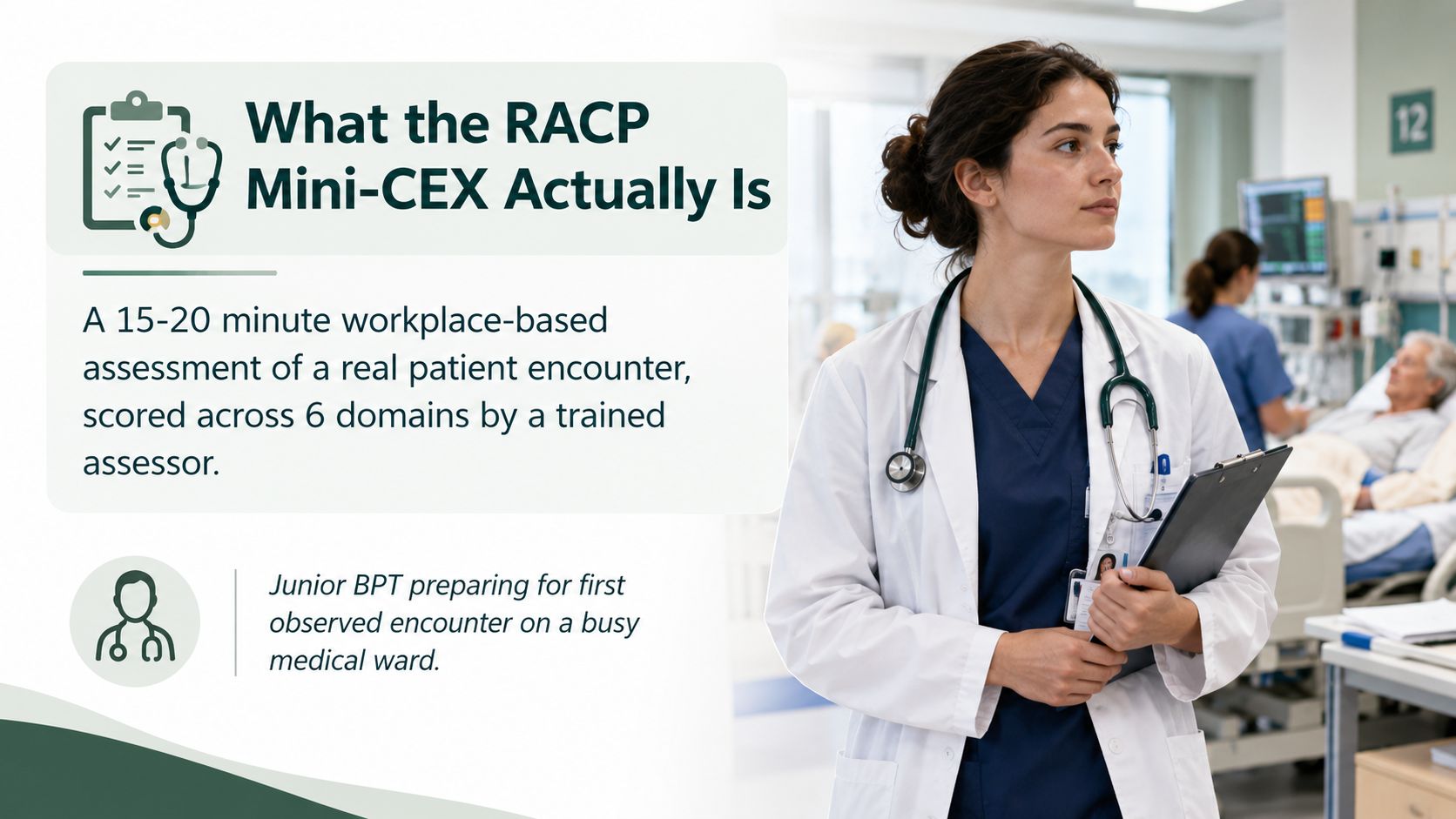
Your consultant is not testing a memorised script in an artificial station. They are observing how you approach a patient, gather information, examine appropriately, communicate, form a plan, and behave as a doctor in your usual clinical setting.
The RACP introduced the Mini-CEX into Basic Training in 2008, and by the time the College reviewed the tool there had been “almost 40,000 cases submitted via the BT Portal” (RACP, Basic Training Mini-CEX Exploratory Study — at a glance, accessed 10 September 2026). Its purpose was to replace vague, occasional consultant impressions with organised observation that could be repeated across patients, supervisors, and rotations. If you are still placing workplace assessments within the wider training requirements, the RACP Basic Training pathway provides that broader context.
A recurring habit, not a single hurdle
Treat each Mini-CEX as a scheduled training requirement with a learning purpose. The encounter gives you feedback on your current practice, while the completed form records that assessment for your training portfolio. It is one useful observation, not a complete verdict on your competence.
One point of confusion worth clearing up early: the Mini-CEX name is used by more than one Australian body, for more than one purpose. The Australian Medical Council (AMC — the body that accredits medical education and assesses overseas-trained doctors) also runs a Mini-CEX, but that one sits inside the AMC’s Workplace-Based Assessment pathway for international medical graduates, and it is marked against the standard of “a graduate of an AMC-accredited medical program at the end of postgraduate year one”. It is a different programme, at a different standard, with its own rules. Do not read AMC guidance as RACP guidance.
On who may assess you: the RACP PREP handbooks do not publish a restriction on who can act as your Mini-CEX assessor. The rating form asks for the assessor’s name, position, email and hospital, and nothing more (RACP Basic Training Mini-CEX rating form, accessed 10 September 2026). Because the College does not set the rule, your training site does — so ask your supervisor who is accepted locally rather than assuming a seniority threshold that the handbook never states.
PREP assessments are submitted through the Basic Training Portal. The handbooks set submission by the end of each rotation and no later than 31 January of the following year (Adult Internal Medicine and Paediatrics & Child Health PREP handbooks, accessed 10 September 2026). Put the deadline in your rotation plan rather than waiting until the final weeks.
Scores also need careful interpretation, and the College’s own analysis is blunter than most summaries of it. The RACP’s exploratory study of 384 Mini-CEX records found “no relationship between clinical performance scores on the mini-CEX and performance in the Divisional Clinical Examination” — not a weak one, none (RACP Basic Training Mini-CEX Exploratory Study — at a glance). Two limitations matter before you lean on that: the sample was a stratified random 384 assessments drawn from calendar years 2010 to 2013, and the College itself recommended re-examining the question “with a larger sample”. Treat it as the best published College evidence, not as a settled finding. Either way, a strong Mini-CEX record is not a forecast of an exam result, and an uneven encounter does not define your overall ability.
Practical rule: Choose a patient who lets you demonstrate ordinary good medicine, not an exotic diagnosis that forces you into a rushed performance.
The Structure of a Mini-CEX Encounter
A Mini-CEX works best when you see it as one continuous workflow rather than two disconnected tasks, observation followed by paperwork. The assessor needs enough context to judge your performance fairly, and you need enough feedback time to convert observation into learning.
Before the patient encounter
Start with a short briefing. Tell the assessor why the patient is appropriate, what stage of the review you’re at, and whether there’s a particular skill you’d like observed. You might say that you want feedback on structuring a breathlessness history, explaining a new diagnosis, or making a safe initial management plan.
The briefing also helps establish the patient’s context. The assessor may clarify whether they’ll focus on all domains or pay particular attention to one area. Don’t use this conversation to give a lengthy case presentation. Give enough information to make the observation safe and useful, then let the consultation show how you work.
During the consultation
The observed consultation takes place in a real clinical setting, not a simulation laboratory. Conduct it as you normally would, while remaining conscious of time. Introduce yourself, confirm the patient’s identity, explain the purpose of the review, and obtain consent for the assessor to observe.
You’ll generally take a focused history, perform a relevant examination, and discuss your initial assessment. You don’t need to ask every possible question. You do need to show that you can identify the presenting problem, recognise safety concerns, respond to the patient’s answers, and adjust your approach when new information appears.
An assessor may remain quiet during this stage. That doesn’t mean they’re looking for a flawless performance. They’re observing your clinical method, including how you respond when the patient is uncertain, distressed, tangential, or unable to provide a clear history.
After the consultation
Once the patient interaction ends, explain your differential diagnosis and immediate plan to the assessor. You make your reasoning visible. Include the findings that matter, the serious possibilities you’ve considered, the investigations you’d prioritise, and when you’d seek senior help.
The final 10 to 15 minutes are for feedback, scoring, narrative comments, and sign-off. Use that time actively. Ask what behaviour helped the encounter, what limited it, and what single change would improve your next review.
The video above is a third-party demonstration of a generic mini-CEX encounter. It is not RACP material and does not show the RACP form or its rated domains — watch it for the shape of an observed consultation, and take the requirements from the College sources linked in this article.
A ward-based Mini-CEX may fit between a registrar review and the next clinical task. The timing can be opportunistic, but the encounter must remain genuine. That’s the main difference from an OSCE — an Objective Structured Clinical Examination, the circuit of timed simulated stations used in medical school and some college exams — where the patient and the task are constructed for the examination.
The Six Rated Domains and the Scale They Sit On
This is the part worth reading off the College’s own form rather than off anyone’s summary, including this one. Open the RACP Basic Training Mini-CEX rating form (accessed 10 September 2026) and you will see six numbered domains plus a separate overall rating — and the domain names are not the ones most trainees would guess.
The six domains, verbatim and in the College’s order:
| # | Domain (College wording) | What the form’s own descriptors cover |
|---|---|---|
| 1 | Medical interviewing skills | Interacting with the patient, directing questions at the key problem, second-order questioning to optimise focus, integrating answers with other information, identifying and responding to non-verbal cues, retaining a range of diagnostic options |
| 2 | Physical examination skills | A systematic and structured examination, sensitivity to comfort and modesty, detecting abnormal signs and weighing their significance, informing the patient, focusing on the most important components, integrating findings to clarify the diagnosis |
| 3 | Professional qualities / communication | Respect at all times, explaining as well as asking, listening as well as telling, awareness of embarrassing or painful components, awareness of confidentiality, adapting questioning and examination to the patient’s responses |
| 4 | Counselling skills | Explaining the rationale for a test or treatment, transferring information clearly and tailored to the patient’s needs, responding and repeating differently when needed, recognising and prioritising the patient’s own wishes, avoiding personal opinion and bias |
| 5 | Clinical judgement | Weighing conflicting clinical data, determining the best choice of investigations and management, relating options to the patient’s own situation, considering risks and benefits, coming to a firm decision on the available evidence |
| 6 | Organisation / efficiency | Synthesising a collection of data quickly and efficiently, appropriate judgement and synthesis, optimal use of time in collecting clinical and investigational data |
Below those six, the form records a separate Overall clinical performance rating. Note what is not on the list. There is no domain called “history taking” — that behaviour is rated under medical interviewing skills. There is no combined “professionalism and organisation” — those are two different domains, numbers 3 and 6. And counselling skills is a rated domain in its own right, which is the one trainees most often prepare for by accident rather than on purpose. If you are choosing what to work on, work on the list above, not on a remembered version of it.
The scale is 1 to 9 in three bands, and the form asks the assessor to “rate the trainee against what you would expect of a trainee in that year of training”:
- Unsatisfactory (1 to 3) — “gaps in knowledge or skills that you would not expect at this level of training. Some concerns about professionalism or patient safety.”
- Satisfactory (4 to 6) — “what you would expect for a trainee at this level at this stage of their training year. Generally clinically competent and with satisfactory communication skills and professionalism.”
- Superior (7 to 9) — “performing well above the level they are at. No concerns about their clinical method, professionalism, organisation, communication etc.”
Each of the six domains can also be marked n/o, not observed, so a domain you never got near in that encounter is not scored against you. The overall clinical performance rating has no not-observed option.
Two practical details sit on the same form and are worth knowing before you walk in. If any rating is unsatisfactory, the assessor must complete the “suggestions for development” box or the form will not submit — so an unsatisfactory rating always comes with written guidance attached. And the form itself records the time taken for observation and the time taken for feedback, which is part of why those 15-to-20 and 10-to-15 minute figures are more than a suggestion.
The form also asks the assessor to number the case 1, 2, 3 or 4 for that training year, which is the requirement of 4 per year showing up in the paperwork.
The rest of this section is practical guidance rather than College criteria, and it is labelled that way deliberately: what follows is how to use the domains, not what the College says about them.
Calibrating your own performance
For a Superior rating — 7 to 9, “performing well above the level they are at” — think about whether your behaviour was consistent, purposeful, and safe across the whole encounter. A strong history isn’t just thorough. It’s shaped by the patient’s story. A strong examination isn’t just technically correct. It answers a clinical question.
An Unsatisfactory rating, 1 to 3, usually reflects a visible gap rather than a minor forgotten detail. You may have failed to clarify a red flag, examined without adapting to discomfort, or offered a plan that didn’t match your findings. The feedback conversation should identify the behaviour, not attach a number to it.
Ask the assessor for an example. “What did I do that made the consultation feel organised?” is more useful than “Was I okay?” Likewise, “Where did my reasoning become unclear?” invites feedback you can apply on the next shift.
How Mini-CEX Differs from Other RACP Assessments
Many trainees prepare inefficiently because they treat every RACP assessment as if it tests the same skill. It doesn’t. The format changes what you need to practise, what the assessor can observe, and how much pressure the result carries.
| Assessment | Format | Duration | Requirement | Stakes | Patient contact |
|---|---|---|---|---|---|
| Mini-CEX | Observed consultation with feedback | 15 to 20 minutes observed, then 10 to 15 minutes of feedback | 4 per year minimum, 1 per quarter or rotation, on PREP Basic Training | Formative and workplace-based | Yes, real patient |
| Learning Needs Analysis (LNA) | Structured reflection on learning gaps with your supervisor | Not specified by the College | 2 per year on PREP Basic Training, ideally 1 per rotation of 10 weeks or more | Formative | No |
| Professional Qualities Reflection (PQR) | Structured reflection on professional behaviour | Not specified by the College | 2 per year on PREP Basic Training, 1 per 6-month period | Formative | No |
| Direct Observation of Procedural Skills (DOPS) | Observed performance of a procedure on a patient | Varies by procedure | An Advanced Training tool, not part of the PREP Basic Training annual set | Formative workplace assessment | Yes, procedural |
| Case-based Discussion (CbD) | Review of a clinical case between trainee and assessor, testing professional judgement | Varies | An Advanced Training tool, not part of the PREP Basic Training annual set | Formative workplace assessment | Discussion based |
| Divisional Clinical Examination (DCE) | 2 long cases and 4 short cases with real patients, at least 2 examiners per case | Long case 95 minutes; short case 17 minutes | Sat at the end of Basic Training, after the Divisional Written Examination | High-stakes summative, each case marked out of 6 | Yes, real patient |
PREP annual requirements from the Adult Internal Medicine and Paediatrics & Child Health Basic Training handbooks. DOPS and CbD appear nowhere in those handbooks; they are Advanced Training tools. DCE figures from the RACP Adult Medicine Divisional Clinical Examination page, 2027 cycle. All accessed 10 September 2026.
The Mini-CEX sits in the middle of your everyday clinical work. It asks whether you can manage a real encounter, not whether you can perform a single procedure like a DOPS or defend a case in a supervisor-led discussion like a CbD.
The Divisional Clinical Examination — the DCE, the end-of-Basic-Training clinical exam — has a different role entirely. It creates a formal examination environment and tests performance under standardised conditions, with at least two examiners per case and each case marked out of 6. Note that this is a different scale from the Mini-CEX’s 1 to 9, which is one of several reasons the two are easy to muddle. Prepare for the DCE deliberately using guidance on the RACP Clinical Exam, and don’t assume Mini-CEX rehearsal is a substitute for exam-specific practice.
Mini-CEX practice builds clinical habits. Clinical examination preparation builds performance in a defined examination format. You need both, but they shouldn’t be confused.
The trade-off is straightforward. Mini-CEX rewards authenticity, responsiveness, and useful feedback. Exam preparation rewards structure, timing, pattern recognition, and repeated exposure to expected formats. During a rotation, use Mini-CEX opportunities to improve your real consultations. Reserve focused study sessions for the knowledge and performance demands of the clinical examination.
Common Station Types and Mapped Examples
The patient presentations vary by rotation, but the underlying task stays stable. You need to collect relevant information, examine with purpose, communicate clearly, and make a safe plan.
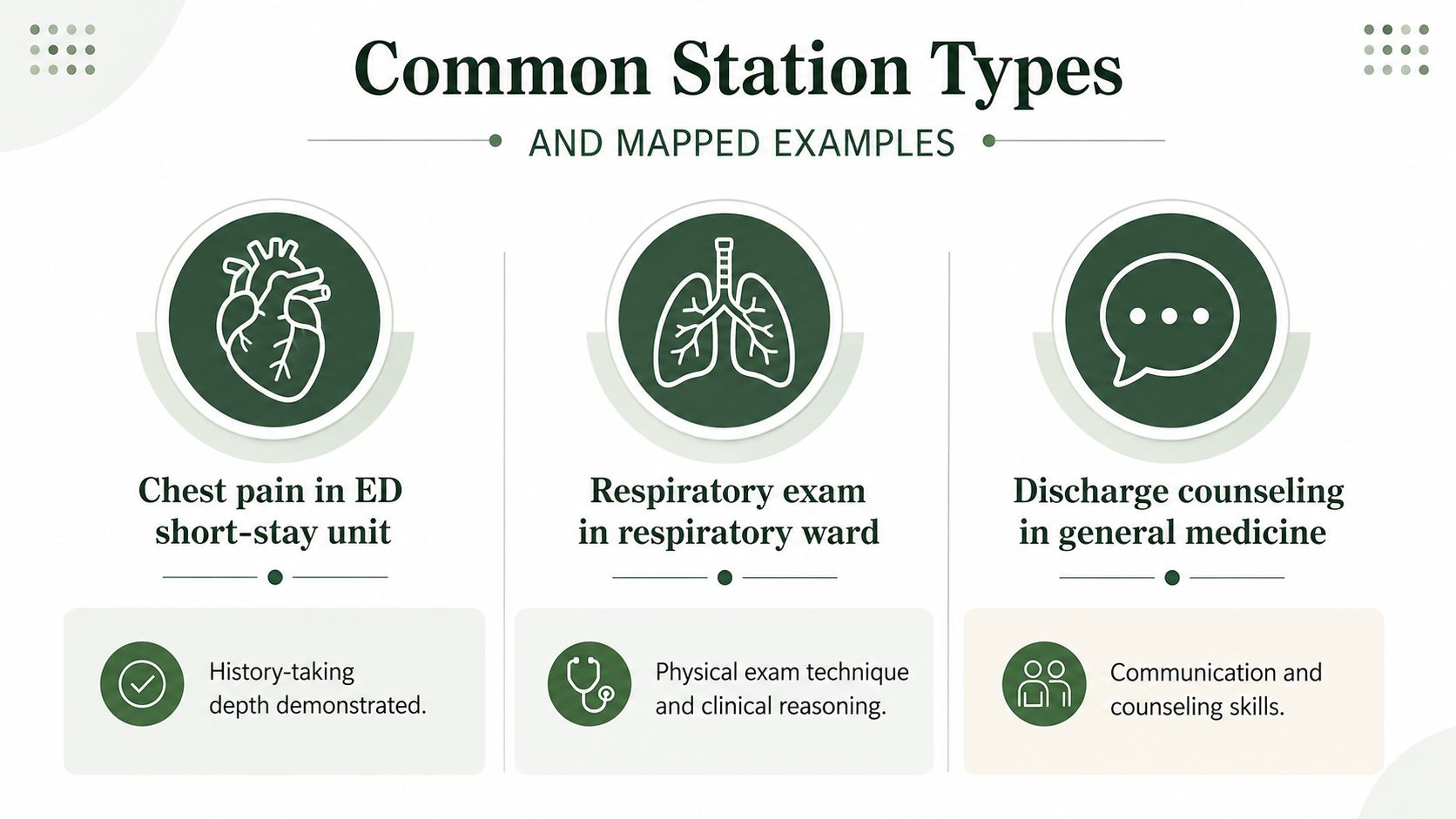
Chest pain in an adult short-stay unit
Start by letting the patient describe the pain in their own words. Then clarify onset, character, location, radiation, provoking and relieving factors, associated symptoms, previous episodes, cardiovascular risk, medications, and the patient’s understanding of what’s happening.
A junior often loses marks by gathering a long history without prioritising immediate threats. Improve the encounter by stating your safety thinking: you’re assessing for acute coronary syndrome while considering other urgent causes, and you’ll escalate promptly if the patient is unstable or the history suggests a dangerous alternative.
Your examination should be focused and linked to the differential. Explain what you’re doing, preserve dignity, and summarise your findings before discussing investigations and management.
Shortness of breath on a medical ward
Breathlessness tests whether you can move from symptom description to physiological risk. Ask about onset and progression, functional impact, orthopnoea, chest pain, cough, fever, wheeze, fluid symptoms, thromboembolic risk, and relevant cardiac, respiratory, metabolic, and medication factors.
The common mark-losing behaviour is an unweighted list of possibilities. Lift the quality by grouping your differential into the most likely, the most dangerous, and the diagnoses your examination or initial tests can distinguish. State what would make you call for help immediately.
Your examination should answer questions about work of breathing, oxygenation, fluid status, cardiac findings, and respiratory signs. Finish by telling the patient what you’ve found and what will happen next.
Paediatric wheeze in an emergency setting
With a child, your communication includes the parent or carer, but the child remains the patient. Adjust your language to the child’s age, observe their behaviour and effort before touching them, and explain each step in a calm way.
Juniors often focus heavily on auscultation and lose marks by underplaying severity assessment. Make escalation thresholds explicit. Describe your assessment of appearance, work of breathing, oxygenation, hydration, feeding, and response to initial treatment, then explain the plan to the parent in plain language.
These examples aren’t scripts to memorise. They’re prompts for deliberate practice. Choose patients from your actual rotation and rehearse the behaviour that your usual clinical exposure gives you the least opportunity to demonstrate.
What Assessors Really Look For in Feedback
The most useful Mini-CEX feedback often has little to do with sounding polished. Assessors watch for patient safety signals, visible clinical reasoning, and how you respond when the conversation changes direction.
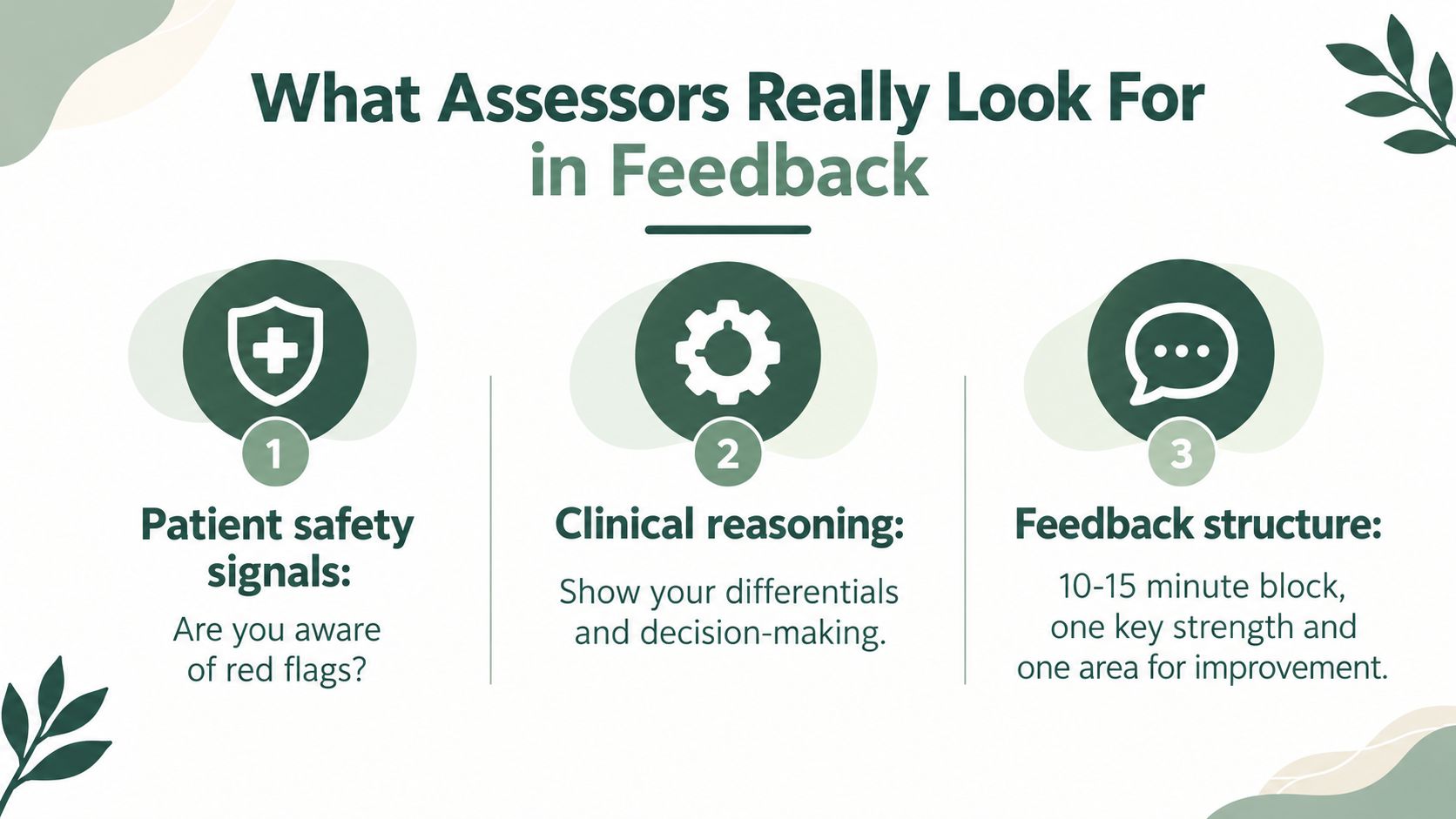
A consultant wants to know whether you recognise when a patient needs help, whether you can ask for that help without delay, and whether your management plan matches the risk. They’re also listening for the reasoning between your findings and your decision. Saying, “I’m concerned about this because…” gives the assessor something meaningful to evaluate.
Your response to redirection matters as well. If the assessor asks about a missed possibility and you become defensive, the encounter reveals less capacity for supervision. If you reconsider the case, explain what you’d change, and identify the safety implication, the feedback becomes evidence of developing judgement.
The feedback request that changes the conversation
Don’t end with “Any feedback?” and wait. Ask for one domain-specific observation:
- “Could you focus on whether my history was structured around the patient’s main concern?”
- “I’m working on making my management plans more explicit. Where did my reasoning become unclear?”
- “Could you comment on how I explained the plan to the patient?”
High-quality feedback names a behaviour, links it to a domain, and gives you a next action. “Good consultation” may feel pleasant, but it doesn’t tell you what to repeat. “You clarified the patient’s fear before explaining the investigation plan. Next time, summarise the agreed plan back to them before leaving” is actionable.
The College’s own Basic Training Mini-CEX Exploratory Study (RACP, accessed 10 September 2026) analysed 384 assessments from 2010 to 2013 and found three things worth knowing. Clinical performance scores showed “very high internal consistency (Cronbach’s α = 0.964)” — meaning the domain ratings move together, which is a mixed blessing rather than pure good news, because it suggests assessors form one overall impression rather than six independent judgements. There was no relationship between Mini-CEX scores and Divisional Clinical Examination performance. And trainees and assessors were “reasonably satisfied” with the tool — reasonably, which is the study’s word, not “highly”.
Two findings from the same study are directly useful when you plan an encounter. The highest scores across the sample went to professional qualities and communication, and the lowest to physical examination skills. Assessors were also less likely to write suggestions for development when they rated a trainee highly overall — so if you want developmental feedback, a strong performance is precisely when you have to ask for it explicitly.
A good Mini-CEX may show that you communicate safely and learn from feedback. On the College’s own evidence, it doesn’t prove you can reproduce the same performance in a high-stakes, standardised exam.
Planning Your Assessments Across the Year
You finish a ward review and a consultant asks, “Can we do your Mini-CEX now?” If you have treated it as a once-a-year hurdle, the request can feel abrupt. A better approach is to use the PREP requirement of 4 Mini-CEX assessments per year, one per quarter or rotation, as four repeated practice cycles. Each encounter gives you a specific behaviour to test, observe, and refine.
If you are on the new curricula, the arithmetic changes but the method does not: 12 observation captures per phase at a minimum of one per month means you get far more attempts, each one smaller. Read the four focuses below as a rotating sequence rather than a four-item list.
Give each training period a focus
Each focus below is named after an actual domain on the form, so the feedback you ask for and the box the assessor ticks are the same thing.
Use the first assessment for medical interviewing skills, domain 1. Ask the assessor to watch how you open the consultation, direct questions at the key problem, use second-order questioning to sharpen focus, and pick up non-verbal cues.
Make the next assessment about physical examination skills, domain 2. Practise a systematic examination, explaining each step, showing sensitivity to comfort and modesty, and integrating your findings with the rest of the picture rather than reporting them separately.
For the following assessment, focus on clinical judgement, domain 5. Weigh the conflicting data out loud, justify your choice of investigations, relate the options to this patient’s situation, and come to a firm decision rather than a list.
Use the final assessment on the two domains trainees consistently under-prepare: counselling skills, domain 4, and organisation and efficiency, domain 6. Counselling is rated on whether you explain the rationale for a test or treatment in terms the patient can use, and whether you give their own wishes priority. Organisation is rated on how quickly and cleanly you synthesise the data in front of you. Neither improves by accident.
Ten prompts for observed practice
Run these with a consultant, senior registrar, or study partner who can observe the process rather than quiz you:
- Chest pain: Begin broadly, then narrow towards urgent causes and risk.
- Shortness of breath: Separate severity assessment from diagnostic labelling.
- Abdominal pain: Build a timeline and explain the purpose of each examination step.
- Undifferentiated fatigue: Explore function, mood, sleep, medications, and red flags without losing structure.
- Paediatric cough: Communicate with both child and carer, then assess severity.
- New anaemia: Explain your initial differential and investigation priorities.
- Falls in an older patient: Include injury, medication, cognition, mobility, and home safety.
- Confusion: Establish baseline function and identify reversible or dangerous causes.
- Discharge counselling: Check understanding, warning signs, medicines, and follow-up.
- A deteriorating patient: Practise calling for help while giving a concise clinical summary.
Before the encounter, read the relevant Mini-CEX form, set a phone timer for the consultation, and write one narrow learning goal. “Improve everything” produces vague feedback. “Make my differential more explicit” gives the assessor a clear target.
Make feedback cumulative
Within 24 hours, record two action items in your learning log: one behaviour to continue and one to change. Revisit them before the next assessment, then tell the new assessor what you have been practising.
The RACP exam preparation guidance can help separate workplace practice from preparation for written and clinical examinations. That distinction protects your time. Mini-CEX is a recurring formative habit, not a rehearsal for every exam station, and the College’s own study found no relationship between Mini-CEX scores and Divisional Clinical Examination performance. Treat the assessments as evidence about your clinical habits, not as a forecast of your exam result.
What Replaced Mini-CEX on the New Curricula
This is not a forecast. For anyone who commenced Basic Training in 2025 or later, it has already happened.
On the new Basic Training curricula, the observed-practice tool is the Observation Capture, not the Mini-CEX. The College defines it as “a work-based assessment tool that documents a supervised observation of a trainee’s performance undertaking a work-task”. The requirement is “12 x observation captures per phase of training, minimum 1 per month”, across three phases — Foundation, Consolidation and Completion (2025 Learning and Assessment Interim Guide, New Basic Training curricula, v1.4, accessed 10 September 2026). They are submitted through the Training Management Platform rather than the Basic Training Portal.
Three differences matter more than the change of name. The volume is higher: a minimum of one a month, against four a year. The assessor pool is wider — the guide states observation captures “can be conducted by a variety of assessors, including those who are not directly involved with supervising the trainee”, and names supervisors, allied health team members, patients and other colleagues. And each capture is linked to one of the ten learning goals rather than rated across six fixed domains, which is the practical shape of programmatic assessment: supervisors weigh many small pieces of evidence over time instead of treating one form as a complete statement about a trainee.
Neither system is the simpler one. They are differently shaped, and the requirement that applies to you is decided by a commencement year you cannot change.
What current trainees should do
Keep your own simple record of observed encounters, feedback themes, and actions. Include the clinical context, the domain discussed, the assessor, and what you changed afterwards. This isn’t a replacement for the Basic Training Portal or the Training Management Platform. It’s a practical backup that helps you recognise patterns and transfer useful history when curriculum requirements change.
Seek breadth in your feedback. A single familiar assessor may know your strengths, but different clinicians observe different aspects of practice. A consultant may notice management safety, while a senior registrar may give sharper advice about workflow, examination technique, or patient communication.
Treat each observation as low-stakes evidence that compounds. Don’t chase one impressive encounter. Build a reliable record of how you listen, examine, reason, communicate, escalate, and improve across different clinical environments.
The open question is how Observation Captures will connect with future signals of readiness for the Divisional Clinical Examination. Nothing published yet answers it, and the Mini-CEX evidence gives no grounds for assuming workplace assessment results predict exam performance. Use the system for what it does best: improving patient care through repeated observation and specific feedback, while preparing separately for the demands of the summative examination.
CliniRoo is building preparation material for the Australian pathway, including the college written and clinical examinations that sit at the end of Basic Training. Nothing is on sale yet. If you want to be told when there is something to use, CliniRoo takes an email address and does nothing else with it.