Workplace Based Assessment in Australia: Tools and Pass Rules
The AMC workplace based assessment pathway for international medical graduates: the tools, the pass rules, eligibility, and how to prepare.
You’re on a busy ward round. Your supervisor says she’ll observe your next admission for a mini-clinical evaluation exercise (mini-CEX), discuss yesterday’s discharge in a case-based discussion (CBD) tomorrow, and remind the nursing team to finish your feedback forms. You’re not sitting an exam that day, but you’re being assessed all the same, and it’s hard to know which part of the work counts for what.
That’s the reality of workplace based assessment (WBA) in Australia. In this guide WBA means the Australian Medical Council (AMC, the body that assesses overseas-trained doctors for registration) program for international medical graduates (IMGs, doctors who qualified overseas). It’s not one test. It’s the same clinical work judged through different tools, each looking for a different output. Once you can separate those outputs, you can prepare for each one deliberately.
Table of Contents
- The Workplace Based Assessment Tools at a Glance
- Why the Australian Pathway Assesses Observed Work
- How Each Assessment Is Scored
- How to Prepare for Each Assessment Format
- Problems That Affect Results and How to Respond
- Eligibility Steps and Pre-Application Checklist
The Workplace Based Assessment Tools at a Glance
Workplace based assessment judges how a doctor performs in real clinical work, sampled across many encounters rather than in one exam room. You don’t leave the ward, clinic or emergency department to prove yourself elsewhere. Assessors watch, question and collect feedback on work you’re already doing, then record it against named criteria.
That matters because real work exposes things an exam station can’t. You can know the guidelines for heart failure and still interrupt the patient, forget allergy checking, hand over vaguely, or write a note nobody can follow. Each tool isolates one slice of that performance so it can be observed and documented fairly.
The Five Tools You Are Most Likely to Meet
| Tool | What it assesses | Who assesses | Output |
|---|---|---|---|
| Mini-CEX | A focused patient encounter: history, examination or counselling | A registered medical practitioner | Rating form and feedback; the AMC puts a mini-CEX at 20 to 30 minutes including immediate feedback |
| CBD | Clinical reasoning on a patient whose care you were involved in | A registered medical practitioner | Rating and feedback at the end of the discussion |
| DOPS (direct observation of procedural skills) | Component skills of a procedure: consent, preparation, technique, communication | A medical practitioner, or a registered nurse with clinical assessment experience | Rating and feedback |
| MSF (multi-source feedback) | Performance over time as seen by colleagues and co-workers | Medical colleagues, nurses, allied health, sometimes patients | Questionnaire-based feedback |
| ITA (in-training assessment) | Performance in real clinical settings over a period of time | Assigned supervisors, with input from others | Structured supervisor report |
The definitions and the mini-CEX timing come from the AMC standards for accreditation of WBA providers. For mini-CEX and CBD, the AMC defines an assessor as someone with general or specialist registration and at least four years’ postgraduate experience in the Australian healthcare environment, or equivalent experience.
A mini-CEX is the most direct observation. A senior clinician watches one focused encounter, for example your history and cardiac examination in a patient with breathlessness, then rates what she saw and tells you what to change. If you want the mechanics of that encounter in physician training, our guide to the Royal Australasian College of Physicians (RACP) mini-CEX format walks through what assessors watch.
A CBD happens away from the bedside. Usually you select the records of two or three patients you helped manage, the assessor picks one, and tests the decisions behind the note. Why that antibiotic, why no computed tomography (CT), what alternative diagnosis did you consider, and what would you do differently now?
DOPS narrows the lens to one procedure, such as cannulation, catheterisation or a joint aspiration. Consent, aseptic technique, patient comfort and safe disposal count, not just whether the needle went in.
Tools That Look Beyond One Encounter
MSF doesn’t test your knowledge at all. Medical colleagues and co-workers such as nurses and allied health staff complete questionnaires on how you perform over time. It captures how you behave when no supervisor is standing beside you.
An ITA, also called a structured supervisor report, summarises your supervisors’ observation of you in real clinical settings over a period. Others may contribute on communication, interpersonal skills, ethical behaviour, reliability and professional integrity.
Practical rule: Ask which output you’re producing before you start. Observed performance, spoken reasoning, a safe procedure and team behaviour need different preparation, even when they come from the same patient.
In AMC-accredited programs, mini-CEX, CBD and MSF are mandatory. Most providers also use DOPS, ITAs and logbooks so that every clinical area and assessment domain is covered (AMC WBA notice of intent form, 2026). If you’re unsure what’s active in your placement, ask for the list in your first week rather than discovering a missing DOPS in your final week.
Why the Australian Pathway Assesses Observed Work
A candidate cannulates a difficult vein on the first attempt and the supervisor is pleased. The same week, that doctor explains a new diagnosis to a frightened patient and finishes without checking what the patient understood. One observed encounter, two different outputs, and, depending on which form is being completed, two different sets of criteria.
That is the logic behind assessing work rather than only examining knowledge. A closed-course driving test proves set manoeuvres on one good day. A licence built from supervised drives on real roads shows how someone handles rain, traffic and a mistake that needs correcting.
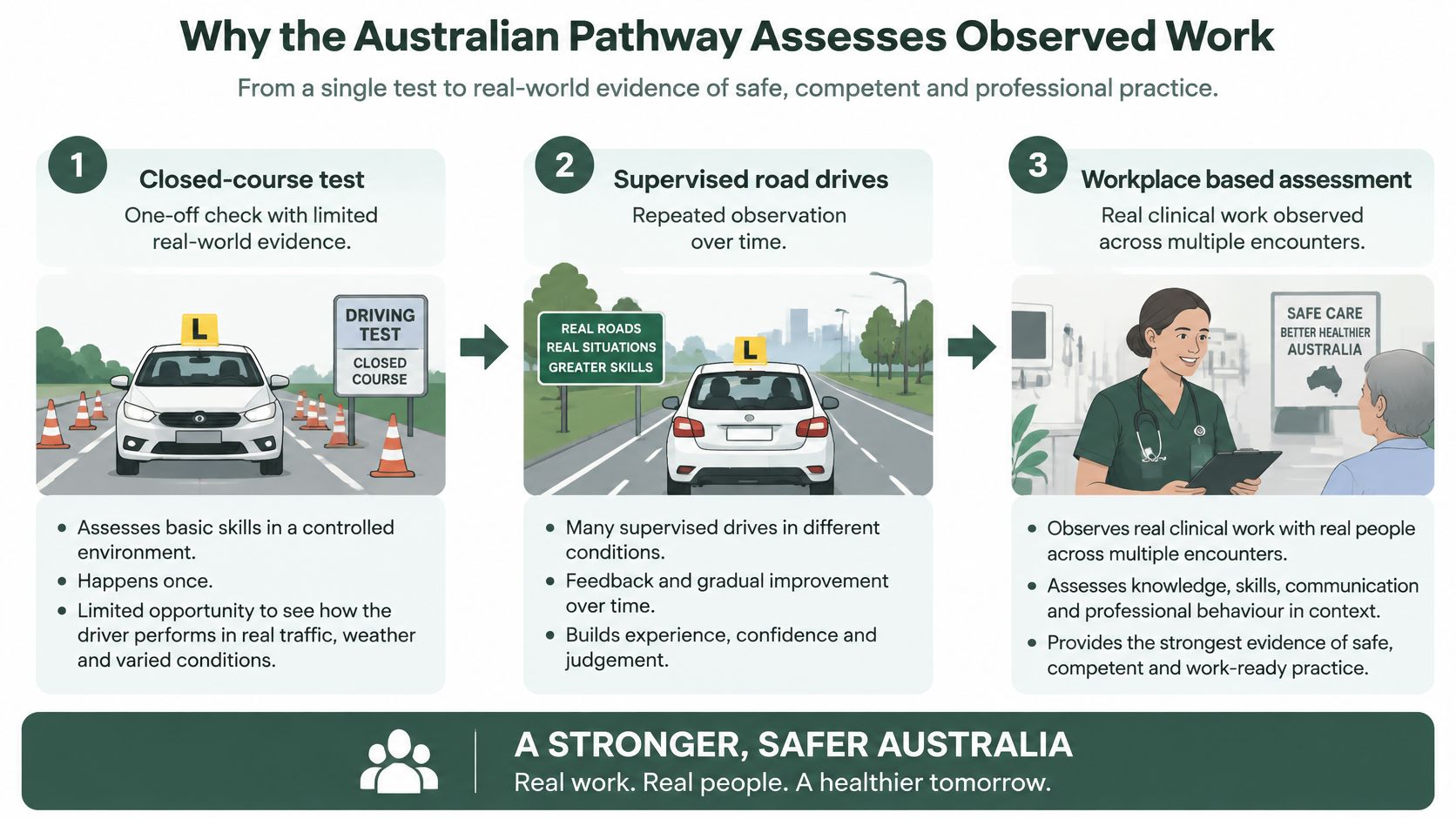
Australia’s WBA pathway for IMGs follows that second principle. The AMC’s 2022 standards for accreditation of WBA providers describe it as developed in response to a 2006 Council of Australian Governments directive for nationally consistent assessment of IMGs, and it is an alternative to the clinical examination component of the Standard Pathway. Successful candidates are awarded the AMC Certificate, which qualifies them to apply for general registration. WBA is high-stakes assessment relocated into the workplace, delivered by an accredited provider with defined methods and recorded outcomes, not orientation, shadowing or a supervisor’s friendly sign-off.
What has to Happen Before WBA Starts
WBA is not the entry point. Candidates first pass the AMC Computer Adaptive Test Multiple Choice Question (CAT MCQ) examination and obtain limited registration from the Medical Board of Australia. Only then can they start WBA in an approved hospital or general practice position.
The sequence interacts with your wider paperwork. If you have had time away from clinical work, our guidance on Australian Health Practitioner Regulation Agency (AHPRA) recency of practice requirements explains how registration status and recent practice are treated as separate questions, and how mixing them up causes avoidable delay.
The principle underneath: competence covers diagnosis and treatment, and it also covers communication, prescribing, counselling, procedures and professional behaviour. A written exam cannot see whether you explain warfarin risks clearly or escalate a deteriorating patient at the right moment. Repeated observation can, provided the observation is structured.
How Each Assessment Is Scored
The same ten minutes of clinical work can carry three different scores. A mini-CEX rates what an assessor watched you do with the patient. A CBD rates how you reasoned about that same patient afterwards. Multisource feedback rates how your behaviour registered with the team across the weeks around it. One encounter, three instruments, three sets of criteria.
The AMC sets the pass rules for the three mandatory methods, and they apply to every accredited program (AMC WBA notice of intent form, 2026).
| Method | How many | Pass requirement or guidance |
|---|---|---|
| Mini-CEX | 12 across the program, two in each clinical area | 9 of 12, and at least one in each clinical area |
| CBD | 6 across the program, covering at least three clinical areas | 5 of 6 |
| MSF | As a guide, two rounds: the first formative, the second summative at the 10-month mark of a 12-month program | Six to twelve assessors recommended in each category, for example six medical colleagues and six co-workers |
Metro North Health in Queensland, for example, assesses across the same six clinical areas as the AMC clinical examination: adult medicine, adult surgery, women’s health, child health, mental health and emergency medicine, over 12 months (Metro North Health WBA program). The AMC also notes that a single mini-CEX cannot cover every required domain, so each one samples some of them, and across the program you are assessed on the full range. Before each assessment, you should know which dimensions are being assessed and which clinical area it counts for.
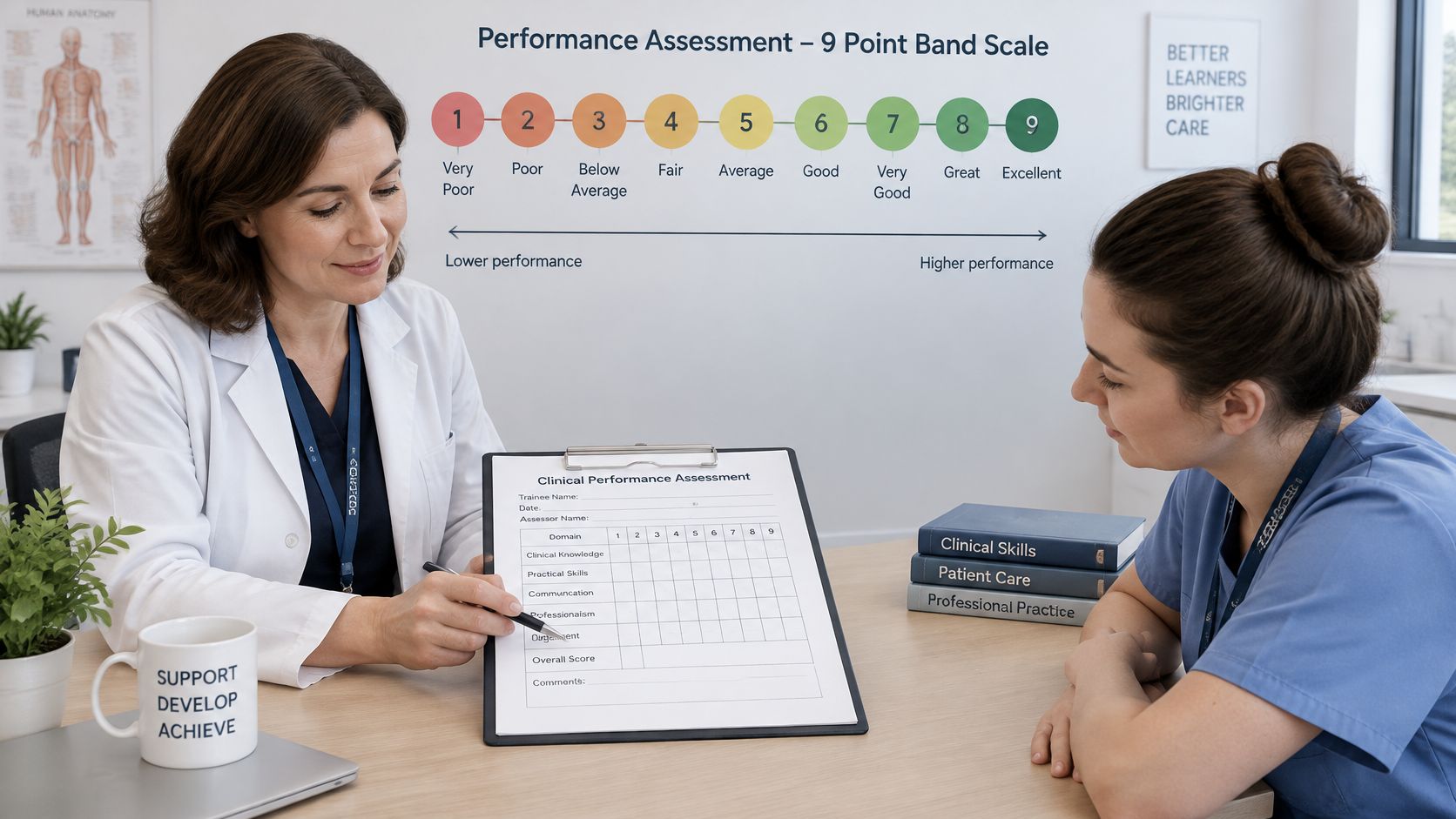
A rating below the standard doesn’t mean you’re a bad doctor. It means that observed performance, on that day and against those criteria, fell short. The useful part is the written comment beside the rating, because it tells you whether the gap was technique, reasoning, communication or safety. A weak mini-CEX often points to structure or examination technique. A weak CBD more often points to thin reasoning or an unsupported management plan.
Read the domain list on the form before you read your score. Your MSF raters are not scoring your differential at all; they are scoring how you communicate, hand over and follow through. The candidate who shines in the observed encounter and fades in the follow-up conversation is being measured accurately, not harshly.
Why One Score Does Not Decide the Outcome
Your outcome comes from a pattern across many observations, different assessors and different methods, not from one encounter. The pass rules above build that in: you can fall short on three of twelve mini-CEX and one of six CBDs and still pass.
That structure protects you. If one assessor is unusually harsh or generous, the other assessments dilute the distortion. Blueprinting adds a second protection, because each task is linked in advance to specified competencies rather than to whatever an assessor happens to value that day.
A single low rating is information. The same weakness named by three assessors, in two different formats, is a finding you need to act on.
An ITA sits beside the numbers as narrative. It explains context the ratings can’t, such as steady improvement after a difficult start or strong performance in a constrained rotation. Read it alongside the scores, not instead of them.
There is a fairness problem in this design worth naming. Your evidence depends on the workplace you are placed in. A rotation with complex cases, senior supervision and a wide pool of trained assessors generates richer observations than a quiet term with one supervisor and a narrow case mix. Two candidates can complete the same number of assessments and not face the same test. Where your workplace is thin, keep your own record of the domains you have been observed in and ask for the gaps to be filled before a summative judgement is made.
What to Check on Every Form
Before you file any form, run three checks.
- Named criteria tested: Did the encounter let you demonstrate the domains being rated?
- Comments matching the rating: Does the written feedback explain the number, or contradict it?
- Fair case mix: Was the case complex enough, and suitable enough, to test you properly?
The national pass counts are fixed, but each provider documents its own assessment blueprint, including which other methods it adds and how those are judged. Ask your provider for it in writing before your first summative assessment.
How to Prepare for Each Assessment Format
Say you’re a registrar reviewing a patient with chest pain at 2 pm. Your consultant watches you take the history and examination, and that’s a mini-CEX. Two days later you discuss that patient’s troponin, risk stratification and discharge plan in a CBD. That same week, the nursing team completes MSF forms based partly on how you handed over and followed up results.
It’s one patient and one stretch of work. Yet you’re judged three different ways, so preparing only the cardiology facts leaves two of the three outputs unrehearsed. Prepare the format, not just the case.
Preparing for a Mini-CEX
A mini-CEX rewards concise, complete observed performance. Practise a focused history or examination you can finish well inside the 20 to 30 minutes the AMC allows for the encounter and feedback together, without rushing the patient. Introduce yourself, check identity and allergies, signpost what you’re doing, and summarise back what you’ve heard.
Say your thinking aloud at the end. A short closing summary works well: your working diagnosis, the two alternatives you haven’t excluded, and your immediate plan. If you stay silent, the assessor can only rate your technique, not your reasoning, and you’ll lose marks you deserve.
Choose suitable patients deliberately. A stable patient with a clear presenting complaint lets you show structure. Save the chaotic multi-problem admission for later in the placement, when your routine is reliable.
Preparing for a CBD
A CBD rewards evidence-based reasoning and honest reflection. Choose the two or three records you offer carefully, since the assessor picks one, and re-read your own documentation first, because the assessor will work from it. Gaps in the note become gaps in the discussion.
Prepare four points before you sit down.
- The decision: What you chose, for example discharge with GP follow-up rather than admission.
- The evidence: Which guideline or local pathway supported that choice.
- The alternatives: What else you considered and why you rejected it.
- The reflection: What you’d do differently, stated specifically rather than apologetically.
Assessors respond well to calibrated uncertainty. Saying you’d now check one more result before discharge sounds safer than insisting every decision was perfect.
Preparing for MSF
You can’t cram for MSF the night before. It measures performance visible to the wider team over weeks, and in AMC programs the first round is formative, so use its feedback before the summative round. Clear handover, respectful requests to nursing staff, answering pages promptly and closing the loop on tasks you promised are what colleagues remember when the form arrives.
Small habits carry weight here. Introduce yourself to new ward staff, explain delays instead of disappearing, and thank people who flag problems early. None of that is clinical knowledge, and all of it is assessable.
Three Habits That Help Every Format
- Ask early: Request an observation in the first half of each placement, while there’s still time to repeat it.
- Name a goal: Tell the assessor beforehand what you’re working on, such as tighter summaries or safer prescribing checks.
- Ask for one change: Finish by requesting one specific behaviour to change, not a general verdict.
You’ll know preparation is working when observations happen on schedule and written feedback names a concrete behaviour, such as pausing before answering or stating allergies before prescribing. General praise feels pleasant, but it doesn’t improve your next score.
Problems That Affect Results and How to Respond
The uncomfortable point comes first. The same skills can score differently across hospitals because case mix, staffing, supervision and rotation access differ. Repeated observation makes assessment more authentic, but it also makes you dependent on local opportunity. If your service rarely admits the presentations on the blueprint, you get fewer chances to prove the same competence as a candidate in a busier unit.
Assessors also have to separate clinical competence from unfamiliarity with local systems. The AMC program tests whether you can practise safely “within the Australian healthcare environment and cultural setting”, and a low score can blur weak reasoning with not knowing a local referral pathway, documentation convention or escalation number.
Those are different problems with different fixes. Treating a systems gap as a competence failure is unfair, and treating a competence gap as a systems issue is unsafe. Your job is to help the record distinguish them clearly.
| Problem | Likely cause | What to do |
|---|---|---|
| Too few observations in a placement | Limited case mix or constrained rostering | Log missed opportunities with dates and reasons, then request a timed observation |
| Scores low across a whole rotation | Unfamiliar local systems, referral pathways or documentation | Ask the assessor, in writing, to separate clinical competence from local process knowledge |
| Feedback is vague | Assessor unfamiliar with formative feedback | Ask for one named behaviour to change and a follow-up observation |
| A rating seems inconsistent | Single assessor and no comparison | Request review against the form’s named criteria and the other assessments on record |
| Assessor unavailable | Rotations, leave or shift changes | Agree a backup assessor and a date with the program coordinator |
Separating Feedback From Decisions
Keep formative feedback and summative decisions apart in your mind and in your folder. Formative feedback is for learning. It can be blunt, provisional and focused on experiments you should try. Summative decisions record outcomes that follow you. Ask, before each observation, which one you’re entering. That one question prevents a great deal of later confusion.
Ask also which shortcomings are considered remediable in your program and over what timeframe. Slow documentation usually is remediable. Repeated failure to escalate a deteriorating patient after feedback is a different category, and you should hear that distinction stated plainly.
How to Request Review or Remediation
Put requests in writing through the provider. Frame them around evidence and learning rather than dispute. A workable wording is that you’d like the rating reviewed against the form’s named criteria and your other assessments, and you’d like a further observed encounter with a different assessor.
Don’t frame the request as a sign that you’re unsafe, and don’t apologise for asking. You’re requesting the triangulation the system is designed to provide.
Record keeping point: Document the date of each missed opportunity, the reason it was missed and the alternative you were offered. A dated log protects you far better than a general complaint made at the end of a placement.
Calm, specific records also help good assessors help you. They can reallocate cases, nominate a backup assessor or schedule remediation while there’s still time in the rotation.
Eligibility Steps and Pre-Application Checklist
The eligibility sequence is fixed. Treating it as flexible is where delays begin, and a job offer does not repair a missing earlier step. Work through the steps in order, and keep proof of each step in one folder you can send to a provider.
The AMC eligibility and application guidance for WBA sets the entry conditions. You need a pass in the AMC CAT MCQ examination, limited registration that lets you be employed in an approved WBA clinical position, and an appointment to a hospital or general practice position for the full length of the program, which runs 6 to 12 months. Within the program, the provider must use at least mini-CEX, CBD and MSF, with multiple observations by multiple assessors over time.
You don’t apply to the AMC directly. You contact an accredited WBA provider and express interest; the provider nominates you through the AMC WBA portal, and AMC staff check your eligibility. If you are offered a place, the AMC emails you a payment link, or you can decline. Accepting a WBA place means withdrawing from the AMC clinical examination.
The Six Steps in Order
- Pass one AMC CAT MCQ examination. WBA cannot start before this result exists, so sequence your study and applications around it rather than hoping a provider will wait.
- Obtain limited registration from the Medical Board of Australia. An approved clinical role requires registration first. A position you cannot lawfully fill is not yet a WBA opportunity.
- Secure an appointment to an approved hospital or general-practice position. Check approval before you sign. A convenient job is not automatically a recognised placement.
- Confirm the provider is AMC-accredited and that your position is part of its program. The AMC publishes the list of accredited providers. Get confirmation in writing from the provider, not just reassurance from the roster office.
- Plan the assessment schedule from your first weeks. A mini-CEX is a snapshot of one encounter. A CBD tests reasoning after the fact. MSF gathers other people’s views over time. Spread all three across the term. Observations bunched at the end look rushed, leave no room to repeat a weak performance and may not satisfy the blueprint.
- Keep a dated record of every observation and assessor. Record the tool, date, assessor, case type and one feedback point. Your log lets the provider match results to its blueprint and lets you spot gaps while they are still fixable. If your workplace cannot offer the required variety, raise it early with the provider.
What Accreditation Means for You
WBA is delivered locally by approved state, hospital and general-practice providers. It is still a governed system. Each provider must show governance, trained and calibrated assessors, appropriate patient and case selection, assessment blueprinting, provisional-result processes and secure candidate records.
Providers report outcomes to the AMC and submit an annual report. A new provider’s accreditation is reviewed once the AMC’s Assessment Committee has evaluated the results of its first cohort, and established providers are reaccredited at least every four years. Separately, the AMC charges candidates when a place is offered (the eligibility page gives no amount), so ask what costs fall to you before you accept.
Your Pre-Application Checklist
Before you commit to a position, confirm each item in writing.
- CAT MCQ pass: Result recorded and available to the provider.
- Limited registration: Granted, current and matched to the role.
- Approved position: The specific job, not just the hospital, is part of the provider’s WBA program.
- Accredited provider: Accreditation is current and covers your setting.
- Assessment blueprint: You have seen which tools apply to your role and how results combine. Ask for this in writing, because “we do mini-CEX” is not a schedule.
- Logbook and feedback routine: Agreed before your first observation, including who reviews it and how often.
- Case mix and assessor access: Ask who will observe you, how many assessors you will see and what happens if a required case type does not appear during your term.
If your next step after general registration is a college pathway, the guide to RACP basic training entry and structure explains what follows.
Take one action this week. Email the provider with your position title, department, start date and registration status. Ask for the assessment blueprint in writing. That reply tells you which tools apply, how often you are observed and what evidence you should start collecting from day one.
CliniRoo is building preparation material for the Australian pathway. Nothing is on sale yet. If you want to be told when there is something to use, CliniRoo takes an email address and does nothing else with it.