Specialty Training Australia Explained for Junior Doctors
Understand specialty training Australia pathways, college structures, selection timelines and what junior doctors need to know to plan your next step.
You’re probably in the phase where everyone keeps asking, “So what are you applying for?” and your honest answer is still, “I’m not fully sure how the system even works.”
That’s normal.
Most junior doctors first meet specialty training in Australia as a blur of acronyms, rotating terms, whispered advice from registrars, and a creeping sense that everyone else somehow knows the rules already. One RMO is polishing a surgical logbook. Another is lining up physician references. Someone else says you need the “right network” before you even think about applying. None of that feels like one national pathway, because it isn’t.
Australia doesn’t run specialty training like a single graduate recruitment round. It runs more like a federation of linked but different systems. Colleges set standards. Hospitals host jobs. States and networks shape local opportunities. Training providers often score applicants using different rubrics, formats, and expectations. That’s why the same applicant can look strong in one process and miss out in another.
That mismatch is where many people lose time. They prepare for “interview skills” in the abstract, when what they need is format-specific preparation. They collect achievements without checking which domains a pathway scores. They assume a polished generic answer will travel well across colleges and networks. Often, it won’t.
Table of Contents
- Introduction to Specialty Training in Australia
- How the Australian Specialty Training System Works
- Comparing College Pathways and Entry Routes
- How Selection and Scoring Actually Work
- Why State and Hospital Network Differences Matter
- Growth Funding and Workforce Pressures Shaping Training
- Planning Your Next Steps Towards Specialty Training
Introduction to Specialty Training in Australia
A common scene goes like this. You finish internship, start residency, and realise your next decisions carry more weight than medical school choices ever did. Which rotations should you chase? Which references matter? Do you need research now, or later? Should you commit early, or keep your options open?
The confusion comes from the way the system is built. “Specialty training Australia” sounds like one road. In practice, it’s a map with different highways, toll booths, and entry ramps depending on the college and location. A physician pathway doesn’t behave like a surgical one. A local network may use one scoring style, while another values the same evidence differently.
Why junior doctors get mixed messages
Senior advice is often sincere but incomplete. A registrar may tell you what worked for their college, their state, and their year. That can be useful. It can also be misleading if you apply it unchanged to a different pathway.
The question usually isn’t “What makes a good applicant?” It’s “What does this specific process score, and how does it score it?”
That’s the key shift.
If you understand the architecture early, you can make cleaner decisions. You stop treating every term as equal. You become more deliberate about rotations, referees, audits, teaching, interview practice, and timing. You also waste less energy copying someone else’s strategy when their pathway isn’t yours.
What makes this maze manageable
You don’t need to know every college rule on day one. You do need a working model:
- Colleges set the training standards
- Hospitals and networks deliver much of the training experience
- Selection methods differ
- Local variation matters more than most generic guides admit
Once that model clicks, the jargon becomes easier to translate into decisions. “Vocational training” stops sounding abstract. “Accredited post” becomes something practical. “Weighted interview” starts to explain why one candidate gets through and another doesn’t.
How the Australian Specialty Training System Works
You finish an RMO year in one hospital, your friend finishes in another, and both of you decide to apply for the same specialty. On paper, your experience can look similar. In practice, one pathway may count those terms, referees, and assessments very differently from another. That is the part of the system that catches people out.
Australian specialty training works like a set of separate training systems sitting inside one health workforce. The colleges set the rules for specialist entry, training standards, exams, and fellowship. Hospitals and health services provide the day-to-day clinical work, supervision, and many of the accredited posts that let you meet those rules.
Australia’s specialist training structure is built around 16 specialist medical colleges that between them represent all the major specialty groups, as set out in a Medical Journal of Australia history of Australian specialisation (A brief history of the specialties from Federation to the present, 2014). The list of recognised specialties and fields of specialty practice is maintained separately by the Medical Board of Australia and changes over time, so check the Board’s current list rather than a count quoted in an article.
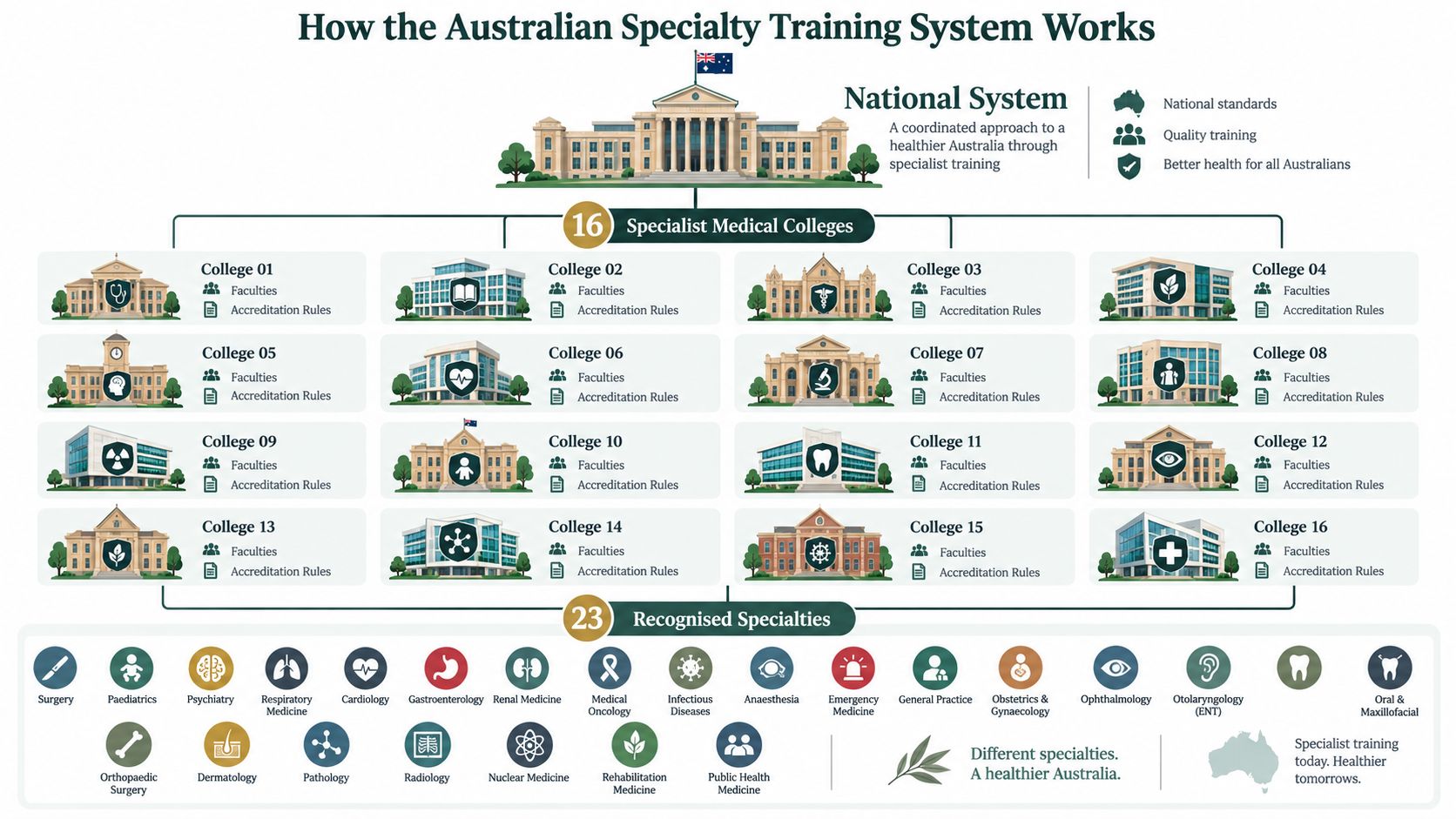
Colleges set the standards. Training sites supply the posts
A college decides what counts as approved training, which jobs are accredited, what assessments matter, and what you must complete before fellowship. A hospital can give you excellent clinical exposure and still offer limited value for your target pathway if that post does not line up with the college’s rules.
That is why two ICU terms, two ED jobs, or two surgical SRMO posts are not automatically interchangeable.
A helpful way to picture it is to treat the college as the examiner and the hospital as the classroom. The classroom matters. The examiner still decides what counts toward passing. If you want a broader map of how internship, residency, and later training fit together, this overview of medical training in Australia gives that bigger picture.
Prevocational and vocational are different stages
These terms sound abstract until you translate them into decisions.
- Prevocational training is the early hospital stage, where you build general experience, complete required terms, and test which specialty direction fits.
- Vocational training is the formal college training program you enter after selection.
That distinction matters because many junior doctors describe themselves as “doing specialty training” when they are still in the stage of building eligibility, signals of commitment, and scoreable evidence for entry.
The system is national in outline, but local in effect
Generic advice starts to fail.
The broad architecture is recognisable across Australia. Colleges accredit training, hospitals deliver much of it, and trainees move through supervised posts toward fellowship. But your real experience depends on the combination of college, state, and hospital network attached to your application.
The same applicant may look strong in one setting and ordinary in another. One network may reward long local referee relationships. Another may place heavier weight on interview performance. A college may care about specific prerequisite rotations, while a local service may first screen for network familiarity or service needs. The system is not random. It is layered.
Funding shapes where posts exist
Specialty training is also shaped by funding and accredited capacity. Governments support training posts, and colleges approve how those posts fit within a pathway. That means training opportunities are not spread evenly across hospitals or regions, even within the same specialty.
For you, the practical question is simple. Does this job only give useful experience, or does it also build recognised progress toward the pathway you want?
Why this matters when you choose jobs
A job is never just a job once you have a target specialty in mind. It is evidence. It may be evidence of breadth, commitment, local fit, procedural exposure, referee quality, or readiness for a specific selection format.
So the order of thinking matters:
- Pick the college pathway you are targeting.
- Check what that pathway recognises and scores.
- Choose jobs that build those exact signals.
Many JMOs do this backwards. They collect terms first, then try to explain the pattern later. A better approach is to build your CV the way a college or network will read it. That is how the same amount of effort starts converting into a stronger application, rather than just a busier one.
Comparing College Pathways and Entry Routes
Not all specialty pathways ask you to enter training at the same point. Some expect a broad base first. Others run more direct competitive entry. Some are heavily tied to local networks. Others have a clearer college framework with local selection layered on top.
That’s why “When should I apply?” has no universal answer.
Different colleges mean different timelines
A physician-style pathway often has a staged structure. You may enter a broad early program, complete basic training requirements, then later compete or progress into advanced training. A surgical pathway is often understood much earlier by applicants as a competitive target, with stronger emphasis on building a portfolio before formal selection.
Other specialties may sit somewhere in between. You might need specific prevocational rotations, particular supervisors, demonstrated interest in the field, or local health service experience that makes your application easier to interpret.
The entry point isn’t interchangeable. “Ready for training” in one college may be “still too early” or “missing prerequisites” in another.
College Pathway Structures at a Glance
| College Pathway | Training Structure | Typical Entry Point | Core Selection Components |
|---|---|---|---|
| RACP Basic Training | Broad physician training followed by later advanced specialty progression | After early resident years with relevant medical experience | Application materials, structured interview, references, local provider processes |
| RACS SET | Competitive specialty-specific entry into surgical education and training | After building surgical exposure, CV evidence, and referees in prevocational years | Structured CV or portfolio evidence, interview, supervisor assessments, specialty-specific criteria |
| College pathways with national screening plus local shortlisting | Standardised early assessment followed by local selection steps | Varies by pathway and region | Written assessment, structured interview stations, geographic or local preference, further site-based review |
| Jurisdiction or network-shaped specialty entry routes | College standards combined with local operational requirements | Often depends on local rotations and workforce pathways | Application review, interview, references, local priorities and predefined scoring domains |
For readers interested in the surgical side specifically, this breakdown of how to become a surgeon in Australia is useful because it shows how early career decisions feed into SET competitiveness.
The practical mistake to avoid
Many applicants compare themselves to a friend in another stream and panic. That usually creates the wrong kind of urgency.
If your friend is assembling a surgical portfolio and you’re considering physician training, you shouldn’t copy their checklist. If you’re looking at a pathway with strong local-network influence, broad generic achievements may matter less than evidence that fits the published domains used by that provider.
A cleaner approach is to build a one-page pathway summary for each specialty you’re seriously considering:
- Eligibility. What must be completed before application?
- Timing. When do applications usually open relative to your resident years?
- Selection components. Is the pathway interview-heavy, portfolio-heavy, or mixed?
- Local dependence. How much does state or network context shape the process?
That exercise usually clarifies whether your uncertainty is about the specialty itself or just about not yet understanding the application mechanics.
How Selection and Scoring Actually Work
Most junior doctors still imagine specialty selection as a room with a panel deciding whether they “like” you. Some processes do still feel personal. But many Australian training pathways are much more structured than that.
A worked Australian example shows what that looks like. When General Practice Education and Training piloted a national selection system for general practice training, eligible candidates took a 50-item written situational judgement test and an observed four-station multiple mini interview — five stations for those on a rural training pathway (Selection into specialist training programs: an approach from general practice, MJA 2011). That pilot is now well over a decade old and general practice training has since changed hands, so treat it as an illustration of selection-centre design rather than a description of any process running today.
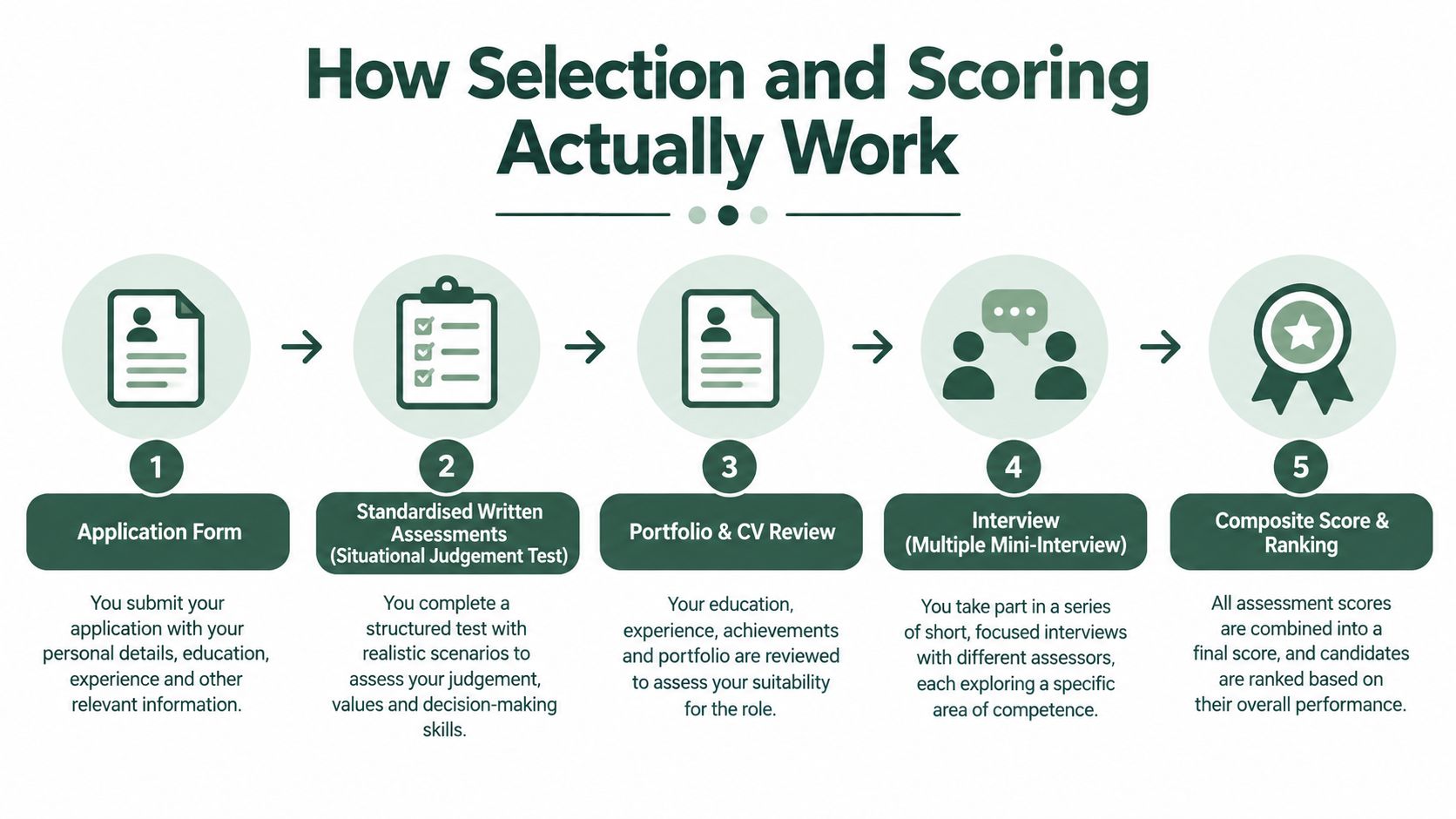
Composite scoring changes how you should prepare
That design tells you something important. Selection may separate different types of evidence instead of letting one long interview dominate from start to finish. A written situational judgement test looks at judgement in standardised scenarios. A multiple-mini interview looks at how you respond in short stations with independent scoring.
So if you prepare only polished conversational answers, you may still underperform. The format is asking for repeated, concise, structured performance under time pressure.
A practical example helps. In a long traditional interview, one strong rapport-building moment can improve the whole interaction. In an MMI, each station resets the game. You can’t rely on “winning the room” once and carrying that goodwill through.
Here’s a short explainer before the next layer of scoring detail:
Rubrics often matter more than charisma
RACP guidance for training providers states that, to assess suitability and ensure rigour and fairness, “there should be at least three assessment components in the selection process: 1. applications (e.g. CV and written responses to key selection criteria) 2. interviewing 3. references”, and that “the method for weighting and scoring each of these components should be clearly established in the planning phase of the local selection process” (Guidelines for Training Providers on Local Selection for Training).
Read that second clause again, because it is the useful one. The weighting is decided locally, in advance, by the provider running your selection — it is not set nationally and it is not something you can infer from another network’s process. The guidance also directs that interview performance be scored independently by each panel member before a consensus score is reached, which is why a single strong rapport moment matters less than it would in a conversational interview.
The practical consequence: the only reliable way to know what carries the most weight in your process is to find the document your own training provider published for your intake year. If it names the components and their weightings, prepare in that proportion. If it does not, ask the selection office rather than assuming the split.
What format-specific preparation looks like
Generic interview coaching often tells candidates to “show insight” or “communicate clearly”. That’s too vague for a scored process.
Format-specific preparation means asking:
- What domains are being scored? Communication, judgement, teamwork, professionalism, organisation, fit with local service needs, or something else.
- How long is each answer expected to be? A two-minute station answer is different from a ten-minute semi-structured interview response.
- What must you volunteer without prompting? Some formats reward candidates who identify safety, escalation, ethics, and systems issues unprompted.
- Is each station independently scored? If yes, you need consistency more than theatrical impact.
This is also where structured practice helps. Most candidates end up building their own station bank from their pathway’s published policies and their own notes, which is slower than it sounds but forces you to read the criteria you are being scored against. Whichever route you take, work from the scoring domains your process names rather than from a generic interview list. Which body sets those domains for your pathway — the college nationally, or your state network — is set out in our guide to specialty selection interviews in Australia.
Why one “best answer” doesn’t travel well
A polished answer to “tell us about a conflict” may work in one panel and score poorly in another if the rubric emphasises escalation, patient safety, or reflective practice differently. The problem isn’t that your answer was bad. The problem is that you prepared for a topic, not a scoring system.
That’s the hidden shift. In specialty training Australia, content knowledge matters. But in selection, scorable behaviour inside a specific format often matters just as much.
Why State and Hospital Network Differences Matter
Even when the college is the same, your application experience may not be.
A lot of junior doctors search for one national formula because that feels efficient. The trouble is that local variation can be the decisive factor. The same specialty may involve different interview formats, different local terminology, different expectations about service knowledge, and different assumptions about what candidates should raise without prompting.
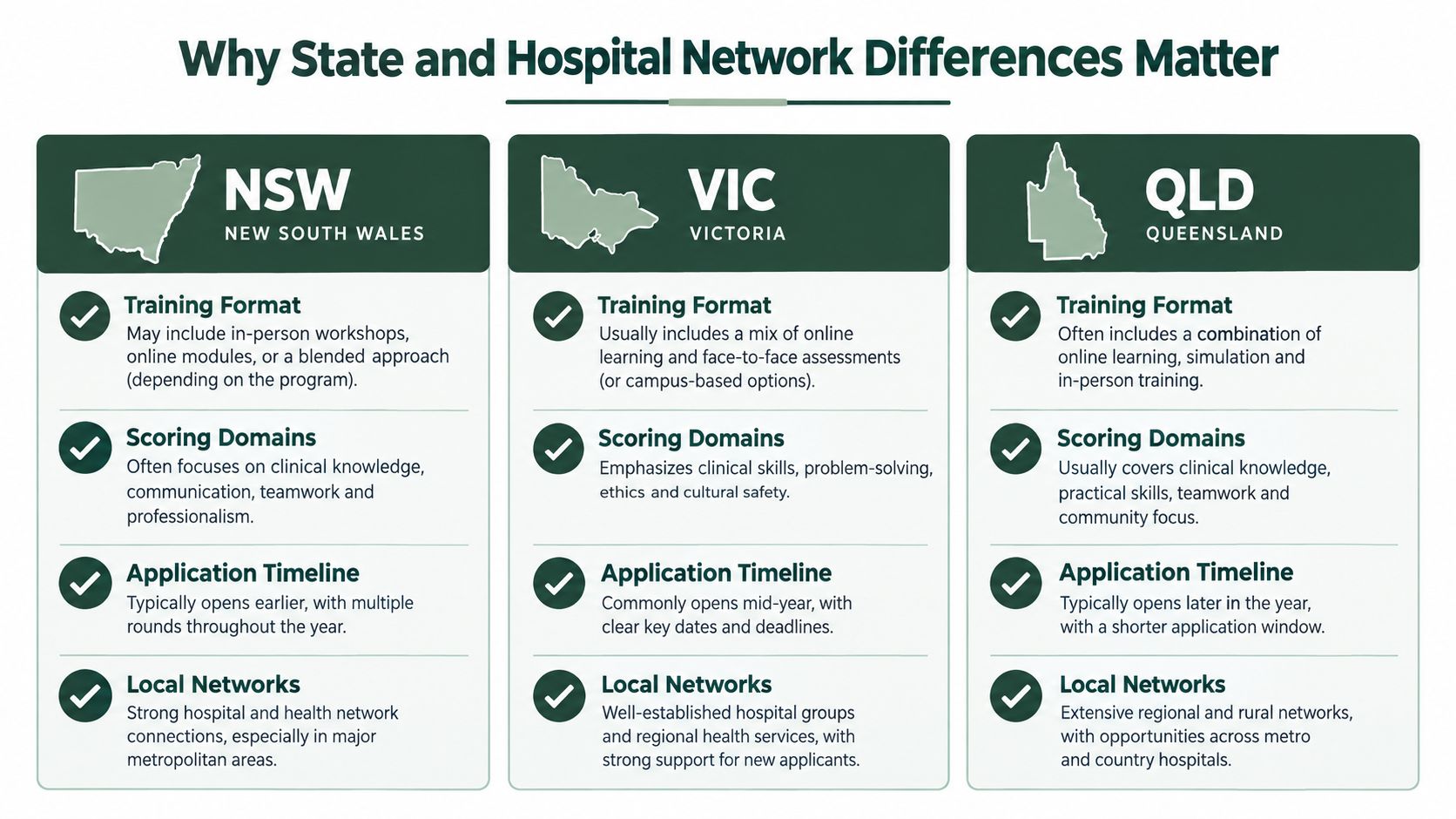
The evidence for inconsistency
A survey of Directors of Physician Education across adult and paediatric Basic Physician Training sites in Australia and New Zealand, run in January and February 2022, found there is no standardised method for Basic Physician Training selection across sites. Selection practices were heterogeneous between sites, and the authors flagged that a heavy reliance on interviews and the reported use of subjective assessments raise concerns about bias in the selection process (‘Selection into training will always be an inexact process’: A survey of Directors of Physician Education, Internal Medicine Journal). Seventy Directors responded, a 35% response rate, so read it as a strong indication rather than a census.
That single finding explains a lot of the folklore junior doctors hear. People aren’t always contradicting each other because someone is wrong. They may be describing different local realities.
The Medical Training Survey, run annually by the Medical Board of Australia and Ahpra since 2019, is the other thing worth reading before you rely on corridor advice. Its reports break results down by college and jurisdiction, which gives you a basis for local research that a registrar’s recollection of their own year cannot.
What to verify before you apply
Before treating a process as “the same specialty everywhere”, check the local version.
- Interview format. Is it panel style, MMI style, or semi-structured with standardised questions?
- Expected answer length. Are you expected to deliver concise station responses or longer reflective narratives?
- Scoring domains. What is explicitly assessed, and what is assumed?
- Local scenarios. Are questions likely to reflect state systems, referral pathways, or public hospital workflows?
- Application sequence. Does the network shortlist first, or does a broader process feed into local ranking?
For a broader orientation to different Australian career streams before drilling into a single network, this overview of medical specialties in Australia is a useful starting point.
Why this changes preparation
If one network expects you to identify escalation thresholds quickly and another gives more room for reflective discussion, your answer structure should change. If one site uses strict timed stations, you must practise finishing cleanly within the limit. If another uses a weighted portfolio plus interview model, your preparation shouldn’t be interview-only.
A candidate doesn’t just perform well or poorly in the abstract. A candidate performs well or poorly against a specific local rubric.
That’s why “be yourself” is incomplete advice. Better advice is: be yourself in a form the process can score.
Growth Funding and Workforce Pressures Shaping Training
You can finish the same resident year as someone else, apply with a similar CV, and still face a very different result because the pressure points are not spread evenly. One state may be trying to staff hard-to-fill services. One network may have stronger supervision capacity. One college may be able to expand accredited posts more easily than another. Training numbers can grow overall while local competition stays tight.
Training capacity works a bit like theatre time. Adding demand is easier than adding accredited supervisors, roster space, clinic exposure, and funded positions in the exact places trainees need them. A college can want more trainees and still be unable to accredit more posts, because the posts depend on hospitals, supervisors and funding it does not control.
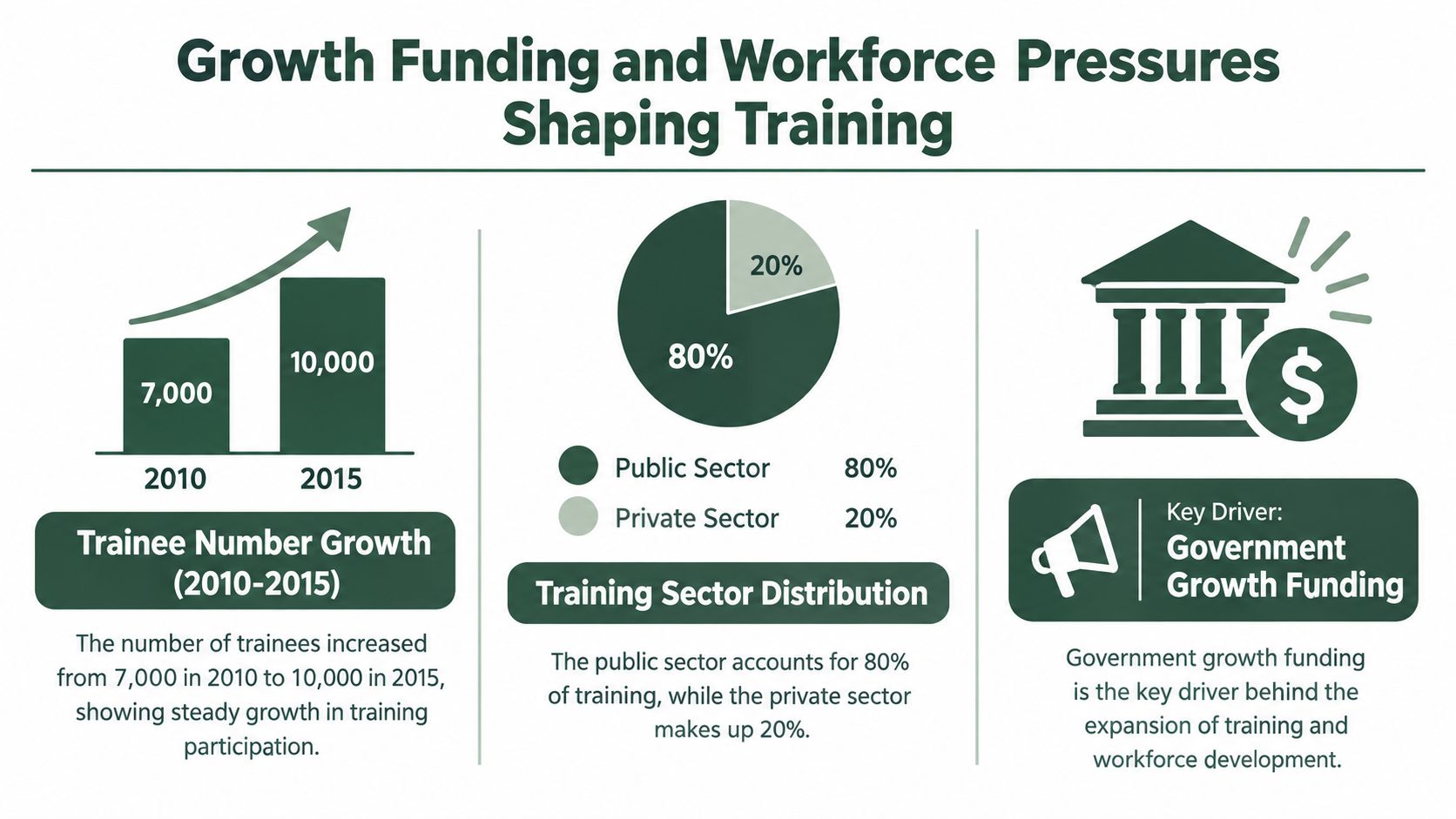
Growth and bottlenecks can exist at the same time
A larger system does not automatically produce easier entry.
The Medical Board of Australia reported that in 2025 there was a nearly 30% increase in specialist international medical graduates seeking a path to practise in Australia, alongside the Expedited Specialist pathway introduced in 2024 that lets eligible doctors with particular qualifications reach registration faster (More international medical specialists coming, 9 June 2026).
Those two facts sit together, not in opposition. Health services need more doctors. Colleges and employers still need enough accredited placements, supervisors, caseload, and funding to train them safely. If any one of those pieces is limited, the bottleneck remains.
Why this affects applicants differently
This is the part junior doctors often miss. Workforce pressure does not translate into a simple rule that “shortage equals easy entry.”
Instead, workforce pressure changes what different selectors care about. A service under staffing pressure may value candidates who can function safely in that local environment from day one. Another network may still rank heavily on portfolio scoring because it has many applicants for a small number of places. A college may support expansion in one setting while maintaining strict evidence requirements for progression.
The result is uneven competition. The same applicant may look strong in one state, average in another, and poorly matched in a third, even before interview performance is counted. That is why generic advice such as “get more experience” often fails. Experience only helps if it matches the scoring logic of the pathway you are targeting.
What to take from this
Treat funding growth and workforce shortage as background conditions, not as reassurance.
They explain why systems are changing, why some pathways open faster than others, and why new opportunities can appear in one jurisdiction before another. They do not remove the need to prepare for the actual rubric used by your target college, state, and hospital network. In practical terms, that means asking a sharper question than “Is this specialty competitive?” Ask, “Where is capacity growing, who controls selection there, and how is that exact process scored?”
Planning Your Next Steps Towards Specialty Training
The most useful next step isn’t “work harder”. It’s be more specific.
If you’re an intern, your job is to keep options open while learning which environments suit you. That means choosing terms deliberately, noticing which supervisors you’d want as referees, and starting a simple document tracking activities that may later support an application.
If you’re an RMO who already has a likely direction, tighten the target. Pick one or two pathways and map them in detail. Write down the eligibility rules, likely application window, scoring components, and local network differences. Then compare your current CV against those domains rather than against someone else’s confidence.
A decision framework that actually helps
Use these questions:
- Which stage am I at? Intern, early RMO, or later resident preparing to apply.
- How firm is my specialty choice? Exploring, leaning strongly, or committed.
- Where am I likely to apply? Specific state, city, network, or hospital group.
- What does that exact process reward? Portfolio evidence, structured interview performance, references, or mixed scoring.
What to do over the next few months
Some actions are high value in almost any pathway:
- Map prerequisites clearly. Don’t assume your current job automatically fits what a college or provider wants.
- Build evidence by rubric domain. If teamwork, teaching, audit, professionalism, or procedural exposure are visible scoring areas, collect evidence that fits them.
- Practise the format. Timed stations, short answers, semi-structured responses, or written judgement tasks all need different rehearsal.
- Research locally. Use college policies, provider guidance, and the Medical Training Survey reports noted earlier rather than relying only on hearsay.
The biggest trap is portable generic preparation. It feels efficient because one set of model answers seems easier to memorise. But in a system this heterogeneous, generic answers often underperform precisely because they ignore the scoring method.
You don’t need perfect certainty before you start planning. You do need a process that turns uncertainty into specific checks, specific practice, and specific applications.
CliniRoo is building preparation material for this exact part of the Australian pathway: specialty selection interview banks, format-specific station practice, and question banks aligned to local processes. Nothing is on sale yet. If you want to be told when there is something to use, CliniRoo takes an email address and does nothing else with it.