How to Become a Surgeon in Australia: The RACS SET Pathway
How surgical training in Australia actually works: RACS SET eligibility, selection, the exams, and how long each stage takes, sourced throughout.
Becoming a surgeon in Australia isn’t mainly a test of whether you can tolerate long hours in theatre. The harder question is whether you can keep clearing separate eligibility, examination, rotation, referee and selection gates, in sequence, over a span of years. The Royal Australasian College of Surgeons (RACS — the body that accredits and delivers surgical training across Australia and Aotearoa New Zealand) describes the pathway as four stages, ending in Surgical Education and Training (SET), the vocational program that produces a consultant surgeon (RACS pathway guidance).
Correct one thing before anything else, because it is the most common mistake about SET entry: there is no postgraduate-year gate. RACS states plainly that “your ability to apply to the SET program is not linked to a postgraduate year (PGY) level”, and that “doctors in PGY3 and beyond will typically have achieved the required specialty prerequisites” (2026 Guide to Surgical Selection, 2027 intake, p.5). Typically achieved is not the same as required. What actually gates you is your specialty’s own prerequisite list, and there are nine of those.
That makes the practical answer to how to become a surgeon in Australia less romantic and more useful. You need a medical degree, general registration, the surgical experience your chosen specialty specifies, the exams it specifies, credible referees and a competitive application submitted inside its window. Miss one gate and you may wait another cycle, or rebuild your portfolio while working in a pathway that wasn’t your first choice.
Every dated claim below is stamped with the intake year it belongs to. Australian selection regulations are reissued annually, so a rule with no year attached is a rule you cannot check.
Table of Contents
- How Long Surgical Training Takes
- Medical School and the Foundation Years
- Who Is Eligible to Apply for SET
- How Competitive SET Selection Really Is
- Training Stages, Exams, and the Fellowship Finish Line
- How Specialty Choice Changes the Pathway
- A 12-Month SET Preparation Checklist
How Long Surgical Training Takes
RACS does not publish a single number for how long the whole thing takes, and neither will this page. What it publishes is the shape: four stages — medical degree, pre-vocational training, postgraduate vocational training (SET), then fellowship and continuing professional development. Two of those four stages have no fixed length — medical degrees vary by university and entry route, and pre-vocational years run until your prerequisites are complete — which is why no honest total exists. Yours depends on your degree, how long you spend building prerequisites, which specialty selects you, and whether you repeat anything. Any article quoting you a single span of years for the whole pathway has added up numbers nobody published.
The main risk was never the length anyway. It is the number of separate gates that must be cleared in sequence, each of which creates records, deadlines and possible points of delay.
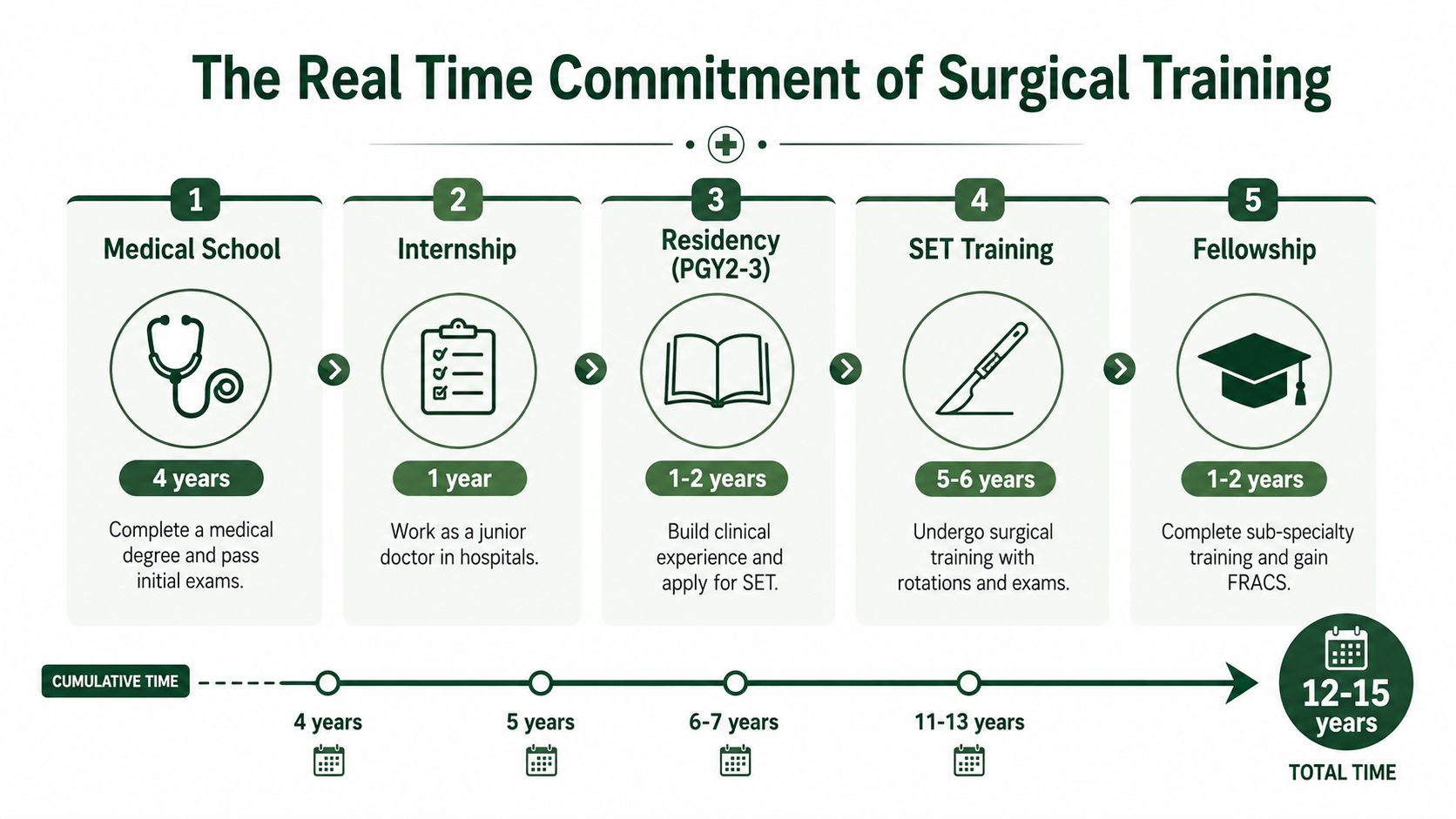
Five phases, five different gates
-
Medical degree: Complete an accredited medical program and meet its academic and clinical requirements. Your results can affect internship options, references and how credible your later applications appear.
-
Internship: Work as a junior doctor and satisfy the requirements for general registration with AHPRA (the Australian Health Practitioner Regulation Agency — the national body that registers doctors and without whose general registration you cannot apply for SET). Rotations, assessments and professional conduct become part of the record you carry into future applications.
-
Residency and prevocational years: Use these years to build relevant surgical exposure, clinical judgement, examination credentials, research, teaching experience and consultant relationships. Selection is annual and competitive: RACS states that “applications are scored and applicants with the highest scores are offered places in the SET program” (RACS SET selection requirements). Meeting the requirements gets you ranked. It does not get you a place.
-
SET training: Complete the structured program for your specialty, including rotations, examinations, logbook requirements and progression reviews. The workload and sequence differ between specialties, so do not plan from a generic timeline alone.
-
Fellowship and consultant transition: After completing every SET requirement you can apply to become a Fellow of the Royal Australasian College of Surgeons (FRACS — the qualification that accredits you to practise independently as a consultant surgeon). Some then complete post-fellowship training to develop a subspecialty focus.
Practical rule: Plan backwards from your specialty’s application window, not forwards from medical school graduation.
The cost is also financial and personal. You defer senior earnings, repeat selection processes and may choose a specialty before you fully understand consultant work. A failed exam, missing prerequisite or unsuccessful application can delay the next stage and force another application cycle.
Track the pathway as a sequence of deadlines and evidence requirements. For every gate, record the eligibility rule, required documentation, relevant rotation or examination, referee expectations and submission date. That approach exposes bottlenecks early, when you still have time to fix them.
Medical School and the Foundation Years
Medical school earns the qualification. It does not make you competitive for surgery. Australian graduates usually complete either an MD (Doctor of Medicine, the postgraduate-entry degree most Australian schools now award) or an MBBS (Bachelor of Medicine, Bachelor of Surgery, the older undergraduate-entry qualification), then internship and further prevocational hospital work. Structures differ between universities and health services, so use this Australian medical training pathway guide to place your university and jurisdiction within the broader sequence.
Internship shifts the focus from academic performance to supervised clinical performance. Meet the requirements for general registration with AHPRA, then use your junior-doctor years deliberately. As above, RACS sets no minimum postgraduate year for SET — but your specialty’s prerequisites take time to accumulate, and that is the real constraint on when you can credibly apply. Read your specialty’s current selection regulations and work backwards from what they require, rather than working forwards from a year count someone quoted you.
Build evidence, not activity
Surgical departments are not impressed by a CV packed with disconnected courses. They want evidence that you understand clinical work, contribute reliably to a team and have tested your interest in surgery over time.
Prioritise:
-
Surgical rotations: Arrange general surgery terms and, where possible, rotations in your intended specialty. RACS’s generic eligibility requirements set no minimum quantity of surgical experience — but individual specialties do, and several set both a minimum number of weeks and a recency window. Those minimums are the single most common reason an otherwise strong applicant is ruled ineligible before anyone reads their CV. Find the number in your own specialty’s current selection regulations, then track eligible clinical time against it from the start.
-
Core acute-care experience: Emergency medicine and intensive care improve your ability to recognise deterioration, escalate decisions and manage competing priorities.
-
Research and audit: Join a project with a defined clinical question. A completed audit, presentation or publication provides stronger evidence than a list of proposed projects.
-
Courses and skills: Check your specialty’s requirements for the RACS skills courses well before applying — EMST (Early Management of Severe Trauma), CCrISP (Care of the Critically Ill Surgical Patient) and ASSET (Anatomy and Surgical Skills for Exposure of Trauma) are the ones most often named. Which of them count, and by when, is set specialty by specialty. A late course may not satisfy every specialty’s rules or application deadline.
-
Referees: Work closely enough with consultants that they can assess your judgement, reliability, communication and response to feedback. A senior doctor who barely knows your work is a weak referee.
Keep a record of rotations, procedures, projects, courses and feedback. Applications are built from evidence, and vague claims become difficult to defend when selection panels ask for specific examples.
Your foundation years should also test whether you understand surgical work. The job includes ward care, emergency decisions, documentation, family communication and repeated uncertainty. If you enjoy only the technical moments, spend more time observing ordinary surgical practice before committing to SET.
Who Is Eligible to Apply for SET
Interest in surgery does not make you eligible for SET. RACS publishes four generic requirements — the floor everyone must clear before their specialty’s own rules are even considered. As published for the 2027 intake, they are:
- Permanent residency or citizenship of Australia or Aotearoa New Zealand.
- General (unconditional) registration in Australia, or general scope registration in Aotearoa New Zealand.
- Completion of the retired Operating with Respect eModule, or the current Introduction to Operating with Respect course.
- A pass in the GSSE (Generic Surgical Sciences Examination — the RACS-set basic-sciences exam covering anatomy, physiology and pathology), achieved either at the time of registration or by the close of SET applications.
Source: RACS generic eligibility requirements, 2027 intake. Note what is not on that list: no postgraduate-year minimum, and no minimum quantity of surgical experience. Both of those live in the specialty regulations, and they are reissued every year.
Internationally trained doctors should check these gates early. Overseas medical qualifications and surgical experience do not replace Australian registration, residency requirements or specialty-specific criteria. English language evidence may also be required under the applicable registration pathway.
The dates control your application
Two naming conventions collide here, and getting them backwards costs a year. A selection round is named for the year it runs. An intake is named for the year you start. They are one apart. When RACS publishes “Applying for the 2027 SET intake”, the assessments in it ran during 2026.
The round that ran through 2026, for the 2027 intake, is closed. RACS published these round-level dates for it:
| Milestone | Date | Notes |
|---|---|---|
| Registration closes | Friday 30 January 2026, 12:00 noon AEDT | Round-level, applies to all specialties |
| Applications open and close | Varies by specialty | RACS does not publish a single national date |
| Referee reports | April/May 2026 | Round-level window |
| Interviews | Varies by specialty | Set and run by each specialty |
| Latest notification of outcome | Friday 13 November 2026 | Round-level backstop, not an offer date |
Source: RACS, Applying for the 2027 SET intake. The page states that “application for selection to the 2027 SET intake through the RACS website is now closed.”
Read the two “varies by specialty” rows as the important ones. RACS runs the round; the specialties run the application windows and the interviews inside it. There is no single national closing date for surgery, and any page that gives you one has invented it. If you are planning for the next intake, the only dates that bind you are the ones on your own specialty’s page, and they had not been published at the time of writing.
Naming check: if a date is described to you as belonging to “the 2027 cycle”, ask whether that means the round running in 2027 or the intake starting in 2027. Those are different years of your life.
Do not transfer dates from an earlier round into your calendar without checking them. A specialty may also require examinations or documents before its applications close. Review the current specialty regulations, confirm each item of evidence, and save copies of every submission.
Deadline discipline: A strong portfolio submitted late is still an unsuccessful application.
Your application must be auditable. Rotation certificates, examination results, registration details, course completion and referee information should align across the portal and supporting documents. If a specialty requires a particular term or examination by a set date, planned completion is not enough. Confirm completion before you submit.
How Competitive SET Selection Really Is
SET selection is a ranking exercise, not an automatic promotion from residency. RACS reported 799 applications across the nine specialties in 2022, and that 284 applicants were offered a training position (RACS Activities Report 2022). That works out at roughly one offer for every three applicants — our arithmetic on those two numbers, not a rate RACS publishes.
Three limitations, all of which matter more than the number itself. It is 2022 data, now four years old, and RACS has not published an equivalent combined figure since. It is a combined figure across nine specialties that select on different rules, so it describes none of them. And it counts applications rather than applicants, so anyone who applied to more than one specialty is in it more than once. Use it to understand that SET is competitive. Do not use it to estimate your own odds.
The same report recorded that 31 per cent of successful applicants were female in 2022.
What ranking actually exposes
Selection panels judge the evidence as a whole. Your CV, referee reports, interview performance and required examinations must support the same picture. A weakness in one area can separate candidates who appear similar elsewhere.
Expect scrutiny of:
- Clinical credibility: Referees must support your account of performance, reliability and teamwork.
- Exam readiness: A required examination may prevent an application progressing to interview.
- Interview judgement: Panels assess communication, ethics, teamwork and insight, not enthusiasm alone.
- Consistency: A sustained record is stronger than a late collection of activities.
| Measure | 2022, nine RACS specialties combined |
|---|---|
| Applications received | 799 |
| Applicants offered a position | 284 |
| Ratio (our calculation) | About 1 offer per 3 applications |
That combined 2022 figure is the only selection statistic on this page, because it is the only one RACS has published at that level. Do not convert it into specialty-by-specialty odds. Orthopaedics, neurosurgery, vascular surgery and general surgery apply different rules and fill different numbers of posts, so the relevant specialty selection documents should guide your preparation.
Build a portfolio that can withstand several assessments. Research cannot repair poor clinical references, and a strong interview cannot correct an unmet eligibility requirement. Review each domain early, then address the weakest one before the application year. In a competitive intake, preparation is about removing failure points, not collecting activities indiscriminately.
Training Stages, Exams, and the Fellowship Finish Line
A SET offer starts the hardest part of the pathway. On how long it lasts, RACS currently publishes two different answers, and it is worth knowing that rather than being handed one of them as settled:
- Its pathway page says the training “occurs primarily in public hospitals and generally takes five to six years”.
- Its 2026 Guide to Surgical Selection, 2027 intake (dated 20 December 2024) uses the same sentence but says “usually takes between four and seven years, depending on the specialty”.
Same sentence, different range. Treat four to seven as the outer bound and five to six as the common case, and get the actual number for your specialty from its own program documents. Either way, the sequence at the end is the same: complete every SET requirement, then apply for FRACS, then work towards independent consultant practice.
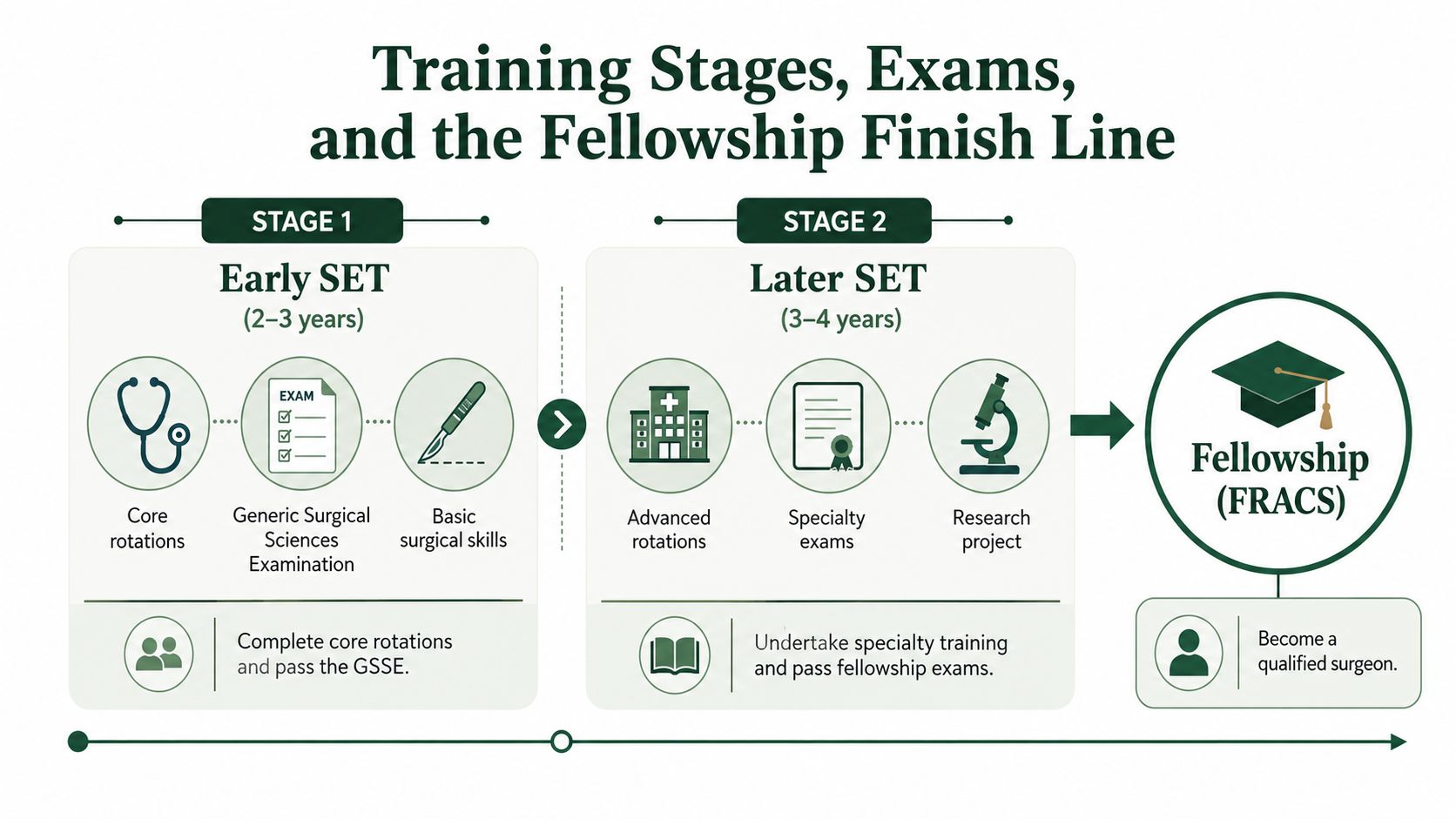
Early SET
Early SET usually combines core surgical rotations, supervised operating, technical skills development and specialty examination preparation. Your logbook and workplace assessments provide evidence of progression. Attendance alone will not carry you through.
Note the ordering that catches people out: the GSSE is an entry requirement, not an early-SET one. It must be passed by the close of applications, which means it belongs to the year before your first day as a trainee. Operating with Respect sits in the same place. The EMST, CCrISP and ASSET courses may or may not be required, and by different deadlines, depending on your specialty. Check the current regulations for your own intake. A course list from another trainee’s year is not a reliable checklist, and a course list from another specialty is not one at all.
Use this Australian medical exam guide to review examination formats and preparation approaches before committing to a study plan.
Later SET and fellowship
Later SET moves towards advanced specialty rotations, greater operative responsibility, specialty examinations, research or audit requirements and fellowship preparation. Keep the logbook current, meet each progression standard and protect your professional conduct. A single unresolved performance or conduct issue can affect progression.
The final credential is FRACS. Many trainees then complete a post-fellowship year in Australia or overseas to consolidate subspecialty skills before consultant practice. That stage still involves applications, references, credentialling and a deliberate choice about the type of practice you want.
Failed examinations and repeated requirements extend the pathway. Plan study around the college syllabus, use active recall and question practice, and reserve regular study time during rotations. Last-minute revision is a poor substitute for sustained preparation.
Fellowship completes formal specialist training, but it does not end professional development. Consultant surgeons continue to refine operative judgement, teach junior doctors, review outcomes and respond to changing evidence throughout their careers.
How Specialty Choice Changes the Pathway
Your specialty choice determines which gates you face before entering theatre as a trainee. The nine RACS specialties use different eligibility rules, examinations, rotations and ranking methods. Compare the current requirements directly, not reputations or anecdotes. For a broader comparison, read this guide to medical specialties in Australia.
The structural point most guides skip is who actually holds the rules. RACS accredits the training and sets the four generic requirements, but for most surgical specialties the selection criteria, the interview and the ranking are run by the specialty society, and RACS’s own specialty pages send you to them. Vascular surgery directs applicants to the ANZSVS (Australian and New Zealand Society of Vascular Surgeons); neurosurgery directs them to the NSA (Neurosurgical Society of Australasia). RACS’s page for each of those specialties publishes historical appointment numbers and a link, and no criteria at all.
This matters practically. It means there is no single RACS document containing your interview weighting, your minimum score or your required rotation weeks — those live with the society, they differ between societies, and they are reissued annually. Our guide to specialty selection interviews in Australia sets out which colleges select nationally, which hand selection to a state network, and which do not interview at all, with each row read from the society’s own current document.
| Specialty | Who publishes the selection criteria | SET duration |
|---|---|---|
| Vascular surgery | ANZSVS | Four to seven years across RACS specialties; check the society’s program documents |
| Neurosurgery | NSA | As above |
| General surgery | The RACS General Surgery (Australia) specialty page | As above |
| Other RACS specialties | The relevant specialty society or board | As above |
The duration column is deliberately unhelpful, because a specific number per specialty is not something RACS publishes centrally. What it does publish is the range discussed above, and the two figures it gives do not agree with each other. Your actual duration depends on the specialty structure, your examination progress, and whether you need additional training time.
Here is why that annual reissue is not a formality. ANZSVS has abolished the vascular surgery clinical examination — its selection page records that the February 2026 sitting was the final delivery, and its current document is the selection regulations for applications made in 2026. A candidate working from a guide written a year earlier would have spent months preparing for an examination that no longer exists, and would have read that preparation as progress the whole time.
That is the failure mode this page is trying to keep you out of. Specific selection thresholds — interview weightings, examination cut-offs, minimum rotation weeks and their recency windows — have deliberately been left out here rather than quoted second-hand, because they move, and because a number carried across from last year’s guide is indistinguishable from a current one until it costs you a cycle. Get yours from your specialty society’s own regulations, for your own intake year.
Choose based on the work, examination burden, required rotations and training structure. General surgery can lead towards colorectal, upper gastrointestinal or breast surgery, while other specialties organise training differently. Prestige is a poor selection test. Choose a specialty whose daily work you can tolerate and whose specific entry requirements you are prepared to meet.
A 12-Month SET Preparation Checklist
Strong SET applications are built before the form opens. Start with a gap analysis, then convert every weakness into a dated task. Track clinical exposure, examination requirements, evidence, referees and interview performance. A polished CV cannot compensate for an ineligible rotation, an unavailable referee or an examination result that misses the cut-off.
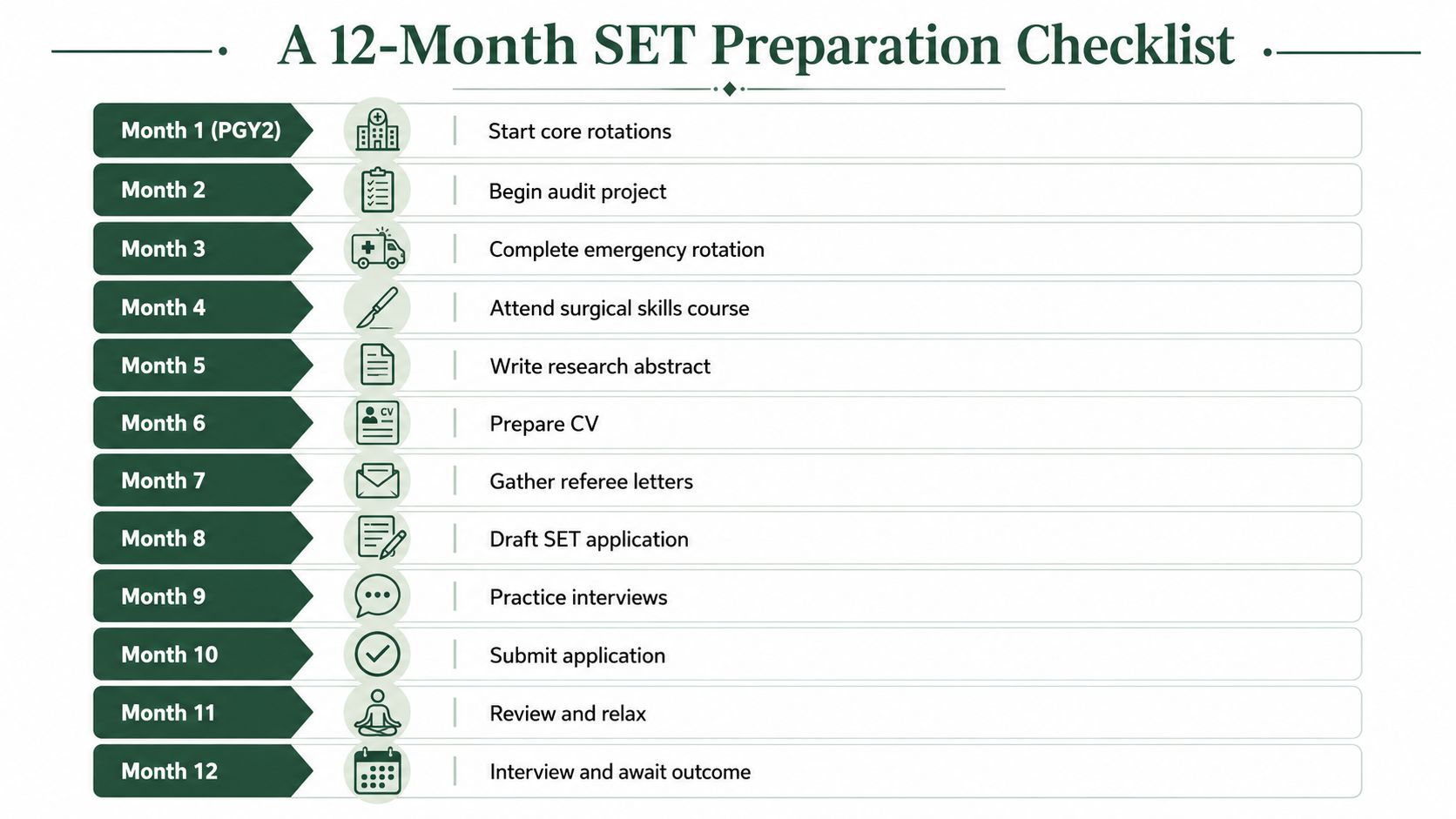
Months 12 to 9
Read the current specialty requirements line by line. Build a spreadsheet with each requirement, the evidence required, the relevant date and the person responsible for confirming it.
- Audit rotations: List every surgical term, its duration and whether the specialty accepts it.
- Audit examinations: Confirm whether the GSSE, clinical examination or anatomy examination must be passed before application.
- Choose referees early: Ask consultants who have directly observed your work. Give them a clear CV and enough time to provide accurate reports.
- Start one useful project: A focused audit or research project is better than several abandoned ideas.
- Protect clinical performance: Selection panels will not overlook poor reliability because you have a busy portfolio.
Use this period to secure rotations that are difficult to obtain. If a specialty requires recent exposure, a general surgical term alone may not satisfy its full experience profile. Check the current requirements before accepting a term and record the dates and duties while the information is still available.
Months 8 to 4
Move from collection to production. Complete the audit, submit an abstract where appropriate, prepare your CV and begin structured examination preparation. Ask referees what they believe your application still lacks. Their feedback can expose gaps that your spreadsheet misses.
Practise interviews in the format used by your specialty. Record answers to ethical, conflict, teamwork, clinical prioritisation and motivation questions. Review whether each answer addresses the question directly. Strong candidates explain decisions, acknowledge limits and show what they learned. They do not rely on a list of hard work or generic claims about commitment.
Keep all supporting material in one folder:
- Registration records: Keep current AHPRA and identity documentation available.
- Course certificates: Save completion evidence for Operating with Respect and other required courses.
- Exam results: Check names and dates against the application portal.
- Rotation verification: Request documents before hospital staff change roles.
- Referee details: Confirm availability during the interview and reporting period.
Use a simple gap-analysis spreadsheet with columns for requirement, current evidence, missing evidence, owner and deadline. Review it with a supervisor or trusted registrar, not only by yourself.
Months 3 to 0
The final quarter is for accuracy, not reinvention. Read every field, upload the correct document and submit before the closing date. Do not anchor that quarter to a date from this or any other article. There are two deadlines, not one: RACS closes registration for the round, and your specialty separately opens and closes its own application window inside that round. For the 2027 intake those were 30 January 2026 for registration and “varies by specialty” for applications. Get both from the source, in writing, for your own intake year, and put them in your calendar separately.
Avoid the errors that repeatedly weaken otherwise credible applications:
- Missing registration deadlines: Put registration, application and examination dates in separate calendar reminders.
- Using weak referees: A prominent surgeon who has not supervised you may write a less useful report than a consultant who knows your work.
- Ignoring rotation definitions: Count eligible weeks, not only terms labelled surgical.
- Leaving examinations too late: A result received after the relevant cut-off may not help that cycle.
- Submitting an untested interview style: Practise concise answers with colleagues who will challenge vague claims.
- Failing to check specialty changes: Requirements can differ between cycles, so review the current regulations before submission.
Your next move depends on your stage: medical students should protect academic performance and find early research exposure, interns should map future rotations, and residents should lock in examination timing, eligible terms and referees.
Use the gap-analysis spreadsheet above to identify your weakest domain, then practise that domain deliberately — in the format your specialty actually uses, with someone who will challenge a vague answer. Record the gaps each session exposes and close them before the application window opens.
CliniRoo is building preparation material for the Australian pathway, including specialty selection interviews and the college examinations. Nothing is on sale yet. If you want to be told when there is something to use, CliniRoo takes an email address and does nothing else with it.