Online Interview Practice for Australian Doctors
How to design online interview practice for Australian medical selection: match the format, timing and scoring domain to the process you will sit.
“Practise common interview questions until your answers sound polished” is popular advice. For Australian medical selection, it can send you in the wrong direction.
A fluent answer isn’t automatically a high-scoring answer. Panels may be listening for problem clarification, empathy, self-awareness, ethical reasoning, responsiveness to diversity, or safe management of uncertainty, depending on the pathway and station. Online interview practice becomes useful when it reproduces those observable behaviours, the timing, and the scoring structure you’re likely to face.
Table of Contents
- Why Generic Rehearsal Fails Australian Selections
- What Interview Assessors Actually Measure
- Core Formats for Online Interview Practice
- Generic Banks vs Format-First Practice
- What a Good Practice Resource Should Do
- Using AI in Interview Practice Safely
- Your Roadmap to Structured Preparation
Why Generic Rehearsal Fails Australian Selections
A junior doctor might spend evenings answering “Why medicine?”, “Tell us about a time you showed leadership”, and “What are your strengths?” The answers become smooth. The candidate learns to sound calm, uses a familiar structure, and feels ready.
Then the selection interview presents a culturally sensitive scenario, a prioritisation problem, or a short station requiring clarification before advice. The candidate gives a thoughtful response, but starts solving the wrong problem. They speak at length, miss the patient’s concern, or offer an ethical conclusion without explaining how they’d involve the team. Afterwards, they say, “I knew the content. I just didn’t show it properly.”
That isn’t necessarily a confidence problem. It may be a practice-design problem.
Fluency is only one observable behaviour
Australian specialty selection is not one process. For the 2027 intake, some colleges run a single national selection, some leave selection to the hospital, network or state scheme that will employ you, and general practice through the Royal Australian College of General Practitioners (RACGP — the college that trains and examines general practitioners) has no interview at all. CliniRoo’s guide to specialty selection interviews in Australia sets out who runs which process, specialty by specialty, with a link to each college’s own current document. Depending on the pathway, you may meet a structured panel, a multiple mini-interview (MMI — a circuit of short stations, each scored separately), a situational judgement test (SJT — a test of how you would act in written workplace scenarios), referee reports, or a templated curriculum vitae (CV).
A generic question bank averages those differences. It may teach you to produce a plausible behavioural answer, but not whether your target pathway expects a panel discussion, a timed station, a scenario response, or evidence of a particular competency.
Consider the difference between these two feedback comments:
- Generic: “You sounded confident.”
- Diagnostic: “You acknowledged the colleague’s concern, but you didn’t clarify the immediate patient-safety risk before discussing team dynamics.”
The second comment tells you what to change in the next attempt. It turns practice into a learning loop rather than a performance ritual.
Practical rule: Practise the behaviour the panel can score, not the sentence you hope will impress it.
Replace volume with targeted repetition
More questions aren’t automatically better. Repetition helps when each attempt has a defined construct, a realistic time limit, and feedback linked to an observable behaviour.
If you’re applying for a pathway that emphasises communication, record whether you opened the conversation, clarified the presenting problem, signposted your reasoning, and checked understanding. If the station assesses ethical judgement, review whether you identified competing duties, considered affected people, escalated appropriately, and proposed a safe next step.
The useful question isn’t “How many questions have I completed?” It’s “Which domain am I deliberately improving, and what evidence shows that my response changed?”
What Interview Assessors Actually Measure
Medical interviews don’t assess one large quality called “doctor potential”. They assess particular constructs through particular tasks. That distinction matters because a strong answer in one station may tell a panel little about performance in another.
Research on how medical communication is assessed makes the same point. A study from Radboud University Medical Center in the Netherlands, published in 2019 in BMC Medical Education (a journal of the publisher BioMed Central), developed the BOCC (from the Dutch BeOordeling Communicatie en Consultvoering, “Assessment of Communication and Consultation”) — a rating tool for how students take a history. It was tested on 672 third-year medical students interviewing simulated patients, and its items grouped into five components: communication skills, problem clarification, specific history, problem influence, and integration skills. Problem clarification made the strongest unique contribution to predicting the rater’s overall grade. That study assessed clinical consultations rather than selection interviews, but it shows the general pattern: assessors score separate, observable components, and one of them can matter more than the rest. The paper is in the Radboud BOCC study.
Clarification comes before cleverness
Problem clarification is easy to underestimate. Candidates often rush to demonstrate knowledge, especially when a scenario sounds clinically familiar. But if you haven’t established what the person is worried about, what has changed, or what the immediate risk is, your subsequent reasoning may be accurate but poorly targeted.
Treat clarification like setting the coordinates on a navigation system. You can know the route perfectly, but if you enter the wrong destination, good navigation won’t rescue the journey.
A station rubric might therefore separate:
| Domain | What the assessor can observe |
|---|---|
| Clarification | Whether you identify the presenting concern and priorities |
| Information gathering | Whether your questions are relevant and ordered |
| Relationship-building | Whether you show empathy, respect and partnership |
| Integration | Whether you connect information to a safe, coherent response |
A single impression score hides these differences. Domain-level scoring tells you whether the weak point was your opening, your questions, your interpersonal approach, or your synthesis. Candidates who want a practical overview of this approach can also review competency-based interview questions for medical selection.
Each station scores one quality
A 2010 Medical Journal of Australia (MJA) study of interviewer bias shows what station-by-station design looks like in practice. It analysed the MMI used to select students for a new Australian medical school in 2006 and 2007. Applicants rotated through 10 stations, one of them a rest station, each lasting 8 minutes and assessing a different quality: one station assessed motivation to study medicine, another assessed communication skills by having the applicant explain something to an actor playing a patient. Formats varied between stations, from questions about past behaviour to scenarios and film clips for comment.
The same study found that the share of an applicant’s score explained by which interviewer they happened to draw ranged from 3.1% to 24.8% across stations, and the average fell from 20.2% to 7.0% after interviewers had skills-based training. That is a medical-school entry process from nearly two decades ago, not a current specialty format. The lesson that transfers is that a station score is evidence about one quality, judged by one person, not a verdict on you as a doctor.
Your practice should reflect that. Label a station by its intended construct, score the relevant behaviours, and compare your performance within that domain over repeated attempts. Don’t interpret a strong motivation answer as proof that your ethical reasoning is ready.
Core Formats for Online Interview Practice
Choose a practice format by asking what selection process is likely to demand and where your current performance breaks down. A polished recording won’t solve poor time management. A friendly mock panel won’t necessarily expose a weak response to a rapidly changing scenario.
Mock panels
A mock panel simulates the social and cognitive load of answering several assessors. It helps you practise eye contact with a camera, concise opening responses, listening to follow-up questions, and recovering when an interviewer challenges an assumption.
Ask the panel to score behaviours independently before discussing the answer. For example, one assessor can focus on communication and empathy, another on structure and reasoning, and another on professionalism or cultural safety. This prevents one confident impression from dominating every category.
Use this format when your content is sound but you become defensive, vague, or overly long under questioning. A realistic MMI interview preparation approach can be more useful than another pass through a general question list when your target process uses short, distinct stations.
Timed stations
Timed stations reproduce the pressure of completing a defined task before moving on. They suit MMI-style preparation, ethical scenarios, prioritisation tasks, and communication exercises where the order of your response matters.
Practise in three phases:
- Read and orient: Identify the task, the affected people, and any immediate safety issue.
- Respond: Clarify the problem, explain your reasoning, and state a proportionate action.
- Close: Summarise, check understanding, and explain follow-up or escalation where relevant.
Don’t use the timer only to force speed. Review whether the time limit changed your behaviour. Did you skip clarification? Did you list every possible issue without prioritising? Did you reach a conclusion without explaining how you’d involve the patient or team?
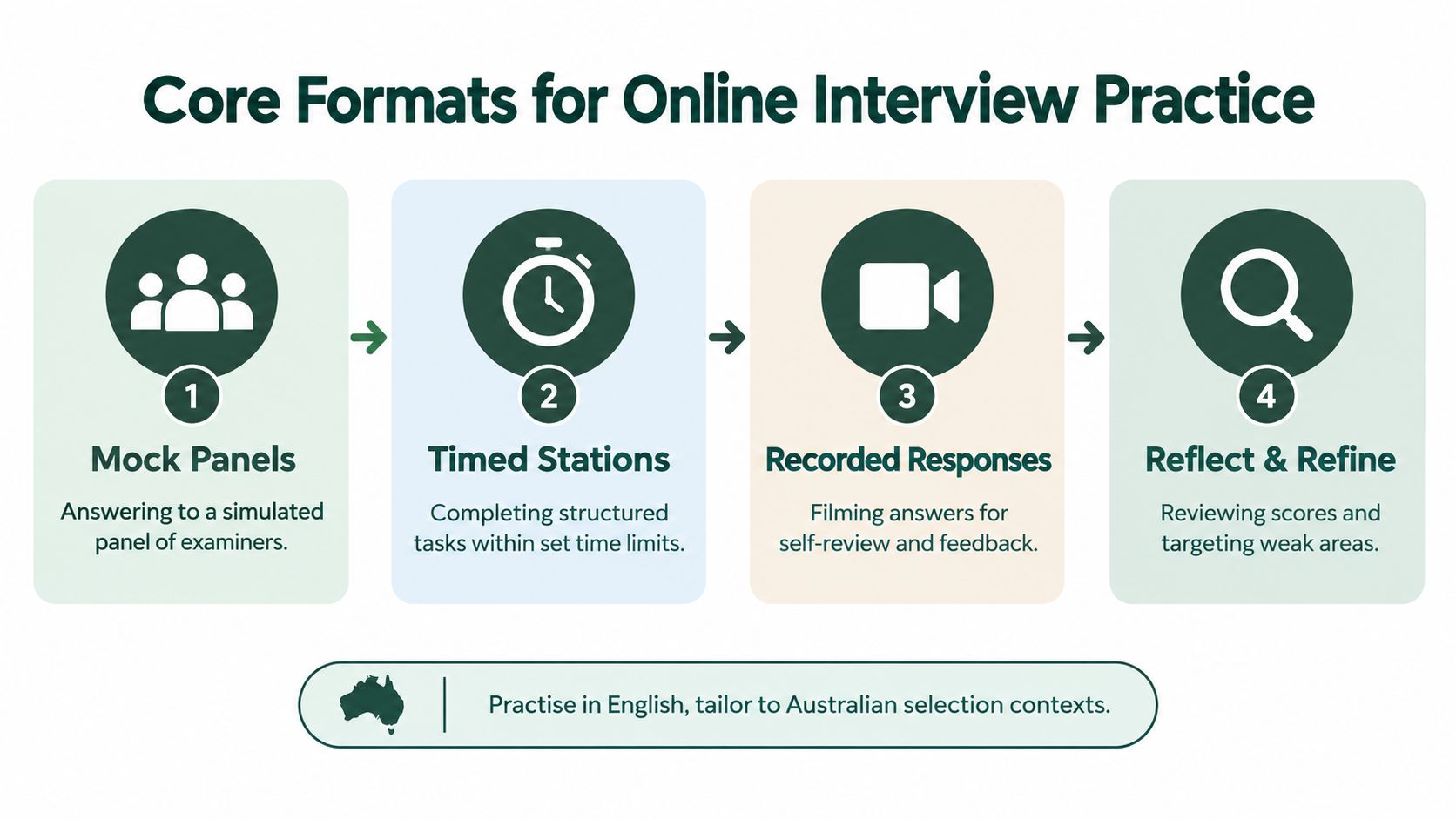
Recorded responses
Recording is valuable because memory is unreliable. You may remember an answer as structured, while the video shows a long preamble, repeated phrases, limited facial engagement, or an abrupt ending.
Review one response twice. First, listen without watching and mark unclear reasoning. Then watch without sound and note pace, posture, attention, and visible signs of uncertainty. Finish by scoring one domain, not your entire personality.
Review question: What would an assessor be able to write down as evidence of the competency?
Generic Banks vs Format-First Practice
Generic question banks help at the very start. They remind you to prepare examples about teamwork, conflict, feedback, failure, motivation, and leadership. The problem comes later. If you keep practising at that level, you train for a generic interview rather than the selection process you will face.
Format-first practice works more like preparing for the right exam paper, not just revising the subject. It starts with your pathway, then asks what that pathway usually rewards: which station formats appear, how long answers tend to run, what sort of judgement is being tested, and how assessors are likely to score it. Once that is clear, the wording of any single prompt matters less than the behaviour you show while answering.
| Generic question-bank approach | Format-first approach |
|---|---|
| Starts with common prompts | Starts with the target selection pathway |
| Encourages polished reusable answers | Encourages adaptable reasoning and authentic examples |
| Gives broad feedback such as “be concise” | Links feedback to a named scoring domain |
| Averages local differences | Names variation between specialties and jurisdictions |
| Rewards completion volume | Rewards deliberate practice on weak behaviours |
Why local variation changes preparation
Local variation changes what “good practice” looks like. A candidate preparing for Surgical Education and Training (SET — the surgical training program of the Royal Australasian College of Surgeons, or RACS) may need a different mix of mock stations from a doctor applying for Basic Physician Training, where, for the 2027 intake, the hospital or network employing you runs the selection and the format varies by site. The specialty selection guide linked above sets out these differences against each college’s own document.
Practising the wrong format creates a misleading sense of readiness. You may become fluent at polished answers that never appear on the day, while underpreparing for what your actual panel is watching for. Useful practice records more than the question. It also tracks the station purpose, response length, expected structure, and scoring cues.
Use model answers as maps, not scripts
A good annotated model answer shows the anatomy of a strong response. It points out where the candidate clarifies the scenario, where they identify the ethical or clinical tension, where they acknowledge uncertainty, and where they choose a safe, proportionate action.
Memorised wording causes two predictable problems. First, your answer can sound fixed when the prompt shifts slightly. Second, you may push an old story into a new station and miss the issue being tested.
A better method is to build a small bank of genuine experiences, then practise using each one in different ways. The example supports your judgement. It does not replace it.
What a Good Practice Resource Should Do
The practical implication is straightforward. An online practice resource should organise preparation around the candidate’s pathway, station type, and scoring domain, rather than present one national interview template.
Match the resource to your application
Before starting a bank, write down four details:
- Pathway: Name the specialty or training program.
- Jurisdiction: Record the state, hospital network, or local process where relevant.
- Format: Identify panel, MMI, situational judgement, or another documented structure.
- Weak domain: Choose one behaviour to improve during the next practice block.
The value of localised practice isn’t that it predicts every question. It gives you a more accurate rehearsal environment. Scenarios can use relevant Australian terminology, referral pathways, and guidelines, while notes can identify where processes differ by state, network, or intake.
Any practice resource is a practice aid, not a substitute for the selection policy or current instructions issued by the relevant college or employer. Check those primary requirements before you commit to a preparation plan.
When you assess a resource, check whether it gives you actionable feedback. If it only produces a broad confidence rating, it may be telling you how polished you sound rather than whether you clarified the problem, addressed risk, or demonstrated the intended construct.
Using AI in Interview Practice Safely
Artificial intelligence (AI) tools can help you generate prompts, simulate follow-up questions, transcribe a response, or organise feedback against a rubric. They should support your preparation, not replace your judgement or manufacture a personality that won’t appear in the interview. If the college, network or employer you are applying to publishes rules on AI use in applications or interviews, those rules apply.
Keep your clinical material de-identified
Don’t upload patient names, dates of birth, medical record details, rare combinations of identifying information, or confidential workplace incidents. Rewrite the scenario so the clinical reasoning remains intact without exposing a real person or organisation.
Voice recordings also deserve care. Before using a tool, check what it stores, whether recordings are retained, where personal information may travel, and whether you can delete your data. If those answers aren’t clear, use fictional scenarios and a local recording that you review yourself.
Treat automated feedback as a prompt
An AI system may identify pace, repetition, filler words, or a missing structural element. It may not reliably judge whether your response showed cultural safety, recognised a power imbalance, balanced confidentiality with risk, or escalated an uncertain situation appropriately.
Use its output to ask better questions:
- Did I clarify the person’s concern before offering solutions?
- Did I identify the immediate safety issue?
- Did I explain competing values rather than announce a verdict?
- Did I preserve my own wording and experience?
A human reviewer, supervisor, or peer who understands the target pathway can assess nuance that an automated fluency score cannot.
Your Roadmap to Structured Preparation
Start with the application, not the question list. Confirm the specialty, jurisdiction, hospital network, intake year, and published format. If the information is unclear, separate what the official process states from what you’re inferring, and avoid building your entire plan around an assumed interview structure.
Then create a domain baseline. Complete one representative station without stopping to improve it. Score clarification, information gathering, relationship-building, integration, and any pathway-specific domains separately. Your first score isn’t a verdict. It’s a map of where another attempt should concentrate.
A workable practice cycle
- Select one construct: Choose communication, motivation, empathy, self-awareness, diversity, uncertainty, ethical reasoning, or another named domain.
- Choose the matching format: Use a timed station for prioritisation, a mock panel for follow-up pressure, or a recording for self-review.
- Practise with authentic content: Use your own experiences and reasoning. Keep examples adaptable rather than memorised.
- Review one behaviour: Identify the exact moment where your response became unclear, unsafe, generic, or overly long.
- Repeat with a narrow target: Change one behaviour in the next attempt, then compare performance within the same domain.
This method gives every practice session a purpose. A candidate who repeatedly misses clarification shouldn’t spend the next session collecting more polished closing statements. They should practise opening questions, concise summaries, and checks that confirm they’ve understood the problem.
Keep a short log with the station title, intended construct, feedback, and next action. Over time, it becomes more useful than a list of completed questions because it shows which behaviours are improving and which still require supervision or targeted rehearsal.
CliniRoo is building specialty selection interview preparation for the Australian pathway. Nothing is on sale yet. If you want to be told when there is something to use, CliniRoo takes an email address and does nothing else with it.