10 Medical School Interview Questions Australia
Prepare for medical school interview questions with 10 Australia-specific MMI and panel examples, model answers, scoring cues and format tips.
You’ve prepared a polished answer about wanting to become a doctor. Then the first MMI station gives you a short scenario, a fixed preparation period and a few minutes to respond. At another university, a panel asks follow-up questions about your experience, motivation and judgement. In both settings, sounding confident isn’t enough. You must identify the quality being assessed, explain your reasoning aloud and adjust your answer to the format in front of you.
Australian medical school interview questions commonly explore motivation, ethics, reflection, teamwork, equity, wellbeing, advocacy, specialty direction and lifelong learning. The format matters because Australian programs don’t use one national interview design — station counts, timings and even whether a human is in the room differ by university and by intake. The Australian Medical Students’ Association admissions guide is a useful starting map of which schools use which formats, though you should always confirm against the university’s own current admissions page.
The University of Melbourne’s Doctor of Medicine is a concrete example. For the 2026 intake, its MMI ran as eight stations, each lasting approximately six minutes with usually four questions per station and all stations equally weighted, delivered online in a recorded format rather than as a live conversation, with each station carrying a standalone score (Information for MMI candidates, 2026 intake). Note what that recorded format changes: there is no interviewer to read, no rapport to build, and no follow-up question to recover with.
For each question below, read in the same order: what the assessor is testing, what a strong answer should contain, the cues that can strengthen your score, how delivery changes between an MMI and a panel, and what you should verify with your target university. Use the examples as directions, not scripts. Current requirements can differ by university, state, pathway and intake, so confirm them through your target program’s official admissions information.
Table of Contents
- 1. Why Medicine?
- 2. Ethical Dilemmas
- 3. Failure, Mistakes and Feedback
- 4. Diversity, Equity and Working Across Cultures
- 5. Stress and Wellbeing
- 6. Leadership and Teamwork
- 7. Why This Specialty?
- 8. Weaknesses and Areas for Development
- 9. Advocating for a Patient or Challenging Authority
- 10. Staying Current With Medical Knowledge
- Top 10 Medical School Interview Questions Comparison
- Turn These Questions Into Interview Practice
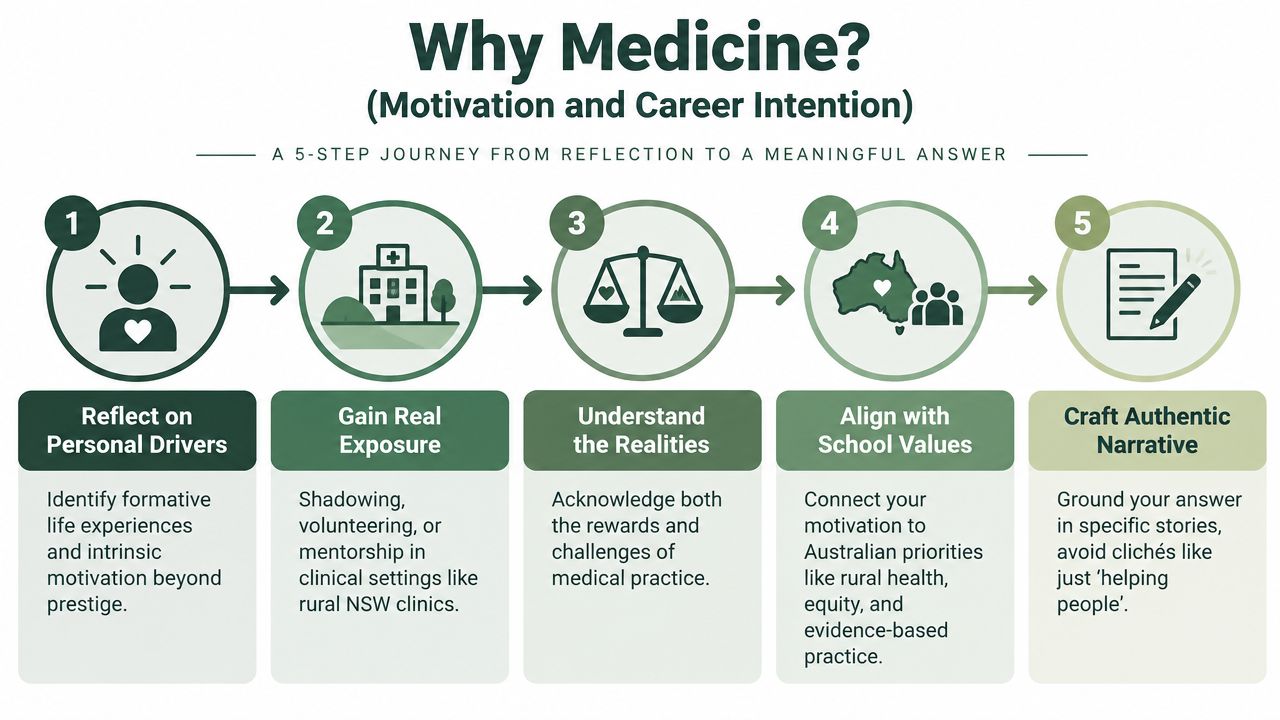
1. Why Medicine?
“Why medicine?” sounds familiar, but a generic answer about helping people rarely demonstrates enough. The interviewer is looking for authentic motivation, realistic career intention and self-awareness. They want to understand how your experiences shaped your decision and whether you’ve considered the difficult, routine and uncertain parts of medical work.
A stronger direction might begin with volunteering at a rural health clinic in regional New South Wales. Explain what you observed, what questions the experience raised and how it changed your understanding of the doctor’s role. A graduate might instead discuss structured mentorship or shadowing, then distinguish a physician’s responsibilities from those of other health professionals. Someone whose parent has a chronic illness can describe the effect of continuity, communication and treatment decisions, without presenting a family experience as automatic evidence of suitability.
Build a specific motivation narrative
Use a simple sequence:
- Experience: What did you see, do or learn?
- Reflection: What did it reveal about medicine?
- Fit: Which values does that connect with?
- Direction: How might it shape your practice in Australia?
Link your motivation to values such as rural health, equity, evidence-based practice and patient partnership, but only where the connection is genuine. If you’re applying to a research-oriented program, show how inquiry and evidence appeal to you. If a program emphasises social accountability, explain how your experience has developed your understanding of access and disadvantage.
Practical rule: Replace “I want to help people” with one concrete experience, one honest insight and one realistic expectation of medical work.
In an MMI, deliver the answer in a clear arc and stop before you start repeating yourself. In a panel interview, expect follow-ups such as “Why not nursing?” or “What have you learned about the less attractive aspects of medicine?” Check the current university values, pathway requirements and interview format before tailoring your final version.
2. Ethical Dilemmas
A patient with a work-related injury refuses permission for information to be shared with their employer. You may also face a scenario about confidentiality, a colleague whose behaviour could affect patient safety, limited resources or cultural beliefs that differ from recommended treatment. These questions test whether you can recognise competing duties, protect patients, communicate respectfully and seek help when the issue exceeds your role.
Treat the dilemma like a clinical assessment. First identify the decision and the people affected. Clarify the facts, the immediate risk and what the patient understands about the consequences. In the example above, confidentiality and autonomy may conflict with workplace safety and legal or professional obligations. Explain what you would ask, rather than rushing to a verdict.
Your reasoning should show a safe, proportionate process:
- Clarify the facts and immediate risk.
- Identify stakeholders and competing principles.
- Explore reasonable options and their consequences.
- Choose an action and explain why it is proportionate.
- State how you would document, review and escalate the matter.
The scoring cues are visible in that sequence. Assessors can hear whether you notice risk, respect autonomy, consider other people, recognise your limits and communicate a defensible plan. A mature answer can acknowledge uncertainty without becoming indecisive. If the facts are incomplete, say what you would clarify and which senior clinician or service you would consult.
Use the CliniRoo guide to MMI practice questions to create timed scenario drills. Australian frameworks, including the Australian Medical Association Code of Ethics, can help you identify professional duties. Refer to a framework only when you can explain how it changes your action.
MMI and panel interviews reward different delivery. In an MMI, make the reasoning easy to follow because the assessor may be scoring defined domains within limited time. In a panel, expect an interviewer to challenge your first option. Pause, reconsider the new information and explain any change without becoming defensive. Before interview day, check whether your state and university use ethical scenarios, role-play, written reflection or another station format.
A short video can help you practise thinking aloud, but it should not replace timed speaking practice.
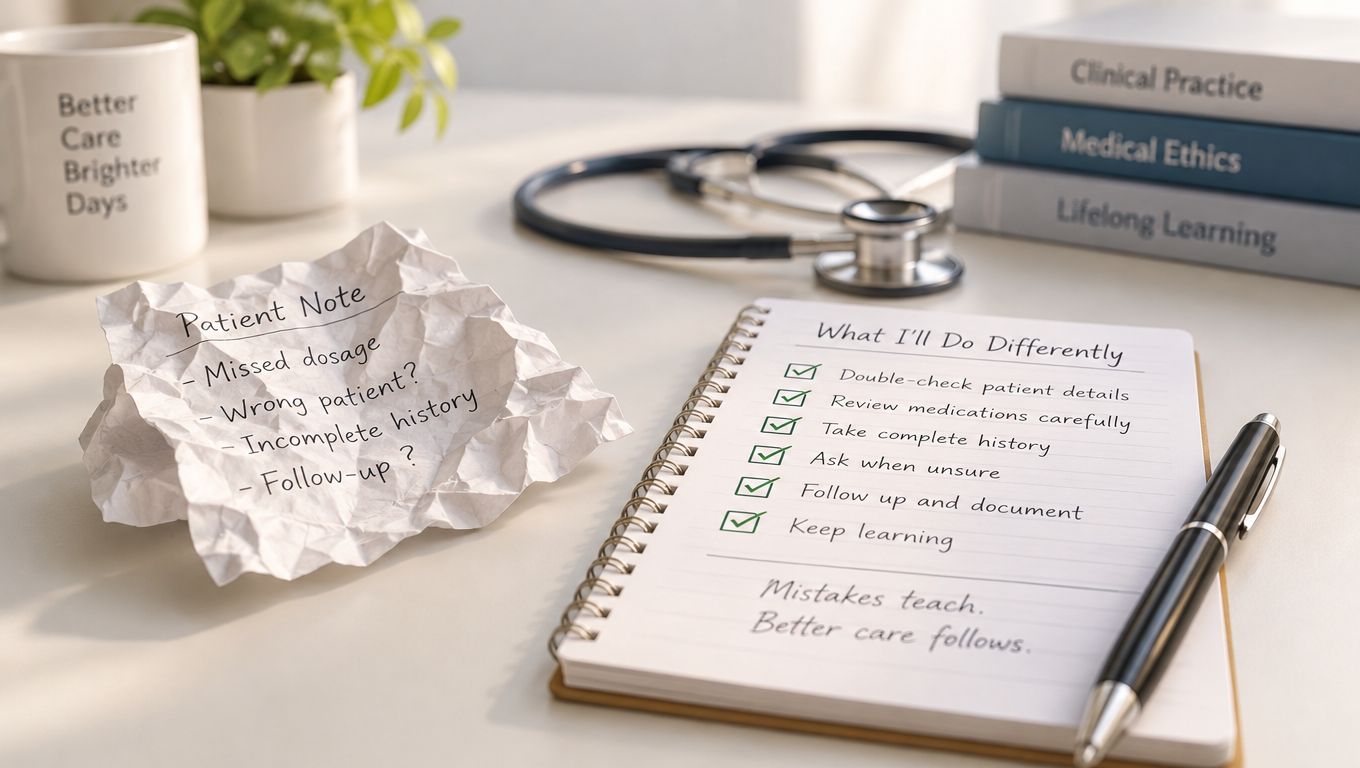
3. Failure, Mistakes and Feedback
A ward-round error, a failed exam or difficult feedback can reveal how you respond when your plan breaks down. This question tests accountability, reflection and behaviour change. The assessor is listening for your part in the problem, the effect on others, the feedback you accepted and the safeguard you introduced afterwards.
Choose an example that gives you something real to examine. For an exam failure, explain how passive review limited your preparation, then show how active recall, feedback and a revised study plan changed your approach. For a clinical example, such as missing an early sign of deterioration during a ward round, focus on immediate escalation, supervision and learning from the system. Protect patient confidentiality, and avoid using patient harm as a dramatic story unless you can explain your responsibility and how recurrence would be reduced.
Build the answer like an incident review: establish what happened, identify the contributing factors, then show the control you added.
- Context: Set out the situation briefly.
- Your contribution: State what you did or failed to do.
- Immediate response: Explain who you informed and how you addressed the issue.
- Feedback and cause: Describe what you learned from feedback and why the mistake occurred.
- Changed practice: Give the specific behaviour, checklist or preparation method you now use.
The CliniRoo medical interview preparation resource can support practice with behavioural prompts. Begin with your own contribution before discussing workload, unclear instructions or system pressures. That order demonstrates accountability without ignoring wider factors.
What earns credibility: “This is what I missed, this is who I consulted, and this is what I now do differently.”
MMI and panel delivery require different preparation. In an MMI, keep the story compact and make the learning easy to score. In a panel, expect follow-up questions about how you measured improvement, what feedback was difficult to hear and what you would do if the situation happened again. Check your state and university requirements before practising, because programs may ask for a personal example, a hypothetical scenario or both.
4. Diversity, Equity and Working Across Cultures
A station may ask how you would work with a patient whose language, culture, identity or access to care differs from your own. The question tests cultural humility, awareness of bias and your willingness to work in partnership with people whose experiences differ from yours. Treat your answer like a consultation plan: first understand the person’s priorities, then identify who should be involved, and only then suggest action.
For example, if you volunteered with an Aboriginal health service in a rural community, explain how you learned about history, trust, local leadership and listening before proposing solutions. A candidate from a low socioeconomic background might discuss access to health information. Someone without formal diversity-program experience could draw on study, employment or community involvement with migrant, LGBTQ+ or disability communities. Focus on what changed in your understanding and practice, rather than presenting yourself as a rescuer.
Use these prompts to shape a concise response:
- Context: Identify the issue, such as Aboriginal and Torres Strait Islander health, rural access, refugee health or socioeconomic disadvantage.
- Assumptions: State what you would ask instead of guessing about a person’s needs.
- Partnership: Explain when you would involve an interpreter, community-controlled service, family, advocate or multidisciplinary team.
- Follow-through: Describe how you would keep learning and question your own assumptions.
Cultural awareness means recognising difference. Culturally safe practice also asks whether your communication and service could make a person feel dismissed or unsafe. Australian applicants can explore this distinction through Australian Indigenous HealthInfoNet resources, then connect the learning to a practical decision rather than reciting a program name.
Delivery depends on the format. In an MMI, address the station’s facts, make your reasoning visible and avoid a memorised personal statement. In a panel interview, prepare for questions about bias, disagreement and a time you changed your view. Check your state and university requirements, including any stated rural, Indigenous or equity priorities, because the scenarios and follow-up questions vary between programs.

5. Stress and Wellbeing
A panel asks how you would respond when exam pressure disrupts sleep, concentration or motivation. An MMI may instead give you a short scenario, such as a student whose stress is affecting performance, and ask what you would do. Both formats test self-awareness, sustainable coping and willingness to seek support early, rather than whether you claim to remain calm at all times.
Start with the signs you would notice. Then link them to an action, like a dashboard warning light: review your workload, protect sleep and meals, schedule exercise or social contact, and speak with a trusted person before the problem grows. A concise model-answer direction is: identify the change, explain your routine, name an appropriate support service, and state when you would escalate.
Your example might involve an intense study period. Explain what you changed, what improved and what you would do sooner next time. If counselling helped with anxiety, private details are unnecessary. Focus on recognising triggers, seeking help and monitoring your wellbeing.
Support should include:
- Early signs: Changes in sleep, mood, concentration or behaviour.
- Practical boundaries: Planned study breaks, rest, exercise, hobbies and time with friends.
- Support network: Mentors, peers, supervisors, counselling or student services.
- Escalation: The steps you would take if coping strategies stopped working or patient care could be affected.
Help-seeking is responsible practice. University services, Beyond Blue and Lifeline Australia may be relevant, depending on your circumstances.
In an MMI, keep the response brief and action-focused, making your priorities visible. A panel may probe how you would support a peer, manage competing commitments or respond to declining performance. Confirm whether your university uses online, face-to-face, panel or station-based interviews, then practise under comparable conditions. State and university expectations vary, so check the official requirements before preparing examples.
6. Leadership and Teamwork
During a group project, one member stops contributing and the deadline remains fixed. An assessor may ask what you would do, not to test whether you can take control, but whether you can clarify the goal, involve the right people and protect the quality of the shared work.
Leadership in medicine is often situational. It may mean coordinating a task, inviting a quieter colleague’s view, accepting correction or escalating a safety concern through the appropriate clinical structure. A useful example could come from a study group, quality improvement project or community initiative. Explain the problem, the people affected, your specific contribution and the result. If participation changed, show how you adjusted the plan rather than blaming the group.
Your answer should make four points clear:
- Team context: Who was involved, and what outcome did the group need?
- Your contribution: What action did you personally take?
- Collaboration: How did you listen, negotiate responsibilities and include different perspectives?
- Reflection: What did the experience reveal about your strengths and an area you still need to develop?
Avoid presenting leadership as doing every task yourself. Effective delegation depends on trust, clear expectations and follow-up. In Australian healthcare, teamwork also involves respectful communication across professional roles, including nurses, doctors and allied health staff. Where a concern could affect patient care, explain how you would use local supervision and escalation processes rather than relying on personal authority.
Format changes the delivery. In an MMI, a teamwork station may be interactive, so listen, clarify the task and describe your approach without dominating. In a panel interview, prepare for questions about disagreement, an underperforming teammate or an idea that was rejected. Give the reasoning behind your response, then state how you would maintain psychological safety and focus on quality. Confirm whether your university uses a collaborative task, an individual behavioural question or both, and check state-specific and university requirements before practising.
7. Why This Specialty?
A panel asks why you want a particular specialty after you have observed a clinic, assisted with research or spoken with a doctor. Your answer should show that the choice rests on the specialty’s day-to-day work, training pathway, patient group and demands, not prestige or habit.
Start with one experience, then explain what it taught you. A surgical applicant might describe operating theatre exposure, procedural work and team coordination, including a moment that challenged an earlier assumption. An RACP applicant could discuss diagnostic reasoning, continuity of care or complex decisions, while acknowledging that training involves uncertainty, feedback and sustained study.
The assessor is testing fit and realism. A strong response links three things: what you saw, what attracted you and how you would prepare for the less appealing parts. Mention a considered direction, such as rural practice, academic medicine or procedural work, only when your experience supports it. You do not need a fixed career plan, but you should show informed curiosity.
Use the CliniRoo overview of Australian medical specialties to organise your research, then confirm pathway details with the relevant college and state selection information. Check whether you are referring to RACS SET, RACP training or a state or hospital network process, since requirements vary — our guide to specialty selection interviews in Australia sets out which colleges select nationally and which hand selection to a state network. You are not expected to know this in detail at medical school interview, but naming the right body is a cheap way to sound like you have actually looked.
In an MMI, expect a concise career-intention prompt or a scenario that tests reflection. In a panel interview, prepare for follow-ups about another specialty, training setbacks, lifestyle and rural practice. Explain your reasoning, avoid memorised college terminology and verify the university’s current format and selection domains before practising.
8. Weaknesses and Areas for Development
A weakness question tests honest self-assessment and your ability to improve safely. “I work too hard” sounds rehearsed because it avoids a genuine capability gap. Choose an area relevant to medical practice, without suggesting unmanaged risk to patients, then show how you are addressing it.
For example, difficulty presenting data to a group may have become clear after feedback about unclear explanations. A useful answer could describe practising presentations, asking peers to critique them and using tutorials to strengthen understanding. If you usually work alone, discuss joining a study group or seeking mentorship to build collaboration. The weakness should remain an area you monitor, rather than a flaw you claim to have permanently removed.
Show the development process
Before giving your example, clarify what the question is assessing. Interviewers want evidence that you can recognise a limitation, respond to feedback and review whether your approach is working. Shape your answer around this sequence:
- Recognition: How did you identify the weakness?
- Effect: When did it reduce your effectiveness?
- Response: What specific practice or support did you use?
- Review: What improvement can you identify, and what still needs work?
In an MMI, state the weakness early and use the remaining time to explain your response. A panel interview may test persistence, receptiveness to feedback and possible effects on clinical teamwork. Confirm the university’s current format and assessment criteria, because expectations vary. If you are applying for a specialty, choose an area connected to thoughtful preparation for that field, without inventing a specialty-specific weakness.
A credible answer remains unfinished in a constructive way. Continuing development is part of medical practice, so ongoing work is more convincing than claiming complete resolution.
9. Advocating for a Patient or Challenging Authority
A medication chart raises a possible interaction during a ward round, but the senior clinician is ready to move on. This scenario tests ethical courage, patient advocacy and respectful escalation, rather than confidence for its own sake. Australian teams use hierarchy, while still expecting concerns about patient safety to be raised through appropriate channels.
Start with the risk, then show how you would check it. Confirm the medication history and relevant information, raise the concern clearly and calmly, and involve the appropriate senior clinician. If a patient appears to be deteriorating after an initially dismissive handover response, explain who you would contact next and how you would maintain professional communication.
Your answer should show proportionate escalation:
- Concern: Identify the possible harm to the patient.
- Verification: Check the facts and your understanding before speaking.
- Communication: State the concern, evidence and requested review.
- Escalation: Contact the next appropriate clinician if it remains unresolved.
- Outcome: Explain what changed, if the scenario provides that information.
- Learning: Describe how you would recognise and raise similar concerns earlier.
A useful analogy is a safety net. It should catch risk early, while still allowing the team’s usual process to operate. Work within your role, document appropriately and seek senior input. Persistence can be respectful. Patient advocacy also means listening to the patient’s preferences, rather than replacing them with your own view.
In an MMI, describe your response to the hypothetical situation instead of claiming clinical experience you do not have. In a panel interview, a real disagreement may prompt questions about your tone, evidence and professional boundaries. Check the target university’s current interview format and expectations for safety, communication and conduct, because these vary across Australian states and programs.
10. Staying Current With Medical Knowledge
You are asked about a new guideline during an interview. The assessor is testing whether you treat learning as a continuing professional responsibility, and whether you can connect reliable information with safe patient care.
Start with a real learning trigger, such as an evidence gap noticed during placement. Then explain how you would search a guideline or peer-reviewed source, assess its quality and currency, compare it with the clinical context, and discuss uncertainty with a supervisor. This sequence shows a method rather than a list of resources.
Your answer can be shaped around four questions:
- Source selection: Why is this resource appropriate and trustworthy?
- Verification: How will you check its currency, quality and relevance?
- Application: What has the learning changed in your understanding or action?
- Limits: When would you seek senior advice instead of relying on your own reading?
Medical students may mention journal clubs, university teaching, research projects or structured evidence summaries. Junior doctors and specialty applicants can refer to college education, relevant journals, conferences and clinical guidelines. Australian applicants might use Therapeutic Guidelines, the National Prescribing Service and resources from the relevant college, while distinguishing Australian recommendations from international material. If you mention an app, podcast or evidence summary, explain how you check its claims.
An MMI usually rewards one clear example and a transparent process. A panel interview may probe misinformation, conflicting guidelines and time management. Check the target university’s current format and recommended resources, because expectations vary across Australian states and programs. Show that databases support supervision and clinical judgement, rather than replacing them.
Top 10 Medical School Interview Questions Comparison
| Question | 🔄 Implementation Complexity | Resource Requirements ⚡ | ⭐ Expected Effectiveness | 📊 Expected Outcomes | 💡 Ideal Use Cases & Key Advantages |
|---|---|---|---|---|---|
| Why Medicine? (Motivation and Career Intention) | Low–Moderate, open-ended reflection | Minimal, personal examples, CV | ⭐⭐⭐⭐ | Differentiates authentic motivation; values alignment | Best for early-stage screening; reveals long‑term fit and personal drivers |
| Ethical Dilemma (Competing Moral Principles) | High, multi‑stakeholder scenarios, nuance | Moderate, well‑crafted cases, trained assessors | ⭐⭐⭐⭐ | Evaluates ethical reasoning, prioritisation, and judgement | Use to test clinical judgment, application of frameworks and escalation choices |
| Failure, Mistakes, and Responding to Feedback | Moderate, behavioural probing (STAR) | Low–Moderate, interviewer probing needed | ⭐⭐⭐⭐⭐ | Predicts accountability, resilience, systems thinking | Highly predictive of professional behaviour; use to assess learning and safety culture |
| Describe Experience With Diversity, Equity, or Working Across Cultures | Moderate, requires cultural sensitivity | Low, specific examples; assessor cultural competence | ⭐⭐⭐⭐ | Reveals cultural humility, awareness of bias, equity commitment | Ideal for assessing cultural safety, Indigenous and rural health alignment |
| How Do You Handle Stress and Maintain Wellbeing? | Low–Moderate, personal coping strategies | Minimal, examples plus knowledge of supports | ⭐⭐⭐⭐ | Assesses resilience, help‑seeking, sustainability of practice | Good for screening fit for training demands; shows realistic self‑care planning |
| Describe a Leadership or Teamwork Experience | Moderate, behavioural evaluation of contribution | Low, concrete examples and outcomes | ⭐⭐⭐⭐ | Predicts team effectiveness, communication, conflict resolution | Use to evaluate collaborative leadership and multidisciplinary practice |
| Why This Specialty? (Specialty Selection Motivation) | Moderate, requires specialty knowledge and realism | Moderate, specialty exposure, mentorship evidence | ⭐⭐⭐⭐ | Assesses specialty fit, commitment, and realistic expectations | Essential for specialty selection; differentiates informed candidates from superficial choices |
| What Are Your Weaknesses or Areas for Development? | Low, self‑reflection required | Minimal, examples and development plan | ⭐⭐⭐ | Reveals self‑awareness and growth orientation | Use to assess maturity; expect concrete remediation plans, not clichés |
| Tell Me About a Time You Advocated for a Patient or Challenged Authority | Moderate–High, sensitive, safety‑focused | Low–Moderate, needs probing, privacy caution | ⭐⭐⭐⭐⭐ | Demonstrates patient safety orientation, ethical courage, escalation skills | Best for assessing speaking‑up behaviour and respectful escalation in safety scenarios |
| How Do You Stay Current With Medical Knowledge and Evidence? | Low–Moderate, habits and examples | Minimal, named resources, examples of application | ⭐⭐⭐⭐ | Shows lifelong learning, critical appraisal, evidence integration | Use to assess commitment to CPD and evidence‑based practice; name sources and applied examples |
Turn These Questions Into Interview Practice
Start by identifying the exact program and pathway you’re applying for. Confirm whether the interview uses MMIs, a panel, a semi-structured format, role-play, written tasks or a hybrid design, and confirm it against the university’s own admissions page for your intake year rather than a forum post about a previous round. As the Melbourne example above shows, the station count, the time per station and the delivery method are all things a university sets for itself and can change between intakes.
Create an experience bank before writing answers. Choose examples from study, work, volunteering, leadership, community involvement and personal development. For each example, record the situation, your responsibility, the action you took, the result and the lesson. Don’t memorise polished paragraphs. Memorised scripts often break when an MMI changes one important detail or a panellist asks a follow-up you didn’t expect.
Practise the same idea in two forms. For an MMI, answer the prompt directly, state your assumptions, explain your reasoning and finish with a clear action. For a panel, prepare to go deeper. A panellist may ask what you’d do differently, how another person felt, what evidence supports your view or how your experience relates to that university.
Score your own responses
After each practice answer, rate the quality of your evidence rather than your confidence alone:
- Specificity: Did you describe a real experience or a clear scenario?
- Reflection: Did you explain what changed in your understanding?
- Ethical reasoning: Did you recognise competing interests and limits?
- Patient focus: Did safety, dignity and autonomy shape your response?
- Teamwork: Did you include listening, collaboration and escalation?
- Cultural humility: Did you avoid assumptions and show partnership?
- Actionable learning: Did you identify what you’ll do differently?
Record yourself answering aloud, then remove repeated phrases and unsupported claims. Ask a practice partner to interrupt with a follow-up, because panel interviews often test whether your reasoning survives challenge. For MMIs, practise moving between unrelated stations without carrying frustration or uncertainty from one response into the next.
Check official admissions pages again before interview day. Requirements can vary by university, state, intake and pathway, and published formats may change. CliniRoo is developing Australia-specific question banks, format-first guidance and university- or pathway-aligned practice materials. The service is currently pre-launch, and pricing hasn’t yet been set.
The strongest preparation doesn’t produce ten perfect speeches. It helps you recognise what a station is testing, draw on genuine experience, communicate safely and adapt your answer to the people assessing you.
CliniRoo is building Australia-specific medical school interview questions, MMI stations and panel practice organised around local formats and scoring domains. Nothing is on sale yet. If you want to be told when there is something to use, CliniRoo takes an email address and does nothing else with it.