9 Medical Interview Questions for Australian Training
Prepare for medical interview questions with Australian station frameworks, model answer structures, scoring tips and practice prompts for 2026.
You have 90 seconds to respond. The clinical facts are familiar, but your answer wanders. You mention the diagnosis, forget to say how you’d escalate, and finish without explaining what you’d document or learn. The panel may not doubt your medical knowledge. It may doubt whether you can apply it safely, clearly and consistently under pressure.
Australian medical interview questions often test more than recall. They reveal how you communicate during handover, reason through uncertainty, respond to hierarchy, support patients, work in teams and reflect on mistakes. The format also matters. Medical school interviews, specialty selection panels and college pathways may use different stations, scoring domains and expectations. Australian programs are highly heterogeneous, and whether your pathway uses an interview at all depends on the college and the state — how specialty selection actually works in Australia maps that before you rehearse for the wrong format. Among programs using interviews, shortlisting has drawn on different combinations of standardised tests, academic performance, portfolios and bonus points, with reported interview shortlisting weights varying by component, as documented in the Australian medical school selection review.
This guide breaks down nine high-value questions by station type and competency. Each section gives you a flexible framework, scoring signals, common pitfalls and realistic variations across universities, specialty training and college selection. CliniRoo is being developed as a pre-launch Australian preparation platform with station-by-station question banks, format-first guidance and annotated model answers. Its content and pricing are still being developed, so check the relevant university, hospital network, state process or college for current requirements.
Table of Contents
- 1. Behavioural question about a difficult clinical handover
- 2. Clinical vignette about acute dyspnoea
- 3. Ethical dilemma involving disagreement with a senior
- 4. Communication station for bad news and medication side effects
- 5. Motivation question about specialty and training program
- 6. Teamwork and leadership in difficult circumstances
- 7. Research and academic experience
- 8. Technical question about imaging or ECG interpretation
- 9. Situational safety and reflective questions
- 9-Item Medical Interview Question Comparison
- Turn questions into repeatable station practice
1. Behavioural question about a difficult clinical handover
“Tell me about a time you had to manage a difficult clinical handover” is best answered with a real event, not a polished story about being an excellent communicator. The panel wants to hear what information was missing, how the risk became apparent, what you did next and how the patient’s care was protected.
Use STAR (Situation, Task, Action, Result — a structure for telling a work story without rambling), then add a reflection:
- Situation: Give the clinical setting and your responsibility.
- Task: Identify the handover problem and potential consequence.
- Action: Explain how you clarified information, prioritised risk, escalated concerns and documented the plan.
- Result: Describe what changed for the patient or team.
- Reflection: State what you’d repeat and what you’ve changed since.
A strong response might describe an intensive care unit handover where an ambiguous abbreviation obscured a patient’s treatment plan. You could explain that you paused, checked the intended meaning with the outgoing doctor, reviewed the chart and medication orders, and confirmed the plan with the senior clinician before accepting responsibility. Mentioning an ISOBAR-style structure (Identify, Situation, Observations, Background, Agreed plan, Read-back — a standardised clinical handover format) or the local handover process can show that you understand communication as a safety system, not just a personality skill. Your answer should also recognise that electronic records support but don’t replace verbal clarification and clear documentation.
Practical rule: Never present a handover problem as someone else’s failure only. Explain the system, your response and the safeguard you put in place.
An average answer says, “I listened carefully and made sure everyone understood.” An unsafe answer blames the overnight team, conceals uncertainty or suggests that a quick verbal update is enough. A strong answer shows respectful directness, appropriate escalation and learning.
Prepare several authentic examples from different rotations, but don’t memorise scripts. The medical interview preparation guide from CliniRoo can help you organise stories around station intent and response structure. Adapt every example to the process used by the university, hospital network or specialty panel you’re facing.

2. Clinical vignette about acute dyspnoea
A 68-year-old patient with type 2 diabetes presents with acute dyspnoea. Don’t rush to name pneumonia, heart failure or pulmonary embolism. Start by showing the panel that you can establish immediate safety while collecting the information needed to narrow the differential.
A useful sequence is stability, focused history, examination, investigations, management and disposition. Say that you’d assess airway, breathing and circulation, obtain observations, look for clinical deterioration and call for senior or emergency assistance if the patient is unstable. Then ask targeted questions about onset, chest pain, fever, cough, wheeze, orthopnoea, calf symptoms, medication use, glucose control and relevant medical history. Explain that diabetes may affect risk assessment and that you’d avoid assuming the cause from one background condition.
What a strong answer sounds like
A strong candidate makes the reasoning visible. You might say that investigations would be guided by the presentation and local protocol, potentially including an ECG, chest imaging, blood tests and other tests indicated by the differential. You’d explain what each investigation is intended to clarify rather than listing every test you remember. You’d also state how you’d treat immediate threats, reassess response and arrange an appropriate referral or admission pathway.
An average answer gives a long differential without prioritising danger. An unsafe answer jumps to treatment, ignores vital signs or promises a referral without considering urgency. The panel is listening for clinical prioritisation, uncertainty management and escalation.
Use current guidance from the relevant college and Australian bodies — the RACGP (Royal Australian College of General Practitioners), the RACP (Royal Australasian College of Physicians, which runs physician training), the RACS (Royal Australasian College of Surgeons) and the Therapeutic Goods Administration, which regulates medicines and devices. Medication choices should be appropriate to the patient and consistent with current Australian approvals and prescribing requirements. Don’t claim that one pathway applies nationally. Local availability, referral routes and hospital protocols can differ.
For more practice with structured scenarios, use the clinical scenario question bank from CliniRoo. Practise asking clarifying questions aloud, then give a concise initial plan before expanding your reasoning.

3. Ethical dilemma involving disagreement with a senior
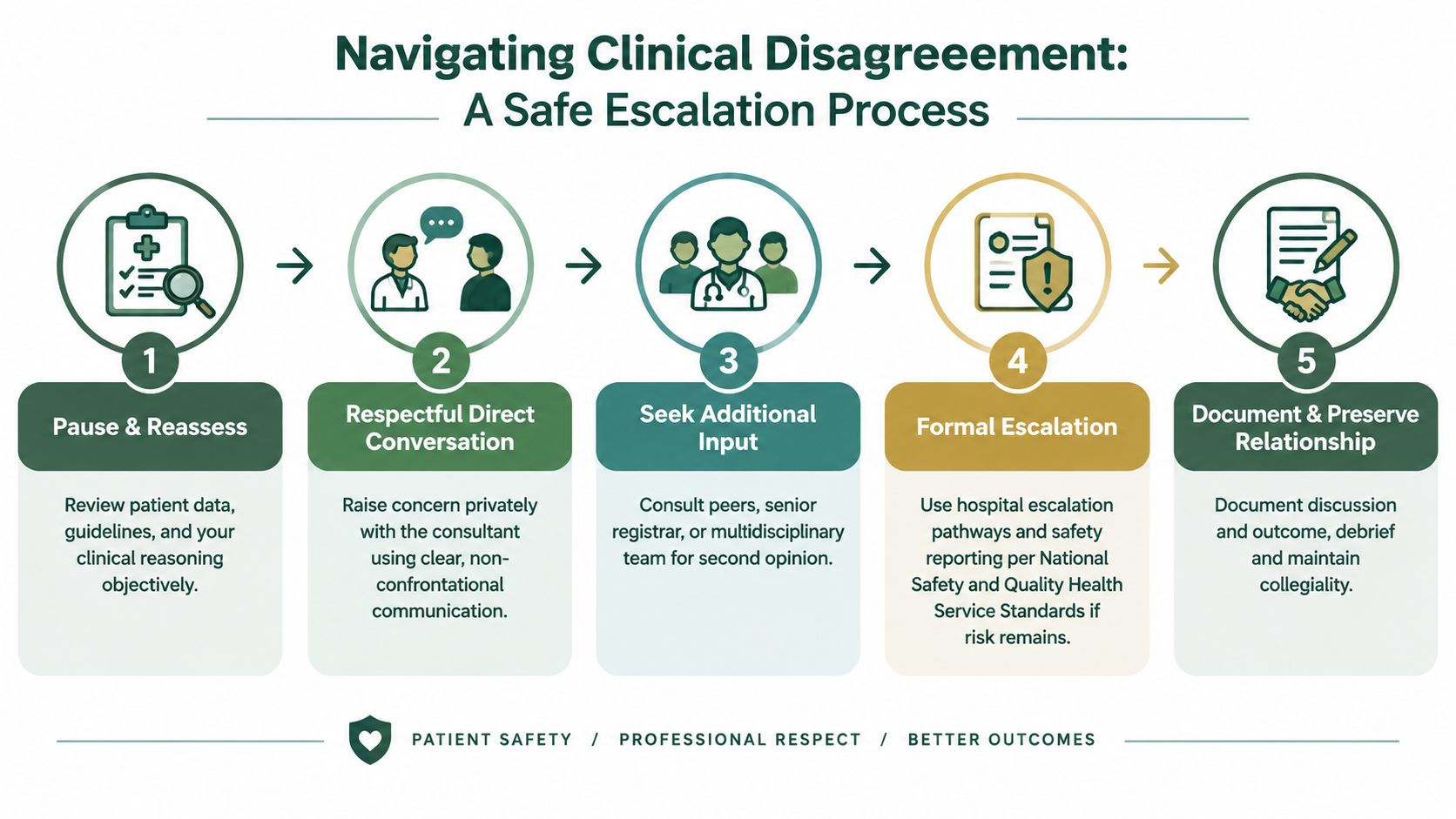
“Your senior consultant disagrees with your clinical assessment of a patient. How do you handle this?” is not an invitation to choose between obedience and confrontation. It tests whether you can preserve collegiality while making a proportionate, patient-centred safety challenge.
Start by clarifying the facts. Reassess the patient, review the relevant results and identify exactly what concerns you. Then speak directly and respectfully with the senior, using objective observations rather than accusations. A phrase such as “I’m concerned because the patient remains hypotensive despite the current treatment” is more useful than “I think your plan is wrong.” Ask the consultant to explain their reasoning, because disagreement may arise from information you haven’t understood or seen.
If the risk remains, describe a clear escalation pathway. Depending on the situation, that could involve another senior clinician, the registrar, an intensivist, an emergency response process, a nurse in charge, a clinical supervisor or a formal safety system. You should say that urgent danger takes priority over preserving a comfortable conversation. You’d also document the assessment, discussion, advice and agreed plan according to local policy.
Scoring signals and pitfalls
A strong answer includes four elements:
- Respect: You recognise the consultant’s experience and invite discussion.
- Specificity: You identify the clinical evidence behind your concern.
- Escalation: You know what you’ll do if the concern isn’t resolved.
- Reflection: You consider how the interaction affects the team and future care.
An average answer says it would “depend on the consultant”. An unsafe answer says you’d accept the decision automatically, or bypass the team and make unilateral changes without communicating.
Australian health services use formal safety and quality expectations, but the exact reporting and escalation route depends on the institution. Avoid presenting yourself as a heroic whistle-blower. Describe yourself as a clinician who raises concerns early, uses the chain of support and remains accountable for patient safety. The MMI practice question resource from CliniRoo can help you rehearse this balance without turning it into a memorised confrontation.
4. Communication station for bad news and medication side effects
This station can shift quickly. You may be asked to explain a malignancy result, then move to a conversation about medication side effects. In both cases, the panel is assessing whether you can match the information to the patient’s needs, respond to emotion and support an informed decision.
For bad news, use SPIKES (Setting, Perception, Invitation, Knowledge, Emotions, Strategy — a six-step sequence for difficult conversations) as a guide rather than a rigid speech. Establish privacy, check what the patient already understands, ask how much detail they want, give a clear warning that difficult information is coming, explain the result in plain language, pause for emotion, and finish with a plan. Don’t fill silence because you’re uncomfortable. A patient who begins to cry may need acknowledgement before they can process another explanation.
For side effects, start with the patient’s concern. Ask what they’ve heard, what they fear and whether they’ve already experienced a symptom. Explain the expected benefit, distinguish common and usually manageable effects from symptoms requiring urgent review, and discuss monitoring, alternatives and follow-up. Never minimise concerns or imply that the patient must continue a medicine without reviewing safety.
Strong, average and unsafe responses
A strong answer checks understanding using teach-back, offers written information, asks about the patient’s preferred communication style and involves a support person if the patient wants that. It also considers cultural safety, including the needs of Aboriginal and Torres Strait Islander patients and people from culturally and linguistically diverse backgrounds. You might mention interpreter access rather than relying on a family member for complex information.
An average answer delivers accurate information but talks too much. An unsafe answer uses jargon, gives false reassurance, ignores consent or fails to explain how the patient can obtain help.
After the explanation, state that you’d document the discussion and communicate the follow-up plan to the treating team. Resources such as Cancer Council, Diabetes Australia and Beyond Blue may be relevant, but only offer them when they fit the patient’s situation. You can also review this communication skills video as a prompt for observing pace, empathy and clarity.
5. Motivation question about specialty and training program
“Why have you chosen this specialty, and what attracts you to our training program?” exposes generic answers quickly. “I like the variety” or “I want to help people” may be sincere, but they don’t explain why this pathway fits your experience, values and realistic career expectations.
Build the answer around experience, attraction, program fit and development. Begin with a specific clinical or educational experience that shaped your interest. Then identify the parts of the specialty that continue to attract you, such as acute decision-making, continuity of care, procedural work, diagnostic uncertainty, research or advocacy. Follow with evidence that you understand the training pathway, including the relevant college requirements, rotations, assessments, supervision and service commitments.
Your program research should be specific. Refer to published values, teaching arrangements, research opportunities, rural exposure or the way the program supports feedback. Don’t repeat words from the website. Explain why a feature matters to your development and how your experience suggests you’d contribute.
Avoiding the polished but weak answer
A strong response shows enthusiasm and realism. An emergency medicine applicant, for example, might connect an emergency rotation with an interest in undifferentiated illness, then acknowledge shift work, resuscitation responsibility, teamwork and the demands of training with ACEM (the Australasian College for Emergency Medicine). A RACP applicant might discuss both acute assessment and longer-term patient relationships rather than describing internal medicine as a vague stepping stone.
An average response lists attractive features without personal evidence. An unsafe response suggests that the specialty was chosen mainly for lifestyle, status or a perceived lack of difficult patients. Lifestyle matters, but mature candidates show that they’ve considered workload, on-call expectations and the specialty’s challenges.
Check the current requirements directly with the program or college. Selection systems change, and Australian medical admissions operate as multi-stage filters that remove most applicants before anyone hears them speak. A BMC Medical Education study of University of New South Wales medicine applicants (2020, covering the 2013–2018 cohorts) reports that only about one in ten applicants secures a place in the program, with roughly 400 domestic applicants invited to interview each year. That shape illustrates why a credible motivation answer needs to work within the actual pathway, not an imagined national template — and why the interview is rarely the first filter you have to pass.
6. Teamwork and leadership in difficult circumstances
Leadership in medicine rarely means giving orders from the front. A strong answer shows that you can create clarity, invite expertise, delegate safely and keep the patient’s needs visible when the team is under pressure.
Choose a situation where your role was meaningful but bounded. You might describe coordinating a complex discharge for a patient with multiple conditions. The work could involve physiotherapy, social work, community nursing, pharmacy and the GP. Explain how you clarified the shared goal, assigned actions according to role and capability, checked for barriers and kept the patient and family informed.
The best stories give the team credit. State what you personally did, but don’t describe yourself as the only person who solved the problem. A registrar who notices that a discharge plan is stalled might call a brief multidisciplinary discussion, ask each service what it needs, identify the unresolved medication or support issue and confirm ownership of the next steps. That demonstrates leadership through coordination, not authority.
What the panel is listening for
Inclusive leadership means asking for dissenting views, especially from professionals who see a different part of the patient’s care. It also means recognising when a junior colleague is overloaded, when a task needs supervision and when a disagreement requires a private conversation rather than public correction.
An average answer says the team worked well because everyone was friendly. An unsafe answer describes delegating tasks without checking competence, ignoring conflict or taking credit for a group result.
End with a genuine reflection. Perhaps you learned that your instinct to solve problems quickly could silence quieter team members, so you began asking each discipline for concerns before finalising a plan. Or you learned that leadership during a quality improvement project required persistence after the initial meeting, not just a confident presentation.
Australian hospitals rely on multidisciplinary structures, but titles and responsibilities vary between services. Use the terms that fit your experience and make clear where you sought senior support. The panel wants a safe colleague, not a dramatic rescuer.
7. Research and academic experience
“Tell me about your research experience and what you learned from it” can be answered well even if you haven’t led a major study. The panel is testing whether you understand how evidence is produced, how limitations affect conclusions and how research changes your clinical thinking.
Use a compact structure: question, role, method, challenge, learning and application. Explain the clinical or educational problem first. Then state exactly what you did. “I was involved in a project” is too vague. Say whether you searched the literature, recruited participants, extracted data, cleaned a dataset, performed interviews, contributed to ethics documentation, analysed results or prepared a presentation.
Your method should be clear at the level expected for your pathway. Identify whether the work involved qualitative interviews, a cohort, a trial, a systematic review, audit or quality improvement. You don’t need to make the answer sound more advanced than it was. A candidate who accurately describes a small project and its limitations will sound more credible than one who claims ownership of every part of a large collaboration.
Turning limited experience into a useful answer
A medical student might discuss a summer project, literature review or critical appraisal exercise. A junior doctor could use a handover audit or medication-safety improvement project. Explain what went wrong or proved difficult, how you responded and what the experience taught you about bias, missing data, feasibility, consent or translating findings into practice.
An average answer focuses on the final result and says little about personal learning. An unsafe answer exaggerates your contribution, treats association as causation or suggests that one paper should determine every patient’s care.
Connect the experience to your specialty’s research priorities and to evidence-based decision-making in Australia. You can mention the relevance of organisations such as the National Health and Medical Research Council or the Australian Research Council when appropriate, but don’t claim support, funding or outcomes you can’t verify. Finish by explaining how you now approach clinical evidence differently, perhaps by checking study design, population, applicability and limitations before changing practice.
8. Technical question about imaging or ECG interpretation
“Walk me through your approach to interpreting a chest X-ray or ECG (electrocardiogram, the tracing of the heart’s electrical activity), and what would trigger referral to a specialty?” rewards a consistent method. A panel may forgive a missed finding more readily than a chaotic approach that makes it impossible to know what you’ve checked.
State your framework before applying it. For a chest X-ray, you could move through patient details and image quality, then a systematic review of the airway, bones and soft tissues, cardiac size, diaphragm, lungs, pleura and lines or devices. For an ECG, describe rate, rhythm, axis, intervals, conduction, atrial and ventricular activity, ST segments and T waves. Adapt the sequence to your training level and specialty.
Don’t stop at interpretation. Explain how the finding changes urgency. An ECG suggesting acute coronary occlusion, a large pneumothorax, severe pulmonary oedema or another immediately dangerous pattern should prompt immediate assessment, senior involvement and the relevant emergency pathway. If the image is equivocal, say what additional history, examination, comparison imaging or test would help.
Referral and uncertainty
A strong answer separates recognition, stabilisation, confirmation and referral. You might state that referral depends on the patient’s stability, the finding, available local services and the responsible specialty pathway. An emergency department, tertiary hospital and rural service may not have identical access or transfer arrangements, so don’t invent a universal turnaround time or promise a specific clinic.
An average answer lists abnormalities without linking them to action. An unsafe answer gives definitive reassurance from a single image, ignores clinical deterioration or delays escalation while waiting for perfect certainty.
Practise with cases relevant to the pathway you’re applying for, including trauma, chest pain and postoperative complications where appropriate. Use current Australian guidance and your local protocols, and state when you’d involve a senior registrar, emergency physician, ICU team, radiologist or cardiologist. The technical answer should sound like a safe working method, not a memory test.
9. Situational safety and reflective questions
“You notice a team member is consistently making the same prescribing error. How do you address it?” tests whether you can protect patients without reducing safety to personal blame. “What is your greatest strength and an area you’re working to improve?” tests whether your self-assessment is specific enough to guide development.
For the prescribing problem, first consider immediate risk. If a patient may be harmed, check the order, involve the appropriate senior clinician or pharmacist and ensure the patient receives timely review. Then speak privately with the colleague, describe the observable pattern and ask whether workload, unfamiliarity, a confusing protocol or another systems issue is contributing. Offer practical support, such as checking the relevant guideline together, while making clear that repeated risk requires escalation.
A graduated response might include:
- Immediate protection: Correct or quarantine the unsafe order through the appropriate clinical process.
- Direct feedback: Discuss the error privately and respectfully.
- System review: Check prescribing tools, supervision, workload and team communication.
- Formal escalation: Use the hospital’s reporting and supervision pathways if the risk continues.
- Follow-up: Confirm that the corrective plan is working.
An unsafe answer ignores the error to avoid conflict. Another unsafe answer publicly humiliates the colleague or files a formal report without first considering the immediate patient and context.
For strengths and development areas, choose something relevant and believable. “I’m detail-oriented” is weak unless you show how that helps your specialty. “I’m improving efficiency” becomes stronger when you describe a concrete change, such as prioritising tasks, seeking feedback and reviewing whether your practice has improved. Don’t disguise a dangerous limitation as a charming weakness.
A strong reflective response shows self-awareness, humility and action. It recognises that professional development includes supervision, feedback, continuing professional development and learning from near misses.
9-Item Medical Interview Question Comparison
| Question | What the panel is actually scoring | Where it appears | Preparation that works |
|---|---|---|---|
| Difficult clinical handover | Communication as a safety system, and your accountability in it | Stations on handover, teamwork, escalation | Three or four real stories; name the local handover framework you used |
| 68-year-old with acute dyspnoea | Prioritisation under uncertainty, not breadth of differential | Clinical stations and college case assessments | Rehearse stability-first sequencing aloud; say what each test would change |
| Senior disagrees with your assessment | Proportionate, respectful challenge with a real escalation route | Professionalism and safety-culture stations | Practise graduated escalation; avoid both deference and heroics |
| Breaking bad news, explaining side effects | Matching information to the patient, responding to emotion | Patient-centred and consent stations | Use SPIKES as a guide, not a script; practise silence |
| Why this specialty and program? | Specific, informed motivation grounded in evidence | Shortlisting and program-fit interviews | Two or three authentic reasons; research the program’s actual structure |
| Leading a team under pressure | Coordination and inclusion rather than authority | Multidisciplinary and quality-improvement stations | Pick a bounded role; give the team credit accurately |
| Research and academic experience | Understanding of evidence and honesty about your contribution | Competitive and academic-track selection | Explain one project plainly, including its limitations |
| Interpreting a chest X-ray or ECG | A consistent method, and what the finding changes | Technical viva and practical stations | Apply one framework every time; state referral thresholds |
| Prescribing error, strengths and weaknesses | Safety-first thinking and specific self-awareness | Reflective and safety-culture stations | Propose a graduated response; name a real development area |
This table sets out what each question is testing. It carries no effectiveness scores deliberately — the evidence comparing selection instruments is mixed, and a rating invented for a blog table tells you nothing about the panel in front of you.
Turn questions into repeatable station practice
Strong performance comes from repeatable behaviours, not from memorising perfect paragraphs. Start by classifying every prompt by station type and competency. A behavioural question needs a real example and reflection. A clinical vignette needs prioritisation and escalation. An ethical station needs respectful challenge and a safe pathway. A communication station needs empathy, plain language and checking understanding.
Then practise in the format you’ll face. Medical school interviews, specialty selection and college pathways may use different timing, station design and scoring criteria. Australian evidence also shows why candidates shouldn’t assume that an interview is a casual conversation. The UNSW selection study compared a redesigned interview process across five cohorts from 2014 to 2018, scoring candidates on interpersonal interaction using structured interviewer marks rather than an open conversation. That supports a practical preparation choice: practise responses against explicit domains rather than relying on general confidence.
Use a simple rehearsal loop:
- Classify the prompt: Name the station and the competency being tested.
- Set the time: Use the actual station limit when your program provides it.
- Choose a framework: STAR, a clinical prioritisation sequence, SPIKES or a technical interpretation method.
- Answer aloud: Include what you’d do first, who you’d involve and how you’d follow up.
- Score separately: Review communication, safety, reasoning, structure and reflection rather than giving yourself one vague mark.
- Change one behaviour: Work on signposting, shorter sentences, earlier escalation or a clearer final reflection.
- Repeat with variation: Change the patient, setting, seniority or complication so you practise transfer, not recall.
Ask a supervisor, peer or study group to interrupt you with realistic follow-ups. “What would you do if the patient deteriorated?” “What if the consultant still disagreed?” “How would your answer change in a rural service?” These variations reveal whether you understand the principle or have just learned a script.
Check current requirements directly with the relevant university, specialty program, state service, hospital network or college. Selection interviews form part of a mixed evidence base. A systematic review of specialist selection methods (Amos and colleagues, BMC Medical Education, 2021) argues that selection instruments adapted from other purposes tend to prioritise reliability over validity, and examines how that affects the diversity of who gets selected. Interviews and multiple mini-interviews are widely used, not demonstrably superior. Your preparation should therefore be specific to the process in front of you rather than to a format someone has told you is best.
CliniRoo’s proposed format-first approach may suit candidates who want Australian-specific stations, named scoring domains and annotated model answers organised around medical school, specialty and college pathways. Use any resource as a practice aid, then replace generic examples with your own experiences, local terminology and verified current requirements. The strongest answers are structured and evidence-aware, but they still sound like you.
CliniRoo is building Australian medical interview question banks organised by station type, pathway and scoring domain, with localised scenarios and annotated model answers. Nothing is on sale yet. If you want to be told when there is something to use, CliniRoo takes an email address and does nothing else with it.