How to Be a Psychiatrist in Australia: The Full Pathway
Learn how to be a psychiatrist in Australia, from medical school through RANZCP Fellowship. Clear steps, timelines, exams, and selection tips for 2026.
You’re a second-postgraduate-year (PGY2) doctor in a Melbourne emergency department. A familiar patient arrives again, distressed, angry, sleep-deprived and carrying a history that won’t fit neatly into a pathology result. You manage the immediate risk, speak with the family, negotiate with the inpatient team and wonder whether psychiatry is the specialty where the difficult questions are the actual work.
That question deserves a more honest answer than “psychiatry offers a good lifestyle”. Becoming a psychiatrist in Australia is a long medical training pathway, and one of the gates is securing a job in an accredited training post. The Fellowship Program of the Royal Australian and New Zealand College of Psychiatrists (RANZCP — the college that trains and accredits psychiatrists in both countries) takes a minimum of 60 months full-time equivalent (FTE — full-time months, so part-time training takes proportionally longer), and you can only apply after at least two years of general hospital work. Your choices before and during that period will shape both your selection prospects and your eventual career.
Table of Contents
- Is Psychiatry the Right Specialty for You
- The Medical Degree and Internship Foundation
- Pre-Training Experience That Strengthens Your Application
- Applying to the RANZCP Fellowship Program
- Exams and Assessments Across the Three Stages
- What the Workforce Reality Means for Your Career
- Your Next 12 Months and a Practical Checklist
Is Psychiatry the Right Specialty for You
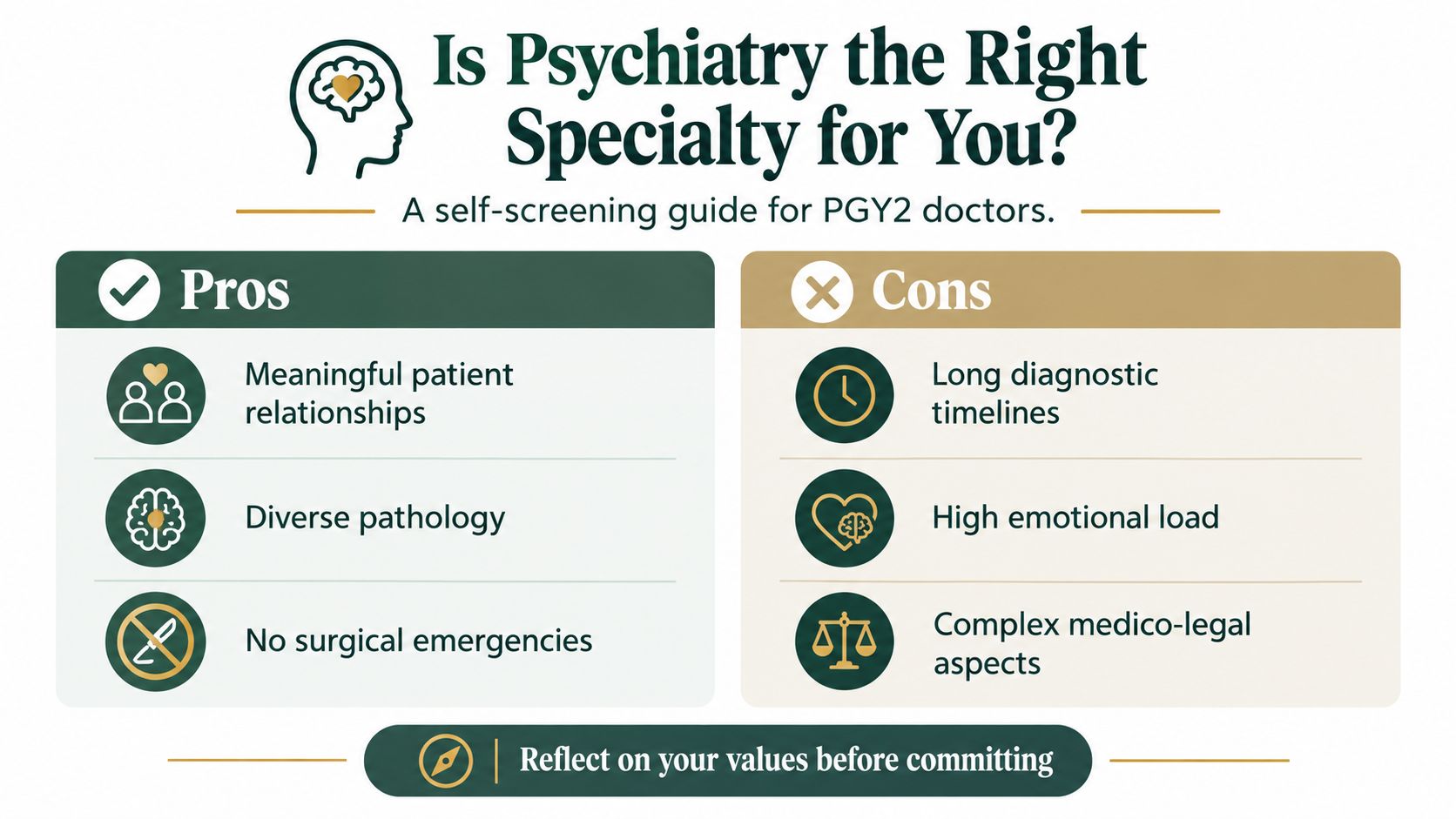
Psychiatry is more than medicine with longer conversations. In a public inpatient unit, you may assess acute psychosis, manage medication changes, negotiate leave and coordinate discharge while balancing the concerns of nurses, psychologists, social workers, families and community services. In community mental health, the work is more longitudinal and systems-heavy. Private practice brings extended consultations, complex histories, diagnostic uncertainty and responsibility for maintaining a therapeutic relationship over time.
The central cognitive task is risk formulation under uncertainty. There often isn’t a single blood test or scan that confirms the diagnosis. You assemble a picture from the patient’s account, collateral history, mental state, physical health, substance use, developmental history, social circumstances and response to previous treatment. You then make decisions that can affect liberty, safety, family relationships and long-term functioning.
That suits some doctors exceptionally well. It frustrates others.
The temperament that tends to last
You’re likely to find satisfaction in psychiatry if you can tolerate ambiguity without becoming passive, take a genuine interest in psychosocial history and value relationships that develop over months or years. You also need to remain emotionally present when a patient is frightened, hostile, suicidal, traumatised or unable to recognise that they’re unwell.
The specialty rewards doctors who can hold competing explanations at the same time. A patient may have depression, alcohol dependence, chronic pain, financial stress and a neurodevelopmental condition. The work isn’t about choosing the most elegant label. It’s about deciding what matters now, what can wait and what support the team can realistically provide.
You may struggle if you’re drawn mainly to a predictable lifestyle, want acute procedural drama every day or dislike advocacy outside the consulting room. Psychiatry involves service limitations, housing problems, guardianship questions, tribunal processes, family conflict and fragmented follow-up. You’ll often need to argue for resources or safer systems rather than just prescribe a treatment.
Practical rule: Spend time in both acute inpatient psychiatry and community psychiatry before committing. One placement can make the field look easier or more glamorous than it is.
Use your next rotation as a proper test. Ask whether you enjoy the assessment itself, not just the roster. Speak to registrars about after-hours work, supervision, psychotherapy training, complaints and the transition to consultant practice. The broader comparison in this guide to medical specialties in Australia can help you test psychiatry against procedural and physician specialties.
If you’re committed, seek a consultant mentor and begin building relevant experience now. If you’re uncertain, don’t apply because psychiatry appears accessible or offers employment. Five or more years of training is too long to spend hoping the day-to-day work will eventually become more appealing.
The Medical Degree and Internship Foundation
The Australian pathway starts with medicine, not psychology. RANZCP’s eligibility criteria for the Fellowship Training Program (accessed 7 October 2026) set four gates:
- A medical degree, with certified copies of your academic record. Australian-trained doctors who complete their degree after 2023 are expected to hold the certificate of completion under the National Framework for Prevocational Medical Training (NFPMT — the Australian Medical Council’s framework for the first two postgraduate years, awarded at the end of PGY2).
- At least 24 months (two years FTE) of general hospital training after your medical degree.
- Current registration as a medical practitioner in Australia or Aotearoa New Zealand.
- A job offer in an accredited training post.
Internship is where you establish the general medical foundation that psychiatry depends on. You’ll assess physical illness, prescribe safely, recognise delirium, understand medication interactions and learn how hospitals make decisions under pressure. Protecting time in a psychiatry rotation is sensible, but don’t treat general medicine as irrelevant. Psychiatric patients often have substantial physical health needs, and psychiatrists remain doctors first.
In practice, the 24-month rule means the earliest realistic entry point is after PGY2, not straight out of internship. Plan your second year accordingly.
The actual specialist timeline
RANZCP divides Fellowship training into three stages, set out in its Fellowship Program overview:
- Stage 1: a minimum of 12 months FTE, all in adult psychiatry, including at least six months in an acute setting (Stage 1).
- Stage 2: a minimum of 24 months FTE, including mandatory six-month rotations in child and adolescent psychiatry and in consultation–liaison psychiatry (Stage 2).
- Stage 3: a minimum of 24 months FTE, by the end of which all assessments must be complete to attain Fellowship (Stage 3).
Together, those stages require a minimum of 60 months FTE, as the RANZCP psychiatry training page states. Part-time arrangements extend the calendar time, and leave, remediation or assessment delays may also affect when you finish.
The program described here is the 2012 Fellowship Program, which held 98.5% of active trainees in February 2026 according to the RANZCP 2025 training and assessment end-year report. RANZCP is designing a replacement — the 2030 New Fellowship Program, whose design directions were described in May 2026 as exploratory and still under consultation. Nothing about it is final, so plan against the current program and check which program your own intake year falls under.
RANZCP also requires trainees to enrol in and demonstrate satisfactory participation in a College-accredited formal education course during the first three years FTE of training. Courses are run by state and region, and enrolment needs approval from the course provider, your Branch Training Committee and your Director of Training. This is a major planning issue, not an administrative footnote: the teaching schedule, travel and workload must fit your clinical roster.
Don’t confuse the Fellowship with RANZCP’s Certificate of Postgraduate Training in Clinical Psychiatry. That certificate takes a minimum of 12 months, can be self-paced over up to 48 months, and is aimed at general practitioners, rural generalists, emergency physicians and other doctors who support patients’ mental health. RANZCP states plainly that it is not a pathway into specialist psychiatry training.
For an international medical graduate, the starting point is different because medical registration and, for overseas-trained specialists, a College comparability assessment apply. Don’t assume the domestic sequence is automatically transferable. Treat your registration and College advice as a separate workstream.
Pre-Training Experience That Strengthens Your Application
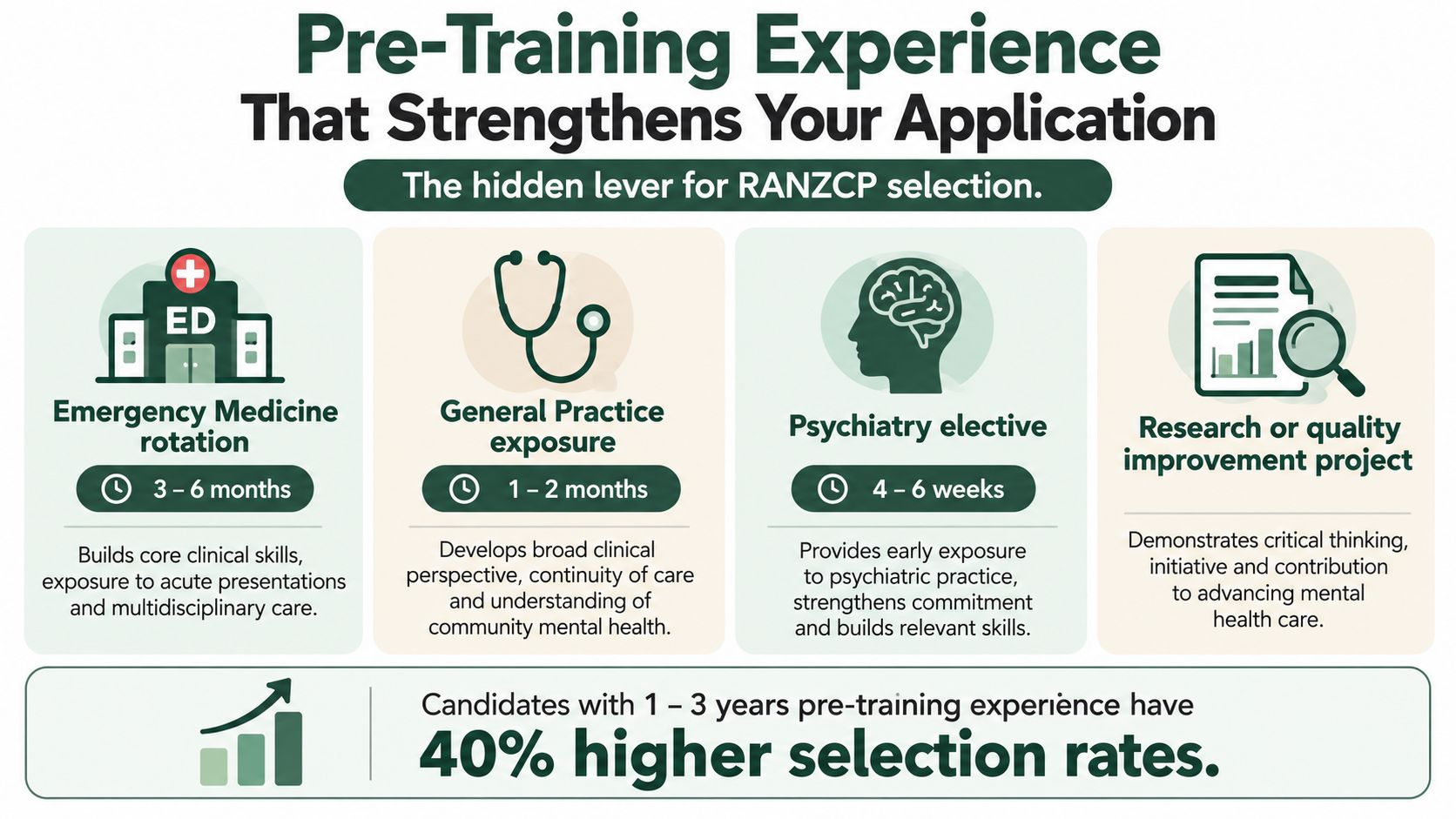
The period between internship and a RANZCP offer is where many applicants waste their strongest opportunity. A year spent collecting unrelated certificates is less persuasive than a clinical role that shows you understand psychiatric work and can function reliably in a team.
Start with acute adult inpatient psychiatry if you can. It gives supervisors evidence about your assessment skills, response to risk, communication with families and ability to work within a multidisciplinary unit. Then add breadth deliberately. Consultation-liaison psychiatry, community mental health, child and adolescent psychiatry and old age psychiatry each show a different understanding of the field.
Build a coherent record
Selection panels don’t need a curriculum vitae (CV) packed with disconnected activities. They need a believable pattern of interest and responsibility.
- Choose rotations with a purpose. A regional or rural psychiatry post may give you broader clinical exposure and closer access to senior supervision than a highly competitive metropolitan position.
- Complete one useful quality improvement project. Pick a problem your service faces, such as discharge communication, follow-up reliability or medication reconciliation, and carry it through to a measurable service change where possible.
- Teach consistently. Medical student tutorials, bedside teaching and structured exam preparation are more valuable when supervisors can describe your preparation and feedback skills.
- Use research strategically. A conference presentation or publication can support your application, but only if you can explain the question, methods, limitations and clinical relevance.
- Take leadership seriously. A junior medical staff representative role matters when it demonstrates negotiation, listening and follow-through rather than occupying a committee seat.
Your referees should be chosen for what they can say, not for their seniority alone. RANZCP’s selection process page says referees are contacted to understand your work experience and aptitude, so at least one consultant psychiatrist should be able to discuss your clinical judgement, response to feedback, communication with patients and contribution to the team. A referee who merely confirms attendance won’t distinguish you.
A strong application tells one story: this doctor has tested psychiatry, understands its demands and has become more useful with experience.
Keep a record of feedback after every psychiatry rotation. Write down examples of difficult assessments, family meetings, handovers, risk decisions and occasions when you changed your approach after supervision. Those examples will improve both your application and your interview answers.
The common mistake is confusing activity with readiness. More courses won’t compensate for poor attendance, weak clinical references or an inability to explain why psychiatry fits you. Your pre-training years aren’t a waiting room. They’re your evidence.
Applying to the RANZCP Fellowship Program
The application is not a national contest decided by examination performance. RANZCP states that trainee selection, “including dates and timing, is managed by local training programs in each state and territory”, with applications reviewed by the state’s Branch Training Committee and shortlisted applicants interviewed by a panel of psychiatrists (RANZCP selection process, accessed 7 October 2026). Because you also need a job offer in an accredited post, you’re applying for a training environment as well as a College pathway. How psychiatry compares with colleges that select nationally, or that don’t interview at all, is mapped in our guide to specialty selection interviews in Australia.
Read the current intake instructions carefully and separate three questions:
- What does RANZCP require?
- What does the relevant state training program require?
- What does the individual position value?
Those requirements can overlap without being identical. Prepare the documents early, including your CV, academic record and referee details. Your written application should show a clear progression from medical training to psychiatric experience, with specific examples of clinical responsibility rather than generic claims about empathy.
Make your preferences credible
Don’t write that you’re passionate about rural practice if every example in your application concerns a metropolitan hospital. If you’re open to regional training, explain what attracts you, what skills you expect to develop and how you’ve tested that interest. Rural work can offer meaningful responsibility and broad exposure, but it can also involve travel, limited services and fewer local subspecialists. Show that you understand both sides. RANZCP’s selection page also states that all eligible Aboriginal and Torres Strait Islander, Māori and rural applicants progress to an interview.
The same principle applies to child and adolescent psychiatry. Expressing an interest is useful, but it becomes persuasive when supported by relevant rotations, family work, developmental knowledge, teaching or service improvement. You don’t need to announce a final subspecialty choice before entering training. You do need to show that your preference is grounded in experience.
Training post availability is the constraint many guides underplay. A candidate can be academically capable and still wait if an accredited position isn’t available in the preferred network, because without a job offer in an accredited post you are not eligible. Intake also moves year to year: the RANZCP 2025 end-year report records 381 Fellowship commencements in Australia in 2025, down from 419 in 2024, with New South Wales alone 29 lower.
That report also records that, across Australia and New Zealand, 309 of 417 new Fellows (74%) in 2025 completed the training pathway, while 108 (26%) were admitted via the pathway for specialist international medical graduates (SIMGs — psychiatrists who trained overseas). Those figures describe the composition of one year’s new Fellows, not future selection odds. For domestic applicants, the lesson is straightforward: understand the local post market and apply with flexibility.
Before applying, contact the relevant state training program and confirm how preferences, interviews, referee reports and offers work for that intake. Don’t rely on an old forum post. The practical distinction between central College requirements and local selection is also relevant in this broader overview of specialty training in Australia.
Exams and Assessments Across the Three Stages
RANZCP training is not one examination followed by a certificate. It combines formal examinations, workplace-based assessment, a psychotherapy case, scholarly work and ongoing supervisor judgement. That means you need two study systems: one for discrete assessments and one for becoming consistently safe at work.
The assessment set has changed recently and is still changing, so check each requirement against RANZCP’s own page rather than a registrar’s old notes. As listed on RANZCP’s exams and exams and assessments pages, accessed 7 October 2026:
| Assessment | What it is | When (per RANZCP) |
|---|---|---|
| Multiple Choice Question (MCQ) exam | Computer-based exam at a Pearson VUE testing centre | Eligible after 6 months FTE; recommended in Stage 2 and should be passed by 36 months FTE. Not required to enter Stage 3, but required to begin a Certificate of Advanced Training |
| Modified Essay Questions (MEQ) exam | Five modified essay questions in 150 minutes, assessing critical thinking about clinical practice | Eligible after 18 months FTE; recommended in Stage 3; should be passed by 60 months FTE |
| Clinical Competency Portfolio Review | A portfolio-based review of competence across multiple assessments and assessors | End of Stage 3, after at least 12 months FTE of Stage 3 training. Replaces the Clinical Competency Assessment – Modified Portfolio Review; first applications opened September 2026 |
| Psychotherapy Written Case | An 8,000–10,000 word case report | During training; see RANZCP’s page for timing |
| Scholarly Project | Original research or another approved project type relevant to psychiatry | During training; see RANZCP’s page for timing |
| Entrustable professional activities (EPAs), rotation assessments and mandatory online modules | Workplace-based evidence that you can be trusted to perform defined tasks | Throughout all three stages |
One change matters for anyone working from older material. RANZCP discontinued the Critical Essay Question (CEQ) exam in June 2025, after the March 2025 sitting. Its replacement, the Critical Thinking in Psychiatry learning modules, was introduced as optional in October 2025 and becomes a mandatory requirement for Fellowship from August 2026, with exemptions depending on individual training trajectories.
General exam preparation principles are also different from the broad medical examination advice in this Australian medical exam resource.
Study for the work, not just the exam
The most reliable preparation starts with patient care. After each assessment, write a brief formulation, identify the key differential diagnoses and review why the treatment plan was chosen. Ask your supervisor what you missed. That habit improves clinical reasoning and creates material you can revisit before formal assessments.
Written preparation should be structured around the College curriculum, not a generic question bank. Use timed practice, error logs and spaced revision. For the essay exam, practise writing to time and check that your answers are organised, safe and responsive to the actual question. A polished answer is less useful than a clear one that recognises uncertainty and escalates appropriately.
Psychotherapy deserves early planning. It isn’t a final paperwork exercise. The written case alone runs to 8,000–10,000 words, and you’ll need suitable cases, regular supervision and protected time. Start by learning how your service documents therapy, how supervisors assess the work and how you’ll maintain continuity when rotations change.
The 60-month minimum FTE pathway should shape your calendar. Don’t postpone every requirement until the final stage, and don’t assume study leave will appear when you need it. Ask early about remediation, leave approval, supervision access and the consequences of changing networks.
For overseas-trained psychiatrists, the SIMG route assesses you as substantially or partially comparable to an Australian-trained psychiatrist rather than putting you through the domestic trainee sequence; partially comparable SIMGs sit some of the same exams, including the MEQ. Eligibility depends on individual qualifications and College assessment, so obtain direct advice before choosing between routes.
What the Workforce Reality Means for Your Career
Psychiatry offers opportunity, but “lifestyle specialty” is a lazy summary. The work can include after-hours crises, compulsory treatment decisions, high-risk discharge planning, complaints, complex family dynamics and sustained responsibility for patients who may not improve quickly. Your eventual lifestyle will depend heavily on setting, caseload, supervision, administrative support and the population you choose to serve.
The workforce data points to demand, but it also shows why demand doesn’t automatically create an easy training pathway. The Australian Government’s psychiatry supply and demand compendium (updated November 2025) counted 4,272 psychiatrists in 2023, equal to 3,812.6 FTE, up from 3,417.8 FTE in 2019. Its baseline projection estimated a shortfall of 103.7 FTE in 2024, peaking at 385.4 FTE by 2033. These figures describe workforce modelling, not an individual employment guarantee.
Choose your scarcity carefully
Child and adolescent psychiatry is an especially important example. RANZCP’s own analysis of the child and adolescent psychiatry workforce, published in July 2026, projects a national shortfall of at least 229.9 FTE child and adolescent psychiatrists by 2028, with Western Australia’s gap projected at 37.8 FTE in 2028, and notes that Western Australia trained just 11 new child and adolescent psychiatrists in the past five years. Those numbers should make you think seriously about workforce need, not just future earnings.
Your subspecialty can alter your bargaining position. Child and adolescent, old age, addiction, forensic, perinatal and consultation-liaison psychiatry each involve different referral networks and service pressures. Regional work may offer responsibility and demand, but don’t accept a position without asking about supervision, accommodation, travel, on-call expectations and access to allied health support.
Public and private practice also reward different capabilities. Public work offers multidisciplinary infrastructure and exposure to complex presentations, but administrative load and service constraints can be substantial. Private practice offers autonomy and continuity, but you carry responsibility for referrals, boundaries, documentation, risk management and the practical limits of outpatient care.
Don’t make financial decisions using salary claims copied from recruitment advertising. Compare the actual contract, session structure, on-call commitments, leave, supervision, indemnity arrangements and expected unpaid administration. A high headline rate can conceal a difficult caseload or an unsustainable roster.
Your Next 12 Months and a Practical Checklist
Treat the next year as a positioning year, not a waiting year. If you’re a PGY2 or PGY3 doctor considering psychiatry, your objective is to create evidence that you can do the work, function in a team and understand the pathway before you ask a selection panel to take a chance on you.
Start with the basics. Confirm that you will have the 24 months of general hospital training and the registration RANZCP requires, then secure a further psychiatry rotation or a closely related role. If you can choose, combine acute adult exposure with one setting that broadens your understanding, such as community, consultation-liaison, child and adolescent or old age psychiatry.
A practical action list
- Audit your clinical experience: Identify which patient groups and service settings you’ve worked with, then target the gap rather than collecting another generic course.
- Find a psychiatrist mentor: Ask for a direct conversation about selection, assessments, supervision and the parts of the job that trainees often discover late.
- Start one longitudinal project: Choose a quality improvement, teaching or research project you can complete and explain clearly.
- Secure useful referees: Build relationships with consultants who have observed your judgement, communication and reliability over time.
- Plan the formal education requirement: Review College-accredited options early, including timetable, travel, workload and employer support.
- Track selection windows: Selection dates and timing are set by each state’s training program. Check the current intake dates rather than assuming every application follows the same calendar.
- Ask about funding: Confirm how your employer handles course costs, examination fees, study leave and travel. These arrangements vary by state, network and contract.
- Prepare for interviews: Practise concise answers about risk, teamwork, conflict, rural practice, child and adolescent interest and why psychiatry suits your temperament.
Selection preparation should be specific to the state and panel. Ask recent trainees what the panel explored, but verify their advice against the current instructions. Practise with a timer, use structured reflection after each attempt and make sure your examples show what you did, not just what the team achieved.
The Australian pathway is long enough that poor planning compounds. A missed rotation can leave a gap in your experience. A weak referee may be impossible to repair before an application closes. A late decision about the formal education course can create avoidable stress during the earliest training years.
Your decision doesn’t need to be perfect today. It does need to be active. Spend the next twelve months testing the clinical work, strengthening one or two credible signals and speaking to the people who will supervise you. If psychiatry still appeals after that exposure, apply with a clear preference and a realistic backup plan rather than a brochure version of the specialty.
CliniRoo is building preparation material for the Australian pathway, including specialty selection interviews and the college examinations. Nothing is on sale yet. If you want to be told when there is something to use, CliniRoo takes an email address and does nothing else with it.