How Much Does a Doctor Earn Per Hour in Australia
What an Australian doctor earns per hour, intern to specialist: 2026 award minimum rates, weekend loadings, and how to work out your real hourly figure.
An intern must receive at least $33.62 an hour under the Medical Practitioners Award pay rates that took effect on 1 July 2026, while the specialist base rate is $67.66 an hour. Those figures are statutory minimums, not market-typical earnings, and treating them as a national answer to how much a doctor earns per hour produces a misleading result.
The more useful question is which hourly rate you mean. An award rate measures the legal floor for ordinary time. A market rate describes what a particular employer or contract actually offers. A personal hourly value measures what remains after roster intensity, overtime, superannuation, tax and unpaid work are accounted for. Those are three different measurements of the same job.
Table of Contents
- The Hourly Rate Question Most Doctors Get Wrong
- Award Hourly Rates by Training Level
- Award Floor Versus Real Market Earnings
- Public Hospital, Private Practice and Locum Pay
- Penalty Rates, Overtime and Take-Home Hourly Value
- Why One National Hourly Figure Is Misleading
- Calculating Your Own Personal Hourly Rate
The Hourly Rate Question Most Doctors Get Wrong
The Medical Practitioners Award 2020 (the national minimum-pay instrument for doctors, code MA000031) provides the cleanest starting point because it establishes a minimum rather than relying on a broad salary average. From 1 July 2026, an intern’s ordinary hourly rate is $33.62, while the listed specialist base rate is $67.66, according to the Fair Work Medical Practitioners Award pay guide. The casual intern rate is $42.03 an hour, reflecting the 25% casual loading.
That distinction matters. The award answers, “What is the minimum ordinary-time value attached to this classification?” It doesn’t answer, “What does an Australian doctor usually earn for every hour worked?” Public hospital agreements, private billing, locum contracts, overtime and penalties can all move the actual figure away from the award schedule.
Three numbers can describe one doctor
A junior doctor comparing positions should separate three earnings layers:
- Award rate: the statutory ordinary-time floor for the relevant training and classification.
- Market rate: the hourly earnings reported for an occupational group, or the rate offered for a particular contract.
- Realised hourly value: gross or net income divided by every hour worked, including overtime, night work, commuting and unpaid administration where relevant.
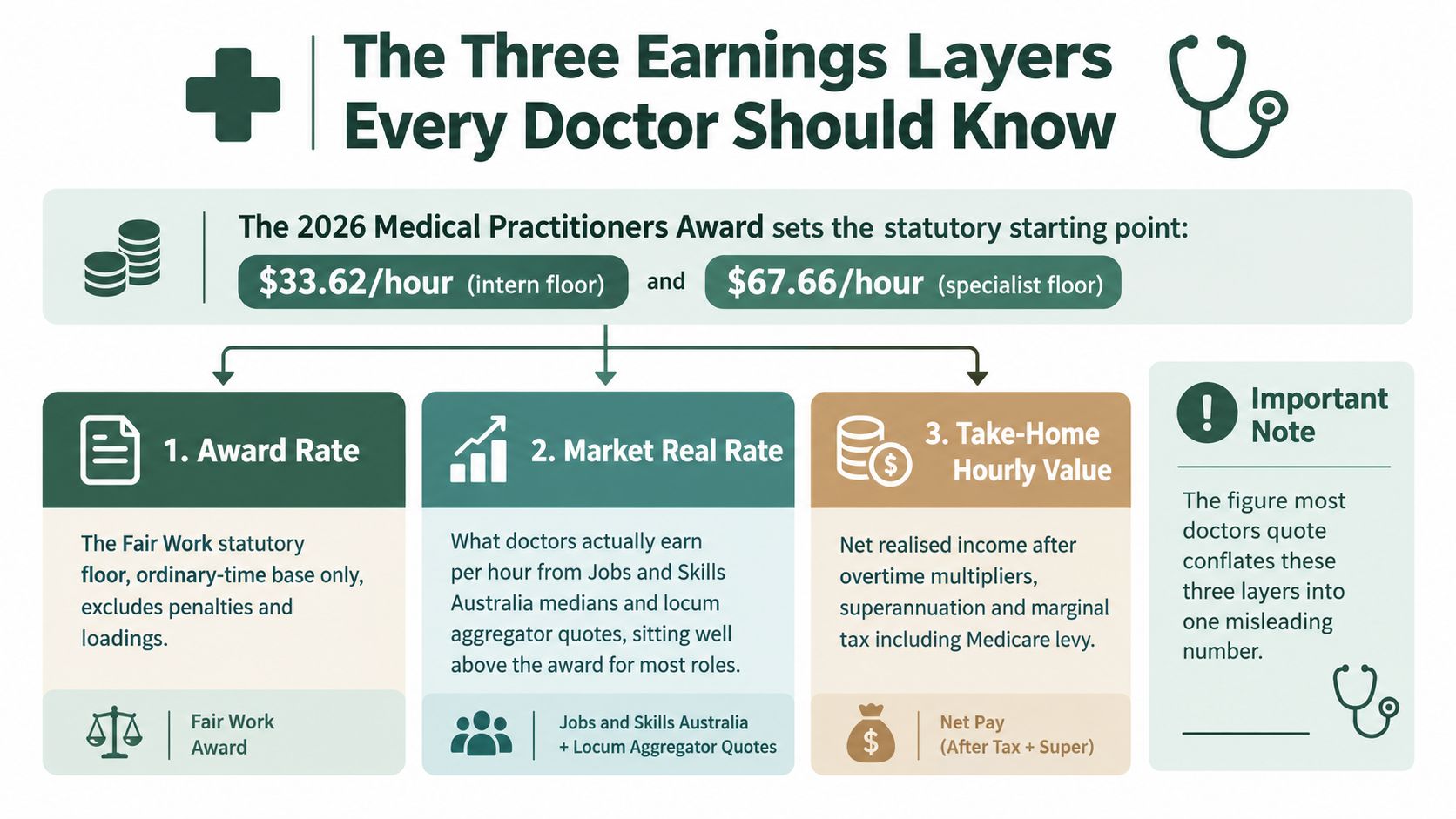
The third layer is where many comparisons fail. A doctor may quote the hourly equivalent of a salary based on ordinary rostered hours, while the actual week includes nights, weekends, handover, mandatory education and charting completed after the shift. Conversely, a penalty-heavy roster can produce a much higher gross hourly result than the ordinary base suggests.
Practical rule: Never compare an award floor with a locum rate, or a salary conversion with take-home pay, unless you first define the hours and inclusions.
Award Hourly Rates by Training Level
The award schedule becomes more useful when read as a progression rather than a single answer. The rate attached to an intern isn’t interchangeable with the rate attached to a registrar or specialist, and each classification represents a different point in the training pathway. The Australian medical training pathway overview provides broader context for where these stages sit in a doctor’s career.
The following table is taken from the Fair Work pay guide for the Medical Practitioners Award, effective 1 July 2026 and published 10 August 2026. It shows full-time and part-time ordinary rates. Annual figures are the weekly rate multiplied by 52 weeks, so they are an award-equivalent base rather than anyone’s actual annual income.
Medical Practitioners Award hourly base rates by training level, from 1 July 2026
| Classification | Hourly rate (AUD) | Weekly rate (AUD) | Annual equivalent (AUD) |
|---|---|---|---|
| Intern | $33.62 | $1,277.54 | $66,432 |
| Resident medical practitioner, pay point 1 | $35.69 | $1,356.33 | $70,529 |
| Resident medical practitioner, pay point 2 | $37.13 | $1,410.96 | $73,370 |
| Resident medical practitioner, pay point 3 | $37.49 | $1,424.67 | $74,083 |
| Registrar, pay point 1 | $40.61 | $1,543.23 | $80,248 |
| Registrar, pay point 2 | $42.28 | $1,606.52 | $83,539 |
| Registrar, pay point 3 | $44.21 | $1,679.79 | $87,349 |
| Registrar, pay point 4 | $45.56 | $1,731.12 | $90,018 |
| Senior registrar, pay point 1 | $53.07 | $2,016.81 | $104,874 |
| Senior registrar, pay point 2 | $55.17 | $2,096.35 | $109,010 |
| Specialist | $67.66 | $2,570.93 | $133,688 |
The specialist rates in the pay guide include an on-call allowance. The award itself defines how a doctor moves between pay points.
What the ordinary rate leaves out
These are ordinary-time base rates. They don’t describe the value of a weekend, public holiday, night shift, overtime period or on-call arrangement, which the pay guide lists separately. For an intern, for example, the guide lists $50.43 an hour on a Saturday or Sunday and $84.05 an hour on a public holiday. Casual employees receive a 25% casual loading on top of the ordinary rate.
A junior doctor should therefore use the table to identify the correct floor for a classification, then inspect the employment instrument for the actual roster rules. Classification details matter: a first-year registrar (pay point 1) sits at $40.61 an hour, and the gap between pay points is small enough that a misclassification is easy to miss on a payslip.
The practical milestone is straightforward. An intern is testing the entry floor. A resident is moving through prevocational responsibility. A registrar is buying greater clinical autonomy with more demanding training and roster expectations. A specialist base rate marks a different employment value, but it still isn’t the same as a private billing rate or a locum offer.

Award Floor Versus Real Market Earnings
The gap between an award rate and a market rate isn’t an error in the award. The award is designed to establish a minimum entitlement for covered employment. Market data captures a wider mix of employers, jurisdictions, experience levels and payment structures.
Salary surveys and job advertisements publish their own figures. Treat any single published figure with caution: it describes whoever was surveyed or advertised, not a doctor at your stage, in your state, on your roster.
A single headline answer fails because the figures aren’t measuring the same thing. An award rate is a legal minimum for a specific classification. A survey median is an average across an occupational category. A locum rate describes a particular temporary arrangement where availability, location, shift timing and contract terms can materially change the offer.
Regional shortages and after-hours demand can lift market rates, but a higher advertised hourly rate may come with travel, accommodation, limited continuity, administrative expectations or a workload that isn’t comparable with a salaried roster. A rate also may be quoted per session, per day or as a percentage of billings rather than as an employee wage.
The award tells you how low a covered ordinary-time rate can go. It doesn’t tell you where a doctor should expect every contract to land.
Use the award to identify underpayment risk and the market data to understand opportunity. Use neither as a substitute for calculating the hours and inclusions in your own agreement.
Public Hospital, Private Practice and Locum Pay
The same doctor can face materially different hourly economics across public hospitals, private practice and locum work. A public hospital role usually exchanges earning flexibility for a structured salary, leave provisions and a defined roster. Private practice can offer greater gross billing capacity, while shifting rooms, staffing, software, insurance and other operating costs to the practice. Locum work may quote a premium for flexibility, but continuity and future bookings are less predictable.
There is no national percentage uplift for state agreements and no standard locum range, so be wary of anyone quoting one as a benchmark.
Public hospital work
Public hospital doctors are often paid under state or territory agreements, not solely under the federal award. The award provides a useful floor reference, but the applicable agreement usually determines the actual payslip. A doctor assessing an offer should identify the classification, ordinary hours, penalty provisions, overtime rules, on-call arrangements and allowances before converting the salary into an hourly figure.
For a resident or registrar, annual salary alone is an incomplete comparison. The roster may include education, handover, documentation and other work that is paid, unpaid or recorded inconsistently. The calculation should show how many hours the salary assumes and how unrostered overtime is handled.
Training also has an opportunity cost. A doctor considering the pathway to becoming a surgeon in Australia may accept a public hospital role because supervision, case exposure and progression matter, even when its effective hourly value is below a short-term locum offer.
Private practice
Private practice commonly quotes income through billings or a percentage split rather than an employee hourly wage. Gross billings therefore do not measure personal earnings. The doctor must count consultation time, preparation, clinical records, patient communication and work outside the consulting room, then subtract the costs needed to produce that revenue.
A specialist who sees more patients may still have a lower effective hourly value if higher volume creates unpaid administration or greater overheads. The relevant calculation is retained income after practice costs, divided by total professional time.
Locum employment
Locum work can carry a higher quoted hourly amount because the doctor supplies flexibility, short-notice availability or willingness to work where recruitment is difficult. An advertised locum rate describes one opportunity, not guaranteed earnings for every shift. Travel time, accommodation, tax treatment, registration, insurance and professional expenses can change the result.
| Career Stage | Public Hospital $/hr | Private Practice $/hr | Locum $/hr |
|---|---|---|---|
| Intern or junior doctor | Award or state-agreement rate | Contract-dependent | Contract-dependent |
| Resident medical officer (RMO) or registrar | Agreement and roster-dependent | Billing or salary split | Contract-dependent |
| Specialist or consultant | Agreement and appointment-dependent | Billing, salary or partnership-dependent | Contract-dependent |
This table is a comparison framework, not a universal pay scale. Before accepting a locum offer, calculate the complete assignment. Include unpaid travel, accommodation arrangements, registration requirements, insurance, meals, gaps between bookings and time spent completing clinical records.
The best setting can change with career stage. A junior doctor may value supervision and training access. A fellow may prefer a locum premium while building flexibility. A specialist may accept a lower headline rate for ownership, autonomy or a stable referral base. The meaningful comparison is the hourly value after time, costs and contract conditions are included.
Penalty Rates, Overtime and Take-Home Hourly Value
A headline hourly rate can rise on a payslip without improving the value of every hour worked. Penalties and overtime increase gross pay for selected periods, while superannuation and tax affect the amount retained. Unpaid work can reduce the effective rate even when the gross salary looks strong.
Build the calculation from the roster
Use the actual contract and payslips to separate:
- Ordinary hours: the base hours covered by the salary or award.
- Penalty hours: nights, Saturdays, Sundays and public holidays, each checked against the applicable instrument.
- Overtime: hours paid above ordinary roster arrangements.
- On-call time: availability, call-backs and work completed from home or at the hospital.
- Unpaid time: handover, mandatory preparation, documentation and travel where they aren’t paid.
The award itself demonstrates why this separation matters. The ordinary intern floor is $33.62 an hour, while the casual loading rate is $42.03 an hour, and the same intern earns $50.43 an hour on a weekend day. Ordinary rates, loadings and penalties shouldn’t be collapsed into one figure.

Compare offers using two denominators
First calculate gross hourly pay, dividing total gross earnings by every paid hour. Then calculate realised hourly value, dividing net income by paid and unpaid professional hours. Keep superannuation visible as a separate component rather than treating it as cash in the bank.
A salaried general practitioner (GP) with superannuation paid on top may have a lower quoted hourly rate but more predictable income. A junior doctor with overtime may have a higher payslip total while earning less per hour after unrostered work is included. A locum rate may look attractive until travel and gaps between assignments are counted.
Use the bank-account figure carefully: net pay is useful for budgeting, but gross pay plus super is the better basis for comparing total employment value.
The right calculation is therefore personal. Obtain the payroll rules, classify every hour, include the benefits that belong to the contract and separate cash income from retirement contributions. Without that work, “take-home hourly rate” is only an estimate.
Why One National Hourly Figure Is Misleading
A national hourly figure hides the variables that determine whether the rate is attractive. Two doctors can receive the same nominal amount and experience very different workloads, purchasing power and professional options because their locations, rosters and employment structures differ.
The award alone shows the problem. The same intern classification is worth $33.62 in ordinary time, $42.03 as a casual, $50.43 on a weekend and $84.05 on a public holiday. None of those is “the” hourly rate. Add state agreements, private billing and locum contracts, and a single national figure stops meaning anything.
The rate needs its context
A useful comparison should name at least four features:
- Role: intern, resident, registrar, GP or specialist.
- Setting: public hospital, private practice, salaried clinic or locum assignment.
- Location: metropolitan, regional or rural, with the relevant agreement and local demand.
- Roster: ordinary days, nights, weekends, on-call, overtime and unpaid work.
The Australian medical specialties guide can help frame the role question, but compensation still depends on the contract rather than specialty name alone.
A regional offer may pay more because the employer needs flexibility or coverage. A metropolitan teaching hospital may offer training value that doesn’t appear in the hourly figure. A private practice may advertise a billing percentage, while a hospital offers salary and benefits. A short locum engagement may pay more because the doctor accepts disruption and uncertainty.
The number isn’t wrong until you use it to answer a question it was never designed to answer.
For a working doctor, the best national answer is a range of frameworks, not a single average. Start with the award floor, check the state agreement that actually applies to you, inspect comparable market offers and finish with the personal rate after real hours and deductions.
Calculating Your Own Personal Hourly Rate
You can calculate a useful hourly value from one payslip, contract letter and roster. Keep the calculation consistent so different jobs can be compared on the same basis.
- Collect annual gross income. Add base salary, overtime, on-call payments and documented incentives. Don’t include an amount that isn’t guaranteed unless you label it separately.
- Count total hours. Use a 48-week working year for the planning method, then add rostered and unrostered overtime separately. Include unpaid clinical administration if you’re measuring the value of your time.
- Calculate two rates. Divide gross annual income by total hours for the gross hourly rate. Divide net annual income by the same hours for the actual take-home rate.
- Strip out overtime. Recalculate using ordinary hours only. Compare that base figure with the award classification that matches your role.
A short hypothetical example shows the effect. A doctor in their third postgraduate year (PGY3) earning $115,000 gross across 2,350 total hours produces a gross hourly figure of about $48.94, calculated by dividing the income by the hours. If unrostered overtime accounts for part of those hours, the ordinary contract rate will be higher than that headline result, but the doctor has still exchanged real time for the total income.
That distinction is the point. The answer to “how much does a doctor earn per hour” isn’t a salary divided by a convenient number. It’s the rate that survives a clear definition of classification, roster, contract inclusions and actual time spent working.
Pay is one input into a career decision; the training pathway is the other. If you are weighing a specialty, how specialty selection works in Australia sets out what each step involves. CliniRoo is building preparation material for selection interviews and college examinations on the Australian pathway. Nothing is on sale yet. If you want to be told when there is something to use, CliniRoo takes an email address and does nothing else with it.