General Practitioner Income in Australia: A 2026 Guide
How Australian GP income is built: Medicare billings, the practice's share, billing model, location, the bulk billing incentive, contracts and tax.
Government modelling released in April 2025 projected that a full-time metropolitan general practitioner (GP) who bulk bills every visit would earn $403,805 a year once the 1 November 2025 Medicare changes took effect (Mark Butler MP, 16 April 2025). That is a modelled figure after the practice has taken its share of billings, and before personal tax. It is not a salary anyone is guaranteed, and it is not take-home pay.
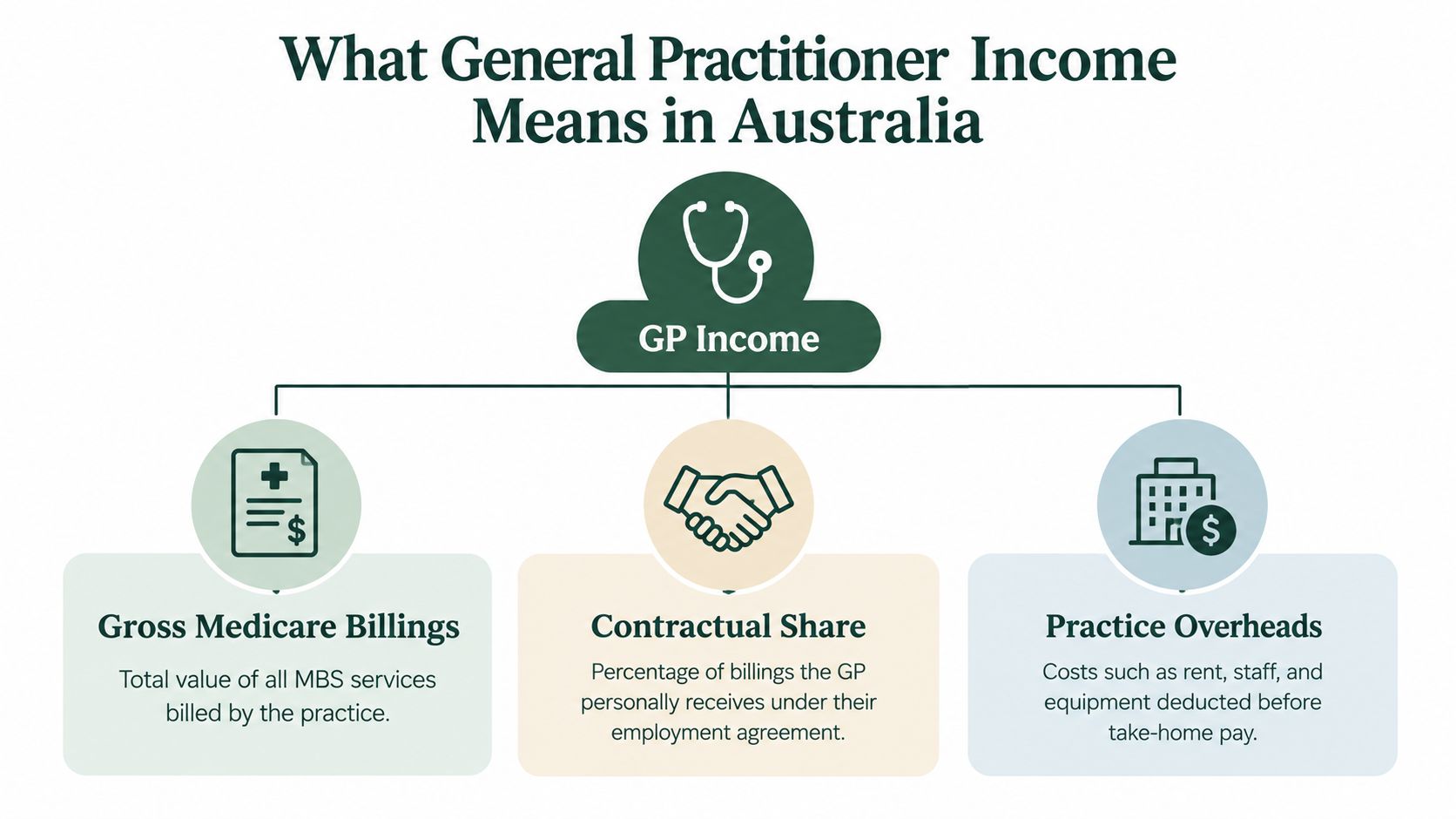
General practitioner income in Australia only makes sense when you separate the layers. The first is gross billings: the money generated through Medicare and any patient fees. The second is the practice’s share: most GPs pay the practice a percentage of their billings to cover running costs. The third is costs the GP carries personally, such as indemnity insurance and professional fees, which depend on the contract. The fourth is taxable personal income, which is what remains once the clinical income has passed through the practice arrangement and the tax system.
That distinction matters because headlines often collapse very different figures into one number. A billings figure, a practice profit figure and a GP’s after-tax income can all be described loosely as “income”, but they are not interchangeable.
Practical rule: if a headline does not say whether it is gross billings, earnings after the practice’s share, or taxable income, do not assume it is take-home pay.
The Minister for Health, Mark Butler, gave the government’s own framing in October 2025: two years earlier, a full-time, fully bulk-billing GP was earning about $280,000 on average after paying practice costs, and GPs “tend to pay around 30 per cent of their fees to the practice” (ABC Adelaide interview, 30 October 2025). In the same interview, the presenter put to him that doctors dispute the modelling’s assumptions about how many patients a GP can see, given time lost to administration. Treat the government figures as modelled benchmarks, not observed pay.
Reading GP income headlines correctly
The fastest way to judge a published figure is to ask three questions. Is it gross billings, earnings after the practice’s share, or income after tax? Does it refer to the doctor personally, or to the practice as a business? Does it assume bulk billing, mixed billing, or private billing?
A headline that skips those answers is usually describing only one layer. For trainees, that is the biggest modelling error in career planning, because a practice can produce strong billings without delivering the same personal income to every doctor inside it.
Table of Contents
- Reading GP income headlines correctly
- What General Practitioner Income Means in Australia
- How Medicare Revenue Becomes GP Take-Home Pay
- Billing Models Compared
- Location and Specialisation Effects on Earnings
- The Bulk Billing Practice Incentive Program Explained
- Hours, Experience and Career Stage
- Tax, Superannuation and Entitlement Considerations
- Realistic GP Income Benchmarks and Planning Tips for Trainees
What General Practitioner Income Means in Australia
Australian GP income is easiest to misread when one figure is treated as the whole story. Medicare pays for services, practices collect the money, contracts set the doctor’s share, and the final amount is then reduced by personal costs and tax.
Four layers, not one salary
Start with gross billings. This is the total value of services claimed through the Medicare Benefits Schedule (MBS — the government’s list of services Medicare pays a rebate for, and how much it pays), plus any fees charged to patients on top.
The next layer is the practice’s share. Some GPs are salaried employees, some are contractors, and some sit between the two. A contractor typically pays the practice a percentage of billings to cover rent, staff, software and equipment. The government’s April 2025 modelling assumed the practice “takes its share to cover running costs (usually around 30% of billings)” (Mark Butler MP, 16 April 2025). For most contractor GPs, that share is how the practice’s overheads are paid, so it should not be subtracted a second time.
Then come costs the GP carries personally: indemnity insurance, registration, continuing professional development (CPD — the ongoing education every registered doctor must complete each year), and anything else the contract does not cover.
The final layer is taxable income. That is the amount assessed for personal tax, and it depends on structure and deductions as well as on billings.
Useful distinction: a GP can have high billings and still end up with modest take-home pay if the practice’s share is high or the contract shifts costs onto them.
For trainees, the practical lesson is to ask which layer a figure refers to before using it for planning.
How Medicare Revenue Becomes GP Take-Home Pay
A Medicare item number starts a payment chain, and personal income only emerges after the practice’s share, personal costs and tax have each been taken.
From item number to personal income
The first question is which billing rule applies to the consultation. Under bulk billing, Medicare pays the rebate directly and the doctor accepts it as the full fee. Under private billing, the practice charges a fee above the rebate, so gross receipts can be higher for the same clinical work.
That is why two GPs can see the same number of patients and still end up with different earnings. One may bulk bill almost every visit and depend on volume and incentives. Another may mix bulk billed and privately billed consultations, which changes both the practice’s receipts and the doctor’s share.
The $280,000 after practice costs figure for a full-time, fully bulk-billing GP, two years before November 2025, shows the gap between billings and earnings: at a 30% practice share, it implies gross billings of roughly $400,000 (ABC Adelaide interview, 30 October 2025).
Practical rule: estimate the consultation pattern first, then apply the billing mix, then subtract the practice’s share and your personal costs, then allow for tax.
Billing Models Compared
Billing model is one of the strongest drivers of GP income because it changes both the size and the reliability of revenue. The government’s April 2025 analysis used Medicare data on all 140 million GP services delivered in 2023–24, and a GP earnings calculator published by General Practice Registrars Australia (GPRA — the national body representing GP trainees). It estimated that under 2022–23 conditions a metropolitan GP with average bulk-billing rates earned $319,443 a year, against $280,051 for a metropolitan GP who bulk billed every visit (Mark Butler MP, 16 April 2025). Both figures are after the practice’s share.
What changes after 1 November 2025
The same analysis projected that from 1 November 2025 those figures would become $398,448 for the average-bulk-billing GP and $403,805 for the GP who bulk bills every visit (Mark Butler MP, 16 April 2025). The gap does not just narrow — it reverses. In the government’s modelling, a metropolitan GP who bulk bills every visit earns slightly more than one on average billing rates, and the release puts the advantage for a rural GP at almost $24,000 a year over a mixed-billing colleague.
Mixed billing sits between the two models. Private billing raises revenue per consultation, but depends on patients paying the fee upfront and then claiming their Medicare rebate.
Location and Specialisation Effects on Earnings
A GP’s income depends on two separate choices: where they work and whether they specialise. The Medicine in Australia: Balancing Employment and Life survey (MABEL — a long-running national survey of Australian doctors’ work and pay) found that in 2012 GPs’ average earnings, before tax but after practice expenses, were $193,958, while specialists averaged $360,000 (Scott, Australian Family Physician, 2014). That is a gap of $166,042, with specialists earning about 1.86 times as much as GPs. The data are from 2012 and predate the 2025 Medicare changes, so use them for the shape of the gap, not its current size.
Why the specialist gap matters for trainees
The comparison shows how large the earnings premium for specialisation has been, before location and billing mix enter the picture. For a trainee choosing between general practice and another specialty, that difference is part of the opportunity cost.
Location changes the result within general practice itself. For a side-by-side view of how hourly rates differ across settings, see how much a doctor earns per hour.
How to interpret the location effect
The government’s own modelling shows location moving the number. In October 2025 the Minister said a fully bulk-billing GP in Adelaide would earn $415,000 from 1 November, and that in country areas the figure was “more like $490,000 a year” (ABC Adelaide interview, 30 October 2025). Part of the reason is structural: the value of MBS bulk billing incentives depends on location as well as on the service (health.gov.au). That is why lifetime income modelling for a GP should separate metropolitan and rural scenarios.
The Bulk Billing Practice Incentive Program Explained
The Bulk Billing Practice Incentive Program (BBPIP), which started on 1 November 2025, adds a distinct layer to GP income. To take part, a practice must bulk bill every eligible service for every Medicare-eligible patient. In return it receives an additional quarterly payment of 12.5% of the MBS benefits paid for eligible services, split evenly between the GP and the practice. The payment sits on top of Medicare rebates and the standard MBS bulk billing incentives (health.gov.au, last updated 10 December 2025).
How the incentive is paid
The incentive does not add 12.5% to a GP’s income. Half of it goes to the practice, so the GP’s share is 6.25% of the eligible MBS benefits they generate. The department asks providers to register their own bank details with Services Australia to receive BBPIP payments (health.gov.au).
The design is practice-wide. An individual GP cannot qualify alone if the practice does not bulk bill every eligible service, so the billing model is a collective decision, not only a personal one.
Practical rule: you only access the incentive if the whole practice commits to full bulk billing.
Why the program changes modelling
The program changes how trainees should read “fully bulk-billing” income claims. A fully bulk-billing GP is no longer only comparing consultation fees with a private or mixed-billing peer. They are also comparing access to the incentive, and that is the main reason the government’s modelling now shows full bulk billing ahead in metropolitan practice.
Hours, Experience and Career Stage
Income rises with experience, but not in a straight line. Doctors move through hospital years, training posts and fellowship before they reach the billing capacity of an established GP. Once they do, the same hour can be worth very different amounts depending on billing mix, practice structure and how much of the day goes to administration.
Why hours don’t scale neatly
More hours should mean more income. In practice the relationship weakens once appointment length, non-billable tasks and fatigue are included. This is exactly the point GPs raised against the government’s modelling: billing estimates assume patient throughput that administration and paperwork eat into.
That is why stage matters. A registrar, a new fellow and an established partner do not convert time into income in the same way. The more control a doctor has over billing and practice structure, the more directly hours convert into personal earnings.
What trainees should ask before assuming a figure
Before accepting any income estimate, ask:
- Is the figure before or after the practice’s share? A post-share number is far more useful than a gross billing estimate.
- Does the practice bulk bill, mix bill or private bill? Billing mix changes the outcome even when patient volume is similar.
- Is the practice in BBPIP? If so, the GP’s half of the incentive is part of the income.
- What work is unpaid? Administration, results follow-up and after-hours tasks reduce the effective hourly return.
For background on the registrar stage, see what a GP registrar is.
Tax, Superannuation and Entitlement Considerations
Two GPs can bill the same amount and still take home very different sums. The difference usually comes from structure, not medicine. Whether the doctor is engaged as a contractor or an employee affects how income is treated, which expenses are borne personally and which entitlements are attached.
The contract matters as much as the billings
If a GP is a contractor, the practice typically keeps a share of billings and leaves the doctor to manage more of their own tax, superannuation and professional costs. If the GP is an employee, the practice handles payroll obligations and leave. Either way, the agreement determines who carries the financial risk.
This is why “gross income” can mislead. It may leave out superannuation, indemnity costs, CPD, leave and administrative support. A doctor with a stronger-looking gross figure can still end up worse off if the contract shifts too many costs onto them.
Contract question: who pays for indemnity, CPD, leave cover and administrative support?
What to check before signing
A practical contract review should cover a few non-clinical items:
- Superannuation treatment: is it included, separate, or expected to be self-managed?
- Leave entitlements: is there paid annual, sick or parental leave, or none?
- Professional costs: who covers indemnity, CPD and registration?
- Practice support: are administrative staff and systems covered by the practice’s share, or billed back separately?
A “higher income” arrangement is not automatically better. A contractor arrangement can offer flexibility, but it can also expose the doctor to costs an employee would not carry directly. Compare net working conditions, not headline pay.
Realistic GP Income Benchmarks and Planning Tips for Trainees
A realistic 2026 view of GP income starts with the layers: gross billings, the practice’s share, personal costs, and tax. The government’s post-1 November 2025 projections — $403,805 for a fully bulk-billing metropolitan GP and $398,448 for one on average bulk-billing rates — are already after the practice’s roughly 30% share (Mark Butler MP, 16 April 2025). They are useful anchors, but they are full-time modelled figures before personal costs and tax, and GPs have disputed the throughput they assume.
A worked example shows how to read them. At a 30% practice share, $403,805 in earnings implies roughly $577,000 in gross billings. The practice’s share does not come off the $403,805 again. What does come off it is the cost of indemnity, registration and CPD if you carry them, any unpaid time, and then income tax.
The 2012 MABEL figures are a reminder that specialist income has historically sat well above GP income, while GP income varies with billing model, location and practice structure. Build income planning around scenarios, not a single average.
For the training pathway itself, see how to become a general practitioner in Australia.
A simple checklist for trainees
- Model after the practice’s share, not before: gross billings overstate personal income.
- Do not deduct overheads twice: if the practice’s share covers running costs, it is the overhead.
- Test billing-mix changes: the 2025 modelling moved a fully bulk-billing metropolitan GP from about $39,000 behind an average-billing colleague to slightly ahead.
- Keep location in the model: rural and metropolitan settings do not produce the same earnings.
- Compare contract terms, not just pay: superannuation, leave and indemnity change the value of an offer.
GP income is layered, conditional and sensitive to the structure around the doctor.