Frontal Assessment Battery Explained for Exams
Learn the frontal assessment battery — what it screens, how to score it, cut-offs and pitfalls. Exam-focused guide for Australian medical students.
You are on the ward with a patient who scores normally on the Mini-Mental State Examination, answers orientation questions correctly and recalls the required words. Yet they cannot organise a simple sequence, interrupt repeatedly, copy a motor pattern or stop responding to a conflicting cue. Memory and orientation appear relatively intact; the bedside concern is impaired executive control.
The Frontal Assessment Battery (FAB) probes that specific problem. It is a brief six-subtest bedside screen that stresses executive and frontal-lobe function. The FAB was first described in 2000, to identify dysexecutive difficulties that broad cognitive screens may miss. Australian dementia-assessment resources describe it as a brief bedside screen for executive dysfunction, including dysfunction associated with frontal-lobe damage.
Key concept: Remember the FAB as a frontal-lobe stress test. Each task applies pressure to a different control process: shifting, inhibition, sequencing, abstraction or resistance to automatic behaviour.
Start with the clinical question, then work through the test:
- What does frontal control contribute to behaviour?
- Which process does each subtest stress?
- Can you administer the task without prompting?
- What does the error pattern show, beyond the total score?
- Does the result justify further assessment?
A low score should prompt workup, but a normal score can falsely reassure when deficits are subtle, context-dependent or masked by compensation. That cutoff problem matters in Australian exam cases, where a patient may perform adequately on a broad screen yet struggle with planning, inhibition or set-shifting on the ward.
For students and junior doctors, the FAB also sits within a wider bedside assessment. This RACP (Royal Australasian College of Physicians, the body that trains and certifies physicians and paediatricians in Australia and Aotearoa New Zealand) Mini-CEX preparation resource supports focused clinical presentation skills. The FAB supplies a narrower answer: is executive control impaired, and how confidently does this score support that conclusion?
Table of Contents
- What the Frontal Assessment Battery Is and Why It Exists
- How to Administer and Score the Six FAB Subtests
- Interpreting Scores Cut Offs and What They Mean
- FAB Compared With MoCA MMSE and ACE
- Limitations Pitfalls and When Not to Trust the FAB
- Exam Focused Cases and Takeaways for Australian Students
What the Frontal Assessment Battery Is and Why It Exists
A patient scores 28/30 on the MMSE, yet cannot organise discharge medications or inhibit inappropriate comments on the ward. Orientation and recall are relatively intact, while planning and behavioural control fail under pressure. The Frontal Assessment Battery is designed to expose that gap.
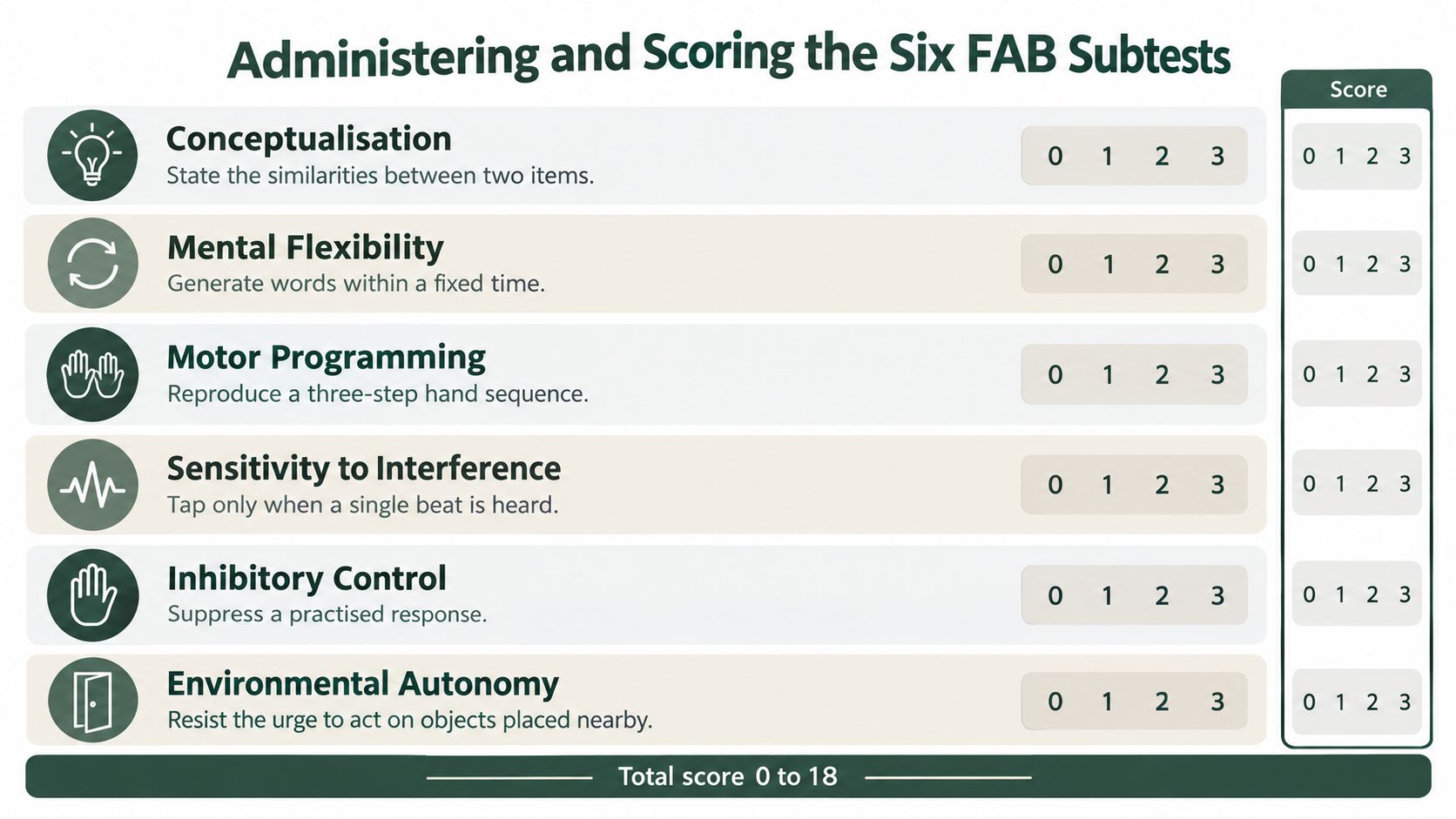
Frontal systems help a person maintain a goal, shift strategy, suppress an automatic response, sequence an action and adjust behaviour using feedback. The FAB samples these control processes through six bedside subtests: conceptualisation, mental flexibility, motor programming, sensitivity to interference, inhibitory control and environmental autonomy. It is better understood as a frontal-lobe stress test than as a smaller version of the MMSE.
The question behind the battery
The FAB exists because broad cognitive screens can leave executive problems hidden. A patient may know where they are but fail when a plan changes. They may remember an instruction yet repeat a habitual response. They may speak fluently while perseverating on one approach.
The battery therefore complements, rather than replaces, wider cognitive assessment. It does not provide a full account of memory, visuospatial function, language or orientation. Its narrower question is whether the patient can organise and control other abilities in real time.
A compact concept map
| Frontal function | FAB domain | Bedside challenge |
|---|---|---|
| Abstract reasoning | Conceptualisation | Find the shared category |
| Set shifting and generation | Mental flexibility | Produce new responses under a rule |
| Sequencing | Motor programming | Reproduce an ordered action |
| Attention to competing rules | Sensitivity to interference | Follow the instructed rule, not the automatic one |
| Response suppression | Inhibitory control | Stop when the cue changes |
| Self-directed behaviour | Environmental autonomy | Resist acting simply because an object or action is present |
The original validation study included 42 normal subjects and 121 patients with frontal-lobe dysfunction. Its discriminant analysis correctly identified 89.1% of cases, with interrater reliability of κ = 0.87 and internal consistency of Cronbach’s alpha = 0.78. FAB scores correlated with the Mattis Dementia Rating Scale at rho = 0.82, and with Wisconsin Card Sorting Test measures at rho = 0.77 and rho = 0.68. These findings were reported by Dubois et al. in the original FAB validation study, published in Neurology in 2000.
The cutoff requires clinical judgment. A low score should trigger further assessment, but a normal score can falsely reassure when impairment is subtle, context-dependent or masked by compensation. That distinction matters in Australian exam cases: a patient may pass a broad screen yet struggle with planning, inhibition or set-shifting on the ward.
The FAB is a brief six-subtest bedside screen designed to detect executive and frontal-lobe dysfunction, particularly when broader cognitive screening may appear relatively preserved.
How to Administer and Score the Six FAB Subtests
Administration should be calm, standardised and economical. Explain that the tasks assess different thinking skills, not intelligence or educational achievement. Use the authorised version and scoring instructions for your service or examination, because small changes in wording, cueing and timing can alter performance.
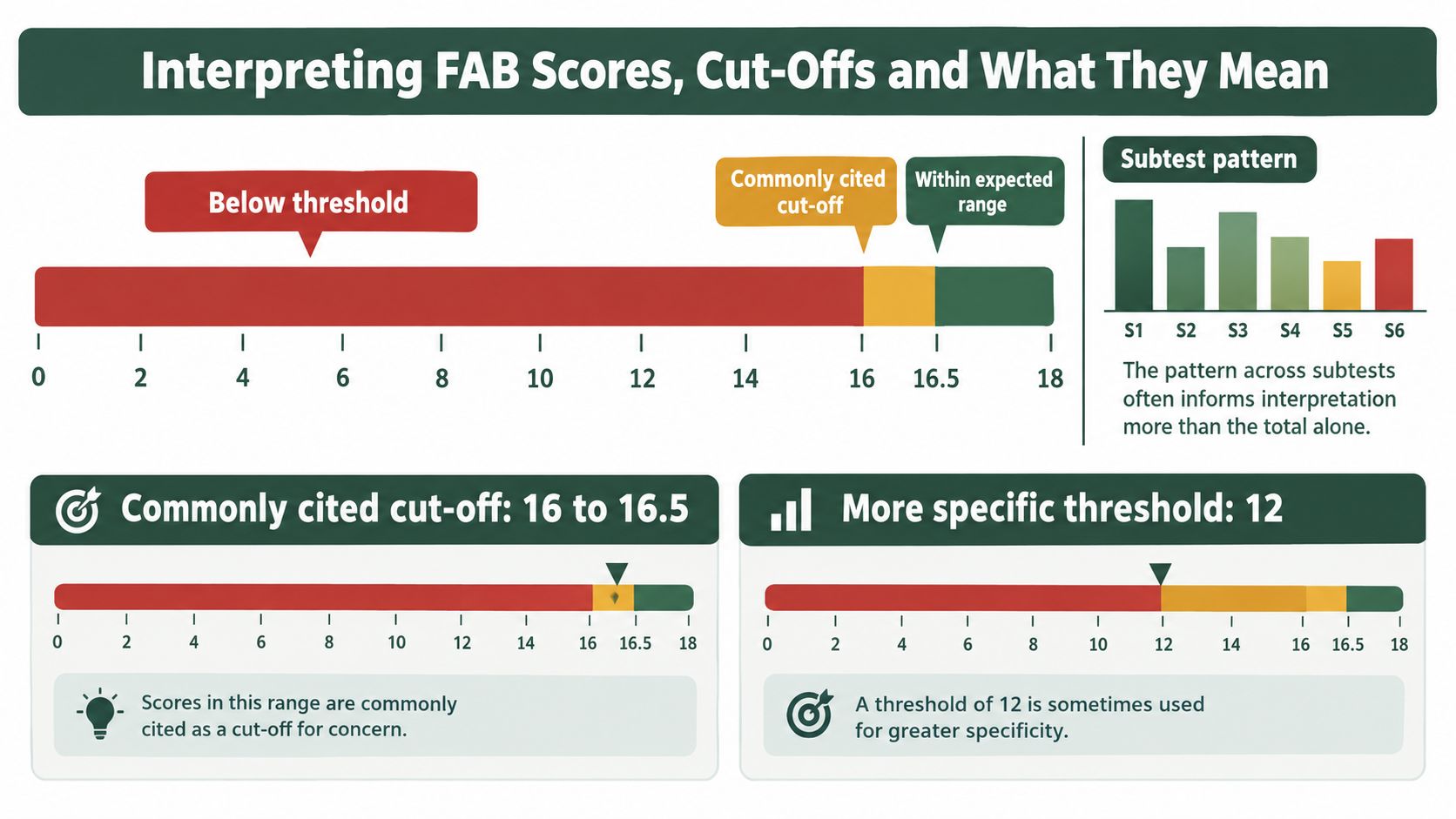
Each of the six subtests receives a score from 0 to 3, giving a total from 0 to 18. The exact anchors depend on the validated administration protocol. Don’t improvise extra examples once the task has begun, and record the error type, not just the final number.
1. Conceptualisation
Ask the patient to explain how two items are alike. The desired response is an abstract category rather than a merely functional or physical similarity.
A response such as “both are fruits” demonstrates abstraction. A concrete response such as “both can be peeled” may show that the patient recognises a relationship but hasn’t reached the broader category. Score according to the standard rubric, and don’t lead the patient towards the category.
2. Mental flexibility
This subtest examines set shifting and verbal generation. Ask the patient to produce words according to the specified letter rule and timing instructions, excluding responses that the protocol excludes.
Listen for perseveration, rule violations and an inability to generate alternatives. A reduced output may reflect executive dysfunction, but language proficiency, education, hearing and fatigue can also affect performance. Note those factors rather than treating fluency as a pure frontal measure.
3. Motor programming
Demonstrate the required three-step hand sequence and ask the patient to reproduce it. Watch whether they understand the sequence, learn it through repetition or become stuck on one component.
Motor weakness, apraxia, tremor and comprehension problems can make this item difficult for reasons other than executive dysfunction. If the patient has a relevant motor or language limitation, document it clearly and interpret the score cautiously.
4. Sensitivity to interference
The patient must respond according to a rule that conflicts with the natural impulse to copy the examiner. The challenge isn’t simple tapping. It’s the ability to keep the instruction active while suppressing an appealing competing response.
Give the instructions once, clearly, and avoid rhythmic movements that provide unintended cues. Record whether the patient follows the rule, imitates the examiner or loses the rule after an error.
5. Inhibitory control
This is the response-suppression task. The patient responds to the designated “go” signal but must withhold the response to the “no-go” signal.
An impulsive response on the no-go trial is clinically meaningful, particularly if it matches behaviour observed during the consultation. However, hearing difficulty, inattention or misunderstanding can produce the same visible error, so check that the patient understood the rules before interpreting it as disinhibition.
6. Environmental autonomy
Place the patient in a situation where an object or examiner’s action could automatically draw out a response. The patient should describe or follow the instruction rather than act just because the environmental cue is present.
This item probes imitation behaviour and the tendency to use objects automatically. Keep your own movements neutral and avoid exaggerated gestures. Environmental autonomy is easy to contaminate with examiner behaviour, so standardisation matters.
Bedside rule: Score the patient’s unaided performance. Prompting may help communication, but it can also erase the very executive difficulty you’re trying to observe.
A safe OSCE (objective structured clinical examination — a circuit of timed, marked stations, as opposed to a written or viva exam) presentation might sound like this: “I’d administer the six FAB subtests using standard instructions, score each from 0 to 3, document the qualitative errors and interpret the total out of 18 in the context of language, education, motor function and the wider neurological examination.” For broader clinical-exam structure, see this RACP clinical examination guide.
Interpreting Scores Cut Offs and What They Mean
A FAB score can look tidy on paper and still mislead you at the bedside. The test is best treated as a frontal lobe stress test, not a mini-MMSE, because the cutoff only matters in the clinical setting you are trying to distinguish.
The key problem is the cutoff problem. A score below threshold suggests executive dysfunction, but the threshold shifts with the population, the question being asked, and the cost of missing frontal disease. For Australian exam cases, that means a normal score should not calm you if the history still sounds dysexecutive.
Use the FAB as a discriminative screen, not a diagnosis in itself. A low score can support frontal dysfunction, including patterns seen in frontotemporal dementia, yet it cannot establish the cause on its own. One 2026 validation study distinguished healthy controls well from a combined group of amnestic mild cognitive impairment and Alzheimer’s disease patients (area under the curve 0.85, optimal cutoff 16.5), but was much weaker at telling those two patient groups apart from each other (area under the curve 0.68, cutoff 10.5) — accuracy depends heavily on which two groups are being separated, not just which cutoff is chosen. Heredia et al., Frontal Assessment Battery: reliability, validity and discriminative ability in a Spanish sample, Journal of Neuropsychology 2026
Why thresholds move
A cutoff is a trade-off between sensitivity and specificity.
- Sensitivity asks how often the test picks up people who have the disorder.
- Specificity asks how often it stays negative in people who do not.
- A lower cutoff can miss milder executive dysfunction, even though it reduces false positives.
- A higher cutoff can catch more borderline cases, but it sends more patients for follow-up.
One French dementia-clinic study found a cutoff of 12 distinguished frontotemporal dementia from Alzheimer-type dementia with 77% sensitivity and 87% specificity. That study also noted the FAB was less reliable at separating frontotemporal dementia from other, subcortical causes of frontal dysfunction. Those limits matter, because a cutoff is a decision rule tuned to one comparison, not a biological border. Slachevsky et al., Frontal assessment battery and differential diagnosis of frontotemporal dementia and Alzheimer disease, Archives of Neurology 2004
The normal-score trap
A normal or borderline FAB does not rule out executive dysfunction. A patient with early, mixed, or context-dependent disease may still manage the short test, especially when real-world behaviour is more complex than the bedside task. Sensitivity also falls sharply outside the populations the test was validated on, which is exactly why a cutoff drawn from one clinical comparison should not be applied uncritically to a different one.
That is why a low score should trigger further assessment, while a normal score should be read as reassurance only in the right context.
A low FAB score supports further evaluation of executive dysfunction. A normal score lowers concern in some contexts, but it does not rule out early or mixed frontal impairment.
Read the pattern, not just the total. A patient may lose points because of inhibition, interference control, or environmental autonomy, which points toward frontal disease. Another patient may score low because language, motor control, or education interfered with performance. The total is a signal. The subtests and the history tell you what the signal means.
FAB Compared With MoCA MMSE and ACE
The choice of cognitive screen should follow the clinical question. If the question is “Is this person broadly cognitively impaired?”, a wide tool such as the Montreal Cognitive Assessment (MoCA) or the Addenbrooke’s Cognitive Examination (ACE) is usually more useful. If the question is “Does this person struggle with frontal executive control?”, the FAB is more targeted.
| Tool | Primary purpose | Key domains | Best use case |
|---|---|---|---|
| FAB | Screen executive and frontal-lobe function | Abstraction, flexibility, sequencing, interference, inhibition and environmental autonomy | Suspected dysexecutive syndrome, frontal dysfunction or behavioural change |
| MoCA | Broad cognitive screening with greater attention to subtle impairment | Executive tasks, memory, attention, language, visuospatial function and orientation | Broad assessment when mild or multidomain impairment is possible |
| MMSE | General cognitive screening | Orientation, registration, recall, attention, language and simple visuospatial ability | Rapid global screen and cognitive tracking, especially when interpreted with other findings |
| ACE | More extensive multidomain cognitive assessment | Attention, memory, fluency, language and visuospatial abilities | A fuller bedside cognitive profile when time and patient tolerance allow |
The MMSE can look reassuring in a patient who is oriented and recalls simple information but behaves impulsively or cannot shift between rules. That doesn’t make the MMSE useless. It answers a different question and remains a useful part of a wider assessment.
The MoCA samples executive function as part of a broader profile. It may be a better first choice when you need to compare memory, attention, language and visuospatial performance rather than isolate frontal control. The ACE gives an even broader bedside picture and can help identify whether the apparent executive problem sits within a wider multidomain syndrome.
A practical choice at the bedside
Use the FAB when the history points towards:
- Behavioural change, such as disinhibition, impulsivity or loss of social judgement.
- Planning failure, despite preserved basic orientation.
- Perseveration, rigidity or difficulty changing strategy.
- Possible frontotemporal or other frontal-subcortical dysfunction.
Use a broader instrument when the patient reports memory loss, language difficulty or general cognitive decline without a clearly frontal pattern. In many cases, the most informative approach is complementary: a global screen establishes the breadth of impairment, while the FAB tests whether executive control is disproportionately affected.
Don’t present the FAB as “better than” the MMSE. In an exam, say that the tools are complementary, then justify your choice by linking it to the suspected cognitive domain.
Limitations Pitfalls and When Not to Trust the FAB
A quick score can invite overconfidence. The FAB is useful because it puts executive control under pressure in a short bedside test, but that same brevity makes it easy to misread. A low result may reflect frontal dysfunction, or it may reflect poor hearing, limited language proficiency, low familiarity with test-style tasks, fatigue, pain, motor slowing, or reduced comprehension.
The verbal and conceptual items are the most vulnerable to these confounders. A patient answering in a second language may produce fewer responses without having a primary executive disorder. A patient with less formal education may approach abstraction differently from the group used to shape the reference standard. The score can still be useful, but only if the examiner interprets it in context.
The motor and language confound
Motor programming can be distorted by weakness, tremor, bradykinesia, apraxia, or arthritis. Inhibition and interference tasks can also be affected by hearing loss, poor vision, or a misunderstanding of the rule. The environmental autonomy item needs careful handling, because an examiner who gestures too much or places objects carelessly can accidentally give a clue.
Before interpreting the score, use a brief OSCE-ready check:
- Did the patient hear and understand the instructions?
- Could motor or sensory impairment explain the error?
- Was English the patient’s first language?
- Did fatigue, pain, delirium, or medication affect engagement?
- Was the task administered and scored using a validated protocol?
Say it clearly at the bedside: “Before I interpret this FAB, I would check hearing, language, education, motor function, and delirium, and I would document the likely source of any error.”
What to document
Record the total, the subtest pattern, and the type of mistake. A wrong answer on a verbal fluency item means something different from poor inhibition, and a cue-related error during environmental autonomy points to a different problem again. That level of detail matters more than a bare total when the history and the bedside performance do not line up.
A low score should prompt collateral history, delirium assessment, neurological examination, and broader cognitive or neuropsychological testing as appropriate. If the score is normal but the family describes clear executive failure in daily life, do not stop there. The bedside screen has limits, and the next step is to explain the mismatch rather than to dismiss it.
Exam Focused Cases and Takeaways for Australian Students
Case one: A patient has progressive disinhibition, poor judgement and loss of planning ability. Memory is comparatively preserved, but the patient performs poorly on inhibition, mental flexibility and environmental autonomy. Present it as: “The FAB demonstrates a dysexecutive pattern, particularly impaired response suppression and behavioural control. This supports further assessment for a frontal syndrome, including frontotemporal dementia, but the FAB alone isn’t diagnostic.”
Case two: A patient has subtle difficulty managing finances and adapting to changed routines, yet performs near the commonly cited threshold. Don’t call the result normal and stop. Say: “The FAB is borderline and may not exclude early executive dysfunction. I’d correlate with collateral history, other cognitive domains, neurological findings and functional change, then arrange further assessment if concern persists.”
For an OSCE, use this order:
- State the purpose of the FAB.
- Name the six domains.
- Explain standardised administration and scoring.
- Report the total and subtest pattern.
- Mention confounders and cutoff limitations.
- Recommend the next clinical step.
The memorable answer is simple: FAB tests frontal control, not global cognition; a low score prompts workup, and a normal score doesn’t always close the case. Regular practice with Australian-focused OSCE preparation can help you deliver that interpretation clearly under time pressure.
CliniRoo is building format-specific question banks, interview stations and clinical exam practice mapped to the Australian training pathway. Nothing is on sale yet. If you want to be told when there is something to use, CliniRoo takes an email address and does nothing else with it.