Entrustable Professional Activities in Australian Training
Entrustable professional activities explained: what they are, how supervision levels work, and how Australian PGY1 and PGY2 doctors are assessed on them.
You’ve just finished assessing a patient when your registrar asks whether you need an entrustable professional activity (EPA) assessment signed off. You know the history, examination and plan, but you’re less sure what the assessment means. Is the supervisor marking your clinical knowledge, deciding whether you can work alone, or confirming that they watched?
Entrustable professional activities connect those questions without making them interchangeable. They help supervisors describe what you can safely do and how much support you need. For students and junior doctors, the useful starting point isn’t the form. It’s the clinical task, the evidence someone observed, and the boundaries of the resulting decision.
Table of Contents
- What Entrustable Professional Activities Are
- How Supervision Levels Show Growing Independence
- Why Entrustment Does Not Mean Independent Practice
- The Four Prevocational EPAs in Australia
- How to Observe and Record an EPA Assessment
- Where EPA Assessment Falls Short in Practice
- Plan Your EPA Preparation Around Your Assessments
What Entrustable Professional Activities Are
An EPA is a unit of real clinical work that a supervisor judges a learner ready to perform at a defined level of supervision. Taking a history and presenting a patient, assessing a deteriorating patient and handing over care are examples of clinical work that can be observed.
An EPA is not just a skill such as listening to heart sounds. It combines skills into a task with a purpose, an outcome, and responsibility for patient care. Assessing a patient requires you to gather information, interpret it, communicate your reasoning, and propose a safe plan.
Think of supervised driving
Learning to drive offers a useful analogy. An instructor doesn’t decide you’re ready because you can explain road rules. They watch how you steer, judge hazards, respond to uncertainty and ask for help.
Their question is specific: can you manage this road, under these conditions, with less support? A quiet suburban route doesn’t demonstrate readiness for every driving situation.
Clinical entrustment works similarly. Knowing the causes of breathlessness isn’t the same as assessing a breathless patient while recognising that you need urgent senior help. EPAs connect knowledge with action.
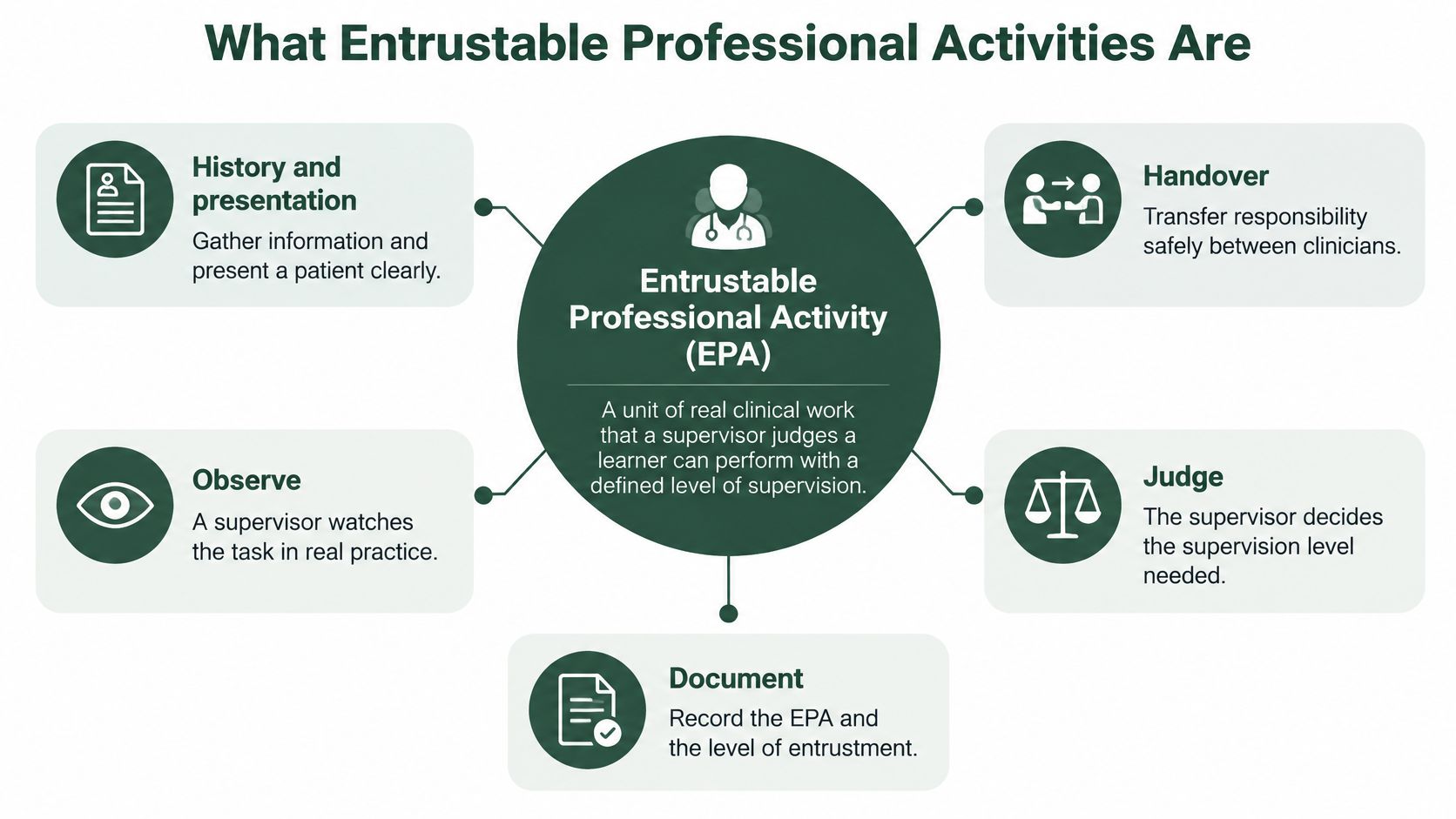
Keep the activity, evidence and decision separate
EPAs belong within competency-based medical education (training organised around what a doctor can be shown to do, rather than time served) because they ask what a learner can demonstrate, rather than treating time served or examination performance as sufficient evidence of workplace readiness.
In practice that splits into three parts:
- Activity: Assess a patient admitted with chest pain.
- Observed evidence: Gather the history, examine the patient, recognise concerning findings and communicate a reasoned plan.
- Entrustment decision: Identify the supervision needed to complete that activity safely.
Repeated observations allow supervisors to consider performance across different patients and circumstances. An end-of-term impression may contribute useful context, but it can’t describe every task with the same precision.
Practical rule: Name the clinical work before discussing the score. Otherwise, you may be judging different things.
Apply this to your current rotation. Choose an activity you already perform, then describe what a supervisor would need to see before leaving the room. Include not just what you’d do correctly, but how you’d recognise when to call them back.
How Supervision Levels Show Growing Independence
A supervision level describes the support needed for a particular activity. It isn’t a judgement of your intelligence, commitment or value as a doctor. A capable trainee may appropriately need close supervision when encountering an unfamiliar task.
In Australian prevocational training (the first two postgraduate years, PGY1 and PGY2), the Australian Medical Council (AMC, the body that sets the national framework for prevocational training) uses a three-point entrustability scale on its national EPA assessment form. The supervisor records the level of supervision the doctor needs for that task (AMC EPA assessment forms):
| Rating | What the supervisor is saying |
|---|---|
| Requires direct supervision | I, or the day-to-day supervisor, need to be there to observe the interactions and review the work |
| Requires proximal supervision | I, or the day-to-day supervisor, need to be easily contacted and able to provide immediate or detailed review of the work |
| Requires minimal supervision | I trust the prevocational doctor to complete the task; I need to be contactable or in the building and able to provide a general overview of the work |
The form also asks whether that rating was appropriate for the doctor’s level of training. Other programs, including college training programs, use their own scales, so check the form you will actually be assessed on.
What changes is more than the supervisor’s physical location. The trainee increasingly anticipates problems, makes defensible decisions and recognises when the situation exceeds their capability. Feedback shifts from correcting the task as it happens towards confirming sound decisions and refining judgement.
Follow a consent discussion through the levels
Consider a hypothetical trainee learning to discuss consent for a minor procedure. They might first watch a supervisor explain the indication, alternatives, material risks and opportunity to decline.
Under direct supervision, the trainee leads the discussion with the supervisor alongside. The supervisor may prompt them to check understanding or clarify an alternative. With stronger evidence, the trainee might conduct the discussion while the supervisor stays easily contactable, then review the outcome together.
Working without a supervisor in the room requires more than a polished explanation. The trainee must recognise uncertainty about capacity, an unexpected patient question or a change in the proposed procedure that requires further advice.
A trainee might therefore need minimal supervision for a familiar handover and direct supervision for prescribing an unfamiliar medicine. Training titles alone don’t resolve that difference. Understanding what a general practice (GP) registrar is helps distinguish a training role from an activity-specific supervision judgement.
For your own rotation, name your current supervision level for several routine activities. Then identify the observed behaviour, rather than relying on more time or more confidence, that would justify less support.
Why Entrustment Does Not Mean Independent Practice
The tempting assumption is that once you’ve been entrusted with an activity, you can perform it independently wherever you work. That isn’t what an EPA decision establishes.
A judgement made during a familiar ward handover doesn’t automatically authorise practice across another hospital, patient population or state pathway. Your registration conditions, scope of practice, local policies and supervision arrangements still matter.
Regulators draw the same line. The Medical Board of Australia’s supervised practice framework says a supervisee must not start practice until the Board has approved the supervisor and the arrangement, and must practise within that arrangement at all times. It sets four supervision levels (direct, indirect present, indirect accessible and remote) scaled to assessed risk. Note its scope: the Board’s page says interns, international medical graduates and doctors in vocational training are covered by separate guidance, so treat it as an illustration of how the regulator thinks about supervision rather than the rule for your intern year.
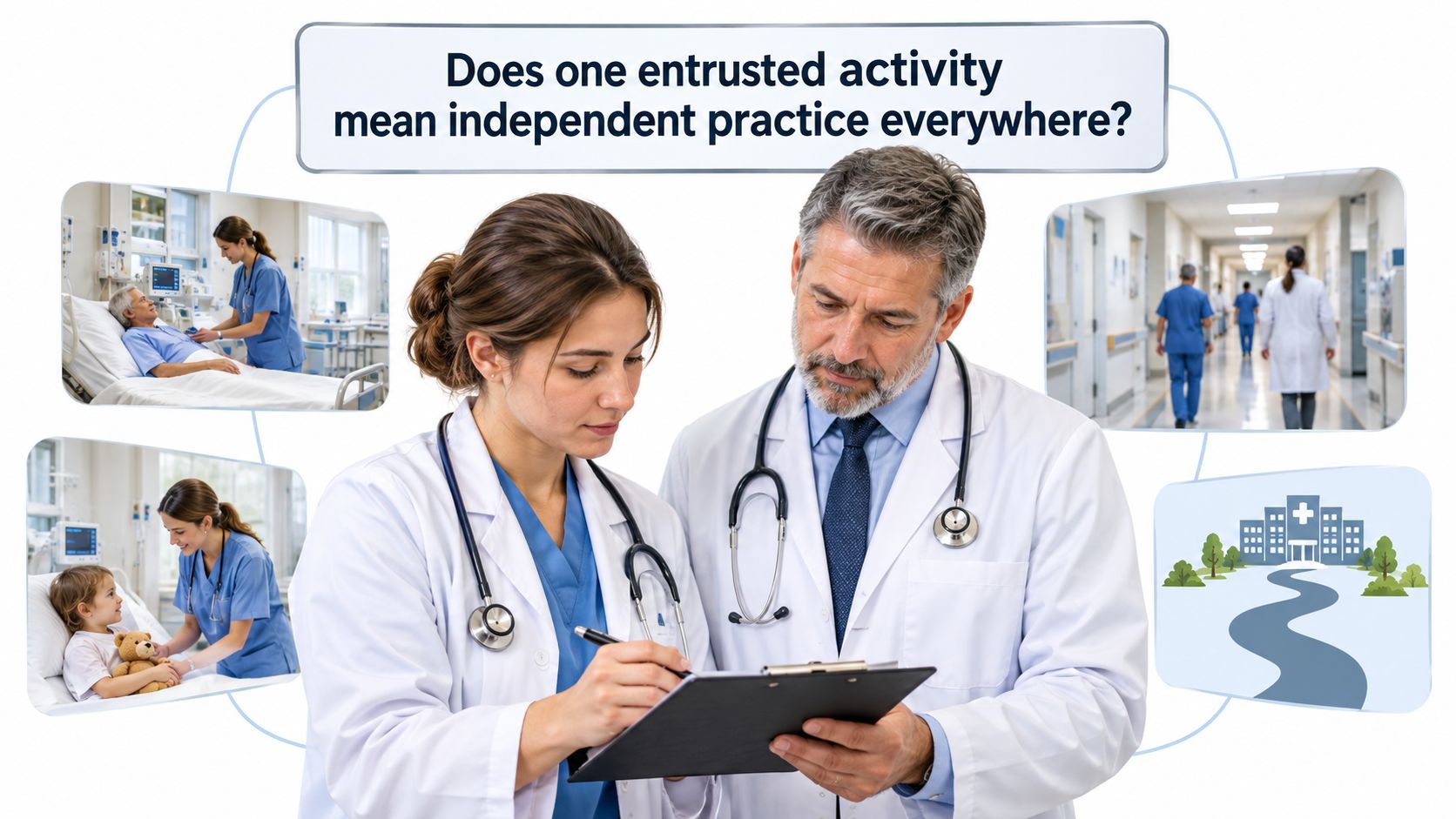
Where the boundary becomes practical
Consider these Australian workplace scenarios:
- Moving teams: You can deliver a clear handover, but a new service still needs you to use its escalation contacts and transfer-of-care process.
- Managing deterioration: An assessor has observed safe initial management, but you must still activate the hospital’s emergency response when the clinical situation requires it.
- Taking consent: Evidence from a straightforward discussion doesn’t establish readiness for a different procedure or a patient with complex capacity concerns.
- Prescribing a controlled medicine: A prescribing assessment doesn’t override applicable authorisation requirements or local medication policy.
- Working in theatre: Successful performance of a procedural component doesn’t authorise you to undertake the whole operation without the required supervision.
These distinctions matter most for interns, international medical graduates and doctors moving between networks. The practical question is not only whether you’ve demonstrated a task, but whether you’re authorised and appropriately supported to perform it here.
Record the boundary, not just the achievement
An assessment record should identify the setting, relevant case complexity, support available, and assistance needed. Otherwise, someone reading it later may mistake a narrow observation for a broad endorsement.
An EPA record is evidence for a supervision decision, not a portable permission slip.
If a supervisor provided telephone advice, record that rather than implying no support was needed. If a task was completed only after a significant prompt, make the prompt visible. EPA evidence supports governance and registration decisions. It doesn’t replace them.
The Four Prevocational EPAs in Australia
The AMC’s National Framework for Prevocational (PGY1 and PGY2) Medical Training sets four EPAs, and the AMC’s training and assessment requirements set how often they are assessed:
- At least 10 EPA assessments across the year, with at least two in each term.
- EPA 1 (clinical assessment) at least once in each term, and EPAs 2 to 4 two to three times each through the year.
- At least one EPA per term assessed by the primary clinical supervisor or an equivalent specialist.
- The same four EPAs are assessed in PGY1 and PGY2, at a higher level of complexity and responsibility in PGY2.
For certifying completion of the year, the evidence required is a minimum of 10 EPA assessments, including one of EPA 1 in each term and at least two of EPAs 2 to 4 (AMC, certifying completion of PGY1 and PGY2). A 2026 pilot study of intern EPAs under the new framework summarises the requirement the same way (Johnson et al., BMC Medical Education 2026).
The four EPAs are EPA 1 clinical assessment; EPA 2 recognition and care of the acutely unwell patient; EPA 3 prescribing; and EPA 4 team communication. They organise assessment around work that junior doctors undertake across different rotations, rather than around a single specialty.
Prevocational EPAs and what assessors look for
| EPA | What the assessor looks for | Example observed task |
|---|---|---|
| Clinical assessment | Complete history, examination, differential diagnosis and plan | Admitting a patient with chest pain |
| Recognition and care of the acutely unwell patient | Early recognition, escalation thresholds and initial stabilisation | Responding to a deteriorating patient on the ward |
| Prescribing | Correct drug, dose, route, monitoring and allergy checks | Writing and reviewing a new medication chart |
| Team communication | Clear handover, escalation and documentation with the team | Handing over overnight patients at shift change |
The examples describe suitable observation opportunities, not a complete marking rubric. Use your program’s actual form to identify the expected behaviours and supervision descriptors.
Turn the requirements into a workable assessment plan
Don’t treat the annual total as the whole requirement. Your assessment plan also needs appropriate distribution across EPA types, terms and assessors.
- Check coverage: Identify which activity types you’ve demonstrated and which remain underrepresented.
- Arrange specialist observation early: At least one EPA each term must be assessed by your primary clinical supervisor or an equivalent specialist, so book it rather than leaving it to chance.
- Use appropriate assessors: Registrars can assess some EPAs after completing assessor training, and a nurse or ward pharmacist may conduct or contribute to one where the supervisor considers it suitable.
- Confirm local implementation: Ask the assessment office for the current handbook, submission process and applicable rollout arrangements.
These are workplace assessments within a programmatic assessment approach. Supervisors observe tasks, offer feedback and contribute evidence that can be considered alongside other information about your progress. A completed form isn’t intended to stand alone as a complete description of competence.
For the wider pathway, distinguish prevocational assessment from specialty selection and college examinations when reviewing medical training in Australia. Their purposes and formats aren’t interchangeable.
A surgical term and a medical term can both provide opportunities in the national EPA categories. The cases change, but using consistent activity labels and explicit assessment criteria helps receiving supervisors interpret your records without assuming every rotation offers identical clinical exposure.
How to Observe and Record an EPA Assessment
A useful EPA assessment captures how the trainee completed the work, not merely whether the final answer was correct. The AMC describes the prevocational EPA assessment as an activity-based discussion combining direct observation and case-based discussion. It must be based on a real patient in whose care you played an active role, the patient must be known to the assessing supervisor, and the supervisor must have observed a significant part of the interaction, or sought feedback from someone who did where that is not possible (AMC training and assessment requirements).
For a trainee, this means demonstrating the complete task: clinical reasoning, communication, escalation and recognition of personal limits. For an assessor, it means watching enough of the encounter to justify the judgement.
Use an observation method that preserves the evidence
-
Agree the activity and target supervision level before starting. Identify the task’s boundaries and what successful performance would look like. A common slip is requesting a generic assessment without deciding whether the assessor is watching the history, the full assessment or the handover.
-
Observe the whole task. Note what the trainee does without prompting, including how they communicate with the patient and team. Reviewing only the final plan can miss an incomplete examination or an important misunderstanding.
-
Identify safety moments. Record when the trainee escalates, checks uncertainty or recognises a limit. Don’t interpret asking for appropriate help as failure; safe judgement includes knowing when not to proceed alone.
-
Give behaviour-specific feedback. Describe actions that supported entrustment and a behaviour that restricted it. Feedback such as “good assessment” offers little direction compared with noting that the trainee recognised instability but delayed contacting the registrar.
-
Record the level and evidence promptly. Aim to complete the comment the same day or by the following day as a practical habit, not an assumed national deadline. Use the program’s descriptors and distinguish independent actions from prompted ones.
-
Agree the next observation. State what evidence would support a change in supervision. Replace “read more” with a task-specific aim, such as presenting an initial management plan and clear escalation triggers before seeking confirmation.
Make the comment usable by the next supervisor
A complete record includes the activity, context, supervision level, observed behaviours, feedback and next step. Relevant contextual details might include an unfamiliar patient, competing ward demands or the need for interpreter support, without including unnecessary identifying information.
The Royal Australasian College of Physicians (RACP) mini-clinical evaluation exercise (mini-CEX) assessment format is another useful point of comparison when learning how to organise an observed clinical encounter. Don’t assume its form or scoring language is identical to your EPA assessment.
A useful hypothetical comment might read: “Completed focused assessment and recognised deterioration without prompting. Required assistance to prioritise the initial plan. Repeat an observed acute assessment with particular attention to stating immediate actions and escalation.”
Where EPA Assessment Falls Short in Practice
The common complaint is understandable: EPAs can become tick-box tasks. A trainee collects signatures, an assessor completes a form from memory, and neither can explain what the resulting record says about readiness.
General surgery training shows how this plays out. General Surgeons Australia (GSA) publishes the EPAs for the Royal Australasian College of Surgeons (RACS) General Surgery Education and Training (GSET) program. Its list has nine core EPAs (the Opportunistic Teaching Session EPA was removed from the requirement in 2025) and principal EPAs such as operative supervision of a junior colleague (GSA EPA list). Under the 2025 requirements, trainees must complete 90 EPAs to the level of Entrustable by the end of GSET3.2 (GSA, GSET resources and guides).
EPAs entered the program when it was implemented in 2022. An Australian interview study of their use (Ealing et al., Journal of Surgical Education, 2025) spoke to 10 surgeons and 10 trainees. They generally found EPAs easy to use and saw their value as creating a shared learning model, but described educational and assessment value as lacking, and attitudes as “tick-box tasks”. In practice, assessment was retrospective, covered a narrow spectrum of operative cases, was often given regardless of the trainee’s performance, and comment boxes were not filled in.
EPA assessment symptoms, causes and fixes
The causes below are practical diagnostic possibilities, not conclusions about every trainee or assessor.
| Symptom | Likely cause | Fix |
|---|---|---|
| Assessments completed in a batch at term end | Recording from memory, long after the task | Record each observation within a day of the task |
| Ticks with no narrative comment | Form lacks prompts and assessors are short of time | Use case-specific prompts and a required comment field |
| Only one type of case appears | Limited exposure, with familiar cases chosen | Plan observations across varied cases and settings |
| High completion count but unclear readiness | Counting assessments rather than recording the supervision level | Record the supervision level reached for each activity |
Repetition has an educational purpose when each observation contributes information. Another familiar case may confirm consistency, while a different case may reveal whether the trainee can adapt their approach.
Repetition becomes less useful when everyone already knows what will be written before the task begins. If every comment is interchangeable, the record won’t explain why supervision should change.
Distinguish missing evidence from weak performance
A sparse portfolio doesn’t necessarily mean a trainee lacks ability. It may mean supervisors haven’t observed the relevant work, suitable cases haven’t arisen, or comments haven’t captured what happened.
Those problems require different responses. A trainee who needs practice with escalation requires targeted feedback and observation. A trainee whose safe escalation was never documented needs an opportunity to make that performance visible.
Portfolio check: Read the comments without looking at the completion total. Can you tell what the trainee did, what help they needed and what should happen next?
For educators, case-specific prompts and explicit supervision criteria make it harder to submit an empty endorsement. For trainees, requesting an observation before the task begins is more useful than asking someone later to reconstruct it.
A high completion count can overstate readiness when the underlying cases and comments are narrow. Check the range of clinical situations, the assistance recorded and whether the assessor’s conclusion follows from the described behaviour.
Plan Your EPA Preparation Around Your Assessments
Start with your actual assessment form, rotation timetable and supervision arrangements. Generic preparation becomes useful only when you connect it to the work your assessors can observe.
Choose an activity that matters on your current term. For prescribing, rehearse the complete sequence: establish the indication, check allergies and relevant patient factors, select the medicine and regimen, arrange monitoring, and communicate the plan. For handover, practise making pending tasks, ownership and escalation triggers explicit.
Prepare for observation rather than performance theatre
Don’t wait for a dramatic case. A routine admission can provide useful evidence if the assessor watches your reasoning, patient communication and management planning.
Ask for feedback that identifies the support you needed, not reassurance that you appeared confident. If you required a prompt, record it and practise the underlying decision before the next observation. If you recognised a limit and sought help appropriately, ask the assessor to document that too.
Your next-rotation checklist
- Check the assessment requirements: Confirm the required distribution, assessor eligibility and submission process with your program. Schedule a consultant-observed clinical assessment early.
- Check the supervision arrangements: Identify who supervises your work, how to reach them and which activities require additional authorisation or direct involvement.
- Choose targeted observations: Select an EPA and seek contrasting cases or settings. Request a narrative comment and an explicit supervision judgement each time.
- Complete a self-check: For each activity you routinely perform, state your current support needs and the evidence that would justify a change.
Keep a short learning log linking each feedback point to your next clinical opportunity. That makes preparation concrete: not becoming better at assessment in general, but demonstrating a particular behaviour under observation.
Before taking on unfamiliar responsibility, confirm the specifics with your supervisor or program coordinator. What you’ve demonstrated and what you’re permitted to do must both be clear.
CliniRoo is building preparation material for the Australian pathway. Nothing is on sale yet. If you want to be told when there is something to use, CliniRoo takes an email address and does nothing else with it.