Clinical Communication Skills for Australian Exams
Clinical communication skills explained for Australian exams and interviews: what assessors score, strong vs average answers and how to practise.
Assessors don’t score clinical communication skills by how warm you sound. They score what they can see you do, whether the patient leaves with the right plan, whether the next clinician can act without phoning back, and whether you speak up when something’s unsafe. Treat each of those behaviours as a named domain, and exam preparation gets much more concrete.
Table of Contents
- What Clinical Communication Skills Really Measure
- Where Australian Exams and Interviews Test Them
- Core Principles That Earn Marks in Every Format
- Strong and Average Answers Compared Side by Side
- How to Structure a Clear Handover Using SBAR
- Interpreters and Culturally Safe Communication in Practice
- How to Practise Until the Skills Hold Under Pressure
- Build Your Practice Plan for the Next Assessment
What Clinical Communication Skills Really Measure
A relay team can be fast and still lose if someone drops the baton. Clinical care works the same way. The diagnosis may be right, but if the explanation, handover or escalation fails, the patient doesn’t get the benefit.
That’s why markers treat communication as a patient-safety capability, not a personal style. In an August 2026 ANU Reporter article, Professor Diana Slade, director of the Australian National University’s Institute for Communication in Health Care, put poor communication at the heart of about 90% of cases of avoidable patient harm, and the cost of that harm in Australia at about two billion dollars a year. The article does not give the method behind either estimate, so treat them as an expert’s figures rather than a measured rate.

Look for five observable behaviours in every format:
- Gathering the patient’s agenda: what they know, want and fear
- Explaining in plain language: one clear point at a time
- Checking understanding: verifying meaning, not assuming it
- Closing the loop at handover: confirming the receiver has the plan
- Escalating or challenging: stating concern when something’s unsafe
When a brief says “communicate well”, translate it into those five behaviours before you speak.
Where Australian Exams and Interviews Test Them
The table below maps the main formats you’ll meet and the behaviours each one scores.
| Format | Where it appears | What it scores |
|---|---|---|
| Medical school objective structured clinical examination (OSCE) station | Clinical years at Australian medical schools, set by each school | Information gathering, explanation, understanding check |
| Specialty selection interview | Specialties that interview, run by the college, specialty society or employer depending on specialty | The domains published for that specialty and intake year |
| College clinical examination | For example the Royal Australasian College of Physicians (RACP) Divisional Clinical Examination at the end of Basic Training | Clinical and interpersonal skills alongside clinical reasoning |
| Handover (SBAR — Situation, Background, Assessment, Recommendation — or equivalent) | Ward and multidisciplinary handover | Structure, closed-loop confirmation, escalation |
| Patient explanation or consent discussion | Procedures, medication changes, discharge | Plain language, adapting to need, confirming understanding |
| Escalation to a senior | Deteriorating patient or disagreement about a plan | Clarity of concern, graded escalation, listening |
The formats differ, the domains overlap
Schools, colleges and jurisdictions set their own station briefs and scoring guides, so you can’t assume one national mark sheet. A national survey of Australian medical schools, published in 2019, found exit OSCEs ranged from 8 to 16 stations, with variation in the marking rubrics used (Heal and colleagues, Medical Teacher). A medical school OSCE may weight information gathering heavily because you’re taking a history from a simulated patient. Whether a specialty interviews at all, and who runs it, depends on the specialty and the intake year; the guide to specialty selection interviews in Australia sets out which specialties interview and who runs selection for the 2027 intake. Where there is an interview, panellists score against the domains published for it, so they need evidence against those exact words. College clinical examinations assess communication alongside clinical reasoning, so a polished explanation won’t rescue an unsafe plan, and a correct plan explained poorly still loses marks.
That variation matters for international medical graduates too. If you’re working through the Australian Medical Council (AMC) clinical exam pathway and its station formats, check which domains your next assessment names rather than importing a generic OSCE script from another system.
What to do before you practise
Across formats, the recurring domains are information gathering, explanation, understanding check, respect and empathy, and teamwork. Candidates often prepare the first two and neglect the last three because they’re harder to rehearse alone.
First step: Name your next format, find its scoring guide, and write its domains at the top of your practice sheet.
If you can’t list the domains, you’re practising fluency, not the assessment. Fluency helps, but assessors can only award marks for behaviours they see during the station.
Core Principles That Earn Marks in Every Format
Explaining something isn’t the same as the patient understanding it. Strong candidates work a closed loop, they send the information, adapt it to the listener, then verify receipt and meaning. That loop sits underneath every principle below.
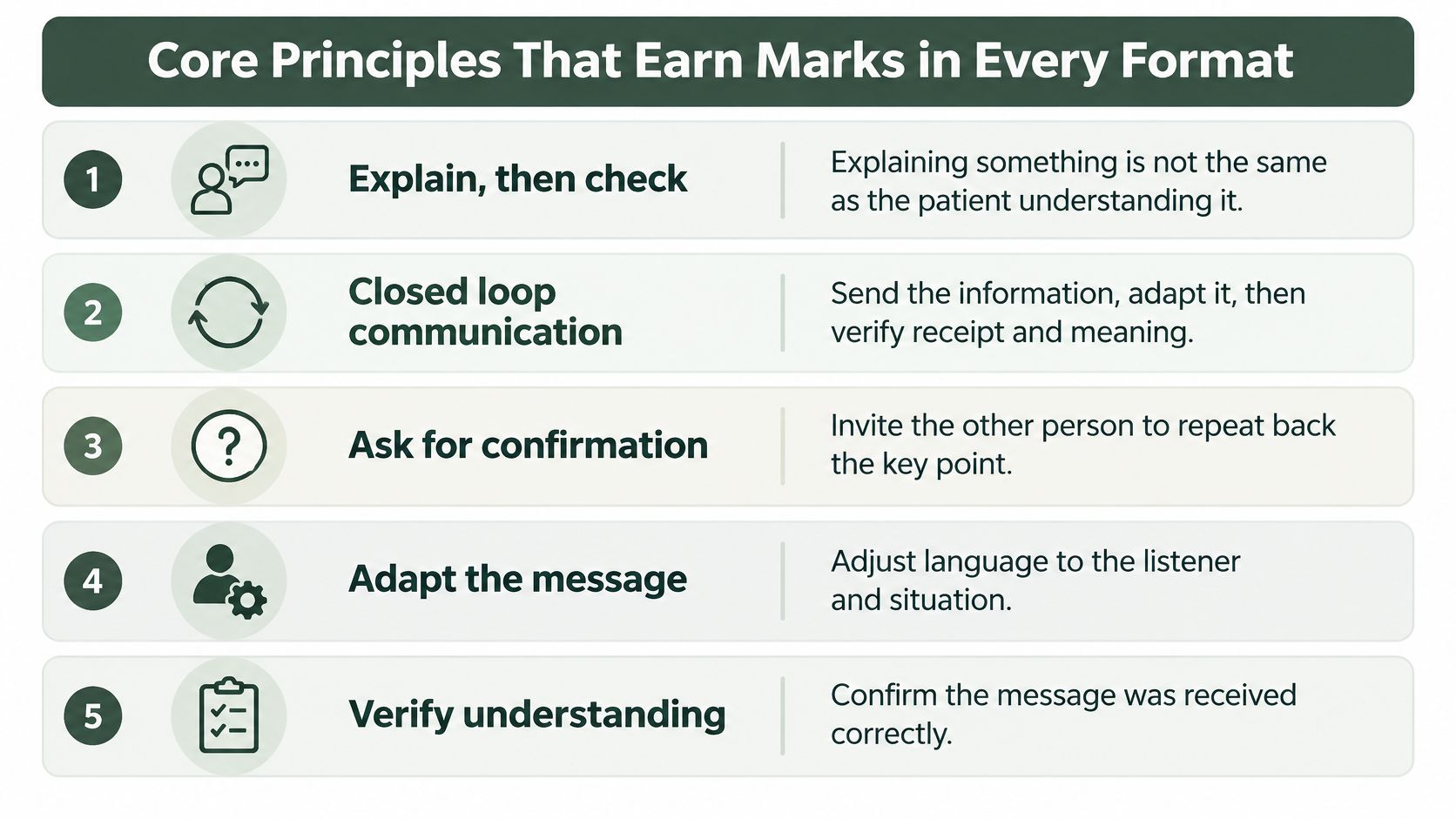
Adapt to health literacy, age and language. “We’ll monitor your renal function” becomes “We’ll do blood tests to check how your kidneys are coping.” Use a professional interpreter when language could affect consent, medicines or safety, don’t default to family.
Next, ask the patient to explain the plan in their own words. Try, “So I know I’ve explained it clearly, can you tell me how you’ll take this when you get home?” That phrasing puts responsibility on your explanation, not their intelligence.
Structure information in a clear order. Give the headline first, then detail. “The scan shows no broken bone. The pain is likely from bruising, and these are the steps that will help.”
Hear the patient’s agenda before the plan. A patient worried about returning to work hears discharge advice differently from one worried about pain. Ask early, “What matters most to you today?”
Speaking up across hierarchy
Challenging a senior feels harder than explaining to a patient. In a 2015 survey of 1,319 Australian undergraduate nursing students across seven universities (Usher and colleagues, International Journal of Nursing Studies, 2017), using the Health Professional Education in Patient Safety Survey, only 59% felt confident that they could approach someone engaging in unsafe practice, while 75% agreed that it was difficult to question the decisions or actions of someone with greater authority, and 78% were concerned that they might face disciplinary action if they made a serious error.
Rehearse graded escalation as a script. State the concern, the observation and the request. “I’m concerned about Mr Lee. His breathing rate has risen and his oxygen has dropped since the ward round. Could you review him in the next half hour?” Respect stays in the tone, clarity stays in the content.
Close handover with a read-back. Ask the receiver to repeat the key actions and time frames. If they can’t, the handover hasn’t finished.
Interprofessional communication needs its own rehearsal. A 2025 qualitative study of six junior nurses and four junior doctors at a large regional health service in Victoria (Dawe and colleagues, Journal of Interprofessional Care) found participants felt their preparatory education lacked focus on interprofessional communication, including role-play simulation, and that hierarchy, workload and lack of confidence got in the way. Patient interviews don’t automatically teach you to clarify who owns a task, negotiate disagreement with nursing or allied health colleagues, or adapt when roles are ambiguous in a smaller regional team.
Five questions for any practice answer
- Did I elicit the agenda before explaining?
- Did I adapt language, pace and channel to this listener?
- Did I verify understanding rather than ask “any questions?”
- Did I state concern, observation and request if risk appeared?
- Did I confirm next steps, ownership and time frame?
If one answer is no, that’s your next target behaviour, not a vague promise to be more empathetic.
Strong and Average Answers Compared Side by Side
A discharge conversation can be factually correct and still leave the patient unsure what to do. Suppose a station asks you to explain a newly prescribed medicine. An average answer might sound like this:
“This is your new blood pressure tablet. Take one each morning. It can make you dizzy, so be careful standing up. Any questions? Good, the pharmacy label has the details.”
The candidate has named the medicine’s purpose, dose and a side effect, but has not checked what the patient already knows, what concerns them or whether the plan fits their routine. “Any questions?” does not show that the patient has understood.
A stronger answer first finds out what matters to the patient: “What have you been told about why we’re changing your medicines? What concerns you most about taking something new at home?” Then it explains the purpose, how to take the tablet and what to do about the relevant side effect, one point at a time. The candidate checks the patient’s understanding, corrects any misunderstanding about a missed dose and confirms who to contact and what symptoms to report.
Why assessors expect that extra work
For doctors, the Medical Board of Australia’s Good medical practice: a code of conduct for doctors in Australia lists, under effective communication, listening to patients and asking for their views, encouraging them to tell you about their condition, taking practical steps to meet their language needs, using qualified interpreters whenever necessary, and endeavouring to confirm that the patient understands what you have said. In an assessment, those expectations become observable behaviours: listening, explaining without unnecessary jargon, responding to communication needs and checking understanding.
For practice, use worked clinical scenario questions to compare answer quality.
A second test: escalation
A deteriorating-patient station tests communication under pressure. “I’ll let someone know and keep an eye on him” signals awareness, but leaves the receiver without a clear action. A stronger response links the concern to the observed change, makes a time-bound request and confirms the plan.
| Criterion | Average answer | Strong answer |
|---|---|---|
| Opening | Starts with the diagnosis | Asks what the patient already knows and what concerns them |
| Explanation | Uses medical terms without checking understanding | Uses plain language and explains one main point at a time |
| Understanding check | Asks, “Any questions?” | Asks the patient to explain the plan in their own words |
| Adapting to need | Gives the same explanation to everyone | Adjusts language and approach to the patient’s needs, using an interpreter when needed |
| Escalation | Says, “I’ll let someone know” | States the concern and observed change, then makes a time-bound request |
| Close | Ends after giving the information | Confirms next steps, who to contact and what to watch for |
Average answers can be accurate yet incomplete. Strong answers make the next step clear.
After each practice station, score yourself against the table. Choose the weakest row as your target for the next attempt. Improvement comes from making one observable behaviour clearer at a time.
How to Structure a Clear Handover Using SBAR
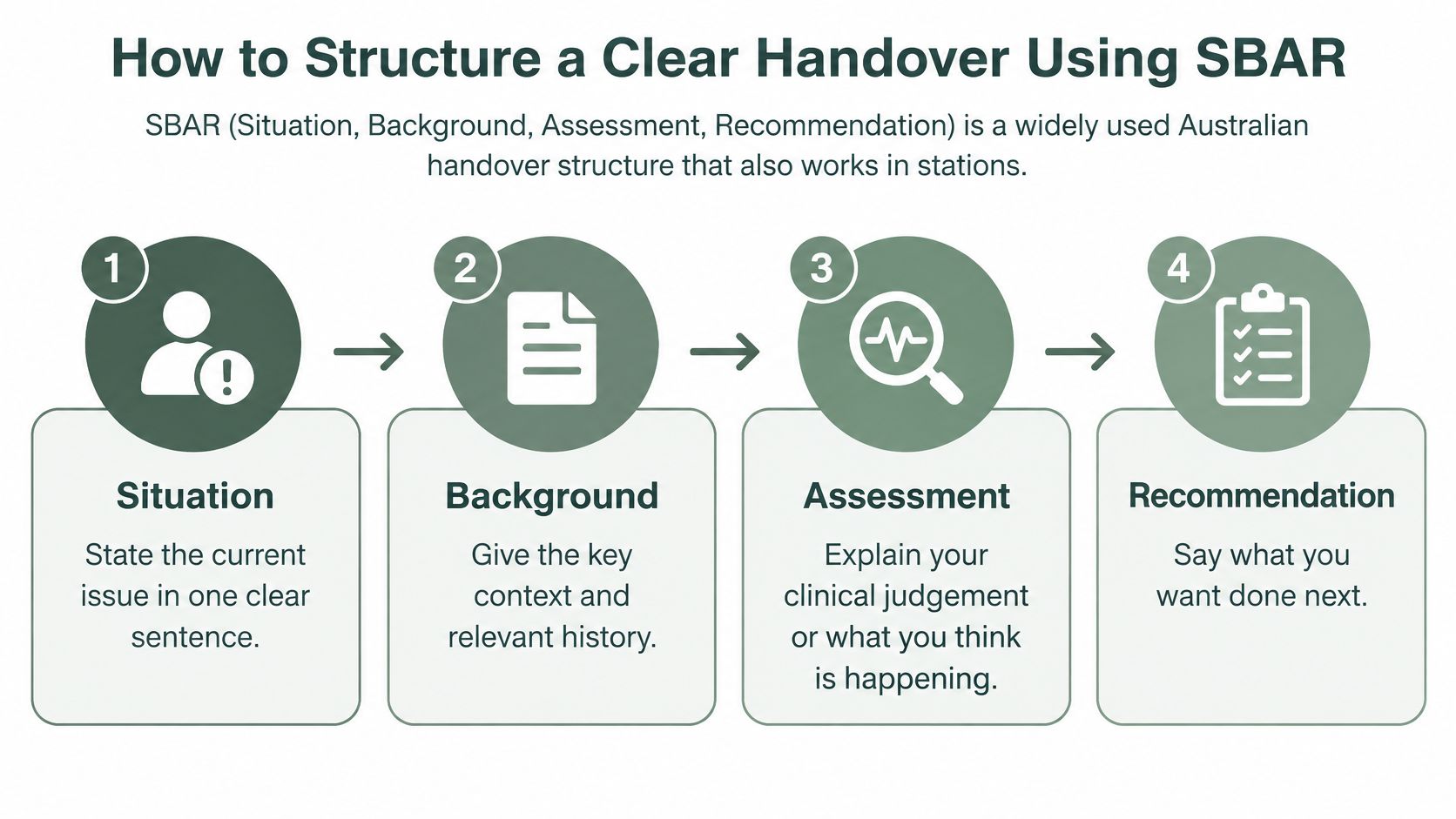
A clear handover lets the receiving clinician identify the concern, understand the relevant context and act. SBAR provides a reliable order: Situation, Background, Assessment and Recommendation. Many Australian services use ISBAR, which adds Identify (who you are and who the patient is) at the start. In an exam station, each part makes a different skill visible to the assessor.
The five steps
-
State the situation in one sentence. Identify the patient, location and immediate concern: “Mrs Patel in bed 12, day two after bowel surgery, has become tachycardic and confused in the last hour.” Starting with the reason for the call helps the receiver set priorities before hearing background detail.
-
Give the background that could change the next decision. Include relevant history, medicines, allergies, recent results and changes. Leave out details that do not affect the immediate plan. A handover is a filter, not a retelling of the admission.
-
Give your assessment, including uncertainty. State what may be happening and what else you are considering: “I’m concerned she may be septic, though bleeding has not been excluded.” The assessor can hear both your clinical reasoning and its limits.
-
Make a specific recommendation with a time frame. For example: “Please review her within the hour, and I’d like blood cultures and lactate taken now, without delaying antibiotics.” A clear request turns concern into an action the receiver can confirm or address.
-
Close the loop. Confirm the agreed actions, timing and who will reassess the patient. Ask the receiver to repeat the plan if needed. You catch a misunderstood instruction before it becomes a missed step.
Using the same order with patients
The structure can also help organise an explanation: what was found, what it means, what happens next and what signs should prompt further help. Findings without an explanation can leave a patient uncertain; a plan without clear next steps leaves them unsure what to do.
The same principle applies when patients move between hospital, community and residential care. Complete, structured information helps the receiving team continue the plan. For how a home-care registered nurse keeps the GP, family and other clinicians connected for an older person, see aged care insights from Core Nursing Solutions.
A handover is complete when the receiver has enough information to act. If they still need to ask for the patient’s location, allergy status or review time, the structure may be present, but the message is unfinished.
Interpreters and Culturally Safe Communication in Practice
Many resources describe cultural communication as respectful wording. That doesn’t tell you when to act, and stations mark the action. Work through four decisions in order.
-
When to use a professional interpreter. Whenever understanding of consent, medication changes, discharge or deterioration depends on language, book one. Family members shouldn’t be the default, they filter, soften and sometimes answer for the patient.
-
How to work with Aboriginal interpreters where available. Ask about language and dialect, allow time for interpreted turns, speak to the patient rather than the interpreter, and explain confidentiality. This is workflow, not just attitude.
-
How to verify understanding. Ask the patient to explain the plan back through the interpreter. Check that the interpreted meaning matches what you said, then correct gaps without shaming anyone.
-
What to do when an interpreter isn’t available. State the constraint, separate urgent from non-urgent information, escalate the access problem and document what couldn’t be safely covered.
The gap is operational. In a 2025 survey of 56 clinical staff at Gove District Hospital in East Arnhem Land, Northern Territory (Sims and colleagues), 96% could identify at least one major local language, but only 18% felt confident pronouncing language names, fewer than 60% had used an interpreter, and just over half knew how to book one. Awareness was present, booking and using interpreters weren’t routine.
Examiners mark the interpreter decision and the understanding check, not whether you insert the word “culturally” into the answer.
Name the decision, make the booking part of your plan, and show how you’ll confirm meaning. That’s culturally safe communication an assessor can score.
How to Practise Until the Skills Hold Under Pressure
Good intentions don’t survive a timed station; rehearsed behaviours do.
The evidence supports training with specific feedback, with honest limits. A 2021 Cochrane review of interventions to improve medical students’ communication (Gilligan and colleagues) pooled 76 controlled studies involving 10,124 students. Interventions had positive effects on most outcomes, though generally with small effect sizes and evidence of moderate to very low quality. Personalised or specific feedback probably improves overall communication skills to a small degree compared with generic or no feedback.
That points to short cycles, scenario, observed performance, domain-specific feedback, reattempt. “Be more empathetic” changes nothing. “You interrupted before she finished describing her worry about work” gives the candidate a behaviour to fix on the next run.
Five techniques that build the cycle
-
Record a five-minute station. Score the recording against named domains, not overall impression. You’ll hear jargon and missed cues you’d swear weren’t there live.
-
Practise in a trio. Rotate clinician, patient and observer. The observer’s only job is the feedback sheet, which keeps comments specific and stops friendly vagueness.
-
Use one observable behaviour per domain. Write “interrupted before the patient finished” or “didn’t check understanding”, never “rapport could improve”. This mirrors structured OSCE preparation built around repeated scored stations, where each attempt produces a mark you can track.
-
Reattempt the same station within a week. Track one target behaviour only. Trying to fix everything at once usually fixes nothing under time pressure.
-
Add difficulty deliberately. Practise with a patient who has low health literacy, hearing loss or a language barrier, or a colleague who pushes back on your escalation.
A training session like the one below works because observers can name what happened minute by minute.

Repeat across several different stations so you learn the principle, not one script. Scripts collapse when the simulated patient goes off-piste. Principles transfer.
Improvement has a clear sign, the same target behaviour appears across three or more stations without prompting. Until then, keep the behaviour on your sheet even if it feels repetitive. Pressure reveals your default habits, and practice is how you replace them.
Build Your Practice Plan for the Next Assessment
Turn your next two weeks into a small, measurable plan.
-
Choose your format. Pick the assessment you’re facing and write down its scoring domains from the school’s or college’s own current document. If you’re earlier in the pathway and still mapping entry routes, a general step-by-step guide to applying to medical school gives an overview of the wider application sequence.
-
Match one domain to one technique. For explanation and understanding check, record a station and score only those rows.
-
Schedule two cycles each week. Each cycle ends with a reattempt of the same station and one tracked target behaviour, such as asking the patient to explain the plan back.
-
Audit SBAR before reattempting. Check every handover or escalation answer for situation, background, assessment, recommendation and read-back. Missing steps get fixed first.
-
Review at two weeks. If the target behaviour appears in three or more stations, move to the next domain. If it doesn’t, repeat the same domain with a harder patient, perhaps low health literacy or a language barrier.
Pick one format, one domain and one weekly schedule before your next practice session. That’s the decision that turns reading into marks.
CliniRoo is building preparation material for Australian medical school, specialty selection and college assessments. Nothing is on sale yet. If you want to be told when there is something to use, CliniRoo takes an email address and does nothing else with it.