AMC Clinical Exam: Format, Scoring, and Preparation Guide
The AMC clinical exam explained: 16 assessed stations, the global rating that decides each one, the 9-of-14 pass rule, and how to prepare for it.
The Australian Medical Council (AMC) clinical exam is a circuit of 16 assessed stations, of which 14 are scored, and you pass by passing 9 or more of those 14. Each station is decided by a single global rating from the examiner. That is the rule under the AMC’s current Clinical Examination Specifications (version 8.3, June 2026), and it is stricter about consistency than it looks: one strong station cannot carry a weak one.
Table of Contents
- What the AMC Clinical Exam Is
- How the Exam Day Is Structured
- How Stations Are Scored and What Counts as a Pass
- The Four Assessment Areas You Will Face
- A Preparation Strategy Built Around Station Performance
- Common Pitfalls and How Candidates Lose Marks
- Practice Resources and How to Choose Between Them
- Your 12-Week Preparation Arc
What the AMC Clinical Exam Is
For international medical graduates (IMGs — doctors who gained their primary medical qualification overseas), the AMC clinical exam is the second assessment on the AMC’s standard pathway, after the AMC multiple-choice question (MCQ) examination. You must have passed the MCQ examination before you are eligible to sit it. AMC clinical examination
It is not a formality. In the 2018–19 reporting year the AMC ran 69 clinical examinations at its National Test Centre, assessing 1,978 IMGs; 537 passed and qualified for the AMC Certificate, a pass rate of 27.1%. AMC Annual Report 2019, clinical examinations Those figures predate 21 March 2024, when the AMC lowered the pass requirement from 10 to 9 of the 14 scored stations. AMC: changes to the clinical pass requirement Read the 2018–19 rate as a measure of how demanding the exam has been, not as a prediction under today’s rule.
The exam now runs both in person at the AMC Test Centre and online. From 1 July 2025 the AMC reduced the fee for the in-person exam from $3,991 to $3,000, and for the online exam from $4,391 to $3,400. AMC clinical examination Check the AMC page for the fee that applies on your booking date.
Why candidates read the room wrong
Many IMGs approach the exam like a knowledge test with a speaking component attached. That is the wrong model. The AMC is checking whether you can work as a safe clinician in repeated short encounters, with the patient, the examiner and the clock all operating at once.
That is why preparation has to start with the structure of the exam itself, not with a list of diagnoses.
Practical rule: If you cannot run a full station smoothly, you are not ready yet, even if your theory is strong.
What the certificate changes
Candidates who pass the MCQ and clinical examinations, and whose primary medical qualification has been verified, are issued the AMC Certificate. AMC Clinical Examination Specifications V8.3, June 2026 That makes the clinical exam a gate rather than a practice exercise, and it should be prepared for as one.
A candidate who has read a lot about chest pain may still fail if they cannot steer an eight-minute station, keep the consultation focused and finish with a safe plan. The exam is built to find out whether clinical knowledge is usable in motion.
How the Exam Day Is Structured
The exam is a circuit of 16 assessed stations and four rest stations. Each station lasts 10 minutes: two minutes of reading time outside the door, then eight minutes of assessment inside. Two of the 16 assessed stations are pilot stations that normally do not count, so your result comes from 14 scored stations, and you pass by passing 9 or more of them. AMC Clinical Examination Specifications V8.3, June 2026
How the circuit runs in real time
At the Test Centre you are given a starting card telling you which station you begin at, watch a short video on examination processes, and then wait outside your first station. An audio signal starts the two minutes of reading time, a second sends you in, and a third ends the station at eight minutes. You leave immediately and have two minutes to reach and read the next stem. Some candidates start at a rest station. Online, an examination coordinator runs identity, security and environment checks and plays a briefing video before you begin. AMC Clinical Examination Specifications V8.3, June 2026
In physical examination stations, the eight minutes is often too short for a full examination, so the examiner may ask you to move on. The specifications say plainly that this is not a sign of poor performance. In some stations you perform only part of the examination and the examiner gives the remaining findings on request, and only the findings you specifically ask for. If you leave out a key step, you will not hear the result. AMC Clinical Examination Specifications V8.3, June 2026
Why the pilot stations still matter
A pilot station is one being used in an examination for the first time. Usually the pilots are excluded from your result, but if there is a problem with one or two of the other stations, the AMC’s Clinical Results Panel may substitute one or both pilots into the 14 scored stations. AMC Clinical Examination Specifications V8.3, June 2026 Every station therefore deserves full attention.
Keep the same structure from the first station to the sixteenth. The exam rewards candidates who can repeat a safe, organised consultation when they are tired, not just those who have one polished performance.
What to rehearse before exam day
Your practice should match the pace of the circuit: two minutes to read and plan, eight minutes to perform. Open with purpose and close without panic. A mock station that is too long or too heavily coached can feel comfortable in training, but it does not prepare you for moving station to station.
What matters is whether you can keep enough stations at a pass level while tired, slightly rushed and unable to control the order of cases. That is why full-station practice matters more than memorising isolated facts.
How Stations Are Scored and What Counts as a Pass
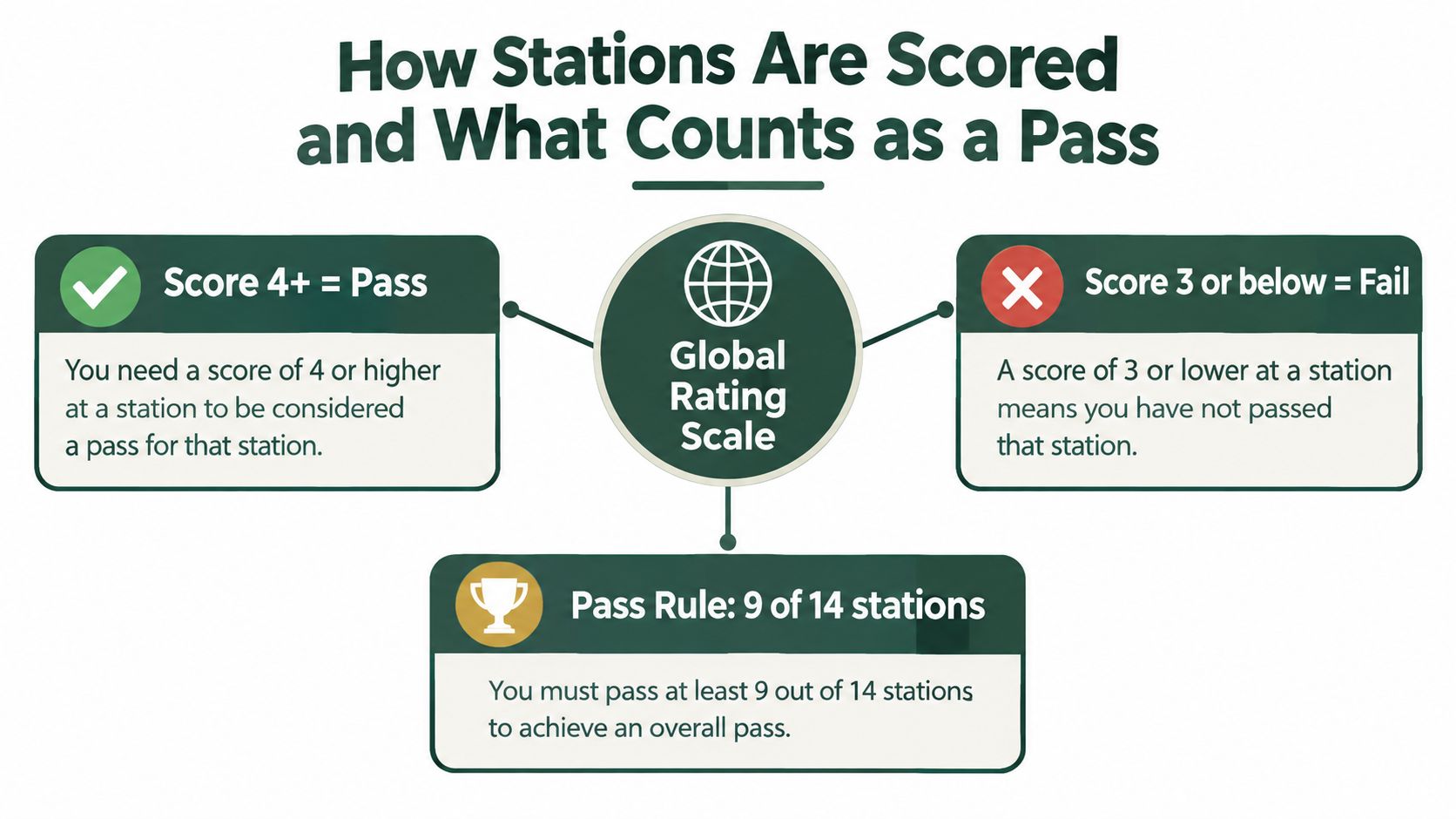
The examiner rates each station in three ways: performance on the station’s key steps, performance on each assessment domain (on a seven-point scale, with no pass/fail point), and a global rating of your overall performance, also on a seven-point scale. The global rating alone decides whether you pass the station. A global rating of 4 or above is a pass; 3 or below is a fail. AMC Clinical Examination Specifications V8.3, June 2026
The pass rule in plain language
You do not pass by balancing one strong station against one weak one. You pass by clearing enough individual stations: 9 or more of the 14 scored stations. Eight or fewer is a fail. There is no limit on the number of attempts. AMC Clinical Examination Specifications V8.3, June 2026
That changes how you should prepare. A candidate can be competent overall and still fail if too many stations slip below the line. A candidate can also pass with a few weaker moments, provided enough of the circuit stays above it.
Working rule: Strength in a few stations does not protect you from unreliable performance elsewhere.
One missed safety step, one unclear explanation, or one management plan out of sequence can turn a borderline station into a fail, even if the rest of your medicine is sound.
Why the global rating changes preparation
Because the global rating alone decides each station, the examiner is judging the whole encounter, not tallying isolated facts. Strong domain performance does not guarantee a pass on the station.
That is why two candidates with similar knowledge can finish with different results. One keeps a clear structure, listens, summarises and moves the station forward. The other knows the content but loses the thread, misses key steps or runs out of time. Under this scoring model, the second candidate is exposed at station level, not rescued by a stronger average elsewhere.
If you want a useful self-check, ask whether your mock stations are landing at a clear pass, not merely feeling “mostly right”.
The Four Assessment Areas You Will Face
The AMC assigns each station a predominant assessment area, shown on the reading screen, and there are four: history taking, examination, diagnostic formulation, and management/counselling/education. AMC Clinical Examination Specifications V8.3, June 2026 You need comfort across all four, not just a favourite format.

History taking stations
The AMC’s examples include taking a history from a patient with shortness of breath, and taking a history from a third party such as a parent or carer. AMC Clinical Examination Specifications V8.3, June 2026 A common trap is to wander through a broad systems review when the station needs a sharper focus. The patient does not need every possible question. They need the right questions, in a usable sequence.
Examination stations
The AMC’s example is examining a patient with suspected vascular disease. As above, you may perform only part of the examination and request the rest of the findings from the examiner, who gives only what you ask for. You need to know not just what to examine, but the order in which to ask.
Diagnostic formulation stations
The AMC’s examples are interpreting a laboratory report and diagnosing a common skin lesion. These test whether you can turn data into a reasoned working diagnosis and say why, out loud, in the time allowed.
Management, counselling and education stations
The AMC’s examples include educating a patient with asthma on inhaler technique, counselling a patient with obesity, and presenting a management plan. AMC Clinical Examination Specifications V8.3, June 2026 Candidates often underestimate these as “easy English” stations. They are not. You still need clinical accuracy, plain language and the ability to explain risk without sounding robotic. The examiner is also watching for prioritisation, escalation and sensible next steps.
If you want to rehearse by assessment area rather than by single topic, these clinical scenario questions show how to map the task, the opening line and the expected closing behaviour to each format.
Useful lens: Your weakest assessment area is usually the one you practise least, not the one you fear most.
The point of grouping stations
Grouping stations by assessment area shows you the gaps in your preparation. If you have practised counselling but hardly any examination stations, the circuit will expose that imbalance quickly. Range only comes from deliberate practice across all four.
A Preparation Strategy Built Around Station Performance
The central mistake is to over-study content and under-rehearse performance. Each station is passed or failed on its own, so preparation should focus on full, timed consultations rather than endless note-taking. A candidate who knows the material but cannot perform it under station pressure is still at risk.
Build your preparation in layers
Start with a content refresh focused on common presentations in Australian practice. Then add a skills layer for history, examination, explanation and management structure. After that, move into a station-performance layer with timed runs, peer marking and immediate correction. Finish with full mock circuits run to the AMC’s two-minute and eight-minute timings.
The goal is not to cram every possible diagnosis. It is to make your consultation shape automatic so your attention stays on the patient in front of you.
Match the work to the format
If the exam rewards consistency across stations, your practice should do the same. Short, repeated consultations with feedback on what happened, not what you meant to do, are better than long study sessions that never test performance. A mock that ends with “good effort” and no correction will not change next week’s station.
Before you build your mock circuit, read this guide to OSCE preparation (an objective structured clinical examination, or OSCE, is a timed, station-based clinical assessment of the kind the AMC exam uses) so your timed runs mirror the station cadence. For the knowledge layer, this explainer on the AMC question bank covers how question practice fits alongside station work, which it should support rather than replace.
Practical rule: If your practice never feels slightly uncomfortable, it probably is not close enough to exam conditions.
Why many IMG study habits miss the mark
A lot of IMGs default to reading, highlighting and watching explanations. That can improve confidence, but it does not reliably improve station behaviour. The exam does not ask whether you recognise the condition after five minutes of reflection. It asks whether you can complete the consultation under pressure and still look safe, organised and patient-centred.
Use content review, but keep it subordinate to rehearsal. Spend less time learning more medicine and more time turning the medicine you know into a repeatable station routine.
Common Pitfalls and How Candidates Lose Marks
The fastest way to lose a station is to let one weak habit control it. Three patterns are worth rehearsing against: communication drift, unsafe shortcuts and time mismanagement. Each feels different, but they end the same way, with a station that never settles into a clear pass.
Communication drift
A candidate starts with the patient’s concern, then slides into a generic systems review that misses the actual issue. The conversation becomes wide but shallow, and the examiner stops seeing a focused consultation. In a chest pain station, spending too long on unrelated history while ignoring urgency cues pulls the overall impression down quickly.
The fix is simple but disciplined. Stay close to the presenting problem, and keep returning to the patient’s actual concern.
Unsafe shortcuts
A candidate ignores a red flag, gives a management plan that feels incomplete, or misses a safety step that should have been obvious. Even if the rest of the station sounds polished, unsafe reasoning is hard to rescue.
A better answer names the serious alternative early, shows awareness of risk and closes with a safe plan. That does not mean overloading the patient with jargon. It means showing you can think safely under pressure.
Time mismanagement
Some candidates spend too long gathering history, then rush the explanation or management plan. Others open well but fail to close the station cleanly. Both are easy to fall into because the clock changes behaviour, and nervous candidates often do not notice the drift until it is too late.
A clean structure changes everything. Open, focus, prioritise, close. If you cannot do that in mock stations, you will not do it under exam stress.
You do not need a perfect consultation. You need a complete one that stays safe and coherent until the final signal.
The most useful feedback from a mock is not “nice bedside manner”. It is which behaviour pushed the station from pass to fail. Once you know that, you can target the habit that keeps repeating.
Practice Resources and How to Choose Between Them
Not every resource helps in the same way. Some teach content, some teach format, and some give feedback that changes how you perform in a station. The best choice depends on what is missing from your preparation, not on what feels most familiar.
Choose the resource that matches the gap
The AMC’s own Clinical Examination Specifications are the anchor, because they define the structure and scoring of the exam itself, and include sample stations. OSCE courses can be useful when they run with realistic timing and direct feedback. IMG study groups help with repetition and confidence, but they drift into guesswork if nobody is correcting structure. In-person mock circuits are strong when the examiner feedback is specific and honest.
Question banks and scenario collections can fill the repetition gap, especially if they are built for Australian practice rather than generic international formats. The closer the scenarios are to local referral pathways, terminology and Australian practice, the more transferable the practice becomes.
CliniRoo is building preparation material for the Australian pathway. Nothing is on sale yet. If you want to be told when there is something to use, CliniRoo takes an email address and does nothing else with it.
A simple way to rank what you’ve got
- Format authenticity: Does the resource feel like a real station, with the two-minute and eight-minute timing, roles and examiner behaviour of the exam?
- Feedback quality: Does someone tell you exactly where the station lost marks?
- Repeatability: Can you use it again and again without the material becoming stale?
- Australian context: Does it reflect local language, referral habits and expected management?
A resource that scores well on all four is rare. More often, you need a combination: a core resource for format-true practice, plus a few other tools that fill specific weak points.
Your 12-Week Preparation Arc
A workable 12-week plan does not need to be fancy. It needs to move you from understanding the stations, to performing them, to proving you can do that repeatedly under pressure. Keep the 9 of 14 pass rule and the global rating in mind and the schedule makes sense quickly.
Weeks 1 to 4, build the base
Spend this block on systematic history taking, focused examination and a refresh of common presentations. Keep each practice session short and structured. The aim is to make your opening, transition and close feel familiar before you try to speed them up.
Weeks 5 to 8, build performance
Shift into timed full stations with peer or mentor feedback. Do not let these sessions become casual conversations. Each run should end with one concrete correction, such as “ask for red flags earlier” or “close with a safer management summary”.
Weeks 9 to 12, build consistency
Run mock circuits, review errors and tighten the weak assessment areas. By this stage you are not chasing more theory. You are checking whether your performance holds up across 16 stations, even when you are tired.
Week one should be simple. Book practice times, identify your weakest assessment area, collect your core resources and record one mock so you can see your starting point. The AMC sets no limit on attempts, but each one costs a fee and months of preparation, so treat a rough first mock as data for this attempt rather than a reason to plan on a second.