Australian Interview Questions and Answers: 7 Key Formats
Australian interview questions and answers for medical training: 7 formats from RACS SET to MMIs, with sample answers, scoring domains and panel expectations.
Orthopaedic surgery moved the interview from 40% of the selection score for the 2025 intake to 60% for the 2027 intake, according to the Australian Orthopaedic Association’s own 2027 selection regulations. In that process the interview now sits beside a verbal referee report at 40%, and the CV, the orthopaedic multiple-choice test and the departmental referee report are hurdles with no weighting at all. The interview became the deciding instrument.
That kind of shift exposes a problem. Most of what ranks for Australian interview questions and answers was written for UK deanery interviews or US residency applications: generic competency lists, “tell me about a time” scaffolds, and one imagined panel. Australian panels score against domains published by the college or employer running the intake, and the structure changes by college, state and hospital network.
This list works backwards from that. Seven formats, each with what the station is measuring, the shape of a strong answer, and the trap that sinks a rehearsed one: Royal Australasian College of Surgeons (RACS) Surgical Education and Training (SET) stations, Royal Australasian College of Physicians (RACP) Basic Training interviews, multiple mini interview (MMI) circuits, ethics scenarios, junior doctor panels, the RACP written paper, and objective structured clinical examination (OSCE) stations. If you want extra volume while you rehearse, Eztrackr’s interview question generator produces practice questions you can time yourself against.
Table of Contents
- 1. RACS Surgical Education and Training (SET) Selection Interview Stations
- 2. RACP Basic Training Selection Interview for Physician Training
- 3. Multiple Mini Interview (MMI) Stations for Australian Medical School Admission
- 4. Medical Board of Australia Ethics and Professional Conduct Scenario Questions
- 5. State and Hospital Network Junior Doctor Selection Panel Questions
- 6. RACP Divisional Written Examination Question Formats
- 7. Medical School OSCE and Clinical Exam Station Questions
- Australian Medical Interview Formats at a Glance
- Prepare on the Right Format, Not a Foreign Template
1. RACS Surgical Education and Training (SET) Selection Interview Stations
The Royal Australasian College of Surgeons scores its SET selection interview rather than conversing through it, and each specialty sets its own weighting. In neurosurgery, for the 2027 intake, the semi-structured interview contributes 30% of the overall selection score, alongside a structured CV at 10%, the Neurosurgery Anatomy Examination at 30% and a reference report at 30%, as set out in the RACS 2026 Guide to Surgical Selection (2027 intake). A strong interview cannot rescue a weak anatomy paper, and a good CV will not cover for a station you fumbled.

What the Stations Are Scoring
The same RACS guide states that interview format and delivery vary by specialty, so the current specialty regulations outrank any generic advice you’ve read. General surgery shows how granular that gets. Under General Surgeons Australia’s selection regulations for the 2027 intake, applicants rotate through five panels of two members, spending up to 10 minutes with each. Each panel asks two structured questions, every panel member scores each question out of five and also awards a global score out of five, and the five panel scores are totalled out of 150.
- Escalation under hierarchy: a colleague raises a patient safety concern about a more senior doctor’s plan. Panels score what you do with the concern and who you tell.
- Competing demands: theatre, ward and clinic collide on the same morning. State the order, the reason, and who you hand off to.
- Team disagreement: a consultant and registrar disagree on management. Show how you raise it and when you’d stop pushing.
Scored, not discussed: every answer needs an action the panel could observe, not a value you claim to hold.
Rehearse in timed stations with someone scoring you against the domains, and keep personal examples to about 30 seconds before returning to the question. The wider pathway is covered in this guide to surgical training in Australia, and the specialty-by-specialty weightings are mapped on the specialty selection interviews page.
2. RACP Basic Training Selection Interview for Physician Training
There is no single national RACP Basic Training interview. The college accredits training settings, but hospitals and networks select and employ basic trainees, so the format depends on where you apply. The RACP’s local selection guidance recommends a structured interview and offers the MMI as an alternative, leaving the choice to the employer. Check the format with the network you are applying to before you rehearse.
Whatever the format, the interview tends to probe clinical reasoning and motivation in the same short sitting, and most candidates rehearse only the first.
The Motivation Station Is a Cost Question
Ask a candidate why they want physician training and you’ll hear about intellectual curiosity. Ask what the next several years involve, financially and personally, and the room goes quiet. The 2024 Medical Training Survey national report puts it in numbers: 62% of specialist trainees agreed that the financial cost of their college training program had led to stress, and 16% agreed those costs had been a barrier to progressing in training. 24,812 doctors in training took part in that survey, so panels have heard the honest version before and can spot a rehearsed one.
- Deteriorating inpatient: name the escalation pathway, the time frames, and what you’d document.
- Difficult diagnosis: structure the conversation, check understanding, then plan the next meeting.
- Patient declining the team’s recommendation: establish capacity, explore the reason, and explain how you’d keep the door open.
Answer the reasoning aloud, step by step. The final decision is a small part of the response; the sequence carries the rest. Prepare two or three well-documented examples you can reuse across stations, and keep the ethics answers anchored to the Medical Board’s code of conduct, Good medical practice.
3. Multiple Mini Interview (MMI) Stations for Australian Medical School Admission
A panel interview and an MMI circuit fail for different reasons. In front of a panel, one weak answer colours the whole sitting. In a circuit, a single flat station costs one score among many, but inconsistency across the circuit is what removes candidates. Each station rewards a repeatable structure, and the trap is treating every stop as a chance to impress rather than a narrow test of one domain.
MMI use varies by university, so confirm each school’s current published format before rehearsing. That check matters because the same broad question can be scored differently depending on whether the station is testing communication, ethical reasoning, prioritisation, teamwork, or reflection. Generic interview practice rarely reproduces the station demands a candidate will face at a particular school.
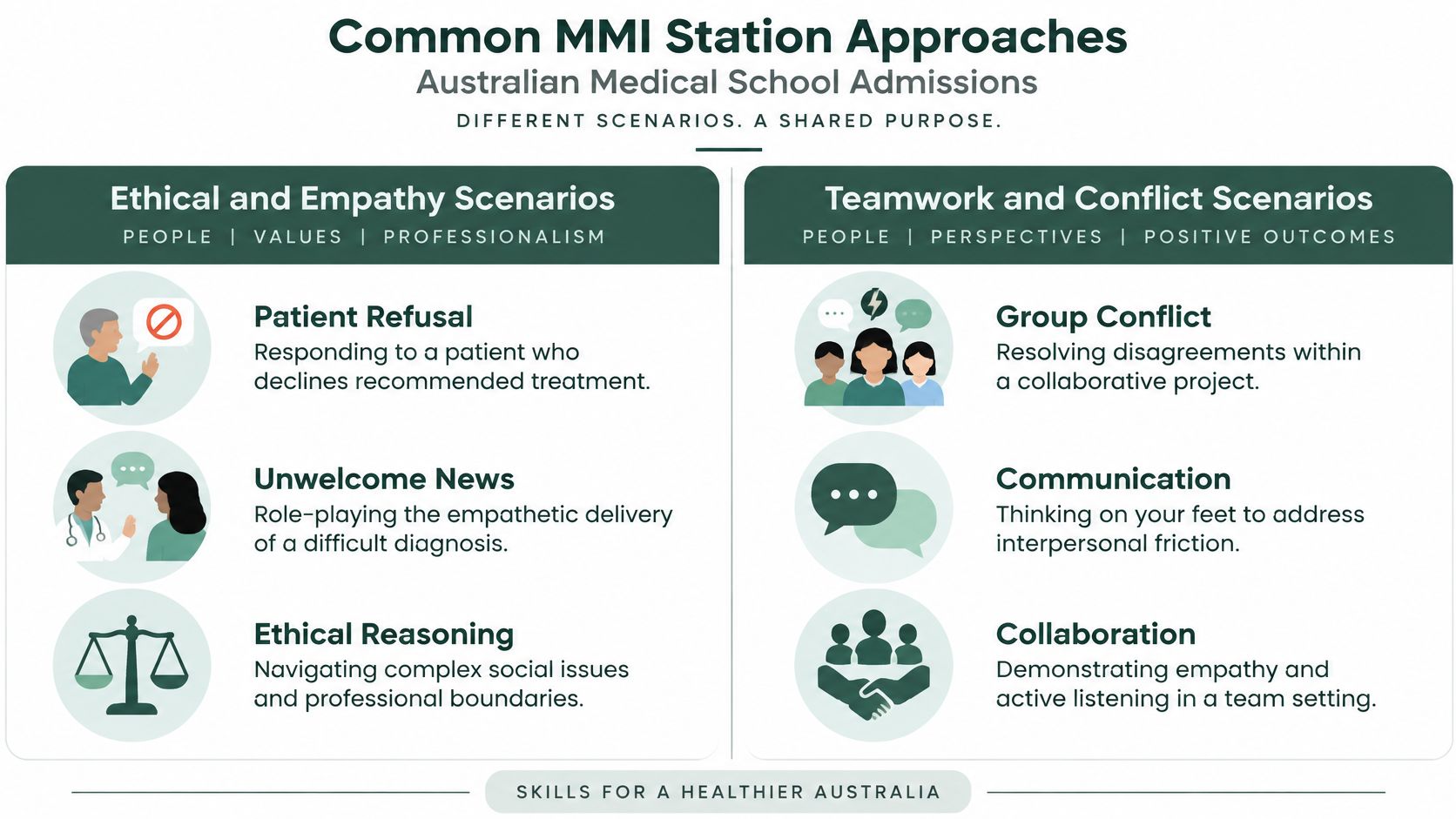
Three Stations That Decide the Circuit
- Treatment refusal: a patient declines a recommended treatment. The station scores exploration, not persuasion. Name the domain being tested, establish the patient’s understanding, check capacity, explore the reason for refusal, then explain what you would document and who you would involve.
- Breaking unwelcome news: a simulated patient receives a poor prognosis. Lead with what they need to know first. Give the key information plainly, pause for response, check understanding, and offer the next step. The trap is hiding behind reassurance.
- Group conflict: a project team has stalled. Say what you’d say, to whom, and in what order. Separate the task problem from the relationship problem, propose a process, and state what you would do if the group still did not move.
A circuit rewards the candidate who is consistently adequate, not the one who is brilliant once.
Good MMI preparation is built around named domains and clean structure. For each answer, state the issue, the priority, the action, and the reason for it. Then practise aloud, in time, with someone scoring the same domains the school says it assesses.
4. Medical Board of Australia Ethics and Professional Conduct Scenario Questions
The ethics station is where rehearsed candidates lose the most marks, because the question rarely has one clean answer and the panel knows it. What gets scored is whether you can name the duties in tension and justify a defensible course of action.
Ethics scenarios appear across specialty interviews, junior doctor panels and medical school assessment, and the Medical Board of Australia’s code of conduct, Good medical practice, is the reference point: patient safety, honesty, confidentiality, professional boundaries, and responsibility for colleagues. Answer with the code applied to the concrete situation, not with instinct.

Answering with the Code, Not with Instinct
- Impaired colleague: smells of alcohol at handover. Immediate patient safety first, then escalation, then what you’d say to the colleague.
- Disclosing an error: you gave the wrong dose and the patient is stable. Open disclosure, documentation, reporting.
- Family requesting information: an adult patient with capacity, relatives asking for results. Confidentiality, with the patient’s permission as the hinge.
Resource limits belong here too. An answer that promises limitless personal cover in a stretched rural or remote service reads as naive, while one that names supervision, escalation and boundaries reads as safe.
Name the duty, name the tension, name the action, name who you would consult.
For worked versions of these scenarios, see this set of medical ethics scenarios.
5. State and Hospital Network Junior Doctor Selection Panel Questions
Junior doctor and prevocational selection is employer-led. State health systems and hospital networks run their own panels, application platforms and question sets, so the panel in front of you is asking about its own service rather than about medicine in the abstract.
The pool behind those panels is large and mixed. The Medical Board of Australia’s 2023/24 annual summary recorded 142,569 registered medical practitioners, up 4.3% on 2022/23, and 9,490 first-time registrants in the same year: 4,059 domestic (including new graduates) and 5,431 international. Different entry points, different expectations, and a panel that assumes you know which one you’re on.
- Why this network: name its services, its patient population, and the term you want.
- Heavy workload, safety intact: show your triage, your escalation, and what you’d hand over at the end of the shift.
- Feedback you’ve received: pick one piece, say what you changed, and keep it under a minute.
Panels ask about the local service because they staff it. Learn the service before you learn the values statement.
Build answers on the STAR structure (situation, task, action, result), and confirm in advance whether the network also runs a written component.
6. RACP Divisional Written Examination Question Formats
This one is an examination rather than an interview, but it is the next assessment many physician trainees face, and it rewards the same habit of reasoning out loud. The RACP Divisional Written Examination (DWE) asks candidates to apply clinical knowledge under time pressure. The RACP’s past DWE results show how much the sitting itself varies: for Australian candidates in February 2026, the pass rate was 74.1% for Adult Medicine and 75.0% for Paediatrics & Child Health, while the October 2025 sitting returned 62.5% and 52.8% respectively. Treat that spread as a prompt to practise timing and reasoning together, not as a fixed difficulty score.
The paper is unforgiving because it asks for decisions, not recital. A candidate may know the diagnosis and still lose marks by choosing the wrong next investigation or sequencing acute management poorly.
Where Marks Actually Go
- Case-based questions: the next investigation, not the eventual diagnosis.
- Acute presentations: initial management, in order, with the safety steps named.
- Data interpretation: results placed in a clinical context, where the reasoning carries the mark.
Check the current examination format on the RACP’s DWE page before you plan, because formats and eligibility rules change between sittings. Write the rationale for each practice answer, including why the alternatives fail, then track recurring weak topics and revisit them on a spaced schedule instead of re-reading notes. Pace matters as much as knowledge, so sit full papers under exam conditions rather than doing questions in blocks.
A useful marking pass is blunt. Name the domain being tested before reading the answer: clinical reasoning, investigation choice, acute management, or interpretation. Then ask where an average answer would stop. The difference is usually the explicitly named safety step, the next decision, or the reason a result changes management.
7. Medical School OSCE and Clinical Exam Station Questions
OSCE stations are marked against a rubric written before the station runs, and that rubric rewards structure an examiner can see. A student who finds the sign but never introduces themselves, washes hands or summarises can score below one who runs an unremarkable but complete sequence.
Australian medical schools run these circuits across history taking, examination, communication, procedures and clinical reasoning. Each station has a set task and a marking rubric. The failure mode is silence: performing an examination without narrating the findings the examiner cannot see you elicit.
- Focused history, chest pain: your school’s sequence, plus risk factors and a clean handover line.
- Delivering a diagnosis: a simulated patient, a clear opening, and a check on what they understood.
- Systematic examination: the routine, the exposure, patient comfort, then the summary.
Rubric reality: the examiner marks what you say and do in the room, not what you know you would have done.
Practise with peers on timed stations and swap rubrics, so you’re scored the way the circuit scores you. Your university’s assessment guide names the specific rubric in use, and this guide to OSCE preparation covers the sequence station by station.
Australian Medical Interview Formats at a Glance
| Format | Stage of Training | Who Runs It | Key Scoring Focus | Best Preparation Approach |
|---|---|---|---|---|
| Station-based selection interview | Surgical training selection | Royal Australasian College of Surgeons (RACS) and its specialty societies | Set per specialty in the current selection regulations | Read your specialty’s regulations; practise timed stations with structured answers |
| Structured interview or MMI, chosen by the employer | Physician Basic Training selection | Hospitals and networks, in RACP-accredited settings | Varies by employer and state | Confirm the format with the network; practise explaining reasoning and prepare documented examples |
| Multiple Mini Interview (MMI) stations | Medical school admission | Australian medical schools using MMI formats | Set by each school | Confirm each university’s format; practise timed stations with peers |
| Ethics and professional conduct scenarios | Medical school, junior doctor, and specialty selection | Selection panels, drawing on the Medical Board of Australia’s code of conduct | Patient safety, honesty, confidentiality, professional boundaries, and reasoning | Apply Good medical practice; explain options, actions, and when you would seek advice |
| Panel interview, sometimes with scenarios or written components | Junior doctor and prevocational selection | State health departments and hospital networks | Set by the employer | Research the network; prepare STAR examples and confirm the interview format |
| Written examination (DWE) | Physician training assessment | Royal Australasian College of Physicians (RACP) | Clinical reasoning, investigation and management | Check the current format; practise timed questions and analyse answer rationales |
| Timed OSCE and clinical examination stations | Medical school clinical skills assessment | Australian medical schools | Set by each school’s rubric | Practise timed stations with peers, use a consistent structure, and review the university rubric |
Prepare on the Right Format, Not a Foreign Template
Check whether your pathway interviews at all before you spend hours rehearsing. General practice is the clearest example of why: the two general practice colleges select differently. The Royal Australian College of General Practitioners (RACGP) uses a situational judgement test rather than an interview for its 2027 intake, while the Australian College of Rural and Remote Medicine (ACRRM) runs multiple mini interviews for its 2028 training year. Rehearsing panel answers suits one and not the other.
The seven formats above do not share a scaffold. A structure that scores well in front of a UK deanery panel can score poorly in front of an Australian one, because the domains, the weighting and the content you are expected to volunteer unprompted all differ. The weighting also moves between intakes, as the orthopaedic change from 40% to 60% shows, so check the regulations for the intake you are applying to.
The field is not thinning either. In 2025 there was a nearly 30% increase in specialist international medical graduates seeking a path to practise in Australia, according to the Medical Board of Australia. A larger, more varied field makes generic answers easier to spot. The useful preparation is the kind that makes candidates rehearse the scoring domain out loud, under time, with the right structure attached. For more on structuring answers to leadership questions in general, see StoryCV’s guide to lead interview questions.
CliniRoo is building interview stations organised by specialty and jurisdiction, with named scoring domains, for the Australian pathway. Nothing is on sale yet. If you want to be told when there is something to use, CliniRoo takes an email address and does nothing else with it.
Pick the format you will sit. Rehearse it in time, name the domain before you answer, and get someone to score the structure you used, not just the content you covered.