Surgical Training Australia How SET Works and How to Get In
Understand surgical training Australia from SET structure to selection, interviews and state variations. Clear guide to milestones and preparation.
You’re halfway through a busy term as a junior doctor, and the same question keeps returning during ward rounds: when should I apply for surgical training, and what counts? You’ve heard that SET is national, yet every registrar seems to mention a different application date, interview format or preferred hospital network. The uncertainty can make surgical training in Australia feel less like a pathway and more like a collection of local customs.
The practical answer is that both impressions are partly correct. The Surgical Education and Training program, governed by the Royal Australasian College of Surgeons, provides the national framework. However, specialty committees, states and hospital networks shape the details that determine how you prepare and where opportunities appear. This guide treats the pathway as a decision problem, not a brochure. You’ll learn how the national structure works, why selection is competitive, how the nine specialties differ, and where local requirements can change your strategy.
If you’re still comparing medicine with other Australian pathways, the broader overview of medical training in Australia can help you place prevocational work, specialty applications and college training in context. For surgical applicants, the important habit is to track progress in layers: first confirm eligibility, then build evidence of readiness, then rehearse the exact selection format used by your specialty and jurisdiction.
Table of Contents
- Introduction to Surgical Training in Australia Today
- How the SET Program Is Structured and What It Means for You
- How Competitive Surgical Training Really Is
- The Nine Specialties and Why Selection Is Not One Process
- Selection Interviews Exams and How You Are Scored
- State and Network Variations That Change Your Chances
- Your Preparation Roadmap From Now to SET Entry
Introduction to Surgical Training in Australia Today
A junior doctor considering surgery usually starts with a broad ambition, “I want to become a surgeon.” The application requires a much narrower set of questions. Which specialty are you targeting? Which selection process applies? Which rotations and referees will show that you’re ready? When do applications open, and does the hospital network use the same interview approach as another state?
That’s why surgical training Australia can feel opaque even to capable doctors. The pathway has a recognisable national name, but the route into it isn’t one national queue. A strong clinical year may help your application, but it won’t replace checking the current specialty eligibility rules or understanding how your target committee assesses candidates.
Practical rule: Treat every application guide as a set of instructions for one specialty and intake, not as a universal rulebook for surgery.
Your first task is to separate framework from mechanism. RACS and SET define the broad training pathway. Specialty selection documents define the operational details, including application windows, examination requirements, interview stages and evidence that must be submitted. State and network documents then add the local context, such as where positions are funded and when interviews occur.
A useful way to manage this is to keep an application file with four sections:
- Eligibility: Record required rotations, examinations, registration conditions and application prerequisites.
- Evidence: Map clinical work, teaching, research, presentations, audits and leadership to the published criteria.
- People: Identify supervisors and referees early, then ask whether they can comment specifically on your clinical judgement and teamwork.
- Dates: Track the opening and closing dates, examination deadlines, interview dates and document requirements for each target pathway.
Success also changes as you move through the process. Before application, success means knowing the rules and choosing a realistic target. At application, it means submitting evidence that matches the criteria. At interview, it means communicating safe reasoning under pressure. If you’re unsuccessful, success becomes a useful review of gaps rather than an unexplained judgement about your potential.
How the SET Program Is Structured and What It Means for You
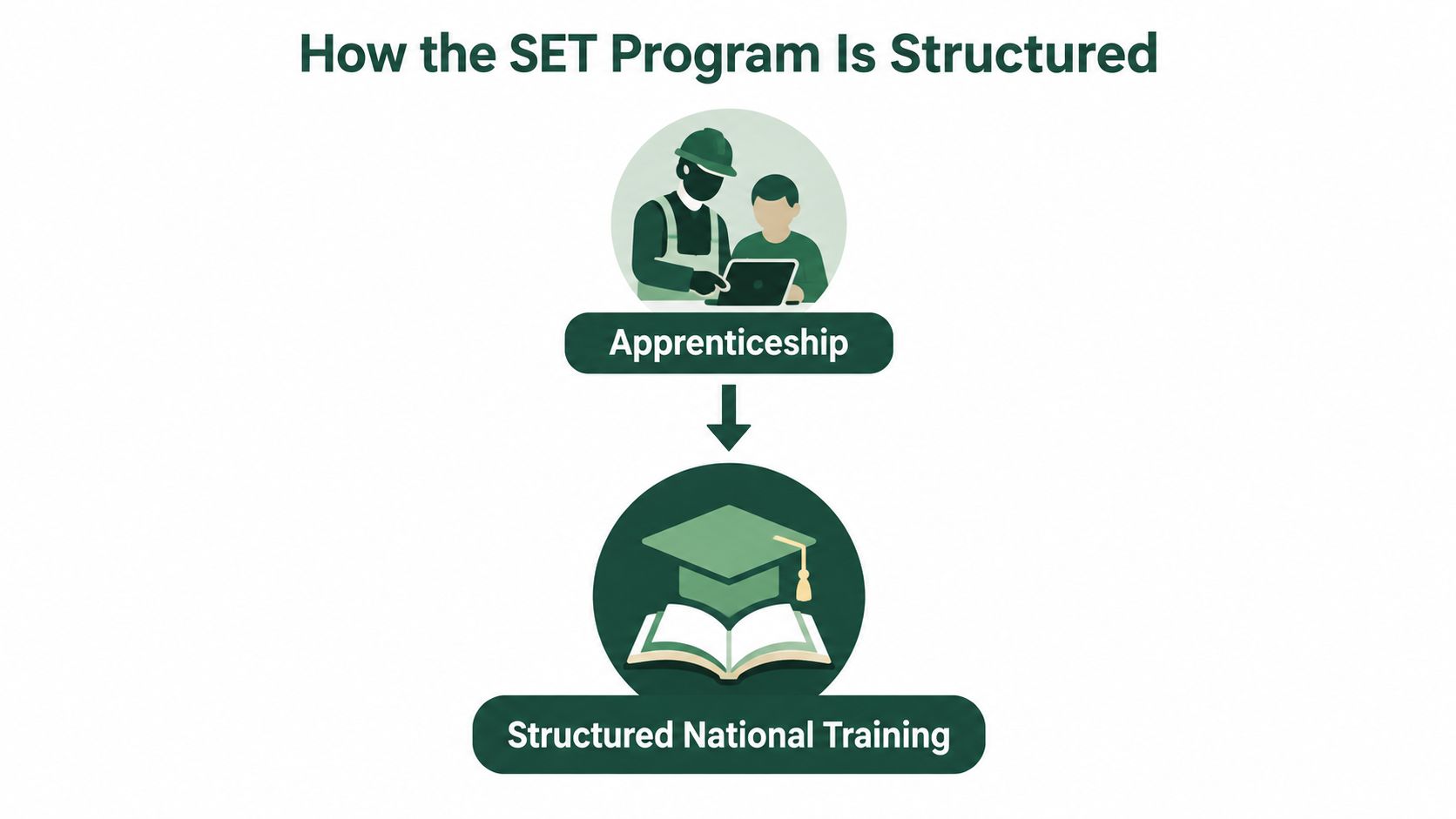
Your first months in a surgical job can feel like learning a map while already walking. You work beside experienced surgeons, observe decisions, perform tasks under supervision, and gradually accept more responsibility. The Surgical Education and Training program, or SET, keeps that apprenticeship foundation while adding a structured national curriculum, defined progression requirements, and formal assessment.
RACS introduced SET in 2008 as a national surgical training pathway across Australia and New Zealand, as recorded in the RACS 2025 Activities Report. Your route generally runs from medical school through internship and prevocational work, then surgical experience and specialty selection. After acceptance, you train within the relevant specialty program, rather than just collecting operating time without a defined progression plan.
What changes after you enter SET
SET combines service work with education. Rotations expose you to the specialty’s clinical work, while supervisors assess patient management, communication, technical skills, and non-technical skills. Progression depends on demonstrating the required standard at each stage, not finishing a set period on the roster.
The sequence, assessments, and rotation arrangements vary by specialty. “I’m applying for SET” identifies the national framework, while “I’m applying for general surgery” or “I’m applying for neurosurgery” identifies the specific rules you must prepare for. State and network arrangements add another layer, affecting funded positions, hospital rotations, and interview timing.
The same RACS report records 1,321 active SET trainees in 2025, up from 1,300 in 2024 — a 1.6% increase year on year. It also records 260 new surgical Fellows admitted through the SET pathway in 2025. These figures show the size and activity of the pathway, not your personal likelihood of selection.
The trainee profile is changing as well. In 2025, women represented 35% of active SET trainees and 41% of successful SET applicants, according to that report. The practical lesson is to avoid assuming that surgery has one standard entrant profile. Your application should show your readiness, reliability, and fit with the specialty.
How to use the national framework
The national framework explains the broad purpose of training and the principles behind progression. It does not settle every practical question. For current requirements, check the specialty’s selection regulations alongside documents from the relevant state or training network. Those local documents may determine where positions are funded, which hospitals participate, and when interviews are held.
Keep an application file with four sections:
- Eligibility: Record required rotations, examinations, registration conditions, and prerequisites.
- Evidence: Match clinical work, teaching, research, presentations, audits, and leadership to the published criteria.
- People: Identify supervisors and referees early. Ask whether they can comment specifically on your clinical judgement and teamwork.
- Dates: Track application windows, examination deadlines, interview dates, and document requirements for each target pathway.
Before applying, you should be able to state your target specialty, the eligibility and examination rules, how candidates are assessed, where positions are advertised, and what evidence demonstrates readiness. That list turns SET from a distant national structure into a local plan you can check and update.
How Competitive Surgical Training Really Is
A junior doctor may have solid clinical experience, strong references, and a carefully prepared application, yet still miss out on surgical training. The limiting factor is often the number of funded, accredited training positions available for suitable applicants. Selection works like fitting eligible candidates into a fixed number of seats. When applications exceed those seats, a capable applicant can remain unselected.
The national picture is competitive. Of the 668 applications to SET received in 2025 for the 2026 intake, 230 applicants were offered a trainee position — an overall offer rate of 34.4%, according to the RACS 2025 Activities Report. Roughly two in three applicants were unsuccessful in that round.
The age profile in the same report tells you something useful about timing: 715 active SET trainees, or 55%, were aged 34 or under in 2025. Entry in your late twenties is not the norm, and a longer prevocational run-up is ordinary rather than a sign that something has gone wrong.
Treat that national rate as background, not as your own probability. For the next intake, confirm the current requirements and application dates through the relevant specialty, state, and training network documents, because local constraints change interview timing and the number of positions available.
Why position numbers matter
Offer rates differ sharply by specialty, which is why the national average is close to useless for planning. In the 2025 round, the RACS report records offer rates ranging from 16.7% in Cardiothoracic Surgery (8 offers from 48 applications) and 25.6% in General Surgery (50 from 195) up to 60.3% in Orthopaedic Surgery (70 from 116). The same overall rate of 34.4% sits on top of processes that are not remotely alike.
Jurisdiction matters too, and for the same reason: the posts exist in different numbers. A July 2024 RACS witness statement to the NSW Special Commission of Inquiry into Healthcare Funding records 154 active General Surgery trainees in NSW against 11 in Cardiothoracic Surgery and 5 in Paediatric Surgery. Those are trainees in post rather than annual selection numbers, but they show the scale difference a national success rate hides.
A missed application does not by itself show that you lack potential. The gap may sit in your evidence, interview performance, application timing, or the number of accredited positions available in that intake. Review the result as a diagnostic exercise:
- Check eligibility first: Confirm every formal requirement was met.
- Review the evidence: Separate strong CV domains from thin ones.
- Analyse the format: Identify whether the application, written assessment, or interview exposed the weakness.
- Rebuild deliberately: Select rotations, projects, and preparation that address the documented gap.
The age profile also affects planning. Do not rush just because colleagues are applying earlier. Additional clinical experience, research, or teaching is useful when it strengthens readiness and matches the published criteria. A longer route can still be productive if each year adds evidence and judgement.
Selection is a constrained matching exercise. A credible specialty choice, an application mapped to the criteria, and preparation for the exact assessment process give you a more realistic plan than either assuming entry is impossible or treating a strong CV as a guarantee.
The Nine Specialties and Why Selection Is Not One Process
You have chosen a surgical specialty, but the application process still depends on the specialty, state and training network involved. RACS covers nine surgical specialties, yet applicants do not enter through one national template. Reviewing the 2017 selection round, the Australian Medical Council found trainees were selected into those nine specialties by 13 different selection processes — the extra four exist because General Surgery, Orthopaedic Surgery, Otolaryngology Head and Neck Surgery, and Plastic and Reconstructive Surgery run separate processes for Australia and New Zealand. Selection was administered by the College for five programs and by the relevant specialty society or association for eight, according to the Australian Medical Council accreditation report on RACS (November 2021).
That split is the single most important thing to understand before you prepare, because it means the document governing your application is often written by a specialty society rather than by RACS. An examination may carry substantial weight in one pathway, while another places more emphasis on documented experience, referees or interview performance. Examination pass marks, validity periods and eligibility thresholds are set specialty by specialty and are reissued for each intake, so read the regulations your own specialty has published for the year you are applying in rather than inferring them from another pathway.
Specialty Selection Differences at a Glance
| Specialty Pathway | Selection Process | Key Eligibility or Exam Rule |
|---|---|---|
| General Surgery | Specialty-specific selection process | Check the current specialty regulations and local intake documents. |
| Cardiothoracic Surgery | Specialty-specific selection process | Confirm position availability and eligibility for the relevant intake. |
| Neurosurgery | Specialty-specific selection process | Check the current examination requirement and how long a result stays valid for your intake year. |
| Orthopaedic Surgery | Specialty-specific selection process | Confirm the current examination, application and interview requirements. |
| Otolaryngology Head and Neck Surgery | Specialty-specific selection process | Use the current specialty guidance rather than assuming another pathway applies. |
| Paediatric Surgery | Specialty-specific selection process | Review eligibility and selection stages for the relevant intake. |
| Plastic and Reconstructive Surgery | Specialty-specific selection process | Confirm the published criteria, evidence requirements and local arrangements. |
| Urology | Specialty-specific selection process | Check the specialty process and any jurisdictional documentation. |
| Vascular Surgery | Specialty-specific selection process | Follow the current specialty regulations, including dates and scoring components. |
Use the table as a map, not as a replacement for current regulations. The national SET framework provides the broad road structure, but state and network documents often determine the practical route: application deadlines, interview dates, available positions, evidence formats and local scoring arrangements. Those details can change between the 2025 and 2026 intake cycles, so check the specialty’s current guidance and the relevant jurisdiction or training network pages before planning your application.
“Specialty selection” may mean an application screen, examination evidence, referee reports, an interview, or several stages in sequence. Treat the process like a circuit with different checkpoints. Missing one required checkpoint can matter even when the rest of your portfolio is strong. Build your evidence backwards from the published criteria, then record which document or person supports each claim.
For a broader comparison before committing to one pathway, the guide to medical specialties in Australia offers useful orientation. After choosing a specialty, compare your preparation with that pathway’s rules, dates and expectations, rather than with applicants in a different process.
Selection Interviews Exams and How You Are Scored
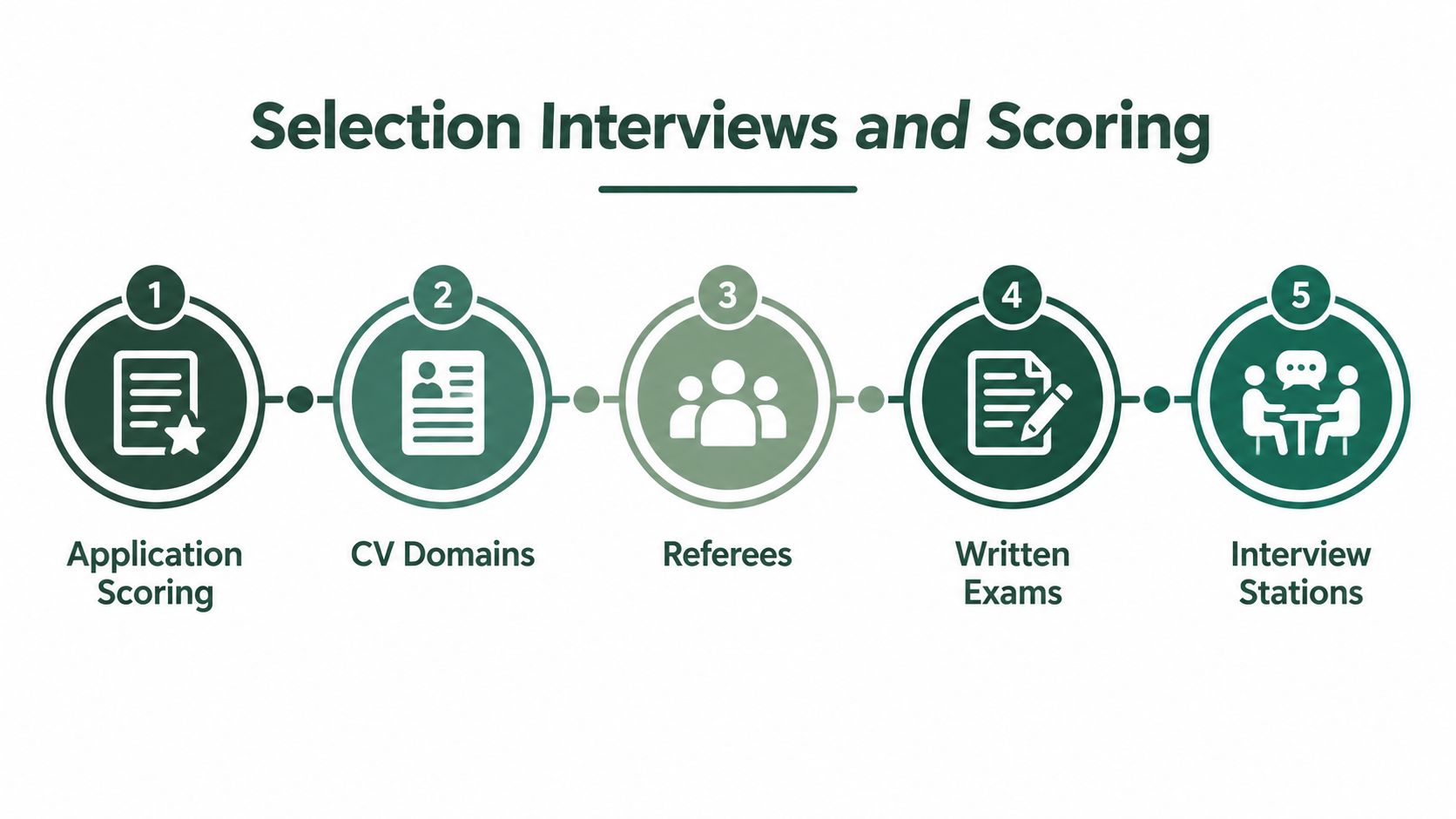
Selection is easier to prepare for when you treat it as an assessment system rather than a personality test. Each component asks a different question. The application asks whether your documented experience matches the criteria. Referees test how you function in a clinical team. Examinations assess knowledge or readiness. Interview stations reveal how you reason, communicate and respond to difficult situations.
Start with the scoring document
Read the current selection guidelines before you decide which activities to pursue. Make a working spreadsheet with the published domains in separate columns, then place your evidence beside each one. This prevents a common mistake, collecting impressive-sounding activities that don’t address the criteria used by your target specialty.
Your CV should make verification easy. For each item, record the date, your role, the output and the supporting evidence. A presentation, audit, teaching activity or research project is more useful in an application when you can describe exactly what you did, what you learned and how it relates to surgical practice.
Referees should be chosen for the quality and relevance of their observations, not only for seniority. A referee who has watched you manage a deteriorating patient, communicate with a team and follow through on a task can provide a more useful report than someone who knows your name but not your work.
Prepare for the station, not the topic
Interview questions often appear broad, but the panel is listening for a structure. For a clinical scenario, begin with immediate safety, assess the patient systematically, seek help early and communicate a clear escalation plan. For a teamwork or conflict scenario, explain the facts, acknowledge the other person’s perspective, protect patient care and follow the appropriate escalation pathway.
You can use a simple rehearsal grid:
- Clinical management: Stabilise, assess, prioritise, escalate and reassess.
- Behavioural examples: Explain the context, your action, the result and what changed in your practice.
- Ethical questions: Identify the competing duties, protect the patient, communicate openly and seek senior guidance.
- Motivation questions: Connect your experience with the specialty’s work, without presenting an idealised version of surgery.
- Reflection: Name what you learned and how you would behave differently next time.
Australian medical exam preparation can help you develop a format-first habit. The same principle applies to SET interviews. Don’t memorise polished speeches that collapse when the question changes. Build flexible answer structures, then practise saying them clearly under time pressure.
Make your reasoning audible
A panel can’t award credit for reasoning that stays in your head. Say what you’re concerned about, what you’ll do first, when you’ll call for help and how you’ll know whether the patient is improving. Strong answers sound calm because they follow a safe sequence, not because the candidate knows every rare diagnosis.
Practise with supervisors, peers and people who will interrupt your assumptions. Record selected answers and listen for missing priorities, vague escalation language and long introductions. Your aim is not theatrical confidence. It’s dependable communication that sounds like the registrar a team can trust during a difficult shift.
State and Network Variations That Change Your Chances
You may prepare for the national SET framework, then discover that the application deadline in your preferred network has already passed. The framework sets the broad structure, while specialty committees and local networks often determine the dates, interview format and scoring details that shape your application. The 2025 to 2026 vascular surgery selection regulations show why you should read the regulations for your intended pathway rather than rely on a national summary.
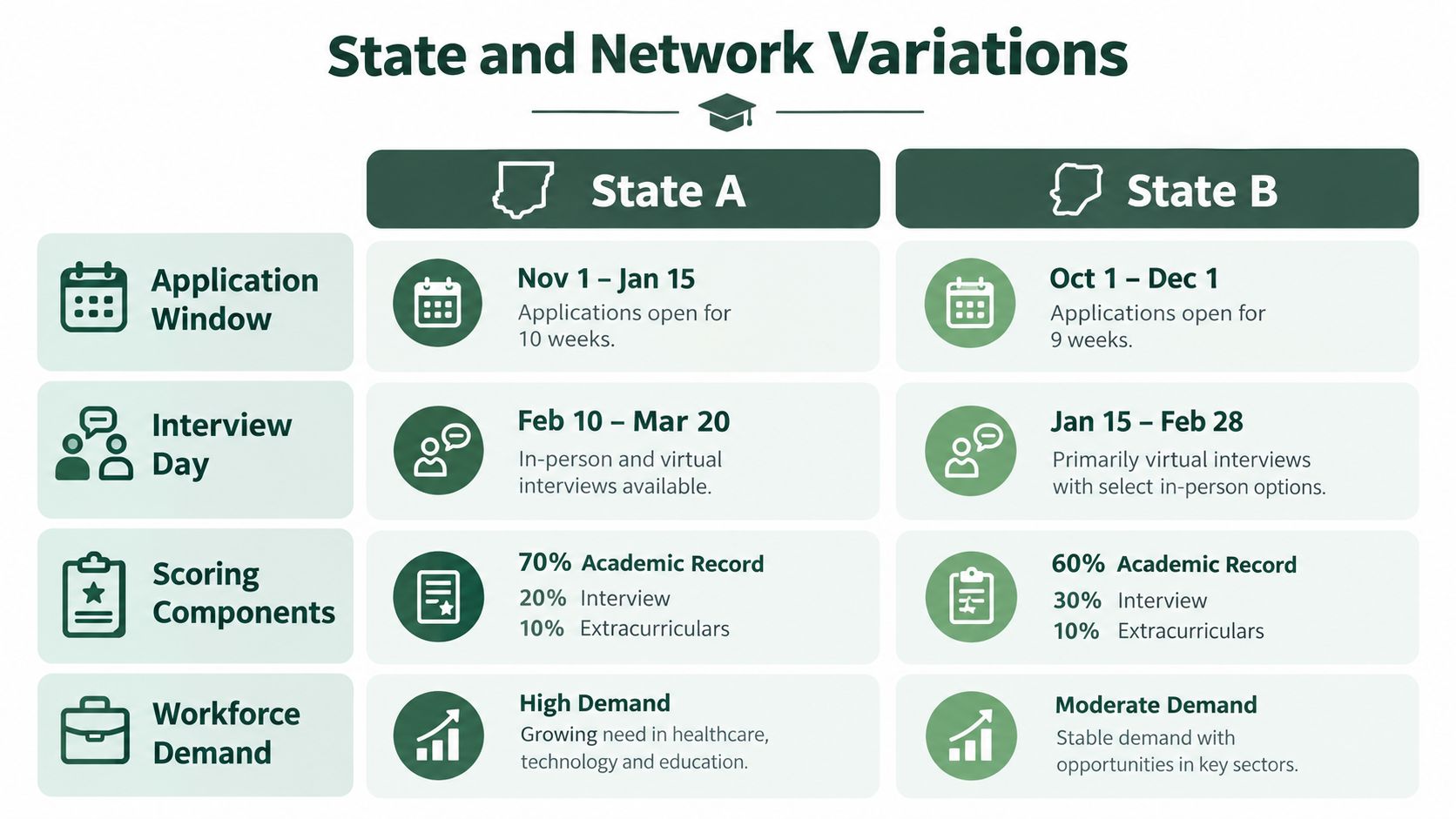
A different closing date changes your preparation calendar. If one pathway closes before another opens, referee requests and documents may need to be ready earlier than expected. Different interview stations or scoring components create a similar problem. Generic practice may leave you rehearsing answers that do not match the process you will face.
Surgery is not unusual in this respect, but it is unusual in how visible the split is. Our guide to specialty selection interviews in Australia sets out which colleges select nationally, which hand selection to a state network, and which do not interview at all — worth establishing before you decide which document you are actually preparing against.
Build a local opportunity map
For every state or network you are considering, record four details:
| Local question | Why it matters |
|---|---|
| When does the application window open and close? | It determines when documents and referee requests must be ready. |
| When are interviews held? | It affects leave, travel, preparation and other applications. |
| What contributes to the score? | It shows which evidence deserves attention. |
| Where is workforce demand strongest? | It helps you understand regional opportunity and service pressure. |
Workforce demand is the hardest of the four to pin down, and it is where informal advice is least reliable. Treat any figure you are given for “surgeons needed” as an estimate tied to a particular jurisdiction and period, and check who published it before you plan around it. A shortage in a specialty does not create an accredited training post in it.
Speak with current trainees in each network you are considering. Ask which documents control selection, whether dates usually change, how local rotations affect access to supervisors and which evidence applicants often miss. Use these conversations as practical context, then verify every requirement against the current published regulations. The network’s rules, not informal advice, determine what you must submit and when.
Your Preparation Roadmap From Now to SET Entry
Start with a target specialty and two or three realistic jurisdictions. Download the current regulations for each, then build a single checklist containing eligibility, examinations, application documents, referee requirements, interview stages and dates. If the documents conflict with advice from a colleague, follow the current published requirement and contact the relevant selection office for clarification.
Your preparation should run on parallel tracks:
- Clinical readiness: Seek rotations that expose you to the specialty and practise safe assessment, prioritisation, escalation and handover.
- Portfolio evidence: Record projects as you complete them, including your contribution and the evidence that verifies it.
- Referee relationships: Ask supervisors early whether they can provide specific, informed feedback on your work.
- Exam planning: Check whether an examination is required, when results are valid and whether the rule differs by specialty.
- Interview rehearsal: Practise the actual station types, with timed answers and feedback from people who understand the pathway.
- Local verification: Recheck application windows, interview dates and scoring components before submission.
Avoid two common errors. Don’t collect activities without checking whether they contribute to the relevant criteria. Don’t prepare for a generic “surgical interview” when your specialty and network use a defined format. Your final review should answer one question for every application item: what requirement does this satisfy, and where is the evidence?
Over the next year, schedule a formal review with a mentor, compare your evidence with the current guidelines and run several practice interviews under realistic conditions. If you can explain your clinical decisions clearly, identify your gaps without defensiveness and submit a complete application on time, you’re controlling the parts of the process that can be controlled.
CliniRoo is building specialty selection preparation for the Australian pathway, including station-based question banks and specialty-specific scoring domains for pathways such as RACS SET. Nothing is on sale yet. If you want to be told when there is something to use, CliniRoo takes an email address and does nothing else with it.