RACP Advanced Training: Pathways, Assessments, and Tips
RACP Advanced Training in Australia: why entry is a hospital and state recruitment process rather than a college match, and what has to line up.
You’ve finished Basic Training, passed the examinations, and expected the next step to feel obvious. Instead, you’re comparing hospital advertisements, trying to work out whether a position counts, asking when applications open in your state, and wondering whether you can start a post before the College approves your plan. That uncertainty is common because Advanced Training with the RACP — the Royal Australasian College of Physicians, the body that trains and certifies physicians and paediatricians in Australia and Aotearoa New Zealand — isn’t the next set of exams. It’s a working appointment, a specialty decision, a recruitment process, and a sequence of College requirements that must line up.
The most useful mental shift is to treat the pathway as both professional training and a job-market process. Your exam results matter, but they don’t appoint you to an accredited position. State campaigns, hospital needs, supervisors, specialty rules, and timing can determine whether your training progresses smoothly or stalls between terms.
Table of Contents
- What RACP Advanced Training Actually Looks Like
- Eligibility and Entry Into an Advanced Training Post
- Structure, Duration and Training Milestones
- Major Specialty Streams and How They Differ
- Key Assessments Across the Advanced Training Pathway
- Why the Real Bottleneck Is Recruitment, Not Exams
- Preparing With Australia-Specific Resources
What RACP Advanced Training Actually Looks Like
Priya is a third-year basic physician trainee (BPT3) in a tertiary Melbourne hospital. She’s completed Basic Training and is deciding whether to apply for General and Acute Care Medicine, pursue a subspecialty, or spend another year strengthening her curriculum vitae. Her immediate questions are practical: which hospitals are recruiting, what rotations will count, who can supervise her, and whether the position will let her meet the relevant curriculum requirements.
That’s the point at which RACP advanced training becomes different from Basic Training. Basic Training gives you broad exposure across physician medicine and builds the general clinical foundation required for progression. Advanced Training asks you to commit to a specialty division, commonly within Adult Internal Medicine or Paediatrics & Child Health, then develop deeper expertise through accredited clinical work and specialty-specific assessments. The Australian physician training pathway is easier to understand when you separate these stages from the beginning.
A job with structured College oversight
Advanced Training isn’t a university course that you enrol in and attend separately from work. You’re employed in a clinical role, caring for patients, attending ward rounds and clinics, taking part in the roster, and meeting service responsibilities. At the same time, the College and your specialty committee expect evidence that your work is appropriate for training.
That evidence can include supervisor reports, learning plans, workplace assessments, procedure records, formal examinations, research or scholarly work, and annual progression decisions. The exact mix depends on the specialty. A registrar in General and Acute Care Medicine won’t have the same training map as someone entering Cardiology, Neurology, or a paediatric subspecialty.
The College’s scale reinforces that this is a major part of the medical workforce pipeline, not a niche option. At 30 December 2023 the RACP recorded 8,966 trainees, of whom 4,068 were advanced trainees — 45.4% of the trainee population (RACP Annual Report 2023). Five years earlier the College reported 8,265 trainees including 3,553 advanced trainees, and training across 38 specialties (RACP Annual Report 2018). Advanced Training sits inside a broad specialist ecosystem rather than one uniform program.
Practical rule: Don’t ask only, “Have I passed the exams?” Ask, “Do I have an accredited post, an approved plan, and a realistic route through the required rotations?”
The duration also varies. Some pathways can be completed in a shorter structured period, while others take substantially longer because of subspecialty requirements, research, examinations, and rotation availability. Training happens on the job, and the quality of your appointment can affect how efficiently you meet each milestone.
Eligibility and Entry Into an Advanced Training Post
Passing Basic Training examinations is essential, but it isn’t the same as holding an Advanced Training position. The College is explicit about the order: “Before applying, you’ll need to secure an Advanced Training position in an accredited training site”, and trainees “must prospectively apply for all periods of Advanced Training” — so this is an annual application, not a one-time enrolment (RACP: moving to Advanced Training, current for 2026 entry). That order explains why a candidate can be academically eligible yet still have no training year to register.
Start with the College gate. You’ll generally need successful completion of Basic Training, including the relevant written and clinical examinations, and confirmation that the College has marked you eligible for the next stage. If you’re still clarifying what those earlier requirements involved, the RACP Basic Training guide provides useful pathway context.
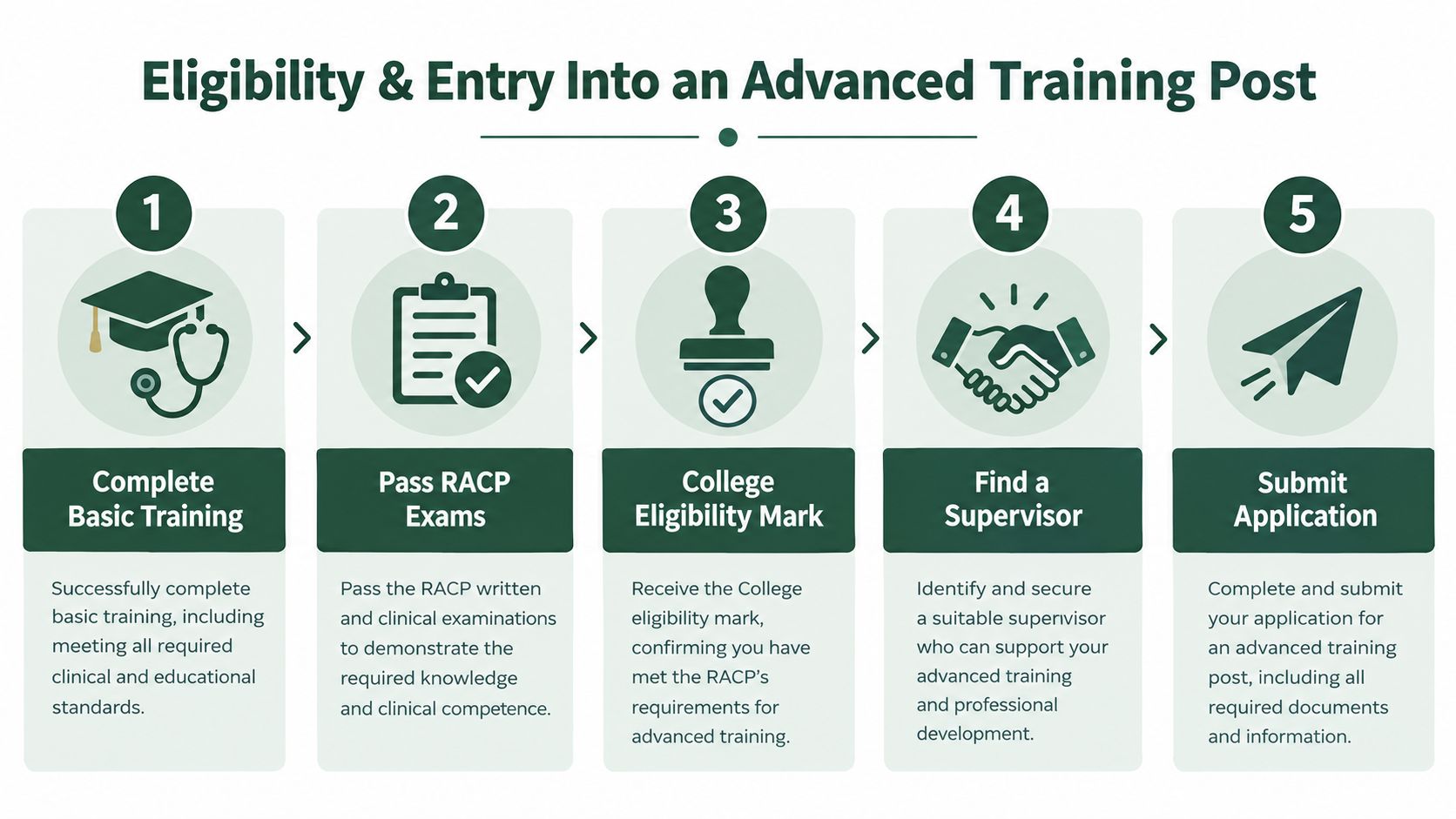
The two gates you must keep separate
College eligibility confirms that you can enter the advanced stage. Appointment to an accredited post gives you the actual clinical position in which training can occur. The second gate is where state and hospital processes become decisive.
Recruitment arrangements vary across Australia, and they vary by specialty at least as much as by state — which is why “how it works in my state” is usually the wrong question. The College’s own October 2025 review of entry into Advanced Training describes several coexisting models rather than one process (RACP Selection into Training Quality Assurance and Improvement Initiative — Discovery Phase Report, Advanced Training, October 2025):
- Queensland runs statewide Queensland Health selection for many specialties, including Cardiology, Gastroenterology, General Medicine, Nephrology and Infectious Diseases.
- New South Wales is mixed. A number of specialties sit inside the annual Junior Medical Officer recruitment campaign on a centralised application platform, but General Medicine and most subspecialties run through individual hospital or Local Health District processes. If General and Acute Care Medicine in NSW is your target, plan for hospital-level applications.
- Victoria uses the Postgraduate Medical Council of Victoria (PMCV — the body that coordinates Victorian medical training placements) Advanced Training Selection and Matching Service for a defined list of specialties, which for the 2025 match included Cardiology, Endocrinology, Gastroenterology, Geriatric Medicine, Infectious Diseases, Medical Oncology, Nephrology, Respiratory and Sleep Medicine, Rheumatology and Clinical Genetics. Read carefully what that service does: the match does not select you. It aligns key dates, standardises the CV format, and allocates applicants to health services on mutual preference after interviews are complete. General Medicine in Victoria sits outside it, and is health-service-led.
- South Australia and Western Australia coordinate a number of specialties through state-based specialty networks and panels rather than hospital by hospital — in SA, General Medicine, Cardiology, Neonatal–Perinatal Medicine and Rehabilitation Medicine; in WA, Nephrology, Gastroenterology and Cardiology.
- Tasmania, the Northern Territory and the ACT recruit directly through individual hospitals or small regional networks.
- A few specialties are coordinated binationally. Neurology selection, for example, runs on national criteria through the Australian and New Zealand Association of Neurologists (ANZAN), with state subpanels doing the interviewing.
Note what is not in that list: there is no single national RACP application portal, and the College does not run a centralised match that appoints you to a job. Selection sits with employers, state health services and specialty networks. Campaigns and arrangements also change year to year, so verify the current process for your specialty and your intended employer before you plan a year around it.
Once you identify a suitable post, the proposed training plan needs prospective approval before the position starts — the relevant Training Program Committee assesses your application and confirms your Advanced Training status. The College’s application deadlines are 28 February for training commencing in the first half of the year and 31 August for the second half (RACP: moving to Advanced Training, current for 2026 entry). Those are College deadlines, and they are a separate calendar from the employer campaign that got you the job — you have to satisfy both. Don’t assume an attractive job advertisement automatically means every month will count towards your program.
A safer sequence
- Confirm your College status. Check that Basic Training requirements are complete and that you’re eligible for the relevant advanced program.
- Map recruitment channels for your specialty, not just your state. Identify whether your specialty runs through a statewide process, a health service, a specialty network or a match, then find that process’s own application window.
- Check accreditation. Ask whether the position is accredited for your intended specialty and whether the proposed rotations meet its requirements.
- Submit the training plan early. Obtain prospective approval before commencing, rather than trying to repair the paperwork after the term begins.
- Diarise it again for next year. Advanced Training is applied for prospectively for every period, so this is an annual task rather than an automatic consequence of passing exams (RACP: moving to Advanced Training).
The common errors are predictable: lodging plans late, starting a post without prospective approval, and assuming exam completion leads to a position. It doesn’t. In practice, your first advanced-training task may be less about revising another topic and more about building a calendar that connects eligibility, applications, appointment, approval and registration.
Structure, Duration and Training Milestones
You can complete a demanding medical term and still lose training time if the post does not match your program. Advanced Training has a formal structure, but the rules differ between specialties. For General and Acute Care Medicine, the College requires three years, or 36 months, of full-time equivalent training — of which a minimum of 24 months is core training and a maximum of 12 months is non-core, with at least 24 months undertaken in Australia and/or Aotearoa New Zealand, all in accredited clinical training positions (RACP: Advanced Training in General and Acute Care Medicine, accessed September 2026). Note also that trainees commencing from 2026 follow a new curriculum rather than the PREP — Physician Readiness for Expert Practice — curriculum that applied before it, so a colleague two years ahead of you may be describing different requirements. A medical job title alone does not make every month count.
For a registrar considering General and Acute Care Medicine, a tertiary placement may form part of the required experience. A term can be clinically useful yet fail to satisfy accreditation or rotation rules. Check the proposed training plan before accepting the job. In practice, the appointment and the curriculum must line up like two timetables. If they do not, the gap may appear only during annual review, when changing posts is harder.
The milestones that keep a year on track
Annual progression depends on several records and assessments arriving together:
- Learning needs analysis: Identify gaps early and use them to set rotation, supervision and workplace goals.
- Supervisor reports: Supervisors document performance, development and readiness to progress.
- Workplace assessments: These assess observed clinical work, rather than relying only on examination results.
- Logbooks and procedure records: Required experience must be recorded accurately, or an administrative issue can surface late.
- Summative assessments: Major assessments are scheduled across the program and must fit with the roster.
- Annual review: The relevant training committee or equivalent decides whether the year meets program expectations.
A missing rotation can disrupt the pathway more than a difficult term. You may need to rearrange later work, apply to another hospital or extend training. That is a workforce-planning problem as much as an academic one. State recruitment campaigns and hospital appointment cycles can determine whether a suitable replacement is available when you need it.
| Specialty | Core months, minimum | Key setting requirement |
|---|---|---|
| General and Acute Care Medicine | 36 months, full-time equivalent (min. 24 core, max. 12 non-core) | Accredited training positions; at least 24 months in Australia and/or Aotearoa New Zealand |
| Other RACP advanced programs | Varies by program | Confirm specialty-specific accreditation and rotation rules before starting |
At 30 December 2023, basic trainees outnumbered advanced trainees — 4,898 to 4,068 (RACP Annual Report 2023). Read that as a headcount at a point in time, not as your odds: the College does not publish applicants-per-accredited-post, so the ratio is context rather than a competition ratio. Duration rules then determine whether the appointment you do get moves you toward completion.
Major Specialty Streams and How They Differ
There isn’t one universal advanced-training experience. A registrar entering General and Acute Care Medicine is following a different curriculum from someone entering Cardiology, Gastroenterology, Neurology or Neonatal and Perinatal Medicine. The specialty determines the clinical depth required, the rotations that count, the assessments you’ll face and the supervisors who can certify your work.
Adult medicine pathways
Adult Internal Medicine programs often combine core physician experience with additional specialty or non-core work. Some advanced specialties demand extended exposure in tertiary centres, procedural services or subspecialty clinics. Cardiology, Gastroenterology, Renal, Respiratory Medicine, Neurology and Endocrinology can each have their own expectations for clinical breadth, procedural competence and formal assessment.
That creates an important application question: what does this particular post allow me to complete? A hospital may offer an excellent service but limited access to a required rotation. Another post may provide the right clinical mix but require a cross-jurisdiction move or a rural term. The position’s training value depends on how it fits the curriculum, not just on the reputation of the department.
Paediatrics and smaller programs
Paediatrics follows separate curricula and assessment structures. General Paediatrics, Paediatric Cardiology and Neonatal and Perinatal Medicine may differ in their logbooks, supervised activities, clinical settings and summative requirements. A junior doctor moving from an adult-focused role should avoid assuming that familiar physician-training assumptions transfer directly.
Smaller streams, including Occupational and Environmental Medicine, Rehabilitation Medicine and Palliative Medicine, may have distinct networks and fewer local posts. That can make supervisor access, geographic flexibility and early contact with the training committee particularly important.
| Specialty stream | Division | Typical duration | Key rotations | Exit assessment |
|---|---|---|---|---|
| General and Acute Care Medicine | Adult Internal Medicine | Program-specific | Acute, general and approved tertiary experience | Specialty program assessments |
| Cardiology | Adult Internal Medicine | Program-specific | Cardiac inpatient, outpatient and procedural services | Specialty examinations and workplace requirements |
| Gastroenterology | Adult Internal Medicine | Program-specific | Gastrointestinal medicine and relevant procedural exposure | Specialty assessments and portfolio evidence |
| Neurology | Adult Internal Medicine | Program-specific | Inpatient, outpatient and neurological subspecialty services | Program-specific clinical and written assessments |
| Paediatric streams | Paediatrics & Child Health | Program-specific | Child health, community or subspecialty settings | Paediatric curriculum assessments |
| Rehabilitation or Palliative Medicine | Distinct specialty pathway | Program-specific | Specialty network and supervised clinical services | Specialty committee requirements |
Dual-training credit also varies. Some programs may recognise overlapping experience, while others require clearly separated requirements. Cross-jurisdiction placements can add complexity if the timing of the move disrupts rotations, supervision or local recruitment. Before applying, compare the curriculum with the actual job plan and ask the department which requirements previous trainees completed in that role.
Key Assessments Across the Advanced Training Pathway
Basic Training examinations test broad physician knowledge and clinical reasoning. Advanced Training assessments narrow the focus and ask whether you can perform safely and consistently within a specialty. The process usually combines formal examinations with evidence collected during everyday clinical work.
A specialty may use examinations run by the College, a specialty society, or both. The exact arrangement differs across programs, so don’t build a study plan from another specialty’s timetable. Your curriculum, assessment handbook and training committee communications should determine which written, clinical, oral or practical assessments apply.
What the assessment mix is trying to measure
Workplace-based tools assess performance that a single examination can’t fully capture. Depending on the program, you may encounter:
- Supervisor reports: These provide longitudinal feedback on clinical performance, professionalism, communication and reliability.
- Observed encounters: Mini-Clinical Evaluation Exercise (mini-CEX) assessments — a supervisor watching you handle a real patient encounter and scoring it — focus on actual consultations, examinations or clinical decisions.
- Case-based discussions: These test how you reason through diagnosis, management, risk and follow-up.
- Procedure logbooks: These document exposure and competence where procedural work forms part of the curriculum.
- Entrustable Professional Activities (EPAs): the College defines these as essential work tasks that can be delegated to a trainee, observed and assessed (RACP: Advanced Training curricula renewal). They frame progression around whether you can perform defined activities with an appropriate level of supervision, and they are a feature of the renewed curricula rather than of every legacy program.
Summative requirements can include mid-cycle reviews, end-of-term decisions, scholarly work and an Advanced Training Research Project — a required scholarly project, broadly relevant to your specialty rather than necessarily specialty-specific, in the programs where that requirement applies (RACP: Advanced Training Research Project guidelines). Paediatric subspecialties may also use structured clinical stations or formats equivalent to an objective structured clinical examination (OSCE — a circuit of short timed stations, each scored against its own checklist). The task isn’t to memorise facts. You need to demonstrate that you can apply them during a consultation, explain a plan to a patient, manage uncertainty and recognise when to escalate.
The RACP clinical examination preparation guide can help clarify how clinical assessment differs from written revision, but advanced candidates still need to check their own specialty’s current requirements.
Assessment advice: Keep a live evidence folder from the first term. Waiting until an annual review to reconstruct procedures, feedback and learning goals creates avoidable stress.
A strong approach links study to your clinical calendar. If your next rotation exposes you to a particular patient group or procedure, use that setting to identify supervised cases, request targeted feedback and record the evidence while it’s fresh. Formal examinations matter, but the portfolio surrounding them often determines whether the year is accepted as complete.
Why the Real Bottleneck Is Recruitment, Not Exams
The usual story is that advanced trainees are delayed because they fail an examination. That happens, but it isn’t the only, or always the main, constraint. A candidate can pass the required academic gateway and still spend time looking for an accredited post because appointment and College eligibility are separate processes.
Recruitment is shaped by local timing and by your specialty. As set out above, Queensland runs statewide processes for many specialties and South Australia and Western Australia coordinate several through state networks, while New South Wales General Medicine, Tasmania, the Northern Territory and the ACT are largely hospital- or district-led (RACP Discovery Phase Report, October 2025). Each arrangement has its own advertisements, documentation, referees, interview formats and decision dates. If you discover the campaign after applications close, exam preparation won’t solve the immediate problem.
Why departments choose some applicants
A department doesn’t recruit in a vacuum. It has a finite number of accredited training positions, service requirements, roster gaps, supervisor capacity and expectations about the experience a registrar can bring. Chief registrars and selection panels may also consider whether an applicant fits the rotations available that year.
That’s why a candidate with strong examination knowledge may not secure the post they want. The panel is assessing suitability for a specific job, not awarding a place in an abstract national queue. The narrow exception is the handful of binationally coordinated specialties, where the criteria and scoring are standardised nationally — but even there the interviews are run by state subpanels and the appointment is still to a job. Experience in a regional or rural service can become important for some specialties because the department needs registrars who can work safely with available support and contribute across a broader service.
The timing problem
The practical sequence often looks like this:
- You complete Basic Training and become academically eligible.
- A state or hospital campaign opens and closes before the training year begins.
- The department ranks candidates against its own position and service needs.
- You receive an appointment, or you continue searching for an appropriate post.
- The College reviews whether the position and plan meet specialty requirements.
A delay at step two or three can push every later milestone back. Repeated gaps may extend the overall pathway and encourage some doctors to reconsider their intended specialty, not because their academic interest changed, but because the available jobs didn’t align with their timing or location.
The better question: “What will make this panel appoint me to this post, and when must I demonstrate it?”
Prepare for recruitment as deliberately as you prepare for examinations. Track campaign dates, identify referees early, study the hospital’s service profile, practise concise answers about your specialty commitment, and ask current trainees which rotations are available. The job application is part of the training pathway, not an administrative task after the work is done.
Preparing With Australia-Specific Resources
A workable preparation plan starts with the roster rather than an idealised study day. You may be covering evenings, changing hospitals, or waiting for recruitment information while trying to maintain clinical performance. Build the year around three phases, then adjust the detail to your specialty and state.
Pre-application work
During the early part of the year, investigate the specialty requirements and the posts that could satisfy them. Read the current curriculum, list required rotations and assessments, speak with supervisors, and identify referees who can comment on your clinical work rather than only your exam results.
Create a campaign calendar for NSW, Victoria and Queensland, then separately monitor local health network advertisements in other states. Keep copies of position descriptions because they often reveal the department’s priorities, available rotations and expected interview themes.
Application and interview preparation
When applications open, your documents should show a coherent reason for choosing the specialty. A useful cover letter connects your clinical experience, future goals and understanding of the advertised role. Generic statements about enjoying medicine are weaker than a specific explanation of how the post supports the curriculum and what you can contribute to the service.
Practise answers in the format the panel uses. Selection interviews may test clinical judgement, teamwork, ethics, teaching, conflict management and commitment to the specialty. Australia-specific resources can help when they reflect local terminology, referral pathways, guidelines and jurisdictional differences rather than offering generic physician questions. If you are working out how your specialty’s selection compares with others, our guide to specialty selection interviews in Australia sets out which colleges select nationally and which hand selection to a state network.
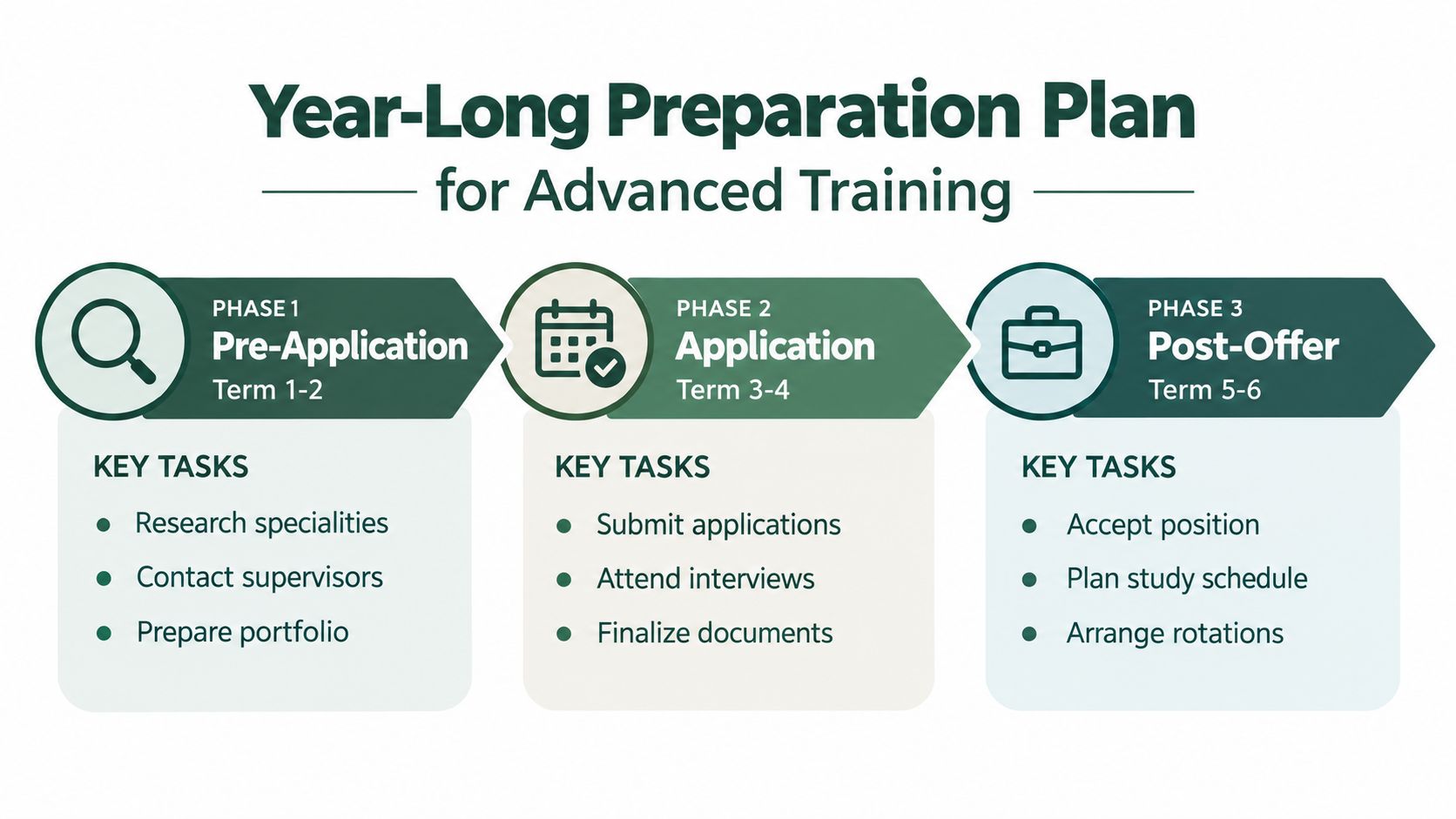
After an offer
Once appointed, shift your focus from obtaining the role to protecting your progression. Confirm the training plan, map assessment deadlines against the roster, arrange supervision, and identify opportunities for workplace-based evidence. Don’t leave the research or scholarly requirement until your clinical workload has already filled the year.
A realistic weekly schedule might look like this:
- Two weekday sessions: Focused question-bank or curriculum revision after work, with a defined topic rather than open-ended reading.
- One shorter session: Review errors, update an evidence folder and prepare questions for supervision.
- One weekend block: Practise clinical reasoning, an interview station or a structured case discussion.
- Clinical integration: Use current patients to rehearse consultation structure, documentation and escalation decisions, without compromising patient care.
The aim is consistency, not heroic study bursts. A question bank should match your specialty’s assessment style, while interview practice should reflect the state, hospital network and selection panel you’re applying to. Whatever material you use, check that it names its sources and states which intake year it describes — selection arrangements change annually, and a resource that cannot show where its process came from is a resource you cannot date.
Use the College requirements to decide what must be completed, your department to understand what the job offers, and your study resources to practise the formats you’ll face. That combination keeps preparation grounded in the pathway rather than reducing Advanced Training to another exam list.
CliniRoo is building preparation material for the Australian pathway, including specialty selection interviews and the college examinations. Nothing is on sale yet. If you want to be told when there is something to use, CliniRoo takes an email address and does nothing else with it.