Medical Interview Coaching: Ace Australian Interviews
Medical interview coaching in Australia: how MMI, hospital-network panel and college selection formats differ, and what to check before booking a coach.
You’ve received three interview invitations in the same fortnight. Your preferred medical school has an MMI (multiple mini interview — a timed circuit of short stations, each scored separately by its own assessor), a state hospital network has included a clinical scenario and behavioural panel, and a surgical college selection process expects concise answers against defined domains. You’ve performed well academically, but each invitation seems to demand a different version of you.
That situation is common in the Australian medical pathway. A response that works in an MMI may sound unfocused in a college panel, while a polished behavioural example won’t compensate for weak clinical prioritisation in a hospital-network station. Medical interview coaching helps you prepare for those differences deliberately, rather than relying on one reusable script.
Table of Contents
- Understanding Medical Interview Coaching
- Who Needs Medical Interview Coaching
- Formats and Key Aspects of Coaching
- Choosing the Right Coach for Your Pathway
- Typical Outcomes and Benefits of Coaching
- Conclusion and Next Steps
Understanding Medical Interview Coaching
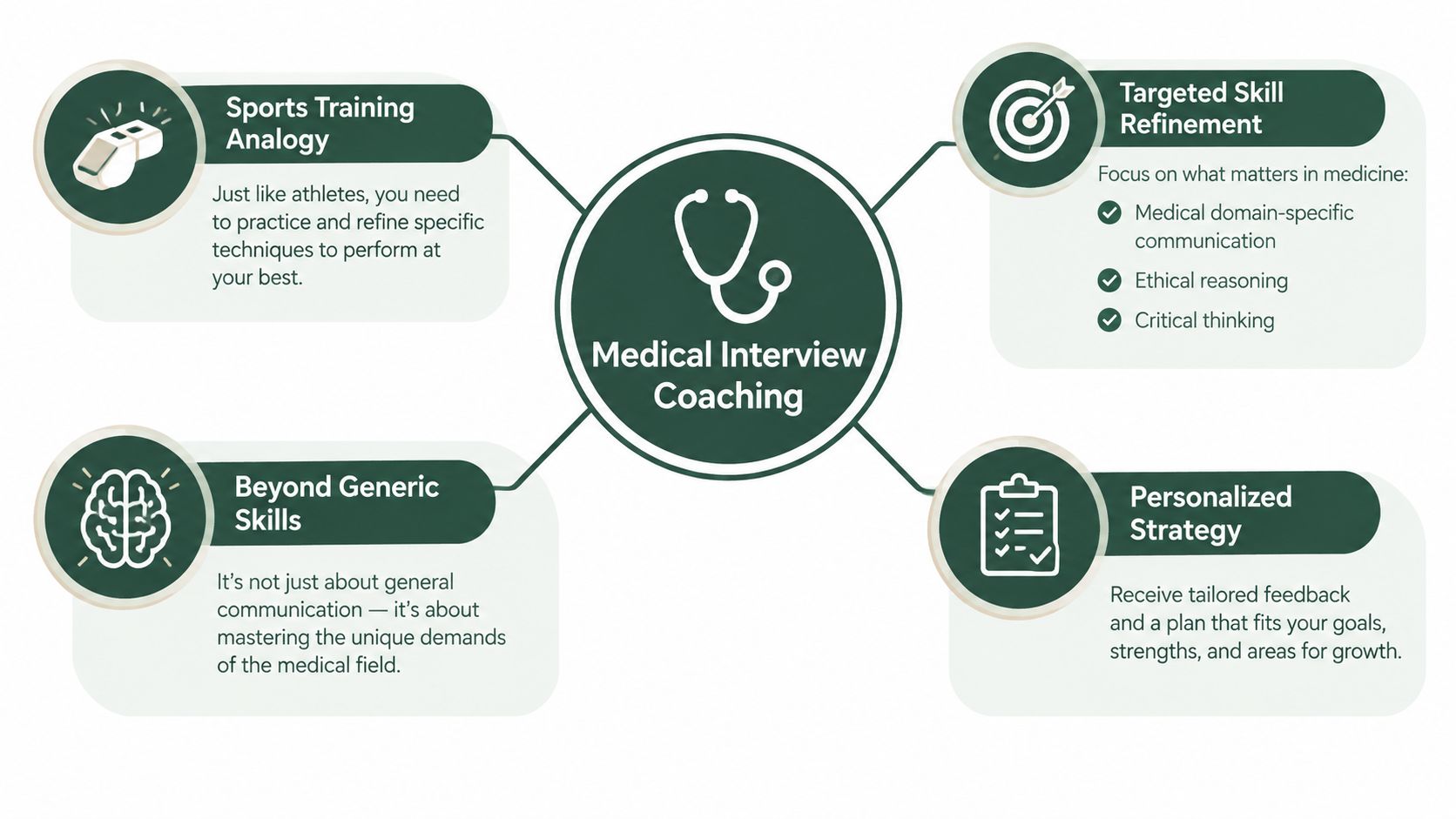
Medical interview coaching is structured performance training, not general encouragement before interview day. The sports analogy is useful: a tennis coach doesn’t only tell an athlete to “communicate better”. They watch footwork, identify a specific weakness, create drills, and measure whether the player can execute under pressure. Interview coaching follows the same logic through timed stations, targeted feedback, and criterion-based scoring.
A strong Australian preparation programme usually has four connected parts:
- Format matching: Practice reflects the interview you’re facing, whether that’s an MMI, a hospital panel, a specialty-selection interview, or a college-related process.
- Station design: Scenarios test communication, ethical reasoning, clinical judgement, teamwork, motivation, and self-awareness in different combinations.
- Rubric-based feedback: The coach identifies what earned or lost marks, rather than offering vague comments about confidence.
- Repetition under time limits: You practise making a safe, organised answer when the prompt is unfamiliar and the clock is running.
The written component matters too, and the weighting is pathway-specific rather than national. On the Australian National University (ANU) Bachelor of Health Science assured pathway into its Doctor of Medicine and Surgery (MChD — ANU’s primary medical degree), offers are based on a final weighted score of 40% weighted average mark, 40% interview score and 20% selection-criteria responses, and applicants submit maximum 200-word responses to five selection criteria questions (ANU: Doctor of Medicine and Surgery (BHLTH), accessed 10 September 2026).
Read that as one worked example, not a rule. It describes one ANU entry route — not ANU’s graduate-entry pathway, and not any other university. ANU does not stamp an intake year on that page, so treat it as current-as-published and re-check it against your own intake before you plan around it. Where a pathway does combine written criteria with an interview, though, the preparation problem is the same: concise written reasoning and oral performance have to be developed together.
Practical rule: Prepare the evidence once, then adapt how you express it for the written criterion, the MMI station, and the panel follow-up.
Coaching should also improve the questions you ask interviewers. A useful guide to good questions to ask in an interview can help you avoid questions that sound rehearsed or focus only on personal benefit.
The video below offers another way to think about interview preparation and performance practice.
Who Needs Medical Interview Coaching
Different candidates fail for different reasons. A medical student may understand an ethical issue but speak in generalities when an MMI assessor wants a clear, balanced response. A junior doctor may have strong clinical experience but struggle to explain leadership, escalation, or reflection in the language used by a specialty panel. Coaching becomes valuable when it translates experience into the scoring system attached to a particular pathway.
Medical students entering Australian programmes
Medical-school applicants often prepare for MMI stations, motivation questions, ethical scenarios, teamwork prompts, and written selection criteria. The challenge isn’t memorising an ideal answer. It’s learning to identify the capability being assessed, establish a safe position, acknowledge competing perspectives, and finish with a reasoned action.
The ANU pathway above is a useful example because it combines academic results, interview performance, and written criteria responses in one score. Where a pathway is built that way, a high academic result doesn’t remove the need to perform well orally or provide specific evidence in writing. Coaching can therefore focus on answer architecture, concise examples, active listening, and the ability to reset quickly between stations.
Junior doctors seeking specialty training
Specialty applicants face a more profession-specific problem. They’re expected to demonstrate insight into the specialty, readiness for training, patient-safety judgement, communication with colleagues, and meaningful reflection on their experience. A generic STAR answer — situation, task, action, result, the standard scaffold for behavioural questions — may provide structure, but it can sound shallow if it doesn’t reveal what the applicant learned or how they’d behave in a real clinical environment.
Preparation may need to reflect Surgical Education and Training (SET) selection run by the Royal Australasian College of Surgeons (RACS), Basic Training entry under the Royal Australasian College of Physicians (RACP), and other college or jurisdictional pathways, rather than treating every specialty interview as interchangeable. These are not variations on one process. Some colleges select nationally, some leave selection to the hospital or network that employs you, and the two produce different interviews.
Applicants for hospital and state-network positions
Hospital-network panels introduce local variation. The scenario may be clinical, but the expected answer can depend on local escalation pathways, service structures, or the panel’s scoring priorities. Candidates need to show safe practice without pretending they know details that haven’t been provided.
Whether your panel is run by a college nationally or by a state network locally changes what you are actually preparing for, and the invitation email rarely spells out which one you are facing. Our guide to specialty selection interviews in Australia sets out which colleges select nationally, which hand selection to a state network, and which do not interview at all. Establish that first — practising the wrong format well is still practising the wrong format.
Formats and Key Aspects of Coaching
The best practice format depends on what the interview demands. A one-to-one session is useful for diagnosing an individual weakness, while a panel simulation tests whether you can stay composed when several assessors are watching. Timed stations build pace, but untimed review is often needed afterwards to understand why a response worked or failed.
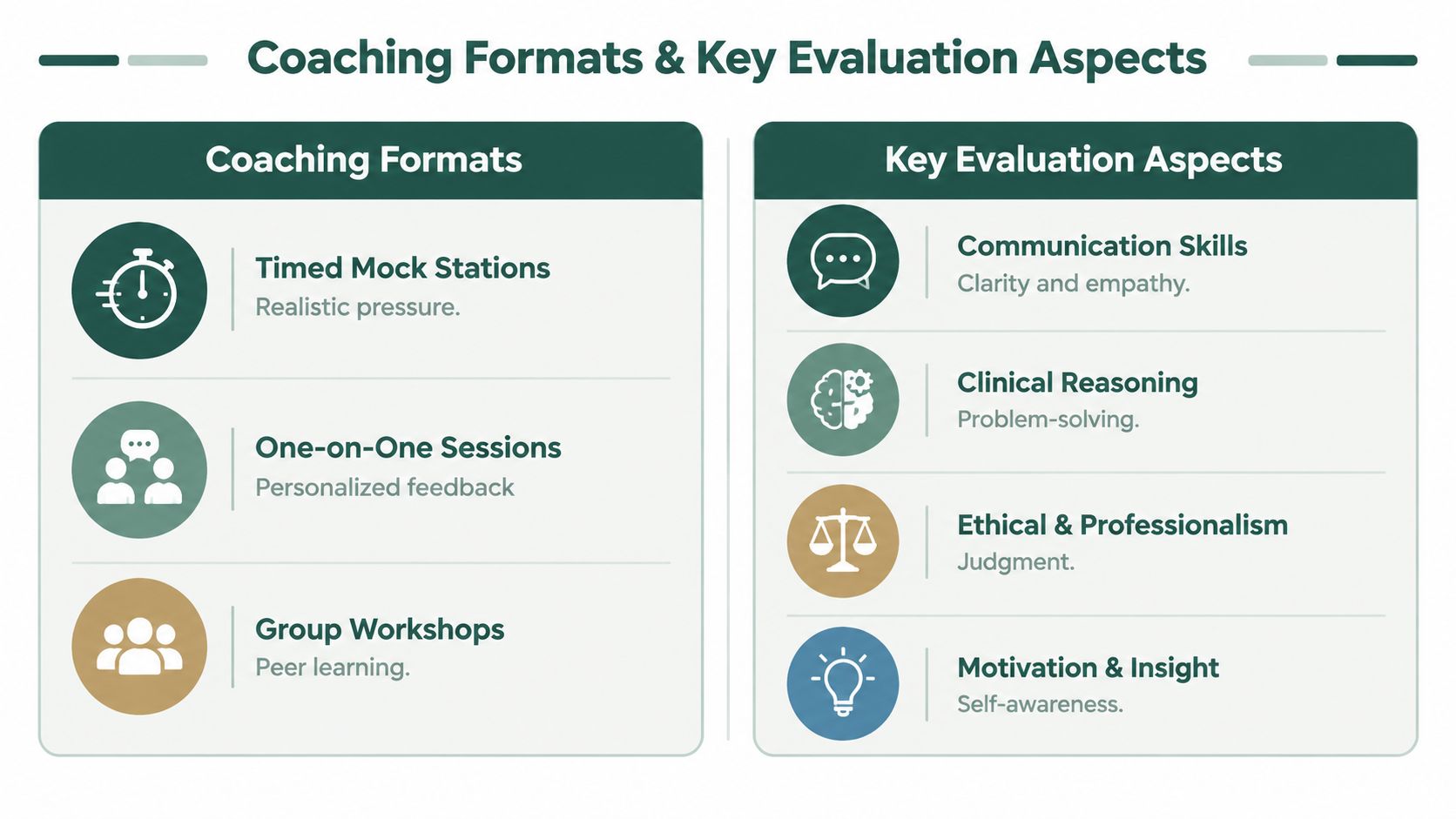
| Coaching format | What it develops | What to look for |
|---|---|---|
| Timed mock stations | Structure, prioritisation, and time control | A clear start, safe reasoning, and a concise close |
| One-to-one coaching | Personalised diagnosis and feedback | Specific comments linked to assessment domains |
| Panel-style practice | Composure and consistency across assessors | Consistent scoring and realistic follow-up questions |
| Group workshops | Peer observation and comparison | Facilitated discussion rather than unstructured opinions |
Behavioural stations
Behavioural questions ask for evidence from your past. “Tell us about a time you managed disagreement” is not an invitation to deliver a polished theory of teamwork. It requires a specific situation, your actions, the result, and your reflection. The assessor may be listening for accountability, communication, respect, and insight.
A coach should also test whether your example answers the actual question. An impressive research project won’t automatically demonstrate collaboration, just as a senior role won’t prove that you can accept feedback.
Clinical and ethical stations
Clinical scenarios test more than recall. They may examine how you gather information, identify immediate risk, communicate uncertainty, involve senior staff, and protect the patient. Ethical prompts often require you to recognise competing duties rather than choose a simplistic “right” answer.
For these stations, feedback should separate clinical content, reasoning, communication, and professional judgement. That makes the next practice attempt targeted. You might need to improve your opening safety statement, ask broader questions, or explain escalation more clearly.
College guidance supports this structured approach. RACP publishes guidance on local selection interviews that names questions developed from the selection criteria, the same questions asked of every candidate, anchored rating scales, and a panel format as core design requirements, with responses evaluated in a structured way and linked back to those criteria (accessed 10 September 2026). Rubric-driven practice is therefore a closer match to what happens in the room than open-ended conversation practice.
Two things about that document are worth knowing. It is written for the selection panels, not for candidates — which is precisely why it repays reading, because it tells you what the people scoring you were instructed to do. And it covers local selection, meaning entry into Basic Training posts filled by the employing hospital or network rather than by the College centrally. It is not a national rule for every specialty, and the page carries no version date, so treat it as guidance rather than as the regulations for your intake.
For additional station practice, use a resource such as MMI practice questions and record not only what you said, but what the station was designed to measure.
Choosing the Right Coach for Your Pathway
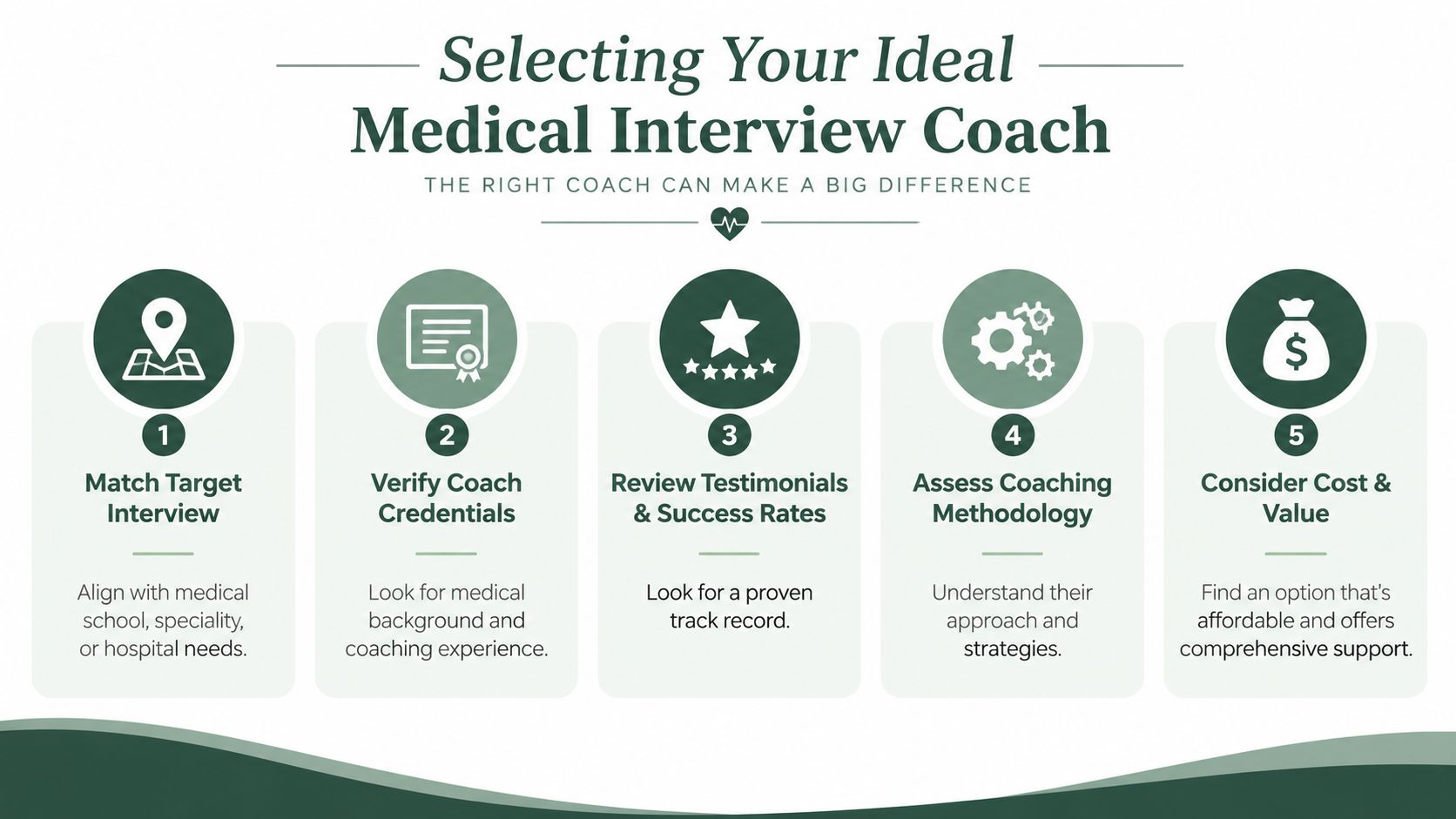
Start with the interview, not the coach. A provider experienced in graduate-entry MMI preparation may not understand the expectations of a RACS SET panel, an RACP training interview, or a state hospital-network process. Ask whether the practice material names the target pathway and explains the relevant scoring domains.
Check the format match
Request a sample station or outline before booking. It should show whether the service distinguishes between:
- Medical-school interviews: MMI timing, personal qualities, ethics, motivation, and selection criteria.
- Specialty interviews: College-specific capabilities, specialty insight, clinical judgement, leadership, and reflection.
- Hospital panels: Local context, patient safety, teamwork, escalation, and service expectations.
A coach doesn’t need to promise the exact questions. In fact, promises of prediction should make you cautious. The useful question is whether the practice reflects the type of reasoning and evidence the panel evaluates.
Inspect the feedback method
Ask how a session is scored. Strong feedback should identify the criterion, quote or summarise the relevant part of your answer, explain its effect, and give you a practical adjustment. “Be more confident” isn’t enough. “State your immediate safety concern before discussing the competing priorities” is actionable.
Thresholds matter as well, and they are worth hunting down for your own process. On the ANU Bachelor of Health Science pathway described earlier, “a passed interview is defined as a minimum raw interview score of 60%” (ANU, accessed 10 September 2026). That is one university’s threshold on one of its routes, not an Australian standard — but knowing whether your process has a pass bar or simply ranks a field changes how you should prepare. Clearing a bar rewards consistency and the avoidance of a single bad station; out-ranking a field rewards distinctiveness. A session built around the first looks different from one built around the second, which is why time control and station-level scoring beat polished delivery as things to buy.
Ask about local variation
Australian pathways aren’t always nationally uniform. State, hospital-network, specialty, and intake differences can affect terminology, station design, and the emphasis placed on particular competencies. A coach should tell you where the material is general and where it reflects a named local process.
Judge any service on three things: whether it names your pathway, whether it states the scoring domains it is practising you against, and whether it can tell you which published document those domains came from. The third is the one that separates mapped material from invented material. A provider that cannot name its source is guessing, and you would be paying to rehearse the guess. For written and clinical examination practice, our guide to the Australian Medical Council (AMC) question bank applies the same test to a different format.
Typical Outcomes and Benefits of Coaching
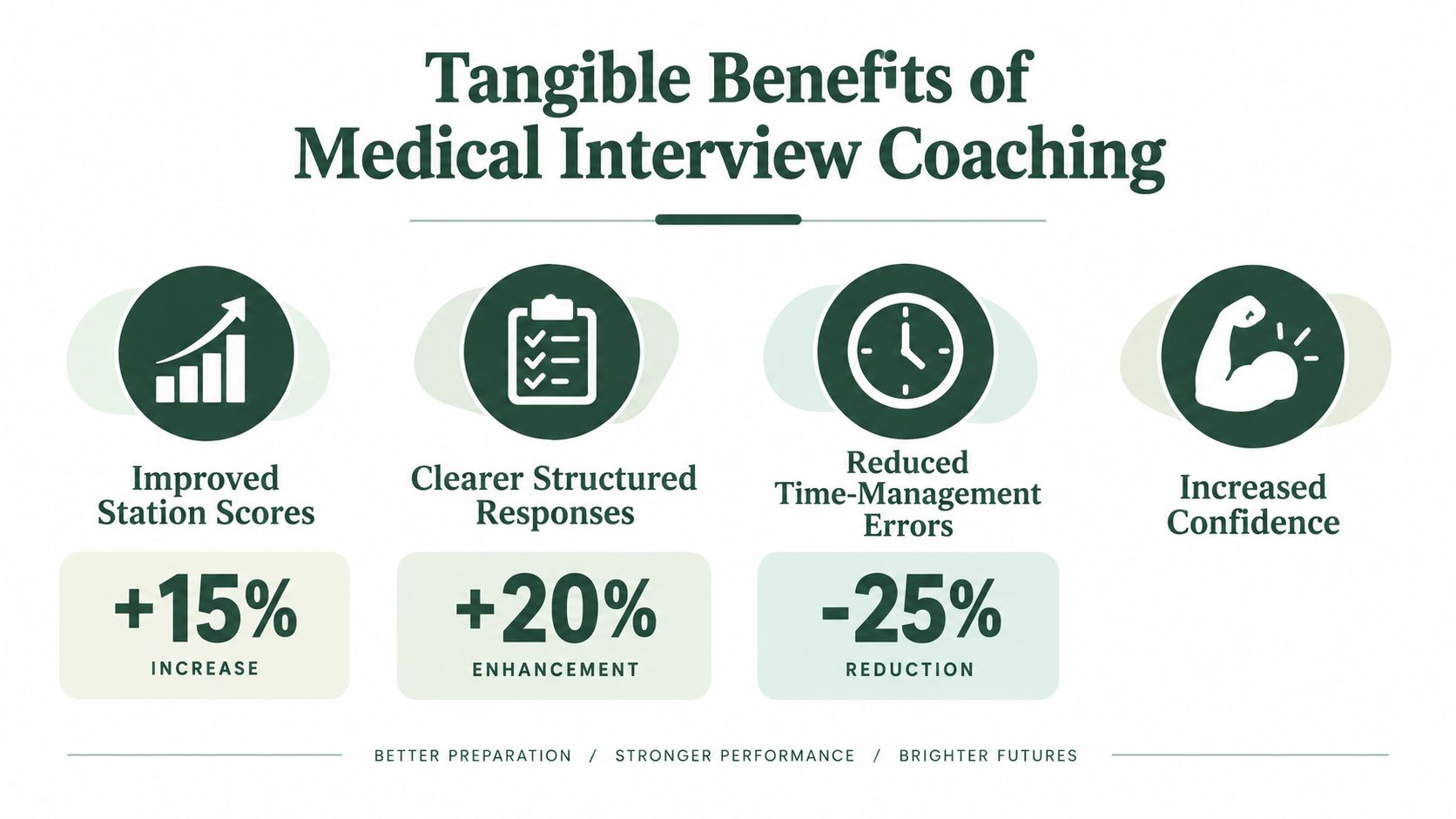
The strongest benefit of coaching is not a memorised answer. It’s the ability to produce a safe, relevant, well-organised response when the prompt changes. Repeated practice helps candidates notice whether they’re answering the question, volunteering the evidence the rubric requires, and leaving enough time to conclude.
Confidence usually follows competence. A candidate who has practised difficult follow-ups is less likely to panic when an assessor challenges an assumption. A candidate who has reviewed station timing can spend less mental energy wondering whether they’re speaking too slowly and more energy listening carefully.
What improvement looks like in practice
Look for changes you can observe between attempts:
- You identify the assessed domain more quickly.
- You open clinical answers with safety and priorities.
- You use specific examples instead of broad claims.
- You acknowledge uncertainty without becoming vague.
- You reflect on your role, not only the outcome.
- You finish within the available time.
These are meaningful outcomes because they can be linked to an assessment rubric. They’re also more reliable preparation targets than promises of a particular interview result.
One revised Australian medical-school interview process offers some evidence that structured assessment can be both reliable and relevant. At the University of New South Wales (UNSW), 512 applicants were interviewed under a redesigned process in which two interviewers assessed each applicant, and agreement between them reached kappa = 0.639 — kappa being a measure of how far two assessors agree beyond what chance alone would produce. Across five cohorts (N = 905), the redesigned process explained 9.4% to 17.8% of the variation in later academic and clinical outcomes, against 1.5% to 8.4% for the process it replaced (Shulruf et al., Journal of Educational Evaluation for Health Professions, 2022 — full text, accessed 10 September 2026).
Carry three limitations with that number. Only one of the five cohorts had been selected under the new process at the time of analysis. The authors name their own main limitation plainly: the outcomes measured run only two years into the medicine programme, because pandemic changes to assessment made the later comparison impossible. And this is one university’s medical-school entry, not college selection into specialty training — it is a reason to expect structured stations to behave better than unstructured conversation, not a measurement of anything a RACS or RACP panel does.
None of that means coaching guarantees selection, and nobody can honestly promise you a result. It does show why structured stations, consistent scoring, and criterion-focused feedback deserve a central place in preparation. Treat each mock as a feedback loop: attempt the station, record the score, identify one priority change, and repeat the same skill in a new scenario.
Conclusion and Next Steps
Australian medical interviews reward pathway-specific preparation. You need to understand the format, practise the relevant station types, and receive feedback against the scoring domains that panels use. That applies whether you’re preparing for medical-school entry, a specialty-selection interview, or a hospital-network panel.
Choose a coach or question bank that names your pathway, reflects local variation, and shows how answers are assessed. Then schedule timed practice, review your written criteria responses, and turn every feedback point into a repeatable skill.
CliniRoo is building preparation material for the Australian pathway: specialty selection interviews, medical school assessments, and college examinations, mapped to the format each one actually uses. Nothing is on sale yet. If you want to be told when there is something to use, CliniRoo takes an email address and does nothing else with it.