GP Training Australia: Pathways, Colleges and Timelines
GP training in Australia compared: AGPT pathways, RACGP vs ACRRM, rural generalist time and fees, intake numbers, and a planning timeline.
You’re looking at general practice (GP) training options between hospital shifts, and every page seems to use a different name: AGPT, Fellowship, rural pathway, rural generalist, FSP (all decoded below). You want to know which application to submit, whether you’ll need to move, and how long it will take before you can practise as a specialist GP.
Those names decode as follows. The Australian General Practice Training (AGPT) program is the Commonwealth-funded training program that the two GP colleges deliver. The Royal Australian College of General Practitioners (RACGP) and the Australian College of Rural and Remote Medicine (ACRRM) are those colleges, and each awards its own Fellowship, the specialist qualification. The Fellowship Support Program (FSP) is an RACGP program for doctors already working in general practice outside AGPT.
The first mistake is treating GP training in Australia as one program. Your funding program, college, training stream and eventual qualification are separate decisions. Getting those distinctions clear makes the timelines, placement rules and costs much easier to compare.
Table of Contents
- GP Training Routes in Australia at a Glance
- How the AGPT Program Is Structured
- Choosing Between RACGP and ACRRM
- Entry Routes and What the Intake Numbers Mean
- Rural Training Time, Fees and Location Rules
- Year-by-Year Plan and Pre-Application Checklist
GP Training Routes in Australia at a Glance
GP training routes in Australia at a glance
| Route | Who it suits | College | Typical length | Key difference |
|---|---|---|---|---|
| AGPT general pathway | Graduates aiming for general practice in urban or regional settings | RACGP | Standard general-practice training sequence; confirm credited hospital experience | General-practice route without the rural generalist qualification |
| AGPT rural pathway | Applicants who accept rural placement terms | RACGP | General-practice sequence with rural placement obligations | Rural location rules apply |
| RACGP rural generalist pathway | Doctors wanting broader rural and emergency skills | RACGP | Longer sequence incorporating additional rural skills and emergency training | Adds requirements for a broader rural credential |
| ACRRM rural generalist Fellowship | Doctors committed to rural or remote practice | ACRRM | Current ACRRM handbook sets the duration and credit rules | Rural and remote generalism is central to the qualification |
| Fellowship Support Program | Non-vocationally registered doctors already working in Australian general practice | RACGP | Individual completion requirements; confirm against the current RACGP handbook | Replaced the Practice Experience Program Standard Stream, which no longer takes applications |
| Practice Experience Program–Specialist (PEP–Specialist) | Overseas-trained GP specialists | RACGP | Comparability assessment and individual requirements determine completion time | Recognition-based route for specialists trained abroad |
Full-time equivalent (FTE) describes training workload rather than elapsed calendar time. Part-time work, leave, outstanding requirements and recognised prior experience can change when you finish. Don’t turn a headline duration into a promised completion date.
AGPT is a training program delivered through the colleges, not a separate college or qualification. “Non-vocationally registered” (non-VR) means a doctor working in general practice without recognition as a specialist GP.
Match your stage before choosing a stream
Read the table in this order:
- Identify your current stage. A medical student is planning towards eligibility; a practising doctor or overseas GP specialist may need an experience-based or recognition route rather than graduate entry.
- Set your location boundaries. Decide whether regional or rural work is realistically workable, not merely acceptable on an application form.
- Choose the college and credential. Compare the work you want to do with the capabilities each Fellowship expects.
For example, an overseas specialist shouldn’t assume they must restart through AGPT. Equally, a hospital doctor with substantial experience shouldn’t assume that experience automatically removes required training terms.
If you’re still sorting out internship, registration and specialty entry, the Australian medical training pathway guide provides the broader context.
First action: Write down the row that matches your current stage. Then record the eligibility question you still need answered.
How the AGPT Program Is Structured
AGPT works more like an apprenticeship than an exam course. A trade apprentice learns through supervised jobs and demonstrated skills; a GP registrar learns through patient care, feedback and progressively greater responsibility. Passing an examination doesn’t replace evidence that you can practise safely.
Say you’re managing a patient with breathlessness. Knowing the differential diagnosis matters, but your supervisor also needs to see you recognise urgency, explain uncertainty, arrange appropriate care and document a safe follow-up plan.
The RACGP describes AGPT as a three-year full-time (or part-time equivalent) program with an optional fourth year: 12 months of hospital terms, then 18 months of community general-practice terms (three six-month terms) and a six-month extended skills term, with the fourth year used for rural generalist additional rural skills training (RACGP, About AGPT, updated 13 April 2026).
What happens during the placements
Hospital training develops experience with acute illness, escalation, discharge planning and the interface between hospital and community care. Keep records of relevant rotations and supervision because the college must assess any request for prior-learning credit.
General-practice placements then develop consultation skills and continuity of care. You’re no longer only addressing the immediate presentation: you also manage prevention, medication review, uncertainty and problems that unfold across repeat visits.
Extended or additional-skills placements develop capability in an approved area. Their purpose and requirements differ between standard general-practice training and rural generalist training, so an interesting hospital job isn’t automatically an approved training term.
What you are expected to learn is set by the RACGP curriculum and syllabus, which comprises 44 units: seven core units and 37 contextual units.
The three-year figure is the standard route only. The RACGP rural generalist route runs longer (see the rural section below), and part-time training, leave and recognised prior learning all move the finish date. Use your college’s current handbook and an individual training plan to settle the duration that applies to you.
What counts as evidence of progress
Progress is judged on evidence gathered in the workplace, not only on examinations. You build that evidence through supervised clinical work, in-practice teaching, mentorship, self-directed study and peer learning. The guide to being a GP registrar explains the role behind the training title.
Create a capability tracker with columns for the skill, setting, feedback and next attempt. A consultation skill might need demonstration in the practice; escalation might arise in hospital; continuity and access might become clearer during home or community care.
Choosing Between RACGP and ACRRM
RACGP and ACRRM compared on the criteria that decide the choice
| Factor | RACGP | ACRRM |
|---|---|---|
| Core focus | General practice across urban, regional and rural settings | Rural and remote generalism |
| Typical length | Three years FTE standard, four on the rural generalist route | Three years of Core Generalist Training plus a 12-month Advanced Specialised Training term (two years for surgery) |
| Where placements happen | Metropolitan, regional and rural placements according to stream requirements | Rural and remote placements are central to training |
| Assessment | Workplace-based assessment mapped to the RACGP’s progressive capability profile, plus Fellowship examinations | Workplace-based assessment and Fellowship requirements; confirm current detail in the ACRRM handbook |
| Best fit | Applicants wanting options across metropolitan and rural work | Applicants committed to rural or remote practice from the start |
ACRRM’s own page sets its Fellowship at three years of Core Generalist Training (12 months primary care, three months emergency care, three months secondary care, and 12 months of rural and remote practice in Modified Monash Model 4–7 locations) plus Advanced Specialised Training (ACRRM, core training, checked 9 November 2026). The Modified Monash Model (MMM) is the Australian Government’s seven-category classification of location by remoteness and town size, from MM1 (metropolitan) to MM7 (very remote communities).
RACGP covers general practice across a broad range of settings, while ACRRM centres rural and remote generalism. Neither choice should be reduced to a judgement about which application seems easier.
The setting you expect to work in helps make that distinction concrete.
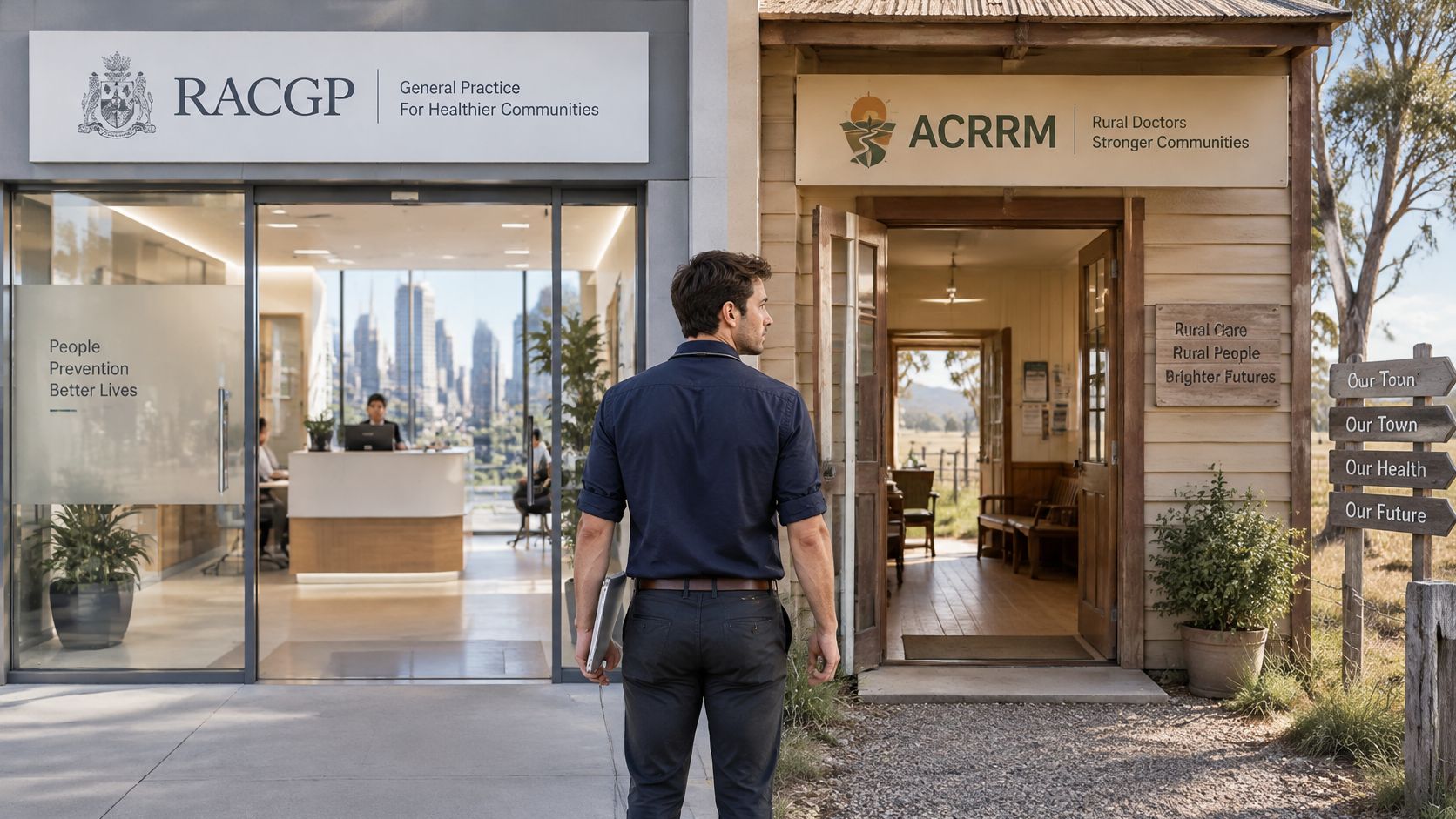
Choose for the work, not just the postcode
In a smaller town, a doctor may need to work across community consultations, hospital care and urgent presentations. A rural generalist qualification is intended to develop that breadth, rather than merely relocate the same training experience.
RACGP applicants need to distinguish rural placement obligations from the rural generalist qualification. Choosing a rural AGPT stream doesn’t, by itself, mean you’ve chosen every additional component required for rural generalist Fellowship.
Compare assessment expectations as carefully as placement maps. Ask what clinical work you must demonstrate, which training posts can provide it, and what happens if a required post isn’t available when you need it.
Fees also deserve a separate comparison. Government-funded training shouldn’t be read as a promise that application, membership, assessment, travel and relocation expenses are all covered. Use each college’s current fee schedule to build a personal budget rather than comparing isolated advertised fees.
Situations that clarify the choice
- You prefer metropolitan practice but may move later. Start by examining the RACGP general stream. Check its actual placement obligations rather than interpreting “general” as a metropolitan guarantee.
- You expect to work in a regional or remote community. Compare ACRRM with the RACGP rural generalist route. Look at the emergency, hospital and additional-skills work you want to retain in your future practice.
- You’re already an overseas-trained GP specialist. Investigate PEP–Specialist eligibility and comparability requirements before committing to a graduate-entry application.
The checks that settle the decision are the approved placement categories, college-specific training requirements, current assessment rules and fee schedule.
Choose the route whose compulsory locations and clinical responsibilities you can accept throughout training, even if your eventual practice plans change.
Entry Routes and What the Intake Numbers Mean
The RACGP publishes intake figures at several stages, and the numbers differ depending on when the count was taken.
AGPT intake through the RACGP, by source
| Intake | Figure | What was counted | Source |
|---|---|---|---|
| 2023 | 1,130 | Doctors entering AGPT | RACGP Health of the Nation 2024 |
| 2024 | 1,204 | Doctors entering AGPT | Same report |
| 2025 | 1,504 | Junior doctors accepting places: 844 general pathway, 583 rural pathway, 77 composite rural placements; 249 (19.8%) more than the year before | newsGP, 20 November 2024 |
| 2025 | 1,544 | Doctors entering, on RACGP training data as at July 2025 | RACGP Health of the Nation 2025 |
| 2026 | 1,772 | Doctors accepted, nearly 19% more than a 2025 cohort of 1,507; 841 on the rural pathway, up 44.2% | RACGP media release, February 2026 |
The 2025 figure appears three ways because it was counted at three different points: acceptances announced in November 2024, training data as at July 2025, and the base the RACGP used for its February 2026 comparison. Compare like with like before working out a growth rate. None of these totals tells you an individual applicant’s chance of a particular placement.
Separate entry eligibility from placement availability
A graduate or vocationally eligible junior doctor generally investigates AGPT selection. A non-VR doctor already working in general practice may instead be eligible for FSP, while an overseas-trained GP specialist may need PEP–Specialist assessment. These routes shouldn’t be treated as interchangeable applications to the same pool.
The 44.2% rise in the 2026 figures concerns the rural cohort, not growth in the total intake. More funded places don’t reveal demand for a particular region, the quality of a placement match, or whether you’ll spend the experience in the kind of rural practice you envisage. A national rural total also doesn’t establish that general and rural applicants face identical selection arrangements.
Before applying, verify:
- Registration status. Check what must be held when applying and when training starts.
- Prior training. Establish whether experience supports eligibility, recognised credit, or neither.
- Visa conditions. Confirm both college eligibility and restrictions affecting employment or location.
- Exact stream rules. Read the current selection regulations, including preference allocation and offer conditions.
Rural Training Time, Fees and Location Rules
Rural training is not merely a lower-access alternative to metropolitan training. A rural generalist pathway can lead to a broader credential, with compulsory emergency and additional-skills components that change both your training workload and future scope of practice.
The RACGP rural generalist FAQs (updated 24 September 2026) list 12 months FTE of hospital terms, 18 months FTE of community GP terms, 12 months FTE of Additional Rural Skills Training (ARST, a year of extra training in an approved rural skill) and six months of core emergency medicine. That adds up to four years, against three for the standard route. At least 12 months FTE of the community GP terms must be in an MMM3–7 location. The ARST assessment fee is $2,800, charged just before the ARST post starts, for the six ARSTs the RACGP manages. AGPT applicants and current AGPT registrars pay no registration fee; a $950 registration fee applies to Remote Vocational Training Scheme (RVTS) and FSP registrars and to practising GPs applying without the Fellowship in Advanced Rural General Practice (FARGP).
Rural generalist durations, placement rules and fees
| Requirement or fee | Amount or duration | Applies to |
|---|---|---|
| Hospital training | 12 months | Rural generalist registrars |
| Community general practice | 18 months | Rural generalist registrars |
| Additional Rural Skills Training | 12 months | Rural generalist registrars |
| Core emergency medicine | 6 months | Rural generalist registrars |
| Community GP training location | At least 12 months in MMM3–7 | Rural generalist registrars |
| ARST assessment fee | $2,800 | Registrars starting one of the six RACGP-managed ARSTs |
| Rural generalist registration fee | Nil | AGPT applicants and current AGPT registrars |
| Rural generalist registration fee | $950 | RVTS and FSP registrars; practising GPs applying without FARGP |
The fees apply at different stages and to different groups. Don’t add the $950 registration fee to an AGPT applicant’s budget, and don’t treat the ARST assessment fee as the complete cost of training.
Rural generalism also includes ordinary consultation work and continuity, not only emergency or procedural care.

A rural label isn’t a placement guarantee
The RACGP’s Health of the Nation 2024 reports that 55% of AGPT and 64% of PEP–Specialist training participants practise in an MM1 (metropolitan) region. These are whole-program distributions, not acceptance rates or measures of rural-pathway competition.
Check the category of each proposed post, because a program label alone doesn’t establish whether that post satisfies your particular requirement.
Check the operational commitment
Ask the training team about region-specific competition, continuity within a community, and any outer-metropolitan or rural obligations attached to a general-stream offer. Get an explicit answer about which placements are allocated centrally and which you must help arrange.
For an already practising GP, recognition of prior learning may reduce outstanding requirements, but only after individual assessment. Supply evidence of responsibilities, supervision and relevant experience rather than assuming years worked equal automatic credit.
- Partner employment and schooling. Test the proposed location against the whole household’s needs.
- Housing and travel. Budget for moves, temporary accommodation and travel between posts.
- Visa and employment conditions. Verify that each intended placement is permissible.
- Deferral and leave. Ask whether postponing a required term is allowed and how it affects progression.
Your decision test is whether you want the additional-skills block, emergency component and rural community obligation enough to organise your life around them. Don’t collapse those distinct components into a single “emergency and procedural year”.
Year-by-Year Plan and Pre-Application Checklist
Work backwards from the current application window, not forwards from an assumed start date. You need time for eligibility checks, documentary evidence, referees and any selection assessment before you can make a reliable employment plan.
A useful timeline separates preparation, application, offer acceptance and training progression. They require different tasks, and progress in one doesn’t guarantee completion of the next.
Medical school and internship
During your final medical-school year, seek exposure to the work GPs do in practice. Notice how clinicians manage undifferentiated symptoms, repeat attendance, preventive care and referrals when the diagnosis isn’t yet clear.
Identify potential referees who can describe your clinical judgement and professional behaviour. Keep an accurate record of placements and responsibilities so you’re not reconstructing them from memory near the application deadline.
During internship, begin a de-identified learning log within your workplace’s confidentiality rules. Record the clinical problem, your reasoning, supervisor feedback and what you’d change. Don’t copy identifiable patient information into a personal study file.
Preparation habit: Turn feedback into an observable action, such as checking the patient’s understanding before ending the consultation, rather than recording “communicate better”.
Postgraduate application planning
The postgraduate year after internship can be a planning point for AGPT, but it isn’t a universal application rule. Your registration, experience and current college eligibility criteria determine when you can apply and commence.
Build an application folder containing registration evidence, employment history, rotation records, referee details and relevant visa documents. Keep document names consistent so you can identify the latest version quickly.
Prepare for the selection format the college currently uses, because the two colleges select differently. For the 2028 AGPT main intake, RACGP entry is decided by the National Entry Assessment, an online situational judgement test (the Casper test, from Acuity Insights) with no interview, sat in March or May 2027 (RACGP, updated 29 April 2026). ACRRM’s 2028 intakes use an online application with referees, then multiple mini-interviews (MMIs): three short interviews, each with two minutes to read a scenario and eight to respond (ACRRM application and selection, checked 9 November 2026). How that compares with selection into other specialties is mapped in our guide to specialty selection in Australia.
Use these planning habits:
- Collect feedback each term. Ask for specific examples of strengths and areas needing improvement.
- Practise under realistic conditions. Rehearse clinical reasoning, professional judgement and communication in the actual format required.
- Track separate deadlines. Applications, assessments, supporting documents and offer acceptance may have different cut-offs.
- Check the next available round. Missing a window can delay commencement; don’t assume a supplementary intake will be available.
Offer acceptance and training
Before accepting, compare the written offer with your location boundaries and budget. Clarify whether the offer identifies a region, a specific practice, or a place subject to later allocation.
Ask how compulsory posts will be arranged and what happens if a needed placement is unavailable. If prior-learning recognition matters to your decision, distinguish an approved credit decision from an informal expectation that credit is likely.
Once training starts, organise preparation around upcoming clinical work and assessment requirements. For example, before a consultation-focused review, practise agenda setting, risk assessment, shared decisions, documentation and safety-netting rather than revising disease lists alone.
For Fellowship assessment scheduling, use the RACGP exam dates guide as a planning aid and confirm the applicable dates with the college. Entry-selection deadlines and Fellowship examination dates aren’t the same calendar.
Your pre-application checklist
-
College choice and future work. Write a realistic medium-term location and scope-of-practice plan. Verify that it fits the RACGP or ACRRM handbook’s required capabilities and placements.
-
Stream and location tolerance. List locations you can accept, locations you can’t, and the reasons. Check the stream’s selection regulations and approved Modified Monash categories, including how preferences and exemptions are handled.
-
Current fee schedule. Build separate lines for application, membership, assessments and practical relocation expenses. Use the chosen college’s current fee schedule, and identify which charges apply to applicants, registrars or already practising GPs.
-
Eligibility and prior learning. Check registration, visa status, specialist recognition and experience requirements against the relevant handbook. Ask how prior-learning applications are assessed and what evidence must accompany them.
-
A timeline tied to the application window. Put the confirmed closing date in your calendar, then work backwards through documents, referees and preparation. Verify dates through the college’s current intake instructions rather than an older article or a colleague’s previous application.
Where CliniRoo fits
GP entry requirements and pathway rules should come from the RACGP and ACRRM directly. CliniRoo is building preparation material for the Australian pathway. Nothing is on sale yet. If you want to be told when there is something to use, CliniRoo takes an email address and does nothing else with it.
Confirm your route and college first, then build your timeline backwards from the application date.