AMC Clinical Handbook: Stations, Timing and Scoring Explained
The AMC Clinical Examination Specifications (V8.3, June 2026) explained: 16 assessed stations, 2+8 minute timing, the global rating and the 9-of-14 pass mark.
What candidates call the AMC clinical handbook is the Australian Medical Council’s (AMC — the body that assesses, for registration, international medical graduates whose primary medical qualification the Medical Board of Australia does not recognise) Clinical Examination Specifications. The current edition is version 8.3, dated June 2026. It sets out how the clinical examination is structured, timed and marked, and what candidates may and may not do on the day.
It isn’t a textbook, and it won’t teach every diagnosis. Its value is showing what the examination measures and how. Preparation works best when you use that structure to practise observable behaviours, not just revise clinical facts.
Table of Contents
- What the AMC Clinical Handbook Actually Governs
- Exam Architecture and Station Composition
- The Four AMC Station Types and What Each Tests
- Reading Time, Changeover, and the Eight-Minute Window
- Disciplines, Settings, and Mixed-Format Stimuli
- Scoring Domains, the Global Rating, and Pass Logic
- Eligibility, Booking, Conduct Rules, and Allowed Equipment
- Pass Rates and What Those Numbers Mean
- Building a Station Repetition Plan
- Where Australian-Specific Preparation Resources Fit
- Frequently Asked Questions for AMC Clinical Candidates
What the AMC Clinical Handbook Actually Governs
The clinical examination is the second of two AMC examinations, after the computer adaptive testing (CAT) multiple-choice question (MCQ) examination. The AMC Clinical Examination Specifications (V8.3, June 2026) describe it as an integrated, multidisciplinary structured clinical assessment whose objective is to assess clinical competence for the safe and effective practice of medicine in the Australian health care system. The standard is that of a graduating final-year Australian medical student about to start the intern year.
The specifications govern the examination’s format and operating rules: station structure, timing, task types, marking, pass requirements, candidate conduct and prohibited materials. They don’t replace clinical references or serve as a complete curriculum.
The behaviour is part of the assessment
A candidate can identify a likely diagnosis and still leave the examiner uncertain about whether they can manage the encounter safely. In a timed station, you need to make your reasoning visible: ask focused questions, explain relevant findings, prioritise risk and check that the patient understands the plan.
The specifications are explicit that the examination “does not only test knowledge”. They ask for clearly enunciated, specific, non-technical English, and advise candidates to rehearse the rate and clarity of their speech. If your rehearsal routinely uses longer consultations or leaves communication until the end, it won’t match the AMC’s conditions.
Prepare from the rules outward. Learn the station architecture, practise the task types, and rehearse the communication you need to demonstrate. Then use your clinical study to strengthen the decisions those behaviours support.
Exam Architecture and Station Composition
The AMC clinical examination page and the specifications set out 16 assessed stations and four rest stations. Rest stations are not scored and give you a supervised break in the circuit. The examination runs either in person at the AMC Test Centre in Melbourne or online by video conference, at a location organised by the candidate and approved by the AMC.
Of the 16 assessed stations, two are pilot stations — stations being used in an examination for the first time, or trialled for operational reasons. Your result is determined by 14 scored stations. Usually those 14 exclude the pilots, but if there is a problem with one or two regular stations, the AMC’s Clinical Results Panel may substitute one or both pilots, and the result is still decided on 14.
What the layout means for your performance
Nothing in the specifications tells you which stations are pilots, and a pilot can end up being scored. Treat every assessed encounter as if it counts, and avoid spending the next station’s time replaying a difficult case. Each station is a fresh task, with its own instructions and criteria.
The practical lesson is to spread your effort. Because the result is a count of stations passed, a strong performance in one encounter cannot make up for a failed one elsewhere. Practise a repeatable routine: identify the task, introduce yourself clearly, address the patient’s immediate concern, and finish with a safe plan.
For wider context on the Australian medical examination pathway, use that guide, then check the AMC’s current specifications for the rules that apply to your sitting.
The Four AMC Station Types and What Each Tests
Each station has a single predominant assessment area, shown at the top right of the reading screen: history taking, examination, diagnostic formulation, or management/counselling/education. Tasks focus on that area but may include others. A scenario typically gives you a clinical stem, a series of tasks (commonly three to four) and a suggested timing for the main task or tasks.
The specifications give examples of each: a history of shortness of breath, or a history from a parent or carer; a physical examination for suspected vascular disease; interpreting a laboratory report or diagnosing a common skin lesion; teaching inhaler technique, counselling a patient with obesity, or presenting a management plan.
History taking
Open with a brief introduction and an invitation: “Hello, I’m the doctor. Could you tell me what’s been troubling you?” Then guide the history towards the presenting problem, relevant associated symptoms, risks and the patient’s perspective. Respect the suggested timing: the specifications warn that a history taken in one to two minutes is unlikely to reach the expected standard when five minutes has been specified for the task.
Examination
Explain what you’re going to do, seek consent and proceed systematically. Say relevant findings aloud where appropriate, rather than assuming the examiner can infer what you noticed. In person, the examiner may interrupt and ask you to move on, because eight minutes is not always enough for a full examination; the specifications say this should not be taken as a sign of poor performance. Online, hands-on examination is replaced by describing technique and process, and you may be shown related findings or images.
Diagnostic formulation
State the leading diagnosis, then show that you’ve considered important alternatives and immediate risks. For example: “My main concern is pneumonia, but I’d also consider heart failure and pulmonary embolism, depending on the examination and observations.” Avoid presenting a broad list without explaining what matters most.
Management, counselling and education
Set out a safe plan, explain it in accessible language, and check the patient’s understanding. A useful opening is: “I’d like to explain what I think is happening and what we can do next, then I’ll answer your questions.” Be explicit about who needs to be contacted, how urgently and why.
The table below is rehearsal guidance, not AMC marking criteria.
| Station type | What to make visible | A common way to fall short in practice |
|---|---|---|
| History taking | Focused questions with patient-centred listening | Checklist questioning that ignores the patient’s answers |
| Examination | Systematic, explained technique and relevant findings | Rushed or silent examination |
| Diagnostic formulation | Prioritised reasoning and a clear differential | Listing diagnoses without ranking or justification |
| Management, counselling or education | Clear plan, safety-netting and a check of understanding | Giving advice without confirming what the patient will do |
If you don’t state your synthesis or plan, the examiner can’t assess your reasoning or whether the patient has understood it.
Reading Time, Changeover, and the Eight-Minute Window
Each station lasts 10 minutes: two minutes of reading time and eight minutes of assessment time. In person, the two minutes also cover moving to the next station; online, the specifications say most stations follow this pattern. When the final notification sounds, you leave the station immediately.
Use the two-minute reading period to answer four questions: who is the patient, what is the task, what is the immediate safety concern, and what will you say or do first? Read the setting and your role as well — the specifications point out that general practice or hospital, urban or rural, changes how you should approach the case. Note any suggested times for the tasks and plan around them.
For a diagnostic task, settle on a working differential to test as you gather information. For counselling, decide what the patient needs to understand and what action they should take. These are starting points, not answers to recite before you have heard the patient.
Rehearse the encounter, not just the content
An eight-minute station is like a short clinical handover: gather what changes your decision, then make your reasoning and next steps clear. A practical sequence is:
- Opening: Introduce yourself, confirm the patient’s concern and set the direction.
- Focused task: Ask relevant questions, examine or explain, according to the station.
- Synthesis: State your assessment and what matters most.
- Closure: Give next steps and safety-net advice, then invite questions.
This sequence is a rehearsal aid. The official guide to timing is the suggested time printed for each task, and a time prompt during the station tells you when to move on. If you notice a missed question, ask it if the answer could change your assessment. Otherwise, use the information you have and move to a safe plan.
Make the reasoning audible. The examiner cannot score a conclusion you keep to yourself, and a patient cannot act on a plan you have not explained. A counselling close could be: “I’d like you to follow this plan. I’ll explain what changes mean you need urgent help. Could you tell me what you’d do if your symptoms worsen?”
Finishing early is neutral. The specifications state it means only that the task was completed ahead of time, not that you have done well or badly.
Disciplines, Settings, and Mixed-Format Stimuli
Stations assess presentations of medical, surgical, women’s health, paediatrics and mental health problems, in a variety of settings including community and hospital. A scenario may be set in metropolitan, regional or remote locations, in preventive, acute or continuing care, and with any age group from newborn to aged. So don’t prepare as if every case begins in an emergency department.
The format of the stimulus changes how you gather and use information. Stations may use actual patients, simulated patients or video patient presentations, along with charts, digital images and photographs; in person they may also use models and telephone consultations. A simulated patient can answer your questions and respond to your explanations. A video, chart or image instead requires you to extract information directly, state what you observe and explain how it affects your reasoning.
Practise switching between disciplines and stimulus types without losing your method. If you receive an image, describe the finding before interpreting it.
Scoring Domains, the Global Rating, and Pass Logic
The specifications describe three marking components in each station:
- Key steps — typically two to five per station, each marked “observed” or “not observed”.
- Domains — typically three to five per station, each rated on a seven-point scale with no pass/fail point. Examples include approach to the patient, choice and technique of examination, differential diagnosis, investigations, management and counselling.
- Global rating — the examiner’s overall rating of your performance on the station, also on a seven-point scale. It takes into account the predominant assessment area and every aspect of your performance.
The global rating alone decides whether you pass the station: 4 or above is a pass, 3 or below a fail. You pass the examination with a pass in 9 or more of the 14 scored stations. That mark applies from March 2024; before then candidates needed 10 of 14, according to the AMC 2023–24 Annual Report. The specifications place no limit on the number of attempts.
Think in terms of a profile, not a single “magic” score
Because the global rating weighs everything you showed, strong clinical knowledge doesn’t erase unclear communication if the patient can’t understand the plan. Equally, a warm manner can’t compensate for missing an urgent risk or failing to take an appropriate action.
Consider two candidates. One gives a clear history and communicates well but misses a key safety issue. Another identifies the risk and proposes an appropriate plan but explains it poorly. Both have given the examiner reasons to rate the station down. Aim to demonstrate safe reasoning, clear communication and professional conduct together, then make your technical performance visible where the task requires it.
Eligibility, Booking, Conduct Rules, and Allowed Equipment
The rules below are from the June 2026 specifications. Your placement letter and AMC communications take precedence for your sitting.
Confirm the practical details before you travel
- Eligibility: You must have passed the MCQ examination. You can apply for only one clinical examination at a time, and not while a result or appeal is pending. Candidates accepted into, completing or awaiting results from an AMC-accredited workplace-based assessment (WBA — the alternative pathway in which an international medical graduate is assessed in an accredited workplace program instead of sitting the clinical examination) cannot apply.
- Booking: You apply through the candidate portal once an examination opens for scheduling, and pay by credit card within a 15-minute window or the place is released. The AMC clinical examination page listed fees of AUD 3,000 in person and AUD 3,400 online, and showed applications for the remaining 2026 online examinations as closed (accessed 19 October 2026).
- Arrival: Late arrivals, in person or online, are not permitted to start the examination.
- Dress: Professional attire, but not medical attire — no white coats, lab coats or scrubs.
- Equipment, in person: All equipment is provided. You may bring your own stethoscope, but not an electronic one. Books, pens, paper, notes, jewellery, watches of any kind, phones and handbags stay in a locker. Writing material is provided in the room and cannot be taken out.
- Equipment, online: The same prohibitions apply, except that one phone, switched to silent, is allowed in the room so the AMC can contact you if the technology fails.
- Conduct: Follow staff directions, respect patients and simulated patients, and never discuss or share station content. Recording the examination or disclosing its content can lead to results being withheld, exclusion from future examinations and referral to the Medical Board of Australia or the Australian Health Practitioner Regulation Agency (AHPRA — the national body that registers health practitioners).
The specifications also warn that the AMC uses a large database of rotating scenarios in which the same opening can lead to different findings and diagnoses. Relying on recalled cases from past candidates, rather than taking the history and examining yourself, compromises your assessment.
Pass Rates and What Those Numbers Mean
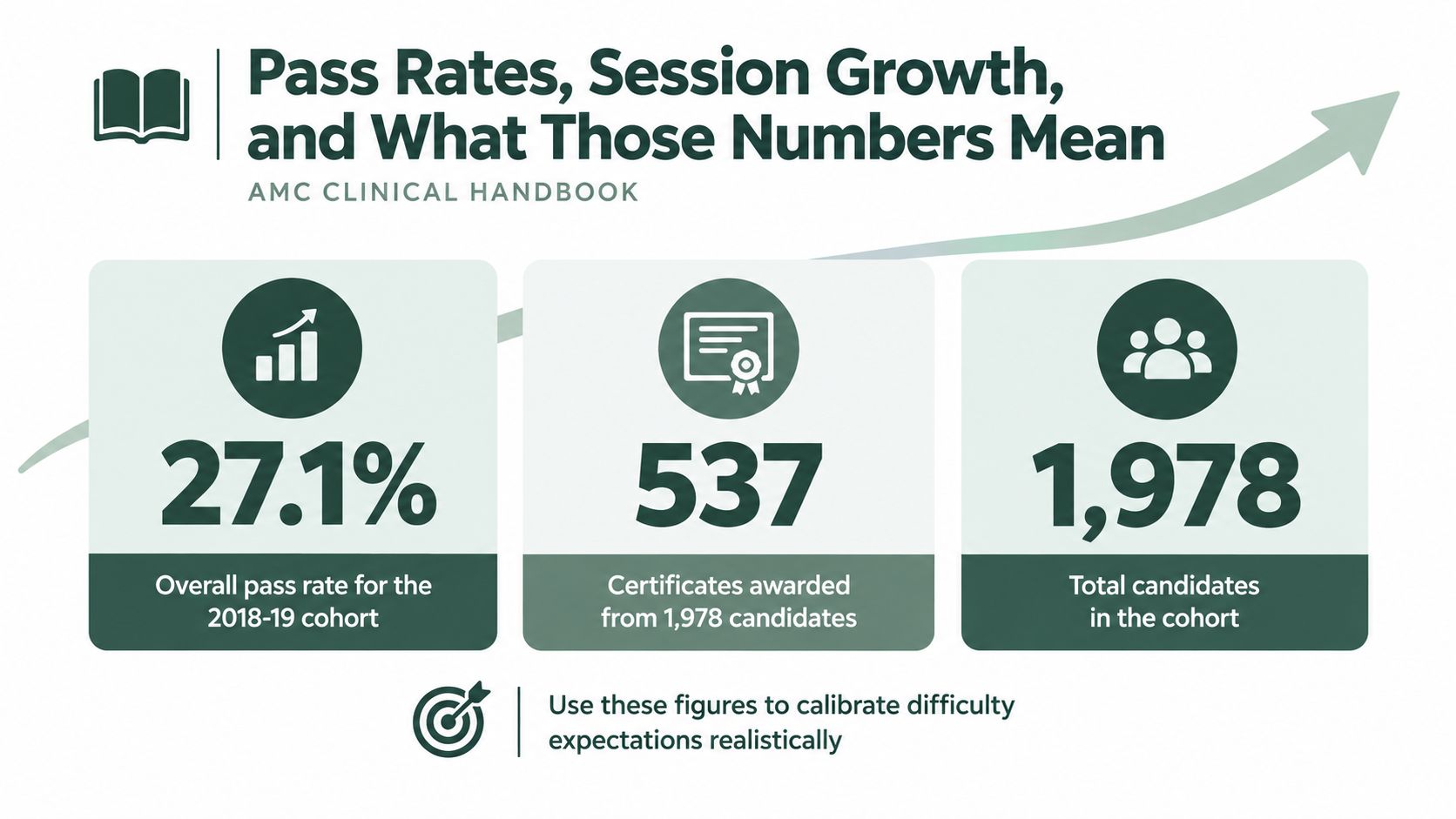
In 2018–19, the AMC assessed 1,978 international medical graduates across 69 clinical examinations, and 537 passed — an overall pass rate of 27.1% (AMC 2019 Annual Report).
In 2023–24, the AMC ran 126 clinical examination sessions assessing 2,107 international medical graduates, of whom 989 were sitting for the first time. 509 passed, or 24%, up from 21% the year before (AMC 2023–24 Annual Report).
Use the figures to calibrate, not predict
These cohort results don’t tell you your personal chance of passing, and they aren’t directly comparable over time. Most of 2023–24 ran under the old 10-of-14 pass mark; the AMC expected the change to 9 of 14 to raise the pass rate. Each year’s figure also counts repeat candidates alongside first-time ones.
What the numbers do show is that the examination has failed most of the candidates who sat it in these years. For your preparation, focus on consistency across stations. Rehearse under the correct timing, review what you failed to make visible, and practise recovering after a difficult encounter.
Building a Station Repetition Plan
A useful plan makes you speak, decide and finish within the exam format. The specifications advise candidates to “practise, review, revise, and practise again”, and suggest that AMC publications, online resources and journals on common presentations are more useful than large general reference texts. Use a repeating circuit to identify habits you can improve, then return to those habits in the next round.
Build each circuit around station performance
Try this study rhythm:
- Start with a timed station: Choose one task type and a clinical presentation. Use two minutes of reading and eight minutes of assessment.
- Rotate the task: Move between history taking, examination, diagnostic formulation and management or counselling. Don’t practise only the format you find comfortable.
- Mark the performance: Ask a peer or mentor to note whether you prioritised, communicated clearly, addressed safety and completed the task.
- Review aloud: Repeat the opening or closing that was unclear, then do the station again rather than only writing a correction in your notes.
- Leave room to recover: Build rest and review into the schedule so that fatigue doesn’t turn every practice session into a rushed performance.
A full mock circuit can mirror the real one: 16 timed stations with four rests. That’s a study design, not an official requirement. You can also use a practical OSCE preparation guide to structure rehearsal and feedback; the AMC describes its clinical examination as an objective structured clinical examination (OSCE — a circuit of short, timed, separately marked clinical stations). The AMC website also lists a resource list and a “Tips from AMC Examiners” document, which the specifications recommend.
Signs the plan is working: your openings are concise, you state your reasoning, and you close with a plan without needing a prompt. If you’re reading extensively but avoiding timed performance, or repeatedly running out of time before safety-netting, shift study time towards spoken practice.
Where Australian-Specific Preparation Resources Fit
The specifications give you the examination architecture. Your next job is to turn that architecture into repeatable station behaviour. The AMC suggests reflecting on differences between your training and the Australian health system to find gaps, and notes that your MCQ feedback can show where your clinical knowledge is weaker.
Choose a resource for the gap you have
If you’re still building broad clinical knowledge, begin with the AMC’s own materials and appropriate clinical references. If you understand the medicine but struggle to structure a station, focus on timed practice, model openings and closings, and feedback on what you make explicit. The AMC examiners also consider that staying in contact with clinical practice in a hospital or other clinical service improves candidates’ chances.
Frequently Asked Questions for AMC Clinical Candidates
Is the clinical retest pathway still available?
No. The AMC’s 2018–19 annual report records that 421 candidates sat a clinical retest that year, of whom 178 passed (42.3%), and that the retest was no longer offered from January 2019. The current specifications make no retest provision: a candidate who fails sits the clinical examination again, with no limit on attempts.
How is a pilot station different from a scored station?
A pilot station is being used for the first time, or trialled for operational reasons, and usually doesn’t count towards your result. But the Clinical Results Panel can substitute a pilot for a regular station that had a problem, so approach every station as though it counts.
How should I interpret my station feedback?
Carefully. Every candidate receives a computer-generated breakdown of performance against selected aspects of each station. The specifications state that these feedback scores do not numerically determine whether a station was passed, because the pass decision is the examiner’s separate global rating. Use the feedback to find the behaviour that needs to become more visible, then practise it under timed conditions.
CliniRoo is building preparation material for the Australian pathway, including AMC-style practice. Nothing is on sale yet. If you want to be told when there is something to use, CliniRoo takes an email address and does nothing else with it.